Best Lean Manufacturing Software for the Indian Garment Industry
by Kunal Kapur
 9
Mins Read
9
Mins Read
- Key Takeaways
- The Quote Arrives as a Single Number
- Why a Supplier Quote Is Never Just a Price
- Why “just send me a breakdown” is not enough
- What “Accurate” Actually Means
- Why labour is the variable that decides the quote
- The Independent Anchor: Standard Minute Value
- SMV and SAM: same measure, different label
- Predetermined motion time systems vs stopwatch time study
- Building the Cost Breakdown Before You Order
- Reading the Gap Between Your Number and Theirs
- When a higher quote is the better deal
- Separating fair-wage cost from inflation
- Red flags in a supplier breakdown
- Comparing Breakdowns Fairly Across Multiple Suppliers
- Issue one Bill of Labour and lock the SMVs
- Build vs Buy: Do You Need Software for This?
- What a spreadsheet and a trained partner can do
- What breaks at scale
- What a costing platform adds
- Walk In With Your Own Number
- Frequently Asked Questions
Key Takeaways
- The best lean manufacturing software for an Indian garment factory is not one product but a stack, anchored on method study and pull-based production planning.
- On a garment floor the costliest wastes are work-in-progress (WIP) and waiting, not slow sewing. Buy tools that cut those first.
- Standard Minute Value (SMV) is the unit lean runs on. Weak SMVs make every calculation above them wrong, whatever the software.
- An ERP runs the business; it is not lean planning. Its planning module schedules at order level and assumes capacity.
- AI now verifies the costed method against what operators actually run, using shop-floor video instead of a stopwatch.
- The right stack scales with factory size and IE maturity, not with brand prestige or the size of the suite.
- India readiness (GST-ready operations, local support, a workable deployment model) matters as much as features, especially outside the metros.
Short on time? For most Indian export factories, the lean core is method study (GSDCost, now with AI motion analysis via GSD RealMotion) paired with line-level flow planning (FastReactPlan). The full reasoning is below.
Tell a Factory Head to “go lean and buy software for it,” and the first hour online is usually wasted. Search for the best lean manufacturing software for the Indian garment industry, and you meet a wall of Enterprise Resource Planning (ERP), Product Lifecycle Management (PLM), and Computer-Aided Design (CAD) vendors, every one of them wearing the lean badge. None is lying. None is the whole answer either. And buying the wrong one, or buying the right one in the wrong order, is how a serious budget disappears into a tool that records the problem instead of removing it.
This guide is for the person signing off that budget: the Factory Head, Industrial Engineering (IE) Head, Production or Operations Manager, or Manufacturing Excellence lead who has to choose. It does four things. It defines what actually makes software lean, maps the wastes on a garment floor to the tools that attack each one, names the products an Indian buyer will realistically meet, and shows where AI changed the picture in the last twelve months. You leave with a shortlist and a sequence, not a slogan.
Why “Lean Manufacturing Software” Is The Wrong Search
Start with the honest point, because it saves money: there is no single lean product. Lean manufacturing is a discipline for removing waste and building flow, drawn from the Toyota Production System, and software becomes “lean” only when it operationalises some part of that discipline. Different tools attack different wastes. So the question is never “which lean tool is best,” but “which combination fits this factory, and what do I buy first.”
The stakes are specific to an Indian unit. Textiles and apparel are the country’s second-largest employer after agriculture, with around 45 million people employed, and the structure of that base is the real driver: roughly 80% of textile capacity sits in Micro, Small and Medium Enterprises that lean on shared services and local supply chains, according to the India Brand Equity Foundation. Fragmentation, buyers compressing timelines, and thin margins make waste expensive and lean valuable. Peer-reviewed work on the sector puts the operational problem plainly: apparel factories struggle to hit due dates, with production lead times typically running 90 to 120 days, dragged out by poor line balancing, bottlenecks and excess WIP. That is a flow problem before it is a technology problem, which is exactly why the software choice matters.
None of this is new to India. The National Productivity Council ran government-backed lean cluster programmes across ready-made garment hubs from around 2010, so the discipline has institutional history here. What has changed is that the tooling finally matches the ambition.
What Makes Software “Lean” On A Garment Floor

Lean manufacturing software is any digital tool that helps a factory find and remove the wastes of production and build continuous flow by making standard times, capacity, materials, and shop-floor status visible and controllable in real time. In apparel, that spans method study and costing, production planning, fabric optimisation and shop-floor execution. It is never one application.
The one test that matters
Ask any tool carrying the lean label a single question: does it remove a waste, or does it only digitise a report? A dashboard of yesterday’s output is data. A planning board that stops two orders colliding on a line, a system that releases material just before it is needed, or an AI tool that finds motion waste inside a sewing operation is lean. The brochure is not the test. The waste removed is.
SMV: the unit lean runs on
The Standard Minute Value (SMV), also written Standard Allowed Minute (SAM), is the benchmarked time a defined operation should take. It is the currency of lean in apparel because line balancing, takt time, capacity and operator efficiency are all derived from it. You cannot compare styles by pieces; you compare them by standard minutes. Get the SMV wrong and everything downstream inherits the error, quietly and expensively.
The eight wastes, and the two that dominate apparel
Lean names eight wastes, remembered by the acronym DOWNTIME: Defects, Overproduction, Waiting, Non-utilised talent, Transport, Inventory (including WIP), Motion, and Excess processing. In garment manufacturing, two of them dominate. Empirical studies of sewing lines attribute most factory waste to WIP and unbalanced scheduling between cutting and sewing, and lean interventions on those lines have cut work-in-process inventory and lead time by large margins in documented value-stream-mapping programmes. Read that twice: the biggest lever on a garment floor is almost never the sewing machine speed. It is the flow.
The Eight Wastes, And The Software That Attacks Each
The table below is the diagnostic. Read it by “where is my biggest waste,” not “what features does this product have.” The common and costly mistake in Indian factories is over-investing in recording output, which is a symptom, while under-investing in the tools that attack WIP and waiting, which are the cause.
| Lean waste | How it shows up on the floor | Software category that attacks it |
| Inventory (WIP) | Bundles of half-finished work stacked between operations; long throughput time | Production planning and control; shop-floor execution (MES) |
| Waiting | Operators idle for want of balanced work, feed, or the next bundle; starved lines | Standard-time data feeding line balancing; pull-based material triggering |
| Defects | Rework and rejects late in the line, or at final inspection | Shop-floor execution (real-time quality capture); method-error root-causing |
| Overproduction | Cutting or sewing ahead of demand to keep lines “busy”, inflating WIP | Pull-based planning; Time and Action (TNA) critical-path control |
| Motion | Poor workstation layout and reach; unmethodised operations | Method study (predetermined motion time); AI motion analysis |
| Transport | Excess movement of bundles across a badly laid-out floor | Line-layout planning; planning informed by SMV data |
| Excess processing | Over-engineered operations, unnecessary steps, wrong machine choice | Method study; operation-bulletin standardisation |
| Non-utilised talent | IE and planning skill lost to spreadsheet firefighting | The whole stack, by automating low-value manual work |
One caveat worth stating out loud, because a good vendor will admit it. Transport and some motion waste are solved as much by physical floor redesign and operator training as by any software. That is the whole thesis in miniature: software enables lean; it does not install it. Buy a tool where it removes a waste you can measure, not because it carries the word.
The Lean Software Stack: Six Categories, Six Different Jobs
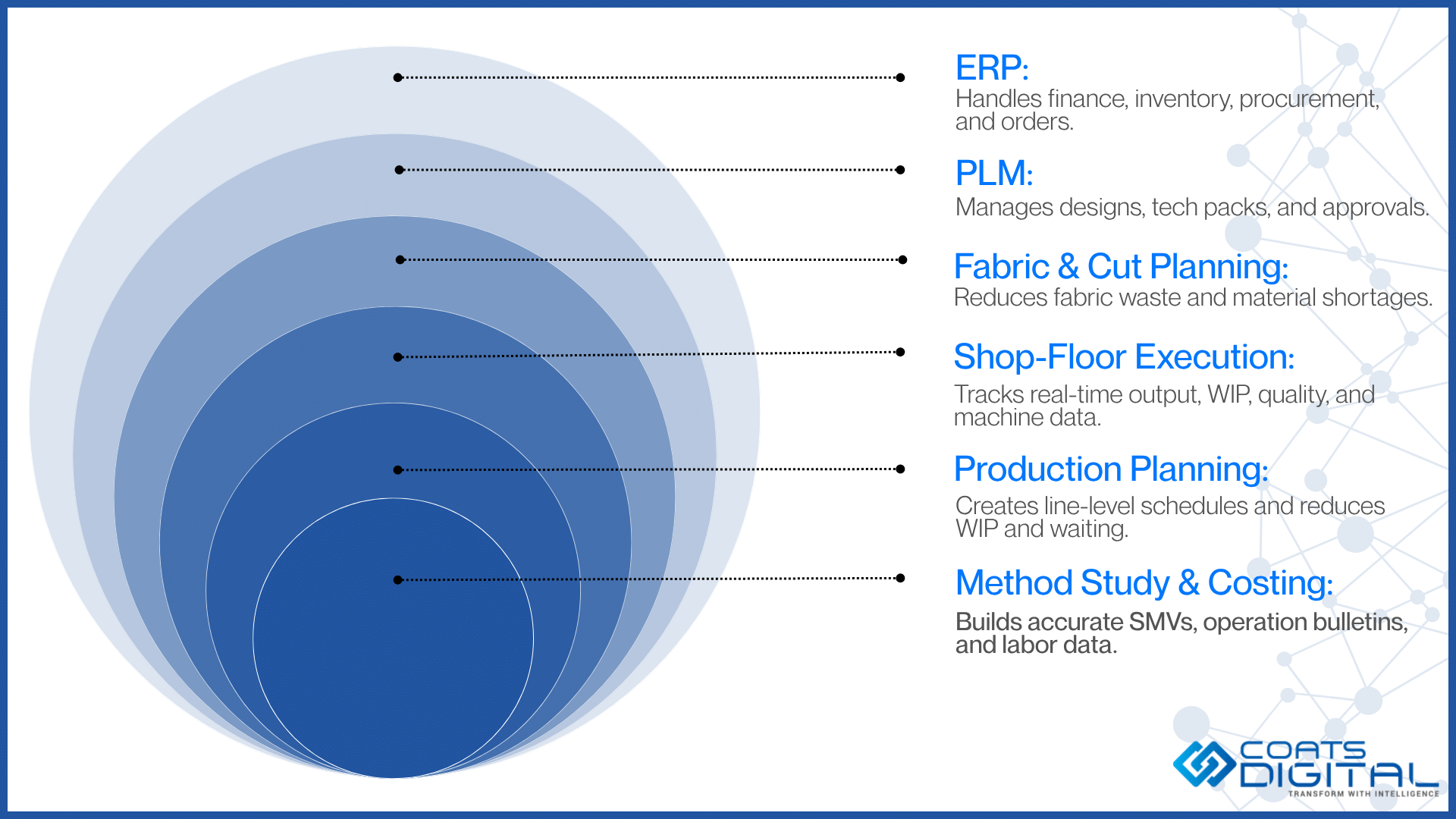
A lean factory is served by up to six software categories, and they do genuinely different things. Confusing them is how a factory pays ERP money to solve a planning problem.
Method study and costing (the IE foundation): Builds standard times from a predetermined motion time system rather than a stopwatch, producing accurate SMVs, operation bulletins, and a Bill of Labour. This is the data layer everything else rests on. Coats Digital’s GSDCost is the widely used apparel example, built on the General Sewing Data (GSD) methodology, whose core database analyses human motion in 39 motion codes, each with its own International Standard Time or Standard Minute Value. Its AI costing companion, GSDQuest, generates a standardised Bill of Labour in seconds from product images, and its newest addition, GSD RealMotion, takes method study to the live floor (below).
Production planning and control (flow and pull): Turns the order book into a visual, line-level schedule that keeps orders from colliding, sequences styles to cut changeover loss, and triggers material just before it is needed. This is where WIP and waiting are actually removed. FastReactPlan is the apparel-specialist example: a dynamic, visual production planning and control tool with critical-path control and a multi-factory control-tower view.
Shop-floor execution (MES): Captures real-time output, WIP, quality, machine and skill data at operation level, so the plan reflects reality and defects surface during the shift rather than at final inspection. This is the category most often marketed as “digital lean.”
Fabric optimisation and cut planning: Fabric is the largest cost line in most garments, so the waste here hurts. This category optimises fabric consumption and cut plans, cutting both material waste and the shortages that stall a line. Coats Digital’s FastReactFabric and the IntelloCut and IntelloBuy tools sit here.
Product lifecycle management (PLM): Manages design, development, tech packs, and approvals so pre-production does not become the hidden delay that pushes the planned cut date. VisionPLM is Coats Digital’s PLM. It sits upstream of the lean-floor question, so it earns a mention rather than a starring role.
Enterprise resource planning (ERP): Runs finance, inventory, procurement, and orders across the business. Necessary, but not a lean tool. Its planning module schedules at order and material level and assumes capacity, where lean needs line-level flow. Treat ERP as the system of record the lean tools plug into.
How To Evaluate Lean Software: A Seven-Point Checklist
- Industrial engineering foundation: Does it build on real standard times from a predetermined motion time system, or assume you already have accurate SMVs? Weak time data undermines everything above it.
- Flow and pull, not just recording: Does it plan at line level with critical-path control and trigger material just-in-time, or only report what already happened?
- Real-time shop-floor visibility: Can it show WIP, output, quality, machine and skill data during the shift, so waiting and defects are caught early?
- Method-to-floor verification: Can it confirm that the method your SMV was costed on is what operators actually run? This is the gap AI motion analysis now closes.
- Integration with what you already run: Does it connect to your ERP and PLM rather than forcing a rip-and-replace?
- India deployment readiness: GST-ready operations where relevant, local implementation and support, and a realistic cloud or on-premises choice, especially outside the metros.
- Adoption and evidence: Will planners and supervisors actually use it? Are there published results in comparable factories, a credible implementation partner, and an ROI horizon you can defend to the board?
A Category Comparison For Indian Garment Factories
This is a category comparison, not a leaderboard, because the categories do different lean jobs. Each row names the lean function, the apparel-specialist example, the alternatives an Indian buyer will actually meet, and the specific waste removed. Naming the alternatives is deliberate: it shows which categories remove waste and which mainly record it.
| Lean function | Apparel-specialist example | Alternatives an Indian buyer will meet | Primary waste removed |
| Method study and SMV / costing | GSDCost, with GSDQuest and GSD RealMotion (Coats Digital) | Stopwatch time study; in-house SMV spreadsheets | Motion, excess processing, guesswork in standard time |
| Production planning and control | FastReactPlan (Coats Digital) | ERP planning modules; India-origin planning suites (e.g. BlueKaktus) | Inventory (WIP), waiting, overproduction |
| Fabric optimisation and cut planning | FastReactFabric / IntelloCut (Coats Digital) | Standalone CAD marker and cut-planning tools (e.g. Lectra, Gerber) | Material waste (largest cost line) |
| Product lifecycle management (PLM) | VisionPLM (Coats Digital) | Broad-market apparel PLM (e.g. Centric, Lectra, Gerber) | Development waste, late approvals |
| Enterprise resource planning (ERP) | Not a lean category | SAP, Infor, Oracle NetSuite, WFX, India-origin apparel ERPs | System-of-record fragmentation (enabler, not a lean tool) |
How to read it. Match your biggest waste from the diagnostic above to the lean function here, then test the example against the seven-point checklist. A pattern worth naming: most factories convinced they “need an ERP” are describing a planning-discipline problem, which points to the production-planning row, not the ERP row. The CAD, PLM, and ERP names in the third column are strong tools in their own right, but none is a lean tool by itself. They are systems of record and development that the lean layer plugs into.
The Lean Core, And Where AI Now Fits
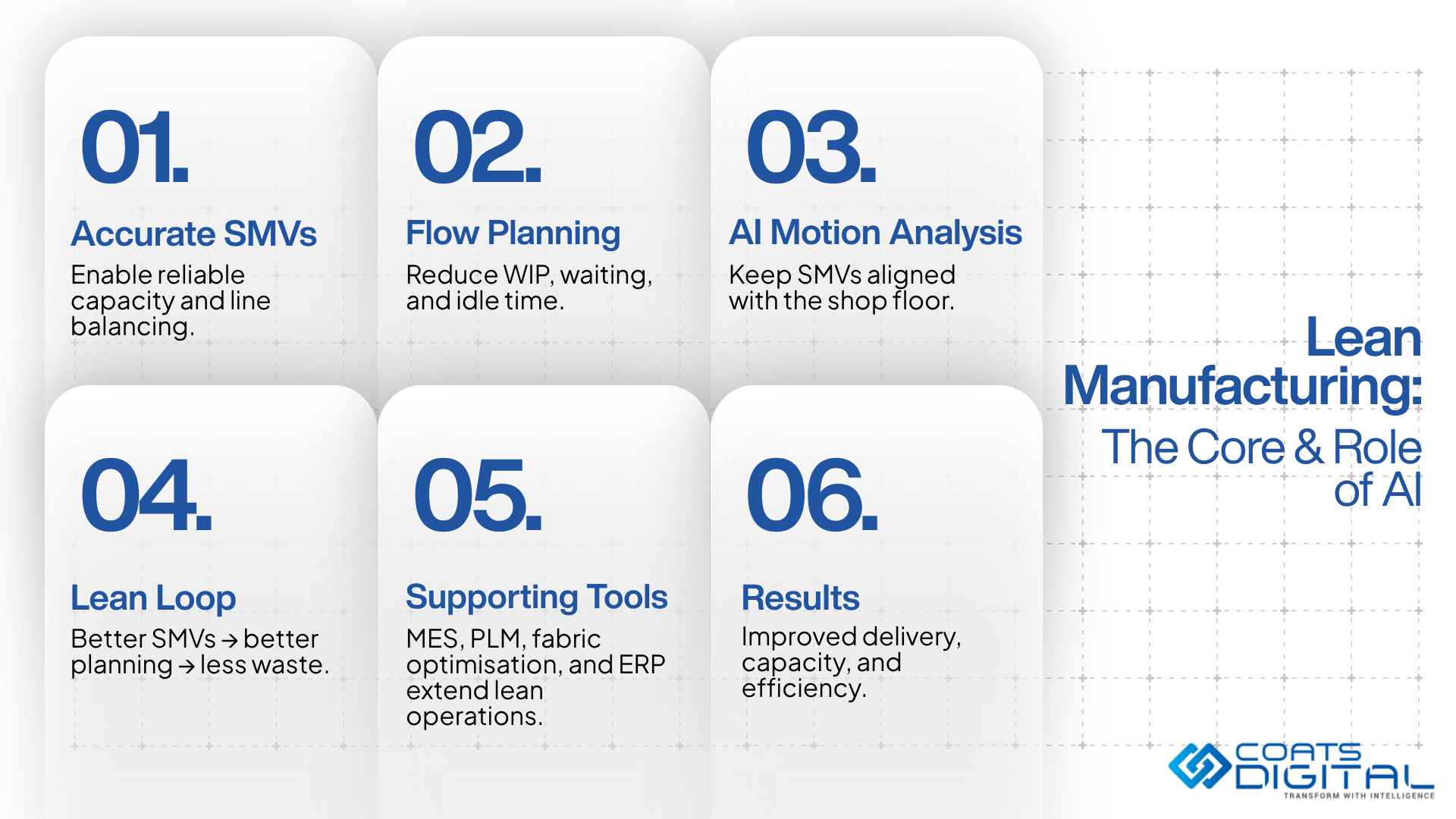
Accurate standard time is the foundation of every lean calculation.
Line balancing, capacity, and operator efficiency all derive from the SMV. If that number is a stopwatch guess that drifts line to line, every decision built on it is confidently wrong. A predetermined motion time system such as GSD removes the guess by building times from defined motions, which is why GSDCost behaves as the data layer of a lean programme rather than one more app. The honest trade-off: it repays factories with trained IE staff most, and delivers least where there is no IE capability to use it. GSDCost supplies the standard-time data; the balancing and scheduling happen in the planning and shop-floor tools, not in GSDCost itself.
Flow planning is where the biggest wastes disappear.
WIP and waiting are removed at the planning layer, not the recording layer. A visual, line-level plan that sequences orders against real capacity using standard minutes and efficiency curves, controls the critical path, and triggers material just-in-time is what stops WIP piling up and lines sitting idle. This is precisely the job an ERP planning module does not do, because it schedules at order level and assumes capacity rather than balancing flow across lines.
This is also where the “leave the spreadsheet behind” advice earns its keep, and it is not a cliché. Decades of research by Raymond Panko at the University of Hawaii found that across audited real-world spreadsheets, around 88% contained errors, with a meaningful share serious enough to have caused major consequences had they gone uncaught. A planning spreadsheet feeding a multi-line factory is a large, frequently edited model of exactly the kind that research flags as risky. That is not an argument against planners. It is an argument for moving the plan onto a system built for it. Tunisian knitwear manufacturer Tunicotex is a clean example: after replacing manual, Excel-based planning with FastReactPlan, Coats Digital reports it lifted on-time delivery from 75% to 85%, cut planning time by 25% and unlocked 40% additional capacity.
AI now closes apparel’s oldest lean gap.
For decades, industrial engineers timed a small sample of operations by stopwatch, and the costed method slowly diverged from what operators actually ran, leaking margin and hiding motion waste. That gap is now measurable. Coats Digital launched GSD RealMotion in August 2026, and it uses AI and computer vision to turn phone video into structured, motion-by-motion GSD method studies validated by engineers in minutes. The efficiency claim is specific: it can turn 45-minute manual timing into 15-minute video-assisted studies, spot inefficiencies, and eliminate margin leak from unverified costing. As its product manager puts it, GSD RealMotion verifies that the method your SMV is built from matches what operators run on the floor, and it works by automatically classifying individual operator motions as value-added, necessary, or non-value-added. The lean payoff is continuous improvement at scale and recovered capacity from time saved on the floor.
The three parts fit together as one loop:
- Accurate SMVs make the capacity plan trustworthy, so method study feeds planning.
- A trustworthy plan removes WIP and waiting, so planning removes the biggest wastes.
- AI motion analysis keeps the SMVs honest against the live floor, so the loop stays accurate over time.
- Fabric optimisation, MES, PLM and ERP extend this core. They do not replace it.
What the results look like in named factories (vendor-reported outcomes, not guarantees). Beyond Tunicotex, Coats Digital reports that South Asia Textiles, a Sri Lankan subsidiary of Hayleys Fabric supplying global brands, used FastReactPlan to cut machine idle time by 74%, reduce capacity planning time by 75%, and improve on-time delivery by 15%, with planning time falling from eight hours to two. Thailand’s VT Garment, a long-standing lean and Kaizen practitioner, won the Golden Award at the Thailand Lean Award 2017 after adopting FastReactPlan, and on the costing side, since adopting GSDCost, increased sales orders by 30%, improved on-time delivery by 13%, and boosted production efficiency by up to 30%. On pure standard-time reduction, Shanghai Jiale cut the time to produce core styles from 15.9 minutes to 11.28, an overall SMV saving of 30.4%, with GSDCost.
Matching The Software To Your Factory
The best starting point depends on operator count, buyer count, and IE maturity, not on buying the largest suite. For most factories, the first milestone is leaving spreadsheets behind, not adopting everything at once.
| Factory tier | Typical profile | Recommended starting point |
| Small unit | Single site, few buyers, moving off Excel, limited IE staff | Establish SMV discipline through method study and a GST-ready operational base; treat leaving spreadsheets behind as milestone one |
| Mid-size manufacturer | Multiple lines, several concurrent buyers, some IE capability, delivery pressure | Method study (GSDCost) paired with dedicated production planning (FastReactPlan) as the lean core; ERP as system of record |
| Large / multi-factory group | Many buyers across units, mature IE and Manufacturing Excellence function | The lean core plus shop-floor execution for real-time data, AI motion analysis (GSD RealMotion) for continuous improvement, and a control-tower planning view over enterprise ERP |
The rollout that actually lands runs crawl, walk, run:
- Crawl. Fix the data first: Establish reliable SMVs through method study and standardise operation bulletins, so every downstream calculation rests on real standard time.
- Walk. Put planning on one visual board: Move from spreadsheets to line-level production planning with critical-path control and just-in-time material triggering, attacking WIP and waiting directly.
- Run. Close the loop: Add real-time shop-floor data and AI motion analysis, and, for groups, a multi-factory control-tower view, so plan, floor and standards stay in sync and improvement runs on evidence.
The reason this order matters is causal, not stylistic. Planning software fed by unreliable SMVs produces schedules that are precise and wrong. Fix the data, then plan, then close the loop.
Metrics That Prove Lean Software Is Working
Lean software is justified by movement in operational metrics, not by the dashboard. Track a small set mapped to the wastes you are attacking, and baseline each one before implementation so the change is provable.
| Metric | What it measures | Direction and evidence |
| On-time delivery performance (OTDP) | Share of orders shipped by the agreed date | Rises after planning is digitised; Tunicotex 75% to 85%, South Asia Textiles +15% (vendor-reported) |
| Line/operator efficiency | Actual output against standard minutes produced | Rises as SMV-based balancing improves; VT Garment reports efficiency up to 30% higher (vendor-reported) |
| Work-in-progress (WIP) | Half-finished work held between operations | Falls as pull-based planning replaces batch push; documented VSM programmes report large reductions |
| Throughput/production lead time | Time from cut to finished garment | Falls as flow planning removes bottlenecks; baseline against your own pre-implementation lead time |
| Right-first-time / defect rate | Quality captured before final inspection | Improves as real-time shop-floor data catches issues during the shift |
| Capacity planning time | Effort to build and update the plan | Falls sharply; South Asia Textiles eight hours to two, Tunicotex down 25% (vendor-reported) |
| Capacity utilisation | Booked minutes against true available minutes | Stabilises near a realistic 80 to 90%, not a fictional 100% |
Every number above is either a clearly labelled vendor-reported customer outcome or a directional principle. When you build your own business case, baseline the metric in your own factory and let your own figures carry the argument to the board.
Lean And Sustainability: The Same Waste, Seen Twice
Most waste in a garment factory is also resource cost, which is why the IE Head’s targets and the sustainability team’s report describe, to a large degree, the same thing. Less fabric waste is less material bought and less landfill. Fewer defects and less rework mean less energy and water per shipped garment. Better capacity use is more output from the same plant and payroll.
This has become commercially material, because global buyers increasingly attach environmental and social documentation to purchase orders, and a measured, documented lean programme doubles as compliance evidence. The link is recognised, not theoretical: Coats Digital’s GSDCost won the Environmental Award at the Just Style Excellence Awards for using digital technology to optimise garment production and reduce waste, alongside recognition for its Fair Wage Tool. The method-study case and the sustainability case are one case.
Three concrete levers:
- Fabric optimisation reduces material waste, cutting cost and footprint together.
- Method study and balancing raise output per unit of energy and labour, improving resource efficiency per garment.
- Right-first-time quality cuts the rework that consumes extra energy, water and material.
Six Common Mistakes When Buying Lean Software In India
A self-diagnostic. Recognising your factory in more than one of these usually means the fix costs less than the mistake.
- Buying an ERP and calling it lean: Worth having as a system of record, but its planning module schedules at order level and assumes capacity. Expecting line-level flow from it is the most common and most expensive mismatch.
- Skipping the IE foundation: Investing in dashboards while standard times stay a stopwatch guess. Every calculation above weak SMVs inherits the error.
- Recording output instead of removing waste: Choosing a tool because it produces reports, when the real losses are WIP and waiting that only flow planning removes.
- Trusting a costed SMV you have never verified: The method operators run drifts from the method that was costed. AI motion analysis now makes checking this feasible at scale.
- Buying the whole suite at once: Attempting method study, planning, MES and ERP simultaneously, then stalling. Sequencing is what actually lands.
- Ignoring India readiness: Overlooking GST-ready operations, local support and a workable deployment model, so a technically strong tool fails on the ground outside the metros.
Buy The Discipline, Not The Dashboard
The best lean manufacturing software for an Indian garment factory is not a product. It is a stack, anchored on accurate method study and pull-based flow planning, kept honest by AI motion analysis, and sized to the factory and its IE maturity. Lean removes waste and builds flow; software makes that discipline visible, repeatable, and scalable.
The sequence is the strategy. Fix the standard-time data. Put planning on one visual board to remove WIP and waiting. Then close the loop with real-time floor data and continuous improvement. Do it in that order and the commitments you make, to buyers and to the board, rest on evidence rather than hope.
Where to go next:
- The method-time-cost foundation: accurate standard minutes with GSDCost
- Removing WIP and waiting at the plan: line-level flow planning with FastReactPlan
- The methodology behind the stack: Manufacturing Excellence
If you want to see method study, flow planning and AI motion analysis working as one loop, a Coats Digital demo is the quickest way to map them onto your own floor.
Frequently Asked Questions
-
What is the best lean manufacturing software for the Indian garment industry?
There is no single best product, because lean is a discipline served by several software categories. For most Indian factories, the lean core is accurate method study and standard-minute costing paired with dedicated production planning. Method study makes capacity trustworthy, flow planning removes the biggest wastes (WIP and waiting), and shop-floor tools plus AI motion analysis keep it honest. The right stack scales with factory size and IE maturity, not brand prestige.
-
What is lean manufacturing in the garment industry?
It is a systematic approach to removing the eight wastes of production and building continuous flow, adapted from the Toyota Production System. On a garment floor it targets WIP bundles, operator waiting, rework and unnecessary motion. Tools such as value stream mapping, 5S, single-piece flow, line balancing and kaizen support it, and software makes standard times, capacity and shop-floor status visible enough to act on.
-
Which software is used for lean manufacturing in apparel?
Lean in apparel is served by up to six categories: method study and costing, production planning and control, shop-floor execution, fabric optimisation, product lifecycle management and enterprise resource planning. GSDCost and FastReactPlan are widely used apparel-specialist examples for the first two, which form the lean core. The category a factory needs first depends on its single largest waste.
-
What is SMV and why does it matter for lean?
SMV, the Standard Minute Value (also SAM), is the benchmarked time a defined operation should take. It is the unit lean runs on, because line balancing, takt, capacity, and operator efficiency are all calculated from it. If the SMV is an inconsistent stopwatch guess, every lean decision built on it inherits the error, which is why a predetermined motion time system such as GSD matters.
-
Is ERP enough for lean garment manufacturing?
Not on its own. ERP runs finance, inventory, procurement, and orders, and is worth having as the system of record. But an ERP planning module schedules at order and material level and assumes capacity, whereas lean needs visual, line-level scheduling with critical-path control and just-in-time material triggering. The two work together: ERP for the business, dedicated planning for lean flow.
-
How does software help reduce waste in a garment factory?
It attacks specific wastes. Method study reduces motion and over-processing by standardising operations. Production planning removes WIP and waiting by sequencing orders against real capacity and triggering material just-in-time. Shop-floor execution catches defects and idle time during the shift. AI motion analysis finds hidden motion waste. The gain comes from matching the tool to the biggest waste, not from buying everything.
-
How is AI used in garment industrial engineering?
AI is being applied to the parts of IE that were slow and sampled by hand. AI motion analysis such as GSD RealMotion turns shop-floor video into structured method studies in minutes, benchmarks the observed method against an engineered standard, and highlights motion waste and method variation. AI costing tools such as GSDQuest generate a Bill of Labour from images, and AI analytics layers surface planning and productivity insights on demand.
-
What is the difference between production planning software and an ERP for garments?
An ERP runs the whole business across finance, inventory and orders. Production planning software does one job well: scheduling the floor. An ERP plans at the order and material level and assumes capacity, while a dedicated tool adds visual, line-level scheduling, dynamically recalculated capacity, and critical-path control. In practice, they are used together, with planning as the layer that makes a schedule executable.
-
How do I reduce work-in-progress (WIP) in garment manufacturing?
WIP falls when a factory replaces batch push with pull: planning at line level so operations are balanced, sequencing styles to cut changeover loss, and triggering material to arrive just before it is needed rather than early. Production planning software makes this repeatable across many orders, and real-time shop-floor data shows where WIP is still building.
-
Do small garment factories need lean manufacturing software?
Yes, but proportionately. A small unit gains most from the fundamentals first: reliable standard minutes through method study, and a GST-ready operational base, treating a move off spreadsheets as milestone one. Full planning and shop-floor systems become worthwhile as buyer count, concurrent styles, and delivery pressure grow. The principle scales with operator and buyer count, not ambition.
-
What are the eight wastes of lean in a garment factory?
The eight wastes, remembered as DOWNTIME, are Defects, Overproduction, Waiting, Non-utilised talent, Transport, Inventory, Motion and Excess processing. In apparel the two costliest are usually Inventory (WIP held between operations) and Waiting (operators idle for want of balanced work or feed). Software is worth buying where it removes a waste the factory genuinely carries.
-
What is a Time and Action (TNA) calendar and is it part of lean?
A Time and Action calendar, also called T&A or critical path, back-schedules every pre-production and production milestone from the ship date and tracks planned against actual dates. It supports lean by exposing late approvals and materials before they push the planned cut date and inflate WIP. It is strongest inside production planning software, where every order’s critical path is visible against shared capacity.
-
How much does lean manufacturing software cost for a garment factory?
Cost varies widely by category, factory size, and deployment, so treat any single figure with caution. India-origin operational tools sit lower, apparel-specialist method study and planning tools sit in the middle, and enterprise ERP is the largest commitment. A more useful lens than sticker price is return on investment measured against the waste removed. Verify current pricing directly with vendors.
-
What lean tools do Indian garment factories use?
Common tools include 5S for workplace organisation, value stream mapping to see waste, single-piece and cellular flow to cut WIP, line balancing driven by standard minutes, poka-yoke for error-proofing, SMED for faster changeovers, TPM for machine reliability, and kaizen for continuous improvement. The National Productivity Council ran cluster lean programmes across Indian apparel hubs from around 2010. Software operationalises these tools at scale rather than replacing them.
-
Should I fix my SMVs before buying planning software?
In most cases, yes. Capacity planning, line balancing and takt all derive from standard minutes, so planning software fed by inaccurate SMVs produces confident but wrong schedules. Establishing reliable standard times through method study is the sensible first phase, after which a plan built on that data can be trusted. This is why method study and planning are usually sequenced together, data first.
-
How does lean manufacturing support sustainability in apparel?
Closely, because most waste in a garment factory is also resource cost. Less fabric waste means less material bought and less landfill; fewer defects and less rework mean less energy and water per shipped garment; and better capacity use means more output from the same plant. A measured, documented lean programme therefore doubles as environmental and social compliance evidence for buyers who now require it.

Best Lean Manufacturing Software for the Indian Garment Industry

Brand-to-Vendor Cost Collaboration: Which Layer of the Cost Stack Are You Missing?
Why Does Capacity Planning Software Fail in Bangladesh’s Garment Manufacturing Sector?
All Blog Categories
- Production Planning
- Corporate
- Method Time Cost Optimisation
- Supply Chain Solutions
- Sustainability
- Videos