UFLPA Compliance Software for USA Apparel Supply Chains: How Brands and Factories Prove Cotton Origin
by Coats Digital
 9
Mins Read
Key Takeaways
- UFLPA compliance software maps apparel supply chains to raw fibre, screens suppliers against the UFLPA Entity List, and builds evidence packages for CBP detentions.
- Under UFLPA, goods made wholly or partly in Xinjiang, or by a listed entity, are presumed barred from US entry until the importer proves otherwise.
- Importers usually get 30 days to answer a UFLPA detention notice, and CBP expects documents tracing every input back to raw material.
- Apparel, footwear, and textiles account for 13,564 of 44,188 UFLPA stops to September 2026, and 68% of apparel stops ended in denial.
- The UFLPA Entity List reached 187 entities in August 2026; 19 of 43 new additions sit outside Xinjiang, defeating geography-only screening.
- No single UFLPA tool covers everything: effective programmes combine supply chain tracing, Entity List screening, isotopic testing and clean PLM or ERP product data.
- Garment factories hold the evidence US importers need, so cotton origin recorded per style, lot and supplier now shapes which factories keep US orders.
- Since 24 July 2026, Section 301 forced-labour tariffs of 10% or 12.5% apply to 60 economies; a US-cotton tariff quota is planned for 2027.
What Is UFLPA Compliance Software? (And Why a Spreadsheet Will Not Clear a Detention)
UFLPA compliance software is software that traces a multi-tier apparel supply chain back to raw fibre, screens every supplier against the UFLPA Entity List, collects and checks origin evidence, and assembles the documents an importer submits to U.S. Customs and Border Protection (CBP) when a shipment is detained.
It exists because the Uyghur Forced Labor Prevention Act (UFLPA) puts the burden of proof on the importer. For apparel, that proof almost always starts with cotton: where it grew, who ginned and spun it, and which fabric lots it ended up in.
In practice, the problem arrives as a detention notice. A container of cotton knitwear sits at a US port, and the importer has 30 days to respond. Within days, the factory that sewed the order receives an urgent request for every supplier behind one purchase order: the fabric mill, the spinner, and the source of the cotton. The business that can answer quickly, with documents, keeps the order.
Two limits are worth stating up front. Software cannot create origin data that nobody captured when the yarn or fabric was bought. Nor does it replace legal judgment: the decision to contest a detention, and how, rests with the importer and its trade counsel. This guide is general information, not legal advice, and its figures are current to 2 November 2026.
Why a spreadsheet will not clear a detention
CBP’s consolidated forced-labour guidance, published in June 2026, indicates that affidavits on their own, redacted or untranslated records and incomplete information on sub-tier suppliers are unlikely to satisfy a review. One trade-law analysis warns that a gap for a single supplier anywhere in the chain can sink the whole submission (Diaz Trade Law via Mondaq).
A spreadsheet of supplier names is a claim. CBP wants the purchase orders, payment records, production records, and transport documents behind every line of it. Paperwork records intention; a chain of custody records reality.
What Does UFLPA Require From Apparel Importers and Suppliers?
UFLPA requires the importer to show that its goods contain no input from Xinjiang or from a listed entity, or else to rebut the law’s presumption with clear and convincing evidence. Either way, the proof is documentary, and it has to reach raw material.
The rebuttable presumption, in plain terms
Since 21 June 2022, goods mined, produced or manufactured wholly or in part in China’s Xinjiang Uyghur Autonomous Region (XUAR), or by an entity on the UFLPA Entity List, have been presumed to be made with forced labour and barred from US entry (Troutman Pepper Locke). Four parties shape what happens next:
- The importer of record carries the burden of proof.
- CBP stops, detains, and decides on shipments at the border.
- The Forced Labor Enforcement Task Force (FLETF), chaired by the Department of Homeland Security (DHS), maintains the Entity List and names high-priority sectors.
- The UFLPA Entity List is the published register of companies whose goods carry the presumption.
The law follows inputs, not the label. A T-shirt that is legally “Made in Bangladesh” is still in scope if its yarn was spun from Xinjiang cotton, because the presumption covers goods made in part in the region. There is no minimum-content threshold either: a small, traceable amount of a listed entity’s input can lead to detention of the whole shipment (Kelley Drye).
When CBP holds goods on a suspected link, the importer has two routes (Holland & Knight):
- Applicability review. Show that the supply chain sits outside UFLPA altogether: no XUAR input and no listed entity at any tier.
- Exception review. Accept the link and rebut the presumption with clear and convincing evidence that no forced labour was involved. That bar is higher than “more likely than not”, and an exception also requires full compliance with the FLETF’s importer guidance and complete answers to every CBP request.
Most apparel importers that source carefully will argue applicability, which makes tracing the core of the response. The window is short: 30 days from the detention notice, filed through CBP’s Forced Labor Portal. Extensions are at CBP’s discretion and have to be requested before the window closes. Where CBP has already determined that goods came from the XUAR or a listed entity, it excludes them outright, and the importer has 180 days to export, destroy, or protest.
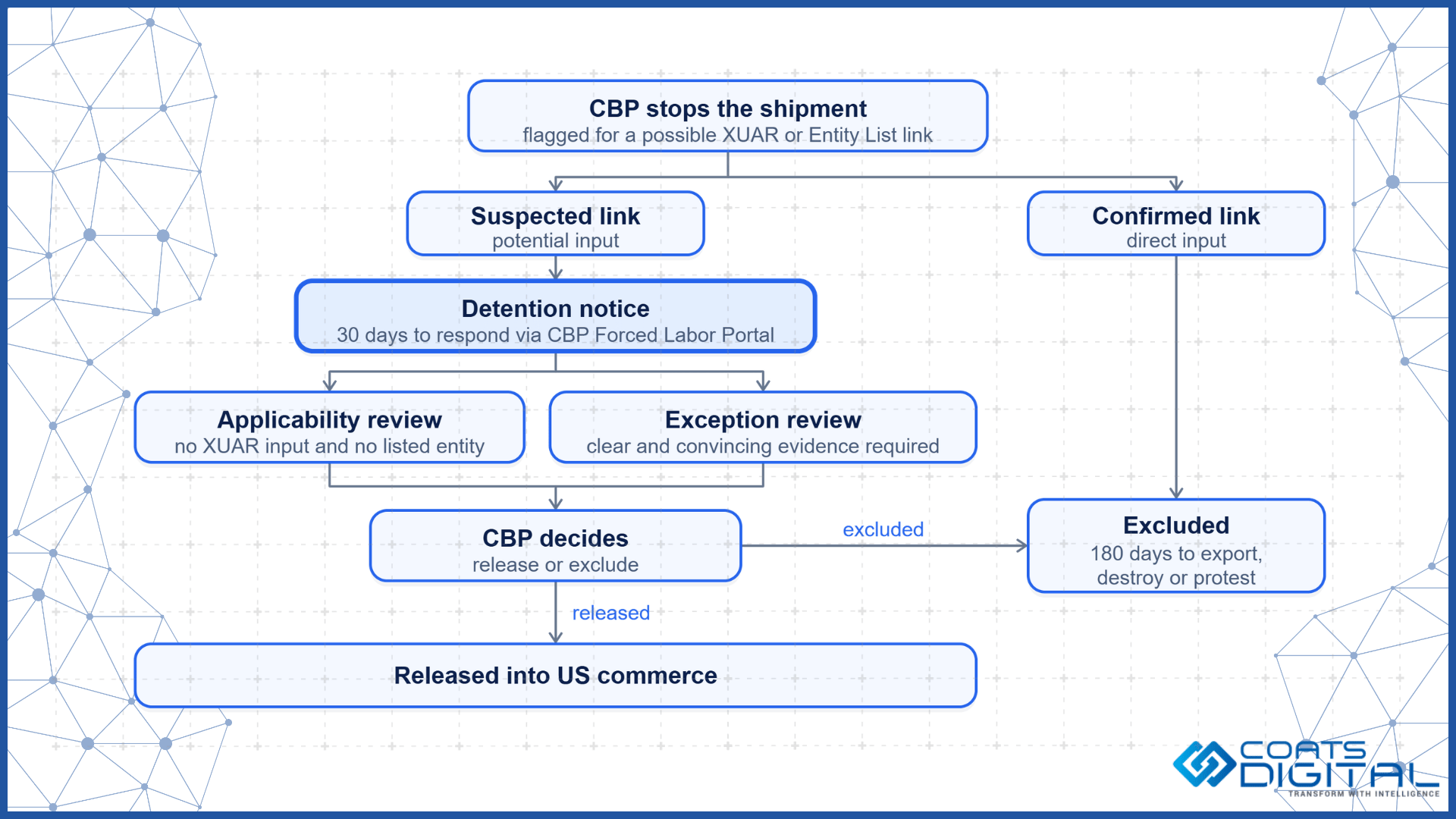
Release comes only through one of the two review routes, and both depend on documents that already exist when the notice arrives. A confirmed link skips review and goes straight to exclusion.
What a defensible response package contains
CBP’s June 2026 guidance asks importers to trace each high-priority product to the raw-material stage, and its appendix sets out tracing documents for sectors that include cotton and apparel (Diaz Trade Law via Mondaq). For cotton apparel, a package that can stand up to review usually holds:
- A flowchart of every production step from cotton gin to finished garment: ginning, spinning, knitting or weaving, dyeing and finishing, and cut-make-trim (CMT).
- Origin documents for each input: a certificate of origin or manufacturer’s declaration naming the producing entity and its location.
- Purchase orders, invoices, and proof of payment at every transfer between tiers.
- Production records that tie specific yarn and fabric lots to the specific goods shipped.
- Transport documents for each movement, from bale to container.
- Due diligence records: supplier codes of conduct, audits and training. Necessary, but never enough on their own.
- Isotopic test reports where documents alone cannot settle origin. The 2026 guidance covers isotopic testing for this purpose.
CBP’s best practice for Forced Labor Portal submissions is a package that is searchable, indexed, translated, and free of duplicates. Building that in 30 days from five tiers in three countries is rarely possible. Building it in advance is.
The high-priority sectors and a moving Entity List.
The FLETF names 13 high-priority sectors for enforcement, and cotton, cotton products and apparel have been among them since enforcement began. The Entity List keeps growing. It stood at 144 entities until 3 August 2026, when 43 additions took it to 187, the largest single expansion since the law took effect.
Nineteen of those 43 new entities are located outside Xinjiang, and four are textile and apparel companies, including Shandong Weiqiao Textile Technology and Henan Tongzhou Cotton Industry (Kelley Drye). The pattern is not new. In May 2024, the FLETF added 26 cotton traders and warehouses, most of them operating outside the XUAR (ArentFox Schiff).
A supplier’s provincial address says little about where its cotton grew. Screening has to run continuously, cover every tier and ownership link, and map each listed name to the styles it touches.
Why UFLPA Risk Jumped in 2026: 187 Listed Entities, Rising Apparel Denials
UFLPA risk rose in 2026 for three reasons: stopped apparel shipments are more likely to end in denial, enforcement has spread beyond Xinjiang and beyond China, and US tariff policy now links forced-labour compliance and cotton origin to landed cost. The number of stops, on its own, did not explode.
Apparel is the most-stopped and most-denied sector
CBP’s enforcement data, current to 4 September 2026, records 44,188 shipments stopped since June 2022, worth $4.13 billion. Of those, 26,830 were denied entry and 15,318 were released (CBP data, compiled by Gatewell). Apparel, footwear, and textiles account for 13,564 of the stops and 9,164 of the denials, more than any other sector on both counts.
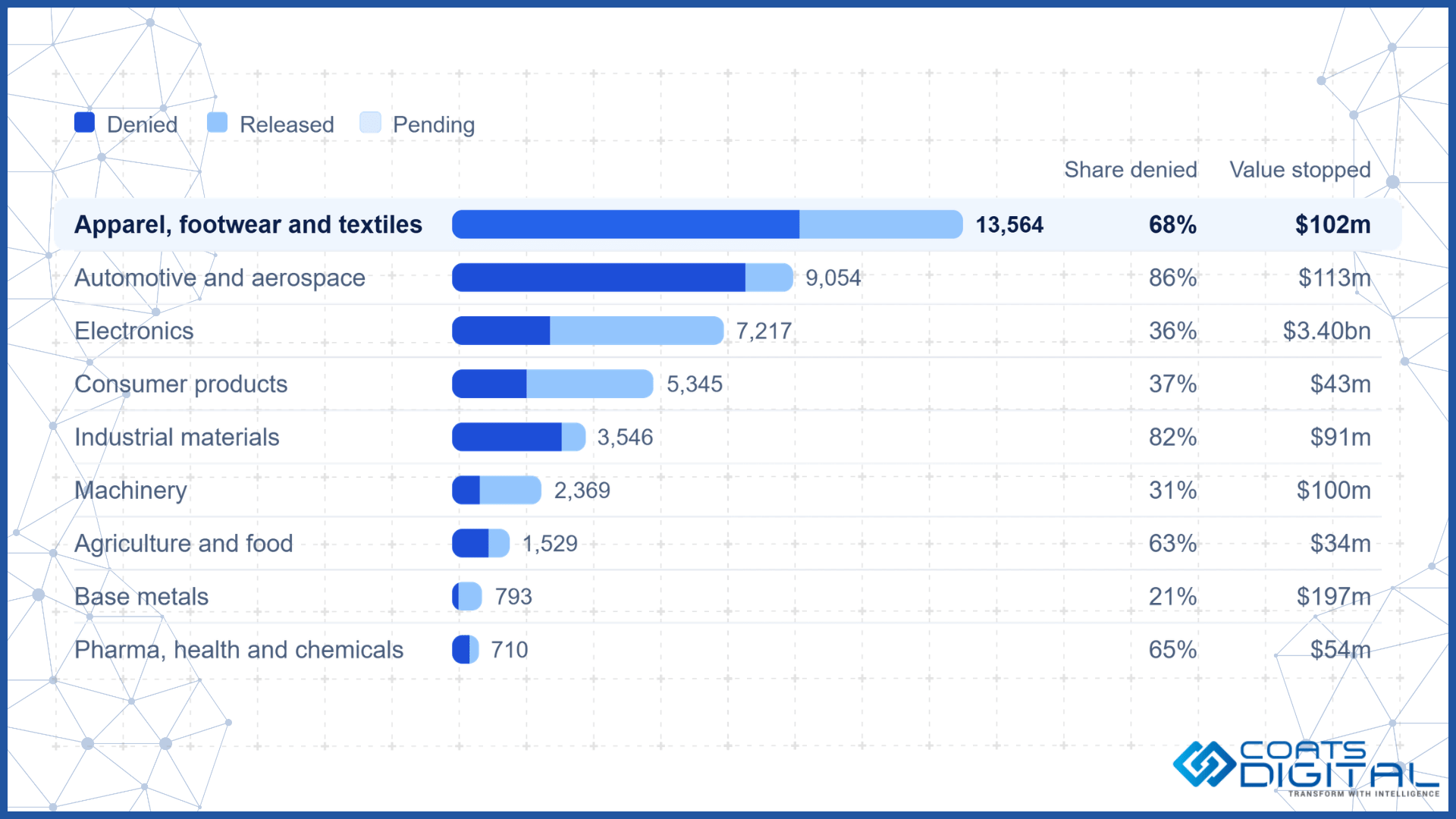
The dollar totals understate the risk. Apparel accounts for about 31% of all stops but only about 2.5% of their value, because a container of T-shirts is worth a fraction of a container of solar modules. What matters to an exporter is the outcome: about two in three stopped apparel shipments were denied, against roughly one in three for electronics. A low-value order is still a lost order, and often a lost customer.
Read the trend with care. CBP’s 2026 dashboard revision counts each import transaction inside an entry as a shipment, so this year’s counts are not comparable with older press figures, and a “stopped” shipment has not always been physically examined. Overall volumes in fiscal year (FY) 2026 are broadly in line with FY2025 (Holland & Knight). Outcomes have hardened, though: in FY2025, 9,227 of 12,272 stops ended in denial (75%), up from 57% in FY2024.
Enforcement has spread beyond Xinjiang, and beyond China.
On 9 June 2026, CBP published its Forced Labor Enforcement Operational Guidance for Importers, an 89-page document that brings UFLPA, Withhold Release Orders (WROs) and other forced-labour authorities into one rulebook. Two weeks later, CBP issued WROs against garments from two Jordanian factories, Needle Craft Ltd. and Casual Wear Apparel L.L.C., taking its active docket to 58 WROs and eight Findings (CBP CSMS #69031301).
For sourcing teams, the message is plain: moving sewing out of China does not move forced-labour risk out of the supply chain. Brands spreading production under a China-plus-one strategy still need supply chain mapping and traceability for UFLPA readiness, whichever country does the cutting and sewing.
US tariff policy now ties cotton origin to landed cost.
The US-Bangladesh Agreement on Reciprocal Trade, signed on 9 February 2026, set a 19% reciprocal tariff and promised zero tariff on a capped volume of apparel made with US cotton or man-made fibre (BBF). Eleven days later, on 20 February, the Supreme Court held that the International Emergency Economic Powers Act (IEEPA) does not authorise tariffs, so the 19% rate never applied. A temporary 10% global tariff under Section 122 took effect on 24 February (Ropes & Gray).
Forced labour then became the legal basis for tariffs. From 24 July 2026, Section 301 duties replaced the temporary tariff for 60 economies: 10% for those that ban, or have committed to ban, forced-labour imports, including Bangladesh, India, Cambodia, Indonesia, Pakistan and Sri Lanka, and 12.5% for most others, including China and Vietnam (Presidential memorandum, Federal Register; USTR). For Bangladesh, the additional duty therefore stayed at 10% (Apparel Times).
The same memorandum directs three-year tariff-rate quotas (TRQs) for Bangladesh, Cambodia, Indonesia and Malaysia, letting a volume of textiles and apparel tied to each country’s imports of US cotton and textile inputs enter free of the Section 301 duty. The quotas are not open yet. In October 2026, the US Department of Agriculture (USDA) said its Foreign Agricultural Service will run the process and launch it in 2027, with purchase thresholds still unpublished (RFD-TV).
For a factory, the two pressures meet in one record. To claim quota relief, it will need to prove US cotton in a style. To keep that style out of detention, it must prove there is no Xinjiang cotton in it. Both require the origin of every fibre, yarn and fabric lot, linked to the style and the shipment.
Europe is next. From 14 December 2027, the EU Forced Labour Regulation bans products made with forced labour at any stage of the supply chain from being placed on, made available on, or exported from the EU market (Mayer Brown). Exporters that build one origin record for US buyers can reuse it for European ones.
Types of UFLPA Compliance Tools: Traceability, Screening, Evidence and Product Data
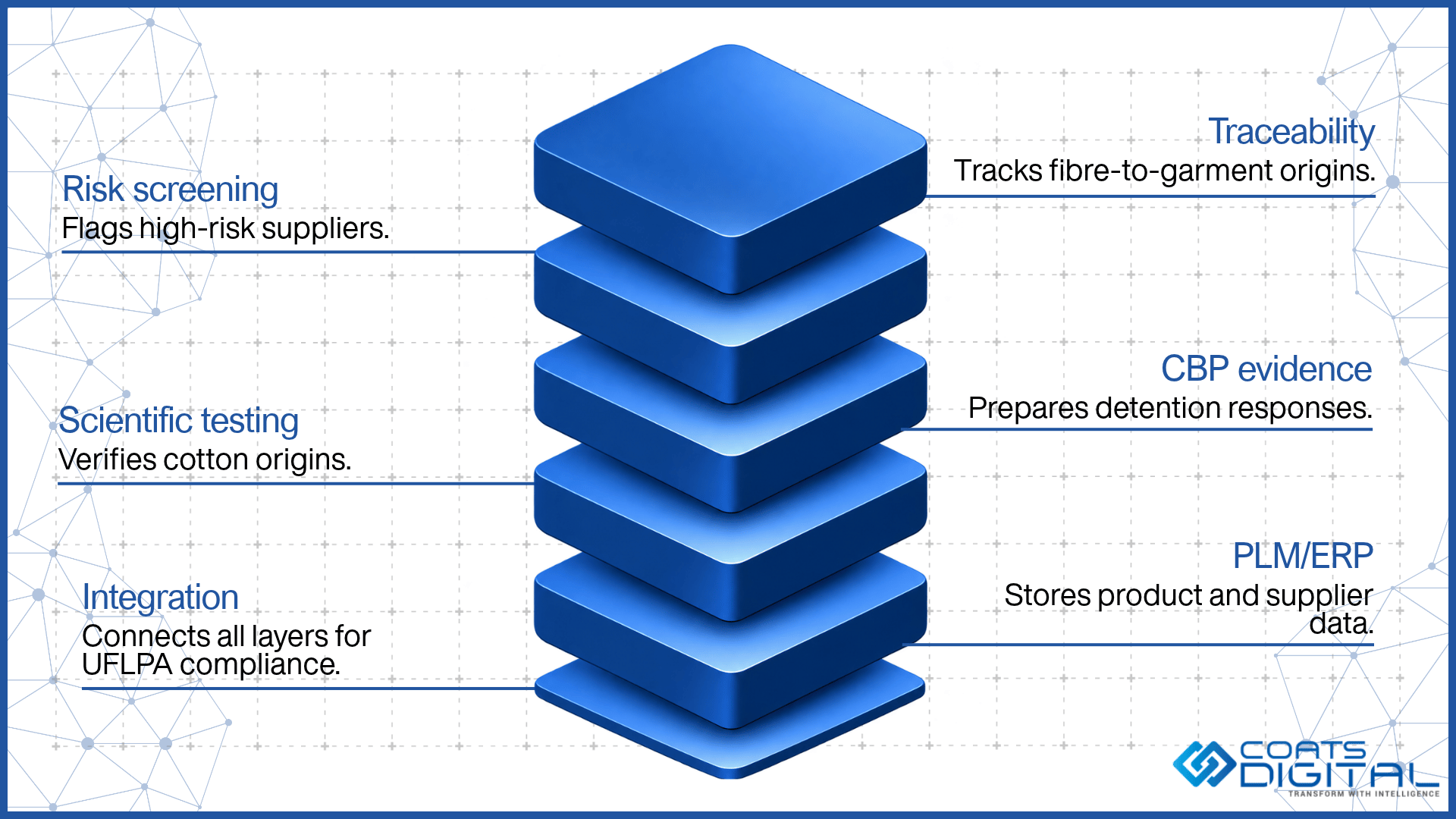
UFLPA compliance tools fall into four software categories plus one laboratory service, and each solves a different part of the burden of proof. Shortlists go wrong when they compare tools that were never designed to do the same job.
Multi-tier traceability platforms
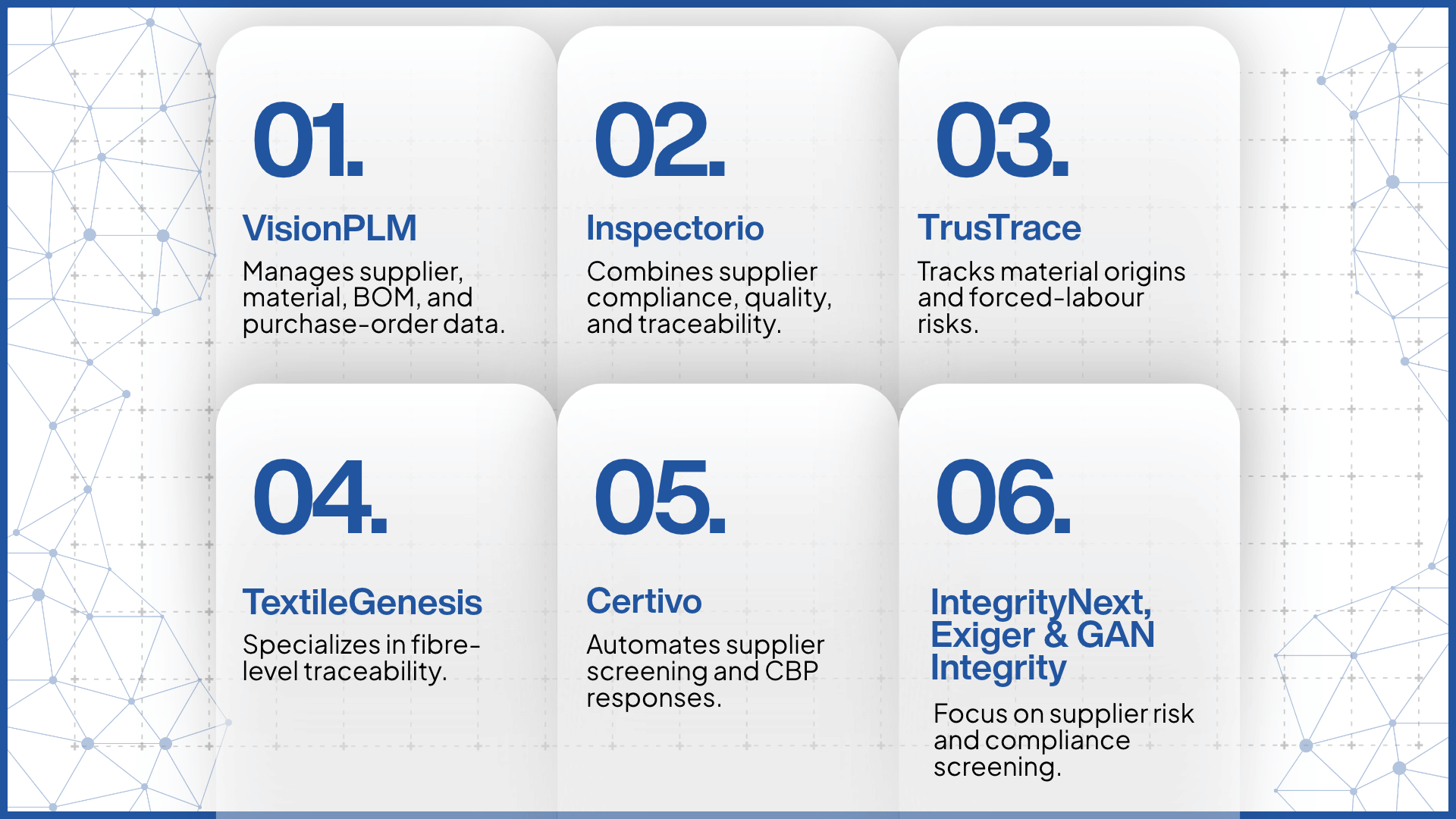
Traceability platforms map the chain of custody from fibre to finished garment and collect supplier and material evidence at each tier: ginning, spinning, knitting or weaving, dyeing and CMT. Their strength is a documented link between a style, its lots and their sources. Their weakness is that the record is only as good as what suppliers upload, so onboarding mills and spinners takes sustained effort. Examples include Inspectorio, TrusTrace and TextileGenesis.
Third-party risk and due diligence platforms.
Screening platforms check suppliers and their owners against the UFLPA Entity List, sanctions lists and adverse media, and alert you when the list changes. The stronger ones look past name matches to corporate networks, site locations and trade data that reveal sub-tier links. Examples include IntegrityNext, Exiger and GAN Integrity, while data providers such as Kharon and Sayari feed risk intelligence into other platforms. Screening tells you where risk sits. It rarely proves the fibre origin of a specific shipment.
Evidence automation and CBP-response tools
Evidence tools collect origin declarations from suppliers at scale, organise them by shipment and generate a detention-response package aligned with CBP’s guidance. Certivo is a dedicated example. An evidence tool presents what exists, faster; it cannot fill gaps in the tracing data underneath.
Scientific origin verification (part of the stack, not software).
Isotopic testing compares the chemical signature of a cotton sample with reference samples of known origin to check whether the claimed growing region is plausible. CBP’s November 2024 guidance asks labs for reference libraries covering all commercially relevant growing regions, documented sample chain of custody, and ISO/IEC 17025 accreditation (Oritain summary of the CBP guidance). Testing is most useful on cotton spun or blended in hubs that also buy Chinese fibre, where the paperwork can be clean while the fibre is not. It tests samples, not every bale, so treat it as a cross-check on high-risk styles and ask labs to quote against your sampling plan.
Product-data and production systems (the upstream data layer).
Product lifecycle management (PLM) and enterprise resource planning (ERP) systems are not compliance platforms. They hold the supplier, material, bill of materials (BOM), tech pack and purchase order records for each style, and those records are where every traceability programme starts. Origin data is born on the floor, at supplier onboarding and product development, not at the border. A fashion PLM such as Coats Digital’s VisionPLM keeps that product and supplier data in one record; a tracing platform then extends it upstream to the fibre.
How the layers fit together
UFLPA compliance runs on four connected layers: upstream product and supplier data, then traceability and chain-of-custody mapping, then due diligence and Entity List screening, then evidence and CBP response. Isotopic testing sits alongside them as a check on what the documents claim.
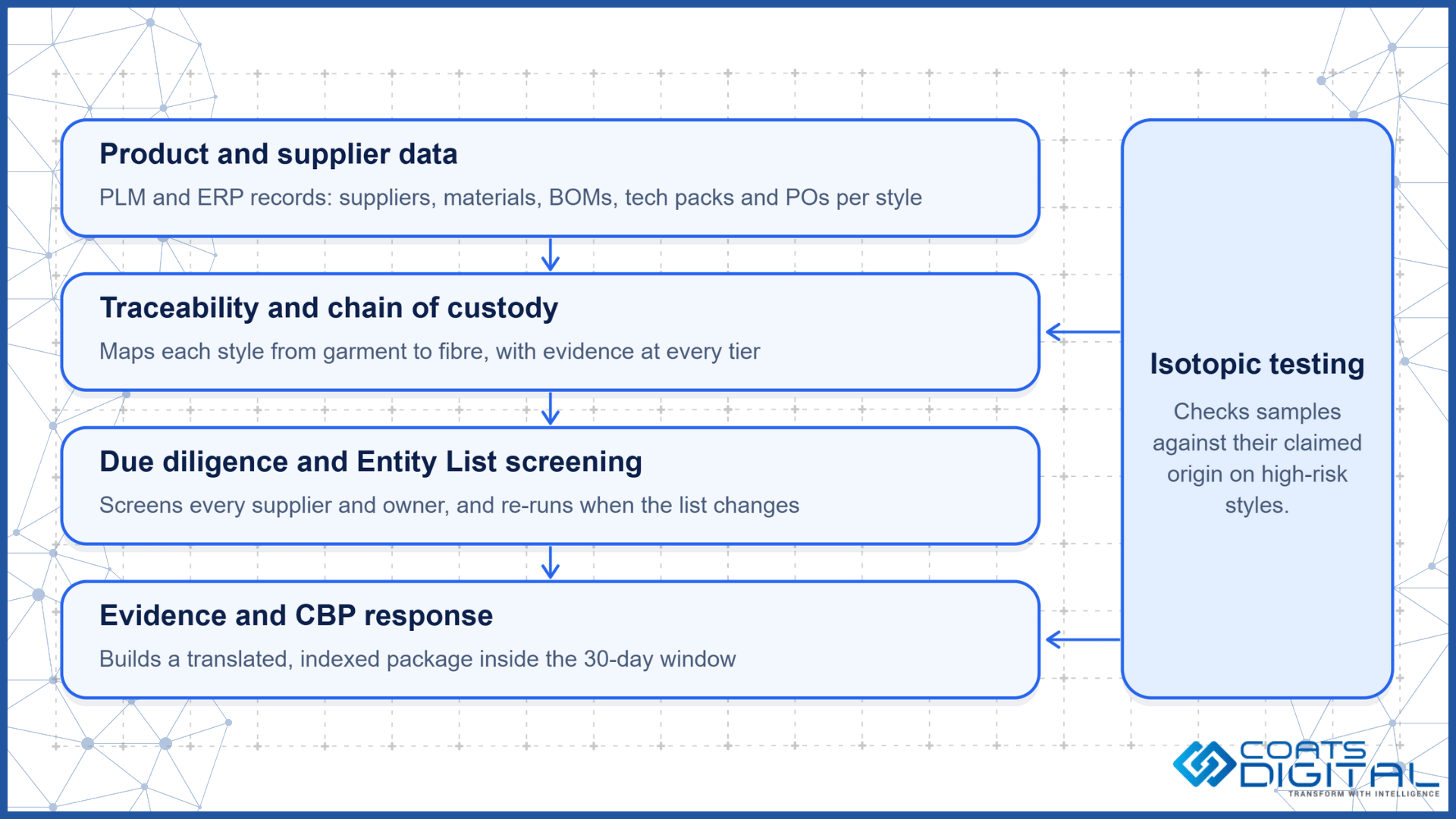
Most brands run more than one platform, because no vendor does all four layers equally well. The minimum is a tracing layer and a screening layer, fed by clean upstream data. Treat any vendor that claims to cover the whole stack alone with caution, and ask it to prove each layer on one of your own styles.
| Category | Core job | What it does not do | Where it fits in a UFLPA programme |
| Product data (PLM, ERP) | Holds supplier, material, BOM, tech pack and PO records for each style | Screen lists, trace beyond recorded suppliers or build CBP packages | Layer 1: the starting record |
| Multi-tier traceability | Maps the fibre-to-garment chain and collects evidence at each tier | Prove origin scientifically or map ownership networks in depth | Layer 2: chain of custody |
| Due diligence and screening | Screens suppliers and owners against the Entity List and sanctions, and monitors changes | Prove the fibre origin of a given shipment | Layer 3: risk detection |
| Evidence automation | Gathers declarations and builds response packages | Create evidence that suppliers never provided | Layer 4: CBP response |
| Isotopic testing | Checks whether a sample matches its claimed origin | Prove chain of custody or test every bale | Cross-check on high-risk styles |
The Best UFLPA Compliance and Traceability Software for Apparel in 2026 (Compared)
The right UFLPA software depends on the layer you need. Established names include Inspectorio, TrusTrace and TextileGenesis for traceability; IntegrityNext, Exiger and GAN Integrity for risk screening; and Certivo for evidence automation. The shortlist below is grouped by category, not ranked, and every entry states its limits. Budgets vary with supplier count, modules, and integration scope, so request written quotes for the same scope and test each tool on one of your own cotton styles.
| Platform | Category | Best for | Watch out for |
| Coats Digital Vision PLM and apparel ERPs | Upstream product data | Clean supplier, material and order records per style | Not a compliance tool |
| Inspectorio | Traceability, quality and compliance | Apparel brands wanting mapping, compliance and lab testing in one place | Full value needs several modules adopted |
| TrusTrace | Traceability and compliance data | Material-level evidence collection for UFLPA | Depends on suppliers keeping data current |
| TextileGenesis | Fibre-forward traceability | Certified and premium fibre programmes | Conventional cotton relies on supply chain discovery, not fibre-forward tracking |
| Certivo | Evidence automation | Fast, structured CBP response packages | Cross-industry; apparel is not a named focus |
| IntegrityNext | Due diligence and screening | Continuous Entity List screening beyond Tier 1 | Does not prepare the CBP package itself |
| Exiger | Risk intelligence | Forced-labour signals beyond list matches | Not apparel-specific; pair with material tracing |
| GAN Integrity | Third-party risk and due diligence | Policy, screening and audit trail in one programme | No stated fibre tracing or CBP submission feature |
Product-data systems: Coats Digital VisionPLM and apparel ERPs
A fashion PLM holds the supplier profiles, materials, bills of materials, tech packs and purchase orders that a traceability programme ingests. VisionPLM manages material development and supplier profiles, costing, sampling and purchase orders, with critical path tracking that extends across both garment and material purchase orders (Coats Digital). It does not screen the Entity List, trace beyond the suppliers you record, or build CBP packages. It complements the platforms above; it does not replace them.
Inspectorio
Inspectorio combines quality, responsible sourcing and traceability for apparel and footwear. Urban Outfitters, Inc. (URBN) is deploying its Responsible Sourcing and Compliance, Lab Test Management and Traceability and Transparency solutions across its brands, using supply chain mapping to support UFLPA due diligence. The limitation is breadth: the platform pays off when several modules, and the supplier base, are on it.
TrusTrace
TrusTrace is a traceability and compliance-data platform that fashion brands use to collect UFLPA evidence at material level. Its partnership with Kharon brings forced-labour risk data into the platform and flags suppliers that match high-risk entities. It is brand-led, so its quality depends on how well suppliers maintain their data.
TextileGenesis
TextileGenesis offers fibre-forward traceability for responsible and certified materials, and a supply chain discovery approach for conventional ones; its partners include Supima and Textile Exchange. It is strongest where a certified-fibre programme already exists.
Certivo
Certivo automates supplier origin declarations, screens suppliers against the Entity List with alias matching, and generates detention-response packages that it describes as aligned with CBP guidance. Its turnaround claims are self-reported, and the industries it names lean towards electronics, automotive, and industrial goods, so test it on a cotton style before committing.
IntegrityNext, Exiger and GAN Integrity
These are risk-led platforms. IntegrityNext screens direct and indirect suppliers against the Entity List and re-evaluates mapped chains when the list changes, but states that counsel or customs advisers prepare the CBP package. Exiger looks for forced-labour signals beyond name matches, including corporate networks and sub-tier links. GAN Integrity brings policy, third-party screening and audit trails together, drawing on partners such as Sayari. Pair any of them with a material-traceability layer for fibre-level chain of custody.
UFLPA Compliance for Apparel Manufacturers: What Your US Buyer Will Demand
A garment manufacturer does not carry the importer’s legal burden under UFLPA, but it holds most of the evidence. A factory that cannot produce cotton origin to raw fibre leaves its buyer with a risk it cannot rebut, and buyers move orders to suppliers who can. For exporters in Bangladesh, India, Vietnam and beyond, UFLPA readiness is now part of keeping US accounts.
Who owns what? The burden is the importer’s; the data is yours
| Task | US brand or importer | Supplier factory |
| Carry the legal burden and answer CBP | Owns it, with trade counsel | Supplies evidence on request, quickly |
| Map the chain to raw fibre | Sets the requirement and checks the result | Maps its own spinners, mills, dyehouses and trims suppliers |
| Screen against the Entity List | Screens the full chain continuously | Screens its own suppliers before booking orders |
| Hold origin documents per lot | Requests and stores them | Captures them at purchase and links them to styles |
| Isotopic testing | Commissions tests on high-risk styles | Supports sampling and keeps the lot records that make tests meaningful |
| Respond to a detention | Files within the 30-day window | Turns document requests around in days, not weeks |
What your buyer will ask for, and where that data should already live
Buyer requests mirror CBP’s documentation expectations. Expect to be asked for:
- Named cotton origin for each style, by country and, where possible, by gin.
- A tier map: spinner, fabric mill, dyehouse and finisher, trim suppliers and any subcontractors.
- Transaction records at each transfer: purchase orders, invoices, proof of payment, and delivery notes.
- Lot-level production records that link yarn and fabric lots to cut orders and shipments.
- Supplier declarations and audit records.
Most of this is created long before shipment, during supplier onboarding and product development, in tech packs, bills of materials, material and supplier profiles, and purchase orders. When those records live in separate spreadsheets and email threads, every traceability request starts a scramble. When they live in one system, it becomes a query.
This is where a PLM system belongs in a UFLPA programme. Coats Digital’s VisionPLM, designed for apparel manufacturers working on both ODM and OEM models, keeps material supplier profiles, bills of materials, tech packs and purchase orders in one versioned record, and lets teams accept or reject supplier-submitted changes before they enter it. That gives a factory its supplier, material and product data in one record. Vertically integrated groups are moving the same way: Colombia’s Manufacturas Eliot, which produces more than 20 million garments a year, chose VisionPLM to centralise design, sourcing and supplier collaboration (Coats Digital).
Be clear about the limits. A PLM record shows which supplier and material went into which style. It does not verify that a spinner’s origin declaration is true; tracing platforms, audits and isotopic testing do that work.
Build the record before the request, not after the detention
A standing, queryable record beats an audit-time document hunt. Build it into the steps you already run:
- Supplier onboarding: capture each material supplier’s legal entity name, address, and ownership, and screen it against the current Entity List.
- Bill of materials: record fibre content and the supplier for every yarn and fabric in the style.
- Purchasing: require an origin declaration with each yarn and fabric purchase order, and file it against the style.
- Production: keep lot numbers through cutting and packing, so a shipment traces back to specific lots.
- Subcontracting: approve subcontractors in advance and record the style, quantity, shipment date, and responsible quality-control officer for every subcontracted lot, so nothing produced off-site falls outside the chain (how Bangladesh factories govern subcontracting).
- Change control: re-screen whenever the Entity List changes or a supplier is swapped.
A factory that answers a buyer’s traceability request once, completely and accurately, becomes the low-risk supplier that keeps the account. The same record will support a US-cotton quota claim once the rules are published, and an EU forced-labour enquiry from December 2027.
Factory self-assessment: is your cotton at UFLPA risk?
Any box you cannot tick is a gap your buyer’s compliance team will find first.
- We can name the country of origin of the cotton in every style we ship to the US.
- We can map every tier from garment to fibre, including subcontracted processes.
- We know whether any spinner or mill buys fibre or yarn through trading or blending hubs.
- We have screened every supplier, not only Tier 1, against the Entity List since its 3 August 2026 update.
- Every subcontracted process, such as printing, embroidery or washing, is recorded against the lot.
- Our origin data sits in one system, not across spreadsheets and email.
- We could send a buyer a complete supplier map and lot documents within a few days.
- Our documents are available in English and unredacted.
How to Choose UFLPA Compliance Software: A 5-Point Selection Framework
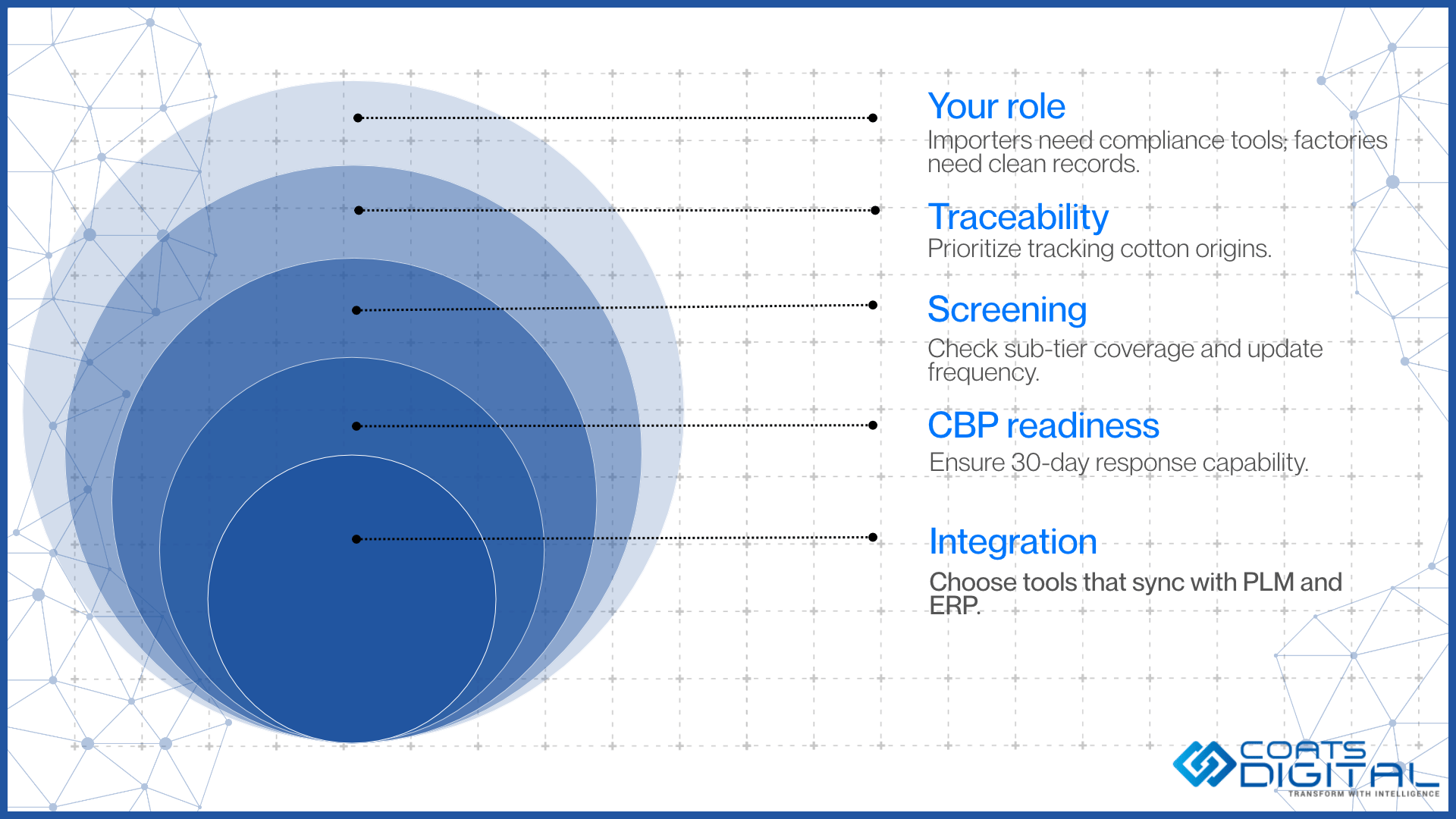
Choose UFLPA compliance software by matching it to your role and your biggest evidence gap, then test it on a real style. An importer and a factory face the same law from opposite ends of the evidence chain.
- Your role. Importers carry the legal burden and need screening, tracing, and response capability. Factories need a clean record and a fast way to answer buyers; many will work inside their buyer’s traceability platform rather than buy their own.
- Your fibre-level gap. If you cannot name the cotton origin for most styles today, start with tracing. A screening dashboard will not close that gap.
- Screening depth and frequency. Ask how the tool finds sub-tier and ownership links, and how quickly it re-screens after a list change. The August 2026 update added 43 names in a single notice.
- CBP response readiness. Ask each vendor to build a mock response package for one of your own cotton styles: lot-linked, translated, indexed, and achievable inside the 30-day window.
- Integration with PLM and ERP. Supplier and material records that have to be rekeyed will drift. Prefer tools that pull from the systems where styles, bills of materials, and purchase orders already live.
| Your profile | Start with | Add when |
| US brand or importer, cotton-heavy | Traceability platform plus continuous screening | Evidence automation as volumes grow; isotopic testing on high-risk styles |
| US brand or importer, low cotton exposure | Continuous screening with sub-tier detection | Tracing for any cotton or other high-priority-sector lines |
| Small or mid-size garment factory | One clean product and supplier record (PLM or ERP) and a documented Entity List check on every supplier | A buyer invites you onto its traceability platform, or cotton-heavy US orders grow |
| Large vertically integrated group | The full stack: product data, tracing, enterprise due diligence and evidence automation | An isotopic testing programme and records ready for US-cotton quota claims |
Minimum viable setup for a smaller factory: you do not need an enterprise stack. You need one reliable, queryable origin record per style and a documented check of every supplier against the current Entity List. The trigger to invest further is buyer demand and the share of cotton-heavy US business, not headcount.
UFLPA Compliance Software Cost vs. the Cost of a Detention
The cost of UFLPA compliance software is best judged against the expected cost of a detention, and for cotton apparel that cost is driven by denial risk rather than delay. Most stopped apparel shipments in CBP’s data never entered the US.
The metrics that matter
- Stop and denial rate on your own entries, by product line and origin.
- Time to evidence: days from a request to a complete, translated package, measured against the 30-day window.
- Named-origin coverage: the share of stock-keeping units (SKUs) with cotton origin recorded to country, and ideally to gin.
- Mapping completeness: the share of shipped volume mapped all the way to fibre.
- Screening coverage: the share of suppliers, at every tier, screened since the last Entity List change.
- Avoided cost: storage, write-offs, chargebacks and accounts retained.
What a detention actually costs
| Cost line | What drives it | Where to get your number |
| Port, storage and exam charges | Days held and carrier free time; they run through the whole response window | Your customs broker and carrier tariffs |
| Goods written off | Denied goods must be exported or destroyed | Landed cost of the shipment |
| Lost sales and markdowns | Missed delivery windows, especially for seasonal styles | Merchandise planning |
| Chargebacks and penalties | Late or cancelled orders under buyer terms | Vendor agreements |
| Professional fees | Trade counsel, brokers and any testing | Recent invoices |
| Relationship cost | A buyer’s confidence in the supplier | Account history and order trends |
Build the business case in four steps
- Take the landed value of a typical cotton shipment, plus the cost of replacing it and the margin you would lose.
- Multiply by the probability that a stopped apparel shipment is denied: about 0.68 in CBP’s data from June 2022 to September 2026.
- Add holding charges for the 30-day window and the professional fees a response would need.
- Multiply by the number of stops you could plausibly face in a year, then compare the total with vendor quotes.
Worked example. The numbers are illustrative, chosen only to show the arithmetic. A shipment worth $60,000, with $15,000 of replacement cost and $20,000 of lost margin, carries an expected loss of about $64,600 per stop before holding costs and fees (0.68 × $95,000). Replace each figure with your own, and label every number in the final case with its source and date.
Then add the upside that rarely makes the spreadsheet. A supplier that answers traceability requests quickly is easier for a buyer to keep, and verified U.S. cotton records may qualify for duty relief once the quota opens.
7 Common UFLPA Compliance Mistakes in Apparel Supply Chains
- Treating purchase orders and codes of conduct as proof. They record intention, not chain of custody. CBP’s 2026 guidance indicates that affidavits and declarations on their own are unlikely to carry a review.
- Mapping only Tier 1. In cotton apparel, the exposure usually sits with the spinner or the fibre trader, three or four tiers above the factory that sews the garment.
- Screening only by geography. Nineteen of the 43 entities added in August 2026 are outside Xinjiang, and most of the 26 cotton traders added in 2024 were too. A supplier’s address tells you little about where its cotton grew.
- Screening once instead of continuously. The list grew by 30% in a single notice. A supplier cleared in July could be listed in August, and the first you hear of it is a detention notice.
- Building the package after the detention. Thirty days is not long enough to collect, translate, and index documents from five tiers in three countries. Hold the package ready for each high-risk style.
- Letting unauthorised subcontracting break the chain. A lot printed, embroidered or washed at an unapproved site has no documented custody for that step. Buyers already treat unauthorised subcontracting as a compliance breach; under UFLPA, it also leaves a gap in the evidence.
- Keeping supplier and origin data in spreadsheets. A buyer’s traceability request should be a query against one record, not a week of emails. This is where clean product and supplier data, held in a PLM or ERP system, pays for itself.
Conclusion: Prove the Chain, Not the Intention
UFLPA compliance is a burden-of-proof discipline. It comes down to three habits: tracing each style from finished garment back to raw fibre, screening suppliers continuously against a list that keeps moving, and holding a CBP-ready package before a detention rather than assembling one after it.
No single platform does all of that well. The right mix of tracing, screening, evidence automation, isotopic testing, and clean upstream product data depends on whether you carry the importer’s burden or answer the buyer’s requests. Since July 2026, the same origin record also affects tariffs, and from December 2027 it will be tested in Europe.
Where to go next
- Shortlist a dedicated traceability and screening platform from the comparison above, and test it on one of your own cotton styles.
- Read CBP’s Forced Labor Enforcement Operational Guidance for Importers and track your sector on CBP’s UFLPA enforcement statistics dashboard.
- If you manufacture for US buyers, get supplier and material data into one record so that traceability requests are answered once, accurately.
Coats Digital works with apparel brands and manufacturers on the product and supplier data that sits beneath every traceability programme. VisionPLM will not make a business UFLPA-compliant on its own. What it does is keep one reliable record of supplier and material data from development to purchase order, so the evidence your buyers and their platforms ask for is ready when the request, or the detention notice, arrives.
Frequently Asked Questions
-
What is UFLPA compliance software?
UFLPA compliance software helps importers and their suppliers prove that goods entering the United States contain no input from Xinjiang or from a company on the UFLPA Entity List. It maps multi-tier supply chains, screens suppliers against the Entity List, collects origin documents back to raw material, and builds the response an importer files with CBP after a detention. It supports due diligence; it does not replace legal advice or create records that were never kept.
-
What is the UFLPA rebuttable presumption?
The rebuttable presumption is the rule that goods made wholly or in part in Xinjiang, or by an entity on the UFLPA Entity List, are presumed to be made with forced labour and are barred from US entry. The importer can show the goods fall outside the law, or seek an exception by proving with clear and convincing evidence that no forced labour was used. That standard is higher than “more likely than not”.
-
Does UFLPA apply to garments made outside China?
Yes. UFLPA covers any goods made wholly or in part in Xinjiang or by a listed entity, wherever the final garment is sewn. A T-shirt made in Bangladesh, India, or Vietnam is in scope if its yarn or fabric contains Xinjiang cotton. That is why US buyers ask suppliers outside China to trace their cotton, and why moving production elsewhere does not remove the risk.
-
What evidence does CBP need to release a detained apparel shipment?
CBP expects the supply chain to be traced to raw material. For cotton apparel, that means a flowchart of every production step, origin documents naming the producer and location of each input, purchase orders, invoices and payment records, production records linking lots to the shipment, and transport documents. Records should be translated, indexed, and unredacted. Isotopic test results can support origin claims where documents fall short.
-
Do purchase orders and a supplier code of conduct satisfy UFLPA?
No. Purchase orders and codes of conduct show what you asked suppliers to do, not where the cotton came from. CBP’s 2026 guidance indicates that affidavits and declarations on their own are unlikely to carry a review, and gaps at sub-tier suppliers can undermine a whole submission. Purchase orders matter as one link in a chain of custody, alongside payment, production and transport records at every tier.
-
How many entities are on the UFLPA Entity List now?
The UFLPA Entity List held 187 entities after DHS added 43 companies on 3 August 2026, its largest single expansion. It stood at 144 before that update. Additions are published in Federal Register notices and apply quickly, so check the current list on the DHS website before each screening run rather than relying on any published count.
-
Why does screening by country of origin no longer work?
Screening by geography misses listed companies that are not in Xinjiang. Nineteen of the 43 entities added in August 2026 are located elsewhere, and most of the 26 cotton traders added in May 2024 also operated outside the region. A supplier in Shandong or Henan can be listed, or can buy Xinjiang cotton. Effective screening looks at named entities, ownership, and inputs at every tier.
-
Which apparel products are highest-risk under UFLPA?
Cotton products carry the highest risk. Cotton, cotton products, and apparel are among the FLETF’s 13 high-priority sectors, and Xinjiang grew to 92.8% of China’s cotton in 2025, according to China’s National Bureau of Statistics as reported by Xinhua. Risk rises for blends, yarn spun in hubs that also buy Chinese fibre, and goods routed through trading companies. Man-made fibre garments are not exempt: the presumption applies to any input.
-
What is the difference between a traceability platform and a due diligence platform?
A traceability platform documents the chain of custody for specific products: which spinner, mill and dyehouse made the yarn and fabric in a style, backed by transaction records. A due diligence platform screens suppliers and their owners for risk, such as Entity List matches, sanctions, or adverse media. Traceability proves where a product came from; due diligence shows which suppliers need a closer look. Most UFLPA programmes need both.
-
Do I need more than one tool for UFLPA compliance?
Usually, yes. Few vendors handle tracing, screening, evidence automation, and product data equally well. A practical minimum is a traceability layer and a screening layer, fed by clean supplier and material records from a PLM or ERP system. Larger cotton-heavy importers often add evidence automation and isotopic testing on high-risk styles. Be wary of any vendor that claims to cover every layer alone.
-
What must a garment factory do to stay UFLPA-compliant for its US buyers?
A garment factory must be able to prove the origin of every input in the styles it ships to the US. In practice, that means naming cotton origin per style, mapping spinners, mills, dyehouses, trim suppliers, and subcontractors, screening them against the current Entity List, collecting origin declarations with each yarn and fabric order, and keeping lot numbers through production. The aim is to answer a buyer’s request once, completely and quickly.
-
Does my PLM or ERP already hold cotton origin data?
A PLM or ERP system may already hold most of the starting record: supplier profiles, materials, bills of materials, tech packs and purchase orders for each style. Whether it holds cotton origin depends on whether you capture fibre source and supplier declarations there. It is not a compliance platform and does not screen the Entity List or verify declarations, but it is the record a traceability programme should draw from.
-
How does isotopic testing help prove cotton origin?
Isotopic testing compares the chemical signature of a cotton sample with reference samples from known growing regions to check whether the claimed origin is plausible. CBP issued guidance on its use in November 2024, and its 2026 operational guidance covers isotopic testing too. It works best as a cross-check on high-risk styles, because it tests samples rather than whole shipments and cannot replace a documented chain of custody.
-
How long do I have to respond to a CBP UFLPA detention?
An importer generally has 30 days from a UFLPA detention notice to respond through CBP’s Forced Labor Portal. Extensions are at CBP’s discretion and must be requested before the window closes. If CBP has already determined that goods came from Xinjiang or a listed entity, it excludes them instead, and the importer has 180 days to export, destroy, or protest.
-
How does the 2026 US-Bangladesh trade deal affect UFLPA compliance?
The US-Bangladesh deal does not change UFLPA, but it raises the value of the same records. The February 2026 agreement promised duty relief for apparel made with US cotton. After the Supreme Court ruled that IEEPA does not authorise tariffs, that relief became a planned tariff-rate quota under the Section 301 forced-labour tariffs, which USDA expects to launch in 2027. Proving US cotton and proving no Xinjiang cotton need the same origin evidence.
-
Is there an EU equivalent of UFLPA?
Yes. The EU Forced Labour Regulation applies from 14 December 2027 and bans products made with forced labour at any stage of the supply chain from being placed on, made available on, or exported from the EU market. Exporters that sell to both the US and the EU will need much the same supplier and origin records for each regime, so it pays to build one record that serves both.
-
How much does a UFLPA detention cost an importer?
There is no standard figure, because the cost depends on the shipment. The main lines are storage and port charges through the response window, the value of goods if entry is denied, replacement cost, lost sales and markdowns, buyer chargebacks, and legal fees. Because most stopped apparel shipments in CBP’s data were denied, the goods themselves are usually the largest exposure for apparel importers.
-
How do I build the business case for UFLPA compliance software?
Start with the expected cost of a stop: landed value plus replacement cost and lost margin, multiplied by the likelihood of denial, plus holding charges. Multiply by the number of stops you could plausibly face in a year, then compare with vendor quotes. Add the commercial upside: suppliers that answer traceability requests quickly are easier to keep, and verified US-cotton records may qualify for duty relief once the quota opens.
Garment Cost Collaboration Software in India: 10 Features to Look For and How to Choose (2026)
All Blog Categories
- Production Planning
- Corporate
- Method Time Cost Optimisation
- Supply Chain Solutions
- Sustainability
- Videos
