Brand-to-Vendor Cost Collaboration: Which Layer of the Cost Stack Are You Missing?
by Kunal Kapur
 9
Mins Read
9
Mins Read
- Key Takeaways
- The Quote Arrives as a Single Number
- Why a Supplier Quote Is Never Just a Price
- Why “just send me a breakdown” is not enough
- What “Accurate” Actually Means
- Why labour is the variable that decides the quote
- The Independent Anchor: Standard Minute Value
- SMV and SAM: same measure, different label
- Predetermined motion time systems vs stopwatch time study
- Building the Cost Breakdown Before You Order
- Reading the Gap Between Your Number and Theirs
- When a higher quote is the better deal
- Separating fair-wage cost from inflation
- Red flags in a supplier breakdown
- Comparing Breakdowns Fairly Across Multiple Suppliers
- Issue one Bill of Labour and lock the SMVs
- Build vs Buy: Do You Need Software for This?
- What a spreadsheet and a trained partner can do
- What breaks at scale
- What a costing platform adds
- Walk In With Your Own Number
- Frequently Asked Questions
Key Takeaways
- Brand-to-vendor cost collaboration isn’t one tool but four layers: Record, Landed, Method and Capacity. Most brands own two or three and lose negotiations in the one they lack.
- A PLM is a system of record for cost, not a method engine. It holds the labour figure a vendor enters; it can’t independently test whether that figure is right.
- A cost sheet records the labour number a vendor submitted. It doesn’t measure it. That one distinction decides whether a quote is negotiable.
- No PLM generates a should-cost figure, because that needs a predetermined motion-time database and an engineering method, not a data model.
- Method-based costing builds a Bill of Labour from defined motions, producing a Standard Minute Value that’s comparable across factories, whatever a line’s current speed.
- With vendor bases concentrating and new-supplier plans shrinking (2026 USFIA study), the old lever of threatening to move the order is losing its force.
- Tariffs raised landed cost without touching make cost, so the lever that remains is to open the make cost and negotiate on method and minutes, not percentages.
A costing analyst opens a vendor’s revised quote inside the PLM. On a carryover style, same construction, no new trims, the cut-make figure has climbed eight per cent. The vendor points to wage inflation and a smaller order. The cost sheet shows the new number cleanly, versioned against last season, fully auditable. And it gives the buyer nothing to push back with.
The system did exactly what it was built to do. The negotiation is still a dead end.
That gap is what this guide is about. Most articles ranking for brand-to-vendor cost collaboration answer a question sourcing teams aren’t asking. They line up product lifecycle management (PLM) platforms on implementation time, seat price and interface, and assume you want to rip one out and bolt another in.
The sourcing leader typing this query usually wants something narrower and far harder: to look at a vendor’s cut-make figure and know whether it holds up.
The software worked. The negotiation didn’t. Those are two different failures, and treating the second as if it were the first is how brands end up buying a new platform that changes nothing. What follows does three things:
- Maps the tools by the job each actually does, not by brand.
- Shows why the capability most teams are missing isn’t a different PLM.
- Hands you a diagnostic you can run this week.
The Cost Collaboration Landscape At A Glance
Here’s the direct answer. The market splits four ways:
- Tools that organise cost information.
- Tools that complete the landed-cost picture.
- Tools that establish what a product should cost to make.
- Tools that protect a cost once it’s agreed.
No single platform spans all four. That’s exactly why you shortlist by the job you need done, not by brand.
Brand-to-vendor cost collaboration is the set of shared tools and methods a brand and its suppliers use to agree, interrogate and hold a product’s cost, from first quote through to shipment.
| Category | Job it is built to do | Named examples | Layer it serves | Independent should-cost? |
| Enterprise brand PLM | System of record for product, cost fields, BOM and supplier workflow | Centric PLM, PTC FlexPLM, Infor, Lectra | Record | No |
| Modern / mid-market PLM | Lighter, faster record and collaboration for smaller assortments | Bamboo Rose, Surefront, BeProduct, Backbone, Delogue, WFX, 3 Clicks Cloud | Record | No |
| Apparel ERP with costing | Transactional costing tied to orders, inventory and finance | BlueCherry, Aptean Apparel, ApparelMagic | Record | No |
| Sourcing / RFQ platforms | Issue RFQs at scale and compare returned quotes | TradeBeyond, Bamboo Rose | Record | No |
| Trade, tariff & landed-cost tools | Model duty, freight and total landed cost | Dedicated trade / landed-cost tools | Landed | No |
| Method-based costing | Build labour from predetermined motions; produce an SMV | GSDCost and other standard-data systems derived from MTM | Method | Yes |
| Production planning & capacity | Schedule lines against real capacity and standard minutes | FastReactPlan and comparable systems | Capacity | No |
The labels hide real differences, so here’s what each category is for:
- Enterprise brand PLM is the deep system of record: specifications, materials, the bill of materials, the cost sheet, and increasingly pricing, inventory and sourcing modules on top.
- Modern and mid-market PLM trades some of that depth for speed and a lighter footprint, which suits a tighter range.
- Apparel ERP ties the cost to the transaction, so the number sits next to the order and the ledger.
- Sourcing and RFQ platforms get a request in front of many suppliers at once and line up what comes back.
- Trade and landed-cost tools turn an ex-factory price into a true cost at your door.
- Method-based costing is the only category built to generate an independent view of the make cost.
- Production planning decides whether the price you negotiated survives contact with the factory floor.
Disclosure: Coats Digital publishes GSDCost (method-based costing), FastReactPlan (production planning) and a PLM, VisionPLM. The argument here doesn’t depend on replacing anyone’s platform, and GSDCost appears below as one member of its category, described at the same level as every other entry.
What A PLM Actually Does On Cost
Start by being fair to the system you already run, because the argument that follows only works if it’s honest about the incumbent.
A modern enterprise PLM is far more than a filing cabinet. Across the product family, it handles a lot:
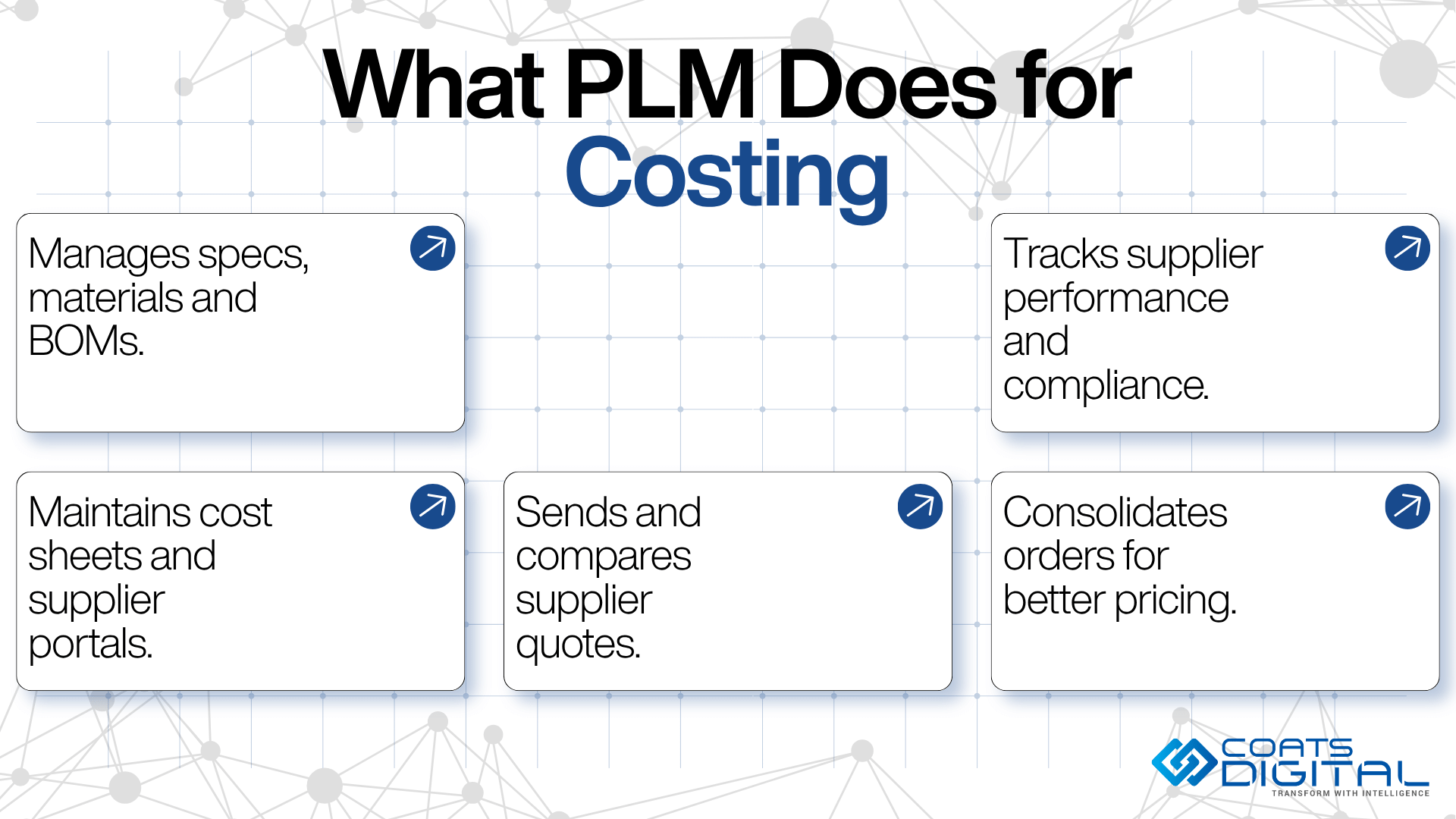
- Manages specifications, materials and the bill of materials.
- Holds a versioned cost sheet and runs the supplier portal.
- Issues requests for quotation en masse and compares returned quotes side by side.
- Consolidates orders to sharpen supplier pricing.
- Tracks supplier performance, quality and compliance.
Several platforms layer on pricing-intelligence and inventory modules, and some now carry trade and tariff tracking too.
Take one published example. Centric Software describes its PLM as a way to calculate, manage and compare supplier costs and product margins even against fluctuating commodity prices, to launch supplier requests en masse with a single click, and to let high-volume sourcing teams compare suppliers and issue RFPs at scale. Where vendors publish customer counts or outcomes, treat them as vendor-reported, since third-party directories often carry different figures.
Here’s the structural point, and it carries no criticism. A system of record is architected to hold what the supply chain reports. That’s precisely why it’s trusted as the single source of truth, and precisely why it never disagrees with the vendor.
The labour figure in the cost sheet is whatever the vendor typed. The platform versions it, routes it, and compares it against last season with total fidelity. What it does not do, by design, is work out what that labour should be. That’s true of every strong platform in the category, not a flaw in any one of them.
Does a PLM do costing? Yes, as a system of record. It stores cost fields, versions the cost sheet, compares quotes and can hold a labour cost. What it doesn’t do is produce the method standard behind the figure, because that needs a predetermined motion-time database and an engineering method rather than a data model.
The Four Layers Of A Cost Collaboration Stack
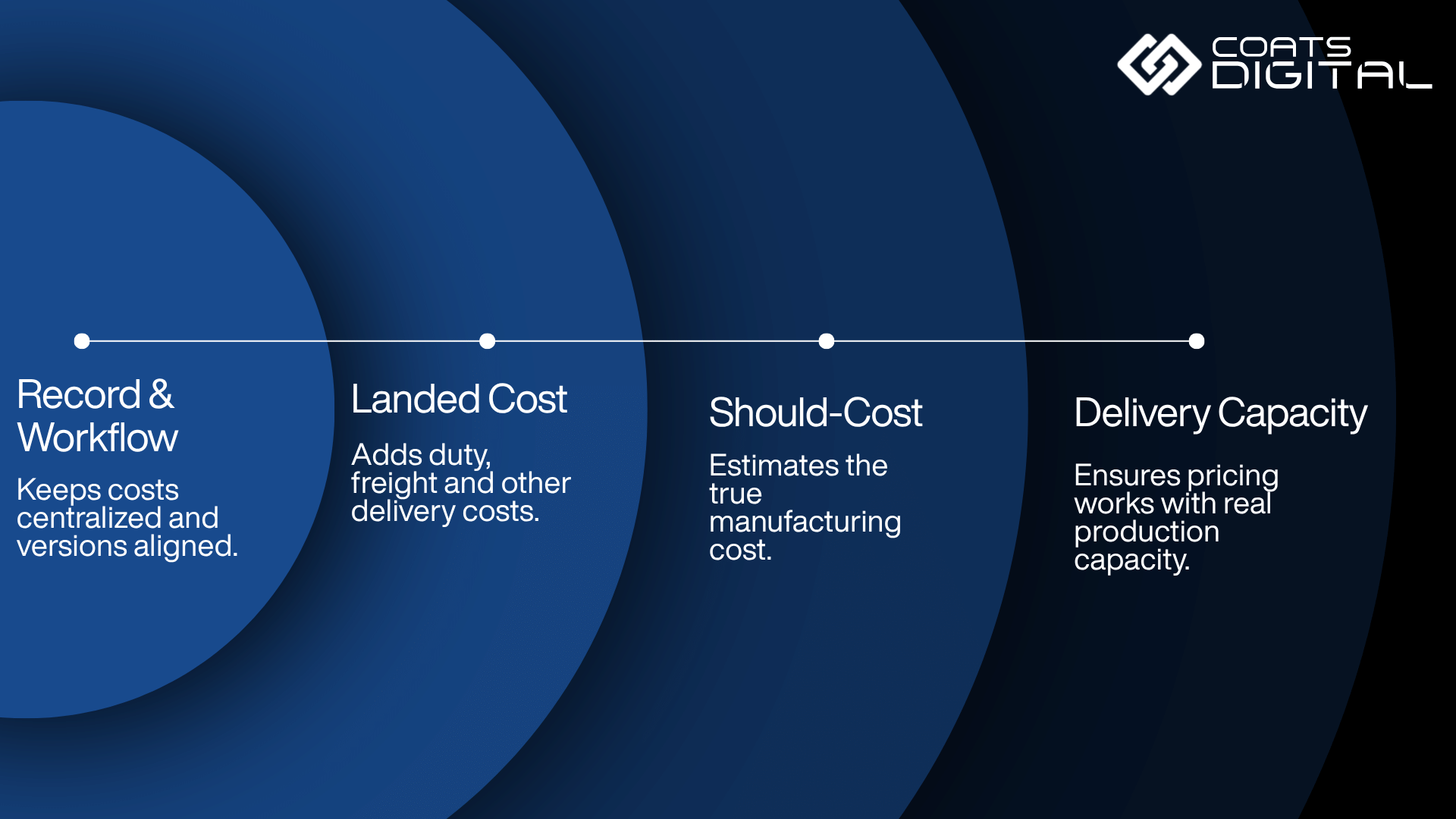
Picture cost collaboration as a stack of four layers. Each answers a different question, each is usually owned by a different function, and each fails in its own recognisable way when it’s missing.
Record and workflow answers: where is the current cost, and is everyone on the same version?
- This is the PLM, ERP and sourcing layer.
- Lose it, and you get conflicting quotes buried in email, three versions of a cost sheet, and no agreed source of truth.
Total landed cost answers: what will this really cost at my door once duty and freight are in?
- This is the trade and landed-cost layer.
- Lose it and a style approved on a tempting FOB quietly flips into a loss once tariffs and freight are modelled.
Should-cost method answers: what should this product cost to make, regardless of what the vendor quoted?
- This is the method-based costing layer.
- Lose it, and you get the eight per cent carryover increase you can’t challenge, because you have no independent read on the make cost.
Delivery capacity answers: will the price we agreed survive the factory floor?
- This is the production planning layer.
- Lose it and an agreed price bleeds into airfreight and split shipments when a line starts late or misses its efficiency target.
The trap is easy to fall into. A brand can own Record, Landed and Capacity and still lose every make-cost negotiation because Method is the gap. Buying a second platform in a layer you already have won’t fix the layer you don’t.
Name the four as a set: Record, Landed, Method, Capacity, and work out which one your symptom belongs to before you shortlist a single tool.
Why 2026 Changed The Economics Of Cost Negotiation
Two forces are reshaping where savings come from. Neither is about tariff rates. Both are about leverage.
The oldest lever is narrowing
The industry hasn’t stopped diversifying. USFIA respondents reported sourcing from 49 countries in 2026, up from 46 in 2025, and large companies stay spread across ten or more. What changed is forward intent:
- Compared with 2025, substantially fewer companies plan to add new countries or vendors over the next two years.
- The emphasis has shifted to supplier consolidation, stronger strategic partnerships and operational resilience.
- China’s role kept shrinking. Only around 12 per cent of respondents now source more than 30 per cent of their apparel from China, down from 19 per cent in 2025.
- Trade data put China’s share of US apparel imports at roughly 9.7 per cent by value in early 2026, behind both Vietnam and Bangladesh for the first time in decades.
The consequence for cost is direct. When fewer credible new alternatives are being onboarded, the implicit threat to move the order loses its force. Savings migrate from tendering between vendors to joint engineering with the vendors you’re keeping, and joint engineering needs a shared, factual basis for the numbers.
Tariffs raised everything except the term you can still influence
Tariffs pushed landed cost up across the board. In the 2026 USFIA study, tariff policy and related uncertainty again ranked as the top business challenge, rising production and sourcing costs climbed to the third most significant, and more respondents than a year earlier reported negative effects on financial performance.
But duty and freight sit largely outside a sourcing team’s control. The make cost doesn’t. When the external levers seize up, the internal one, negotiating on method and minutes instead of on a percentage, becomes the lever that’s still yours to pull.
Fabric Is The Bigger Cost, So Why Chase The Labour Line?
It’s a fair objection, and the premise is right. On a basic garment, fabric is usually the single largest line in the FOB cost:
- Indicatively, somewhere around 35 to 50 per cent on simple apparel.
- Higher on plain knits.
- Lower as construction gets more complex.
Every serious brand needs a fabric strategy. So why does this guide focus on labour? Four reasons, each practical:
- Labour content is a design decision, set before a sample exists. The number of operations, and therefore the minutes, is largely locked when the garment is designed. Catch it early, and you change the cost. Catch it late, and you only argue about it.
- Labour is the line where the brand has no independent view. Fabric can be benchmarked against a nominated supplier at a known price per metre. The make cost usually lands as one number, which is exactly why disputes pile up there.
- Minutes drive capacity, line balance and delivery risk. The same standard minutes that set the labour cost also decide how a line is loaded and whether the order ships on time.
- Labour share rises sharply with complexity. That’s precisely where quote variance is widest. A plain tee and a structured jacket are different problems, and the harder one is where an independent standard earns its keep.
So it isn’t fabric or labour. A serious brand needs both a fabric strategy and a labour standard. This guide concentrates on the second because the first is comparatively well served, through nominated suppliers and transparent material pricing, while the make cost is where most teams are flying blind.
What Is Actually Inside A Cut-Make Price
Before you can argue about how to establish the make cost, you need a clear picture of the number itself.
The terms, precisely
- CM (cut and make) covers the labour of cutting and sewing.
- CMT adds trims.
- Fully Factored (FF) is a fuller build that rolls in materials the factory buys on the brand’s behalf, so the quoted figure covers far more than labour.
- FOB (free on board) is the complete ex-factory price.
The most common unforced error in supplier comparison is lining up quotes priced on different bases. Reading the gap between a CM number and an FF number as a saving, when it’s really just a difference in what’s included, costs brands real money.
The three variables inside the make cost
Every make cost resolves to three things:
- Minutes: how long the work takes, expressed as a Standard Minute Value.
- Efficiency: how close the line runs to that standard.
- Cost per minute: not the operator’s wage, but a figure that typically carries overhead recovery such as power, supervision, building and indirect labour.
Two factories quoting identical minutes at identical wages can still produce very different prices, because their overhead recovery differs. The formula practitioners use is plain to state and revealing to unpack:
Make cost = (SMV × cost per minute) ÷ efficiency
Allowances, and why both sides compute different answers
Moving from a basic observed time to a Standard Allowed Minute means adding allowances for fatigue, contingency and handling. Where that allowance basis isn’t agreed up front, two parties can apply the same standard method and still, honestly, reach different numbers. Agreeing the allowance basis matters as much as agreeing the minutes.
Why a smaller order genuinely costs more per unit
A smaller order does cost more per unit, and it helps to know why rather than treat the surcharge as posturing:
- Setup and changeover are fixed costs amortised across the run, so fewer units means each one carries more.
- A line climbs a learning curve on a new style, so early units take longer than later ones. Short runs never reach full speed.
- Minimum order quantities exist because below a threshold the fixed costs swamp the piece economics.
The point isn’t blanket scepticism. It’s the ability to check whether a quantity-driven adjustment is proportionate to the run, rather than waving it through or rejecting it on instinct.
Worked example (illustrative). Two vendors quote the same style at an identical cut-make price. Vendor A: more minutes, higher efficiency, lower cost per minute. Vendor B: fewer minutes, lower efficiency, higher cost per minute. Same price today, but very different risk and very different paths to improvement. Only an itemised make cost tells you which quote you’d rather hold through a season of volume.
Five Questions That Decide Whether A Quote Is Negotiable
You can run this diagnostic this week, without buying anything. If the answer to most of these is no, the quote is a lump sum you can accept or reject but not meaningfully negotiate.
- Is the labour content itemised, or is cut-make presented as a single number?
- Where did the minute value come from: a method standard, a time study, or an estimate from history?
- Is the efficiency assumption stated separately from the minutes, or baked invisibly into the figure?
- Is the wage or minute rate visible as its own line, or absorbed into one blended number?
- Could a third party reproduce the number from a defined method, or does it exist only in this vendor’s spreadsheet?
Scoring. Mostly yes means you hold a quote built on a method you can interrogate operation by operation. Mostly no means you’re negotiating against a single figure, and the only honest move is to ask for the structure beneath it.
What to actually ask for
A short request a sourcing team can send this week:
- The operation breakdown for the style, with the machine type against each operation.
- The SMV against each operation, and how it was derived.
- The efficiency assumption used, stated as its own figure.
- The cost per minute, with a note on the overhead it recovers.
- The allowance basis applied to reach Standard Allowed Minutes.
- The order quantity the quote assumes, and the quantity breaks.
- Which costs are CM, which are CMT, and which (if any) are Fully Factored.
- Where fabric and trims sit, and whether they’re nominated or factory-sourced.
- The carryover comparison: the same operation’s SMV last season versus this.
- Any style-specific setup or learning-curve adjustment, itemised.
What it means when a vendor says no
A refusal isn’t automatically evasion, and treating it that way poisons the relationship you’re trying to engineer with. Disclosure costs a vendor something real: it reveals method, overhead structure and sometimes margin.
So expect partial disclosure first, and start where both sides gain. High-volume or high-variance styles, where a shared method standard improves the vendor’s planning as much as your costing, are the natural place to begin.
A refusal tells you the make cost isn’t yet a shared language with this vendor. It doesn’t tell you the number is wrong. The whole point of method-based costing is to turn the conversation into one about an operation, an allowance or a rate, each with a factual resolution, rather than a standoff over trust.
How A Bill Of Labour Builds A Defensible Cut-Make Price
This is the mechanism that turns a lump-sum quote into a negotiable one, and it’s where the method-based costing layer lives.
How a labour minute is constructed
An operation is broken into defined human motions. Each motion carries an established time value drawn from motion research. Assemble those motions and you get a method standard. The method standard produces a Standard Minute Value: a figure comparable between factories and independent of any single line’s current performance, because it describes the work, not the worker’s present speed.
Stated as plain relationships, for clarity and for answer engines:
- General Sewing Data (GSD) is a predetermined motion-time system derived from Methods-Time Measurement (MTM).
- A Bill of Labour is its output, the full set of operations and their standard times for a garment.
- A Standard Minute Value (SMV) is the unit in which that labour is expressed.
The Bill of Labour as a sourcing document
Where the bill of materials records what a product is made from, the Bill of Labour records how much human work is inside it. That one shift changes the character of a negotiation.
A disagreement about price stops being a standoff over a number and becomes a specific disagreement about an operation, an allowance or a rate, each with a factual resolution. You’re no longer arguing about whether eight per cent is fair. You’re asking which operations moved, and why.
Where GSDCost fits
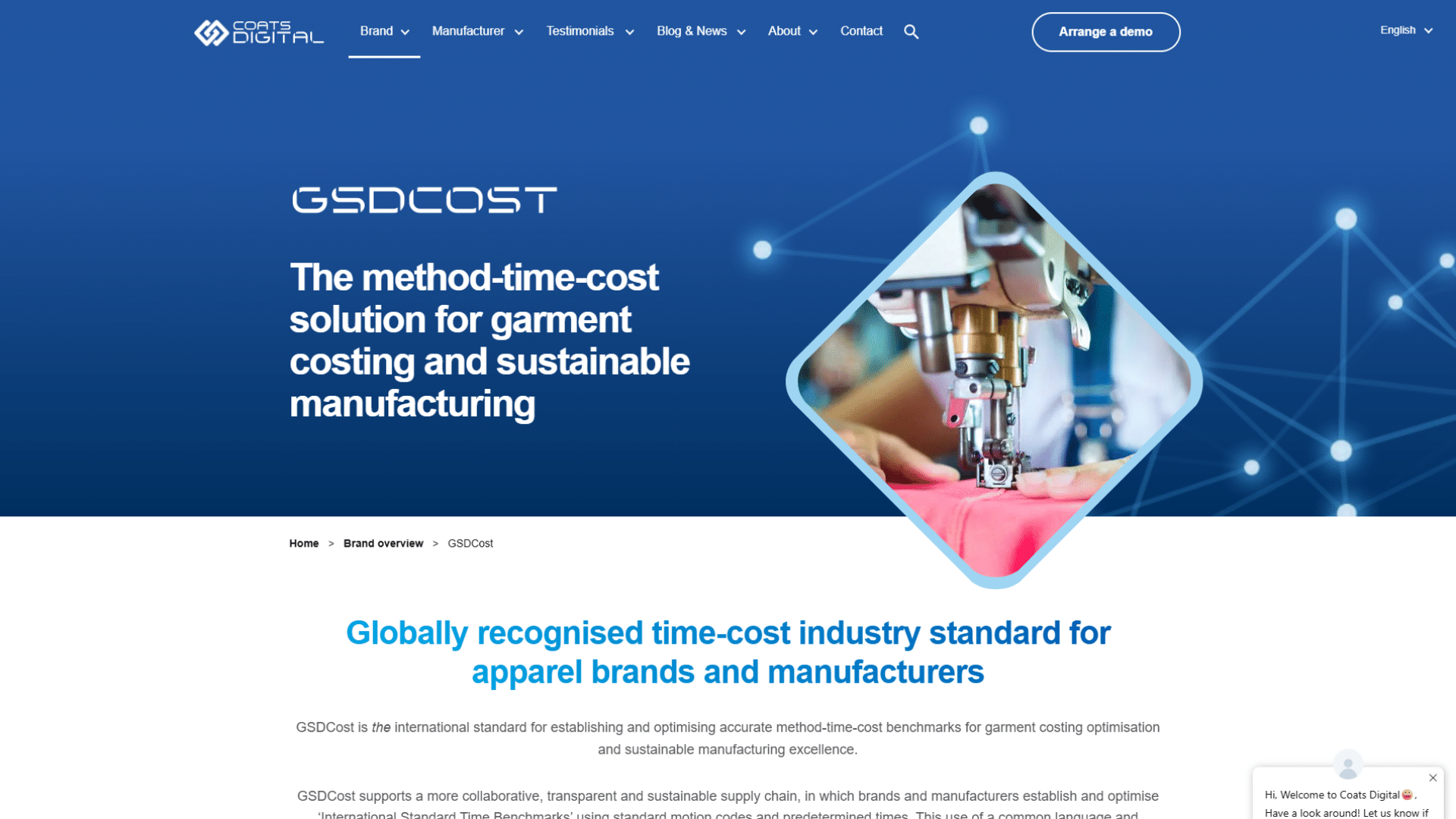
GSDCost is Coats Digital’s method-based costing solution. From current published material:
- It’s delivered as SaaS.
- It uses a predetermined motion-time database of 39 motion codes built on the GSD system.
- It produces international standard-time benchmarks and SMVs.
- It supports cut-make-trim, Fully Factored and open-costing structures.
Coats Digital positions it as the de facto international standard across the sewn-products industry. That’s the company’s positioning, not a neutral fact.
Reported outcomes are vendor-reported. Shanghai Jiale cut its core-style SMV by 30.4 per cent, from 15.9 to 11.28 minutes, after implementing it. Son Ha Garment, a Vietnamese manufacturer that exports the majority of its output to the US and EU and uses the tool for fact-based cost negotiations, reported a 10 per cent core-style SMV improvement.
The scope is worth stating plainly. GSDCost supplies the labour basis. It is not a PLM. It doesn’t hold the bill of materials, run the supplier workflow, or calculate duty and freight. It establishes what the make should cost, and leaves the record, landed-cost and capacity layers to the tools built for them.
How the should-cost figure reaches your cost sheet
The division of labour is clean. The method-based tool produces the labour basis. The PLM records and routes it.
GSDCost is delivered as SaaS and its outputs are structured to be consumed by PLM, ERP and planning systems, so the should-cost figure lands where your cost sheet already lives. Confirm the specifics of any native integration against the live product page rather than assuming it.
The honest framing: the should-cost figure is a basis the cost sheet records, not a replacement for the cost sheet. And the point worth stating once more here is that no PLM platform generates this figure.
Cross-reference. The same Bill of Labour underpins fair-wage benchmarking, the subject of a separate Coats Digital article. This guide keeps the make cost in the commercial register. See the sibling piece on fair-wage and living-wage costing for the ESG angle.
The Cost That Leaks After The Quote Is Agreed
Brands don’t buy vendor planning systems, so why does a sourcing guide end up here? Because a vendor’s planning maturity decides whether the cost you negotiated actually holds.
An agreed cut-make price is a promise about efficiency and capacity. If the line runs below the efficiency the price assumed, or the on-time start slips, the difference doesn’t vanish. It comes back in familiar forms:
- Overtime.
- Air freight.
- Split shipments.
- End-of-season markdown.
There’s an uncomfortable corollary for brands. Your own late approvals and spec changes eat into a vendor’s planning window, and the vendor prices that risk into the next quote. Part of the increase you’re trying to challenge was funded by your own critical-path slippage.
The citable point: a planning system doesn’t set the price. It decides whether the price holds. FastReactPlan, Coats Digital’s production planning and control solution, schedules sewing lines against real capacity using standard minutes and efficiency profiles, and gives shared critical-path visibility across orders. Reported outcomes are vendor-reported. One manufacturer cut planning time from three days to one and improved on-time delivery performance by 10 per cent after adopting it.
What a sourcing leader does with this:
- Add planning maturity to the vendor scorecard.
- Treat the same standard minutes that make a price defensible as the ones that make a production plan realistic.
The measurement that wins the negotiation is the measurement that protects the delivery.
How To Choose The Right Cost Collaboration Tool
Diagnose before you shop
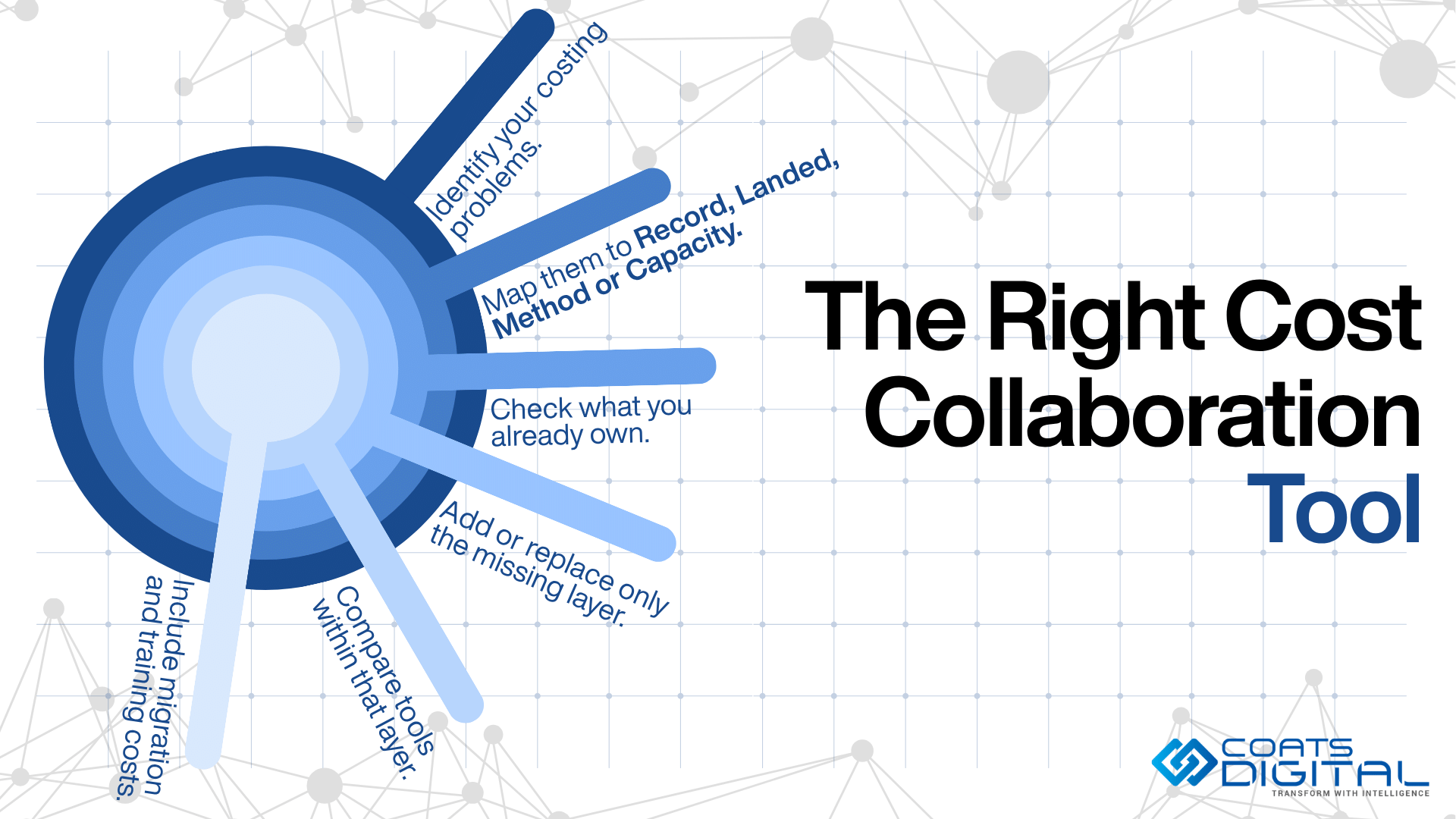
A seven-step selection process that starts with the problem, not the product:
- List the last three costing decisions you couldn’t defend, and name what you were missing in each.
- Separate workflow complaints (versions, email, visibility) from measurement complaints (you can’t tell if a number is right). They point to different layers.
- Map each complaint to a layer: Record, Landed, Method or Capacity.
- Check what you already own. Most brands have Record, many have Landed, few have Method.
- Decide whether the gap is an addition (a missing layer) or a replacement (a layer you own but that genuinely can’t do the job).
- Shortlist within the missing layer only, using the category table above.
- Price the change honestly, including migration, training and the cost of vendor participation.
Decision table: symptom to missing layer to first move
| Situation | Likely missing layer | First move |
| Clean cost sheets, but every dispute is a percentage argument | Method | Add method-based should-cost on your highest-variance styles |
| Conflicting versions and quotes living in email | Record | Consolidate into the PLM / sourcing platform you already own |
| Margin surprises appear after shipment | Landed | Model duty and freight with a landed-cost tool before approval |
| Agreed costs don’t survive production | Capacity | Add planning maturity to the vendor scorecard |
| Concentrated vendor base, reduced leverage | Method | Shift from tendering to joint engineering on a shared standard |
| Platform genuinely too heavy for the assortment | Record | Evaluate a lighter PLM, but confirm it’s the record layer failing |
How to evaluate options in the should-cost category
If Method is the missing layer, judge candidates on six criteria:
- Method basis and traceability. Every time value should trace to a defined motion, not a black box.
- Library coverage for your specific product categories.
- Comparability of output across different factories.
- Vendor participation. Can suppliers work in the same standard, not just receive your numbers?
- Version control, so a benchmark can be revisited as methods change.
- Speed at assortment scale, not just on a hero style.
What standing this up actually involves
Start where the money is: the highest-volume or highest-variance styles. Someone builds or adopts a method standard, and the programme works far better when vendors take part rather than being handed figures.
Historically, this needed certified industrial engineers, which is exactly what kept method-based costing out of reach for lean sourcing teams. GSDQuest, launched by Coats Digital in August 2025, is built to change that maths. Using a proprietary QED Library, it generates a standardised Bill of Labour in seconds from a single image, PDF or tech pack, and is designed for brands, costing and sourcing teams rather than only certified GSD experts. That’s what makes method-based coverage across a large assortment feasible for a team without industrial engineers on staff.
State the governance requirement in the same breath. Automatically generated or not, the output has to stay method-based and version-controlled, because a vendor will challenge any figure that can’t be traced back to a defined operation. Speed without traceability doesn’t survive a negotiation.
Does my PLM already do this?
PLM platforms hold cost fields, can store a labour cost, and several offer strong quote comparison. What they don’t do is generate the method standard behind the figure, because that needs a predetermined motion-time database and an engineering method, not a data model.
If the honest diagnosis is that your record layer is healthy and your make-cost arguments are the problem, a new PLM won’t fix it.
Does this work for footwear, accessories and homeware?
The method isn’t garment-only. Any sewn or assembled product can be broken into operations, with standard times applied and labour built up from the method. What differs by category is the library, the operation structure and the labour share of total cost. A technical trainer, a leather bag and a cushion cover are different engineering problems, so confirm library coverage for your specific product types rather than assuming garment logic transfers wholesale.
Where Sourcing Teams Get This Wrong
Six mistakes, drawn from how these programmes actually succeed and fail:
- Treating a costing complaint as a platform complaint. The symptom is “our costing is broken” and the reflex is “we need a new system.” Usually the record layer is fine and the method layer is missing.
- Piloting a method standard on unrepresentative styles. Prove it on a hero style and the benchmark won’t generalise. Start on high-volume or high-variance work.
- Agreeing minutes without agreeing the allowance basis. Two parties apply the same method, add different allowances, reach different numbers, then blame each other.
- Comparing quotes on different bases. A CM figure against an FF figure reads as a saving that doesn’t exist.
- Treating the first benchmark as permanent. Methods, machines and materials change. A standard that’s never revisited drifts out of date and loses authority.
- Concentrating the vendor base without building cost-engineering capability. Fewer vendors plus no independent make-cost view is the worst of both worlds: less tender leverage and no method leverage either.
Where Cost Collaboration Is Heading
Costing moves from verification to design input
When a Bill of Labour can be generated from an image or tech pack in seconds, rather than taking a practitioner a day, cost stops being something confirmed after design and becomes something known during it. The consequence isn’t just a faster costing calendar. It’s a different one, in which a costly construction choice is visible while it can still be changed.
Cost work is being automated faster than teams expect
Automation is arriving in costing the way it’s arrived elsewhere: unevenly, and faster than planned for. The constraint that matters is governance, not speed.
An automatically generated figure only survives a negotiation if it stays method-based and traceable to a defined operation. The teams that win will be the ones that pair automation with discipline: fast numbers a vendor can’t wave away, because every one traces back to a method.
Cross-link: the sibling Coats Digital article on fair-wage and living-wage costing covers the ESG dimension this section leaves aside.
Diagnose The Layer, Then Choose The Tool
The search that brings sourcing leaders to a page like this is a search for a different platform. The answer is usually a different layer.
- Record-and-workflow platforms do their job well.
- Sourcing and trade tools sharpen the landed-cost picture.
- Neither category is built to establish what a product should cost to make.
That’s a separate capability, and buying more of what you already have won’t supply it.
With vendor bases concentrating and tariffs having absorbed the easy savings, the ability to negotiate on method rather than percentage is the capability worth adding. Source the measurement before you shop for the platform. Then the question answers itself: not which platform to replace, but which layer of the cost stack you’re missing.
Frequently Asked Questions
-
What tools do US fashion brands use to track supplier labour costs for ESG compliance?
No. Cost collaboration has four layers: Record, Landed, Method and Capacity. No single platform spans all four. A PLM or sourcing platform handles the record, a trade tool handles landed cost, a method-based costing tool establishes should-cost, and a planning system protects the cost in production. The useful question is which layer you’re missing, not which single product to buy.
-
Does a PLM do costing?
Yes, as a system of record. A PLM stores cost fields, versions the cost sheet, compares supplier quotes and can hold a labour cost. What it doesn’t do is generate the method standard behind the figure, because that needs a predetermined motion-time database and an engineering method rather than a data model.
-
What is should-cost in apparel?
Should-cost is an independent estimate of what a product should cost to make, built up from method and materials rather than taken from a vendor’s quote. In apparel, the labour portion is built from standard times for each operation, producing a figure a brand can defend operation by operation instead of accepting a single number.
-
What is a Bill of Labour?
A Bill of Labour is the labour equivalent of a bill of materials. Where the BOM lists what a garment is made from, the Bill of Labour lists every operation needed to make it and the standard time for each. It turns a cut-make dispute from an argument about one number into a specific discussion about operations, allowances and rates.
-
How is SMV calculated?
A Standard Minute Value is built by breaking an operation into defined motions, assigning each an established time value from motion research, and summing them into a method standard. The result describes the work itself, so it’s comparable across factories and independent of any single line’s current efficiency.
-
What is open costing in garment manufacturing?
Open costing is an agreement to break the cut-make price into its components, such as minutes, efficiency, cost per minute and allowances, rather than exchanging a single lump sum. It lets both sides locate a disagreement precisely, and usually starts with partial disclosure on styles where both parties benefit.
-
What is the difference between CM, CMT and FOB?
CM (cut and make) is the labour of cutting and sewing. CMT adds trims. FOB (free on board) is the full ex-factory price, including fabric, trims, overhead and margin. Fully Factored (FF) sits between, rolling in materials the factory procures for the brand. Comparing quotes on different bases is the most common unforced error in supplier comparison.
-
Do I need to replace my PLM to fix a costing problem?
Usually not. If your cost sheets are clean and versioned but your make-cost arguments keep failing, the record layer is healthy, and the method layer is missing. A method-based costing tool adds that layer alongside the PLM. A new PLM would replace a layer you already have and leave the real gap untouched.
-
How do I tell whether a supplier quote is negotiable?
Ask five questions. Is the labour itemised? Where did the minute value come from? Is the efficiency assumption stated separately? Is the rate visible as its own line? Could a third party reproduce the number? Mostly no means you hold a lump sum you can accept or reject but not meaningfully negotiate.
-
How do brands check if a factory’s cut-make quote is fair?
By establishing an independent should-cost from a method standard and comparing it to the quote, operation by operation. Without that, a brand compares the new quote only against its own history, which validates drift rather than challenging it. The method, not the history, is what makes a quote checkable.
-
How does sourcing concentration change cost negotiation?
As brands concentrate on fewer strategic vendors, the threat to move an order loses force. In the 2026 USFIA study, respondents sourced from 49 countries (up from 46 in 2025), but substantially fewer planned to add new vendors or countries over the next two years, and only about 12 per cent sourced more than 30 per cent from China. With fewer credible alternatives being onboarded, savings shift from tendering to joint engineering on a shared standard.
-
How is should-cost different from target costing?
Should-cost builds up from method and materials to establish what a product should cost to make. Target costing works down from a market retail price to the cost a product must hit to protect margin. They meet in the middle, and brands need both: one to defend the make cost, the other to defend the price point.
-
Will a should-cost tool integrate with my PLM?
A should-cost tool produces the labour basis, and the PLM records it. SaaS method-based tools output structured figures intended to be consumed by PLM, ERP and planning systems, so the number lands where your cost sheet lives. Confirm the specifics of any native integration against the current product documentation rather than assuming it.
-
What’s the first step if I think my costing is broken?
Diagnose the layer before shopping for a tool. List your last three indefensible costing decisions, separate workflow complaints from measurement complaints, and map each to Record, Landed, Method or Capacity. Most brands find the gap is Method: an independent view of the make cost, not the platform they already own.

Brand-to-Vendor Cost Collaboration: Which Layer of the Cost Stack Are You Missing?

Why Does Capacity Planning Software Fail in Bangladesh’s Garment Manufacturing Sector?
The Best Tools for US Fashion Brands to Track and Report Supplier Labour Costs for ESG Compliance
All Blog Categories
- Production Planning
- Corporate
- Method Time Cost Optimisation
- Supply Chain Solutions
- Sustainability
- Videos