Why Do Many Small Garment Factories in India Still Depend on Manual Planning Instead of Production Planning Software?
by Coats Digital
 9
Mins Read
Key Takeaways
- Many small garment factories in India use manual planning instead of production planning software because, for years, it was the rational choice.
- Fit mattered more than price: most planning systems assumed an industrial engineering team and IT support that a 60-machine unit does not have.
- The labour cushion is thinning: Tiruppur exporters said in 2025 they needed 100,000 more workers, and trained operators often leave within months.
- Manual planning’s cost hides in overtime, airfreight and penalties; recent audits reviewed by Raymond Panko found errors in 91% of spreadsheets examined.
- “We tried software, and it failed” usually means a heavy ERP was bought to fix a floor-scheduling problem it was never built for.
- Switch on triggers, not headcount: overlapping buyers on shared lines, rising style complexity, or one planner holding the entire plan in their head.
- Madura Garments, an Indian shirt maker, cut delivery penalties from nearly US$ 1.3 million to under US$ 67,000 after moving off manual planning.
Why Small Garment Factories in India Use Manual Planning: The Short Answer
Many small garment factories in India still depend on manual planning for five rational reasons. Most planning software was built for large exporters with industrial engineering teams. Cheap, available labour made the payback weak. Thin margins and costly capital made upfront spend hard to sign off. Few units have in-house IT. And owners trust a spreadsheet they control. Each of those reasons is now weakening.
What is manual planning?
In a garment factory, manual planning is a working system held together by people: Excel or Google Sheets kept by each merchandiser, Time and Action (T&A) registers and whiteboards, WhatsApp updates from the floor, and the production head’s memory acting as the real scheduling engine. None of these parts are connected to the others.
Is Your Factory Behind If It Still Plans by Hand?
It is 8.30 in the morning. The plan lives on a whiteboard and in three spreadsheets, and the production head is rebuilding it from yesterday’s output before the line review. Overnight, a buyer pulled a delivery forward by a week. Two lines are now booked for the same slot, and nobody will notice until one order’s cartons are not ready at dispatch.
Most owners and operations heads already know manual planning has limits. The more useful questions are why so many units like theirs still work this way, and whether staying put now costs more than changing.
If your factory plans by hand, you are in the majority. Nearly 80% of India’s textile and apparel capacity sits in micro, small and medium enterprise (MSME) clusters, according to the Ministry of Commerce’s 2025 sector review. In the Ministry of Statistics’ Annual Survey of Unincorporated Sector Enterprises (ASUSE) 2023–24, making wearing apparel accounted for about 12% of India’s 7.34 crore (73.4 million) unincorporated non-farm establishments, second only to retail trade. Across all of those establishments, only about 27% reported using the internet.
So the honest benchmark is not “everyone else has software”. It is whether your floor has hit the point where manual planning breaks. That point is a trigger, not a date on the calendar.
This guide covers why manual planning held on, what it quietly costs, how a spreadsheet, an ERP, and a dedicated planning tool differ, which triggers mean you have outgrown manual methods, and why buying software sometimes fails anyway. If you already know you need a tool and want to compare options, our guide to which production planning tools fit your segment covers that ground.
What Does Manual Planning Look Like on an Indian Garment Floor?

“Manual” does not mean primitive or careless. In most small units, it is a functioning system, run by experienced people who know their lines, their operators, and their buyers well. Describing it precisely matters, because the way it is built explains exactly where it breaks.
The tools of manual planning
A typical small or mid-sized unit in Tiruppur, Noida, Ludhiana or Bengaluru plans with some combination of these:
- A whiteboard or T&A register showing which style is on which line and when key events (fabric in-house, approvals, cutting, sewing start, ex-factory) are due
- One master Excel or Google Sheet per merchandiser, often with its own formulas and colour codes
- WhatsApp groups where supervisors post hourly or daily output, problems and photos
- Printed cutting plans and line-loading sheets that travel around the floor
- The production head’s memory, which quietly does the real scheduling: which operators can handle a new collar, which line struggles with stripes, which buyer always changes quantities late
Each tool works on its own. None of them talk to the others, so every update has to be carried between them by a person.
Why manual planning works, until it doesn’t
Manual planning works well for a unit with one or two buyers, a low style count and a single process flow, because one experienced planner can hold every dependency in their head. It is flexible, costs nothing in licences, and everyone understands it.
The problem is not sudden incompetence. The same system simply does not scale with the number of buyers, styles and processes. Every new buyer adds a calendar of approvals. Every new style adds operations, a learning curve, and a fresh set of material dates. Every outside process (washing, printing, embroidery) adds a dependency the sewing plan cannot see. At some point the planner stops planning and spends the day reconciling.
The manual planning stack: what each tool does well, and where it quietly fails
| Tool | What it does well | Where it quietly fails |
| Whiteboard or T&A register | Visible to the whole floor at a glance | Cannot be shared off-site, keeps no history, wiped clean by the next update |
| Per-merchandiser spreadsheet | Flexible, familiar, no licence fee | Drifts away from what the floor is doing; formula errors and file versions multiply |
| WhatsApp floor updates | Fast and real-time | No single source of truth and no audit trail; key messages get buried |
| Printed cutting and line-loading sheets | Easy for supervisors to follow | Out of date as soon as a buyer changes quantities or dates |
| The planner’s memory | Fast, expert judgement on people and lines | A single point of failure that walks out of the door on leave or resignation |
The Five Real Reasons Manual Planning Persists in Indian Garment Factories
The easy explanation is that owners resist change. The evidence points somewhere else. Manual planning survived because a set of real constraints made it the sensible choice, and the interesting story is which of those constraints are now dissolving.
1. The software was built for the wrong user
This is the decisive reason. Much of the planning and ERP software sold to apparel manufacturers was designed around large, multi-factory exporters: businesses with an industrial engineering (IE) department, an IT team, and a dedicated planning cell. In a small unit, the person who plans is usually a merchandiser, a production manager, or the owner. A tool that expects clean standard minute values (SMVs), efficiency curves, and a maintained line master is hard to run without someone whose job is to keep that data alive.
So the pattern repeats. Implementation stalls, the floor keeps working from its own sheets, and within months the system holds a copy of the plan that nobody trusts. Coats Digital’s analysis of why capacity planning software fails in garment factories names low adoption and “shadow spreadsheets” among the most common causes.
Academic work points the same way. A study of Industry 4.0 adoption in India’s textile and clothing sector by Majumdar, Garg and Jain (2021), based on a survey of 40 industry experts, found that a lack of trained staff and weak understanding and commitment from top management drove the other barriers. High implementation cost came out as a consequence of those barriers, not the root cause. This is a fit problem, not an intelligence problem.
2. Cheap, available labour made the payback weak
For years, when an order spiked, a factory added a second shift, borrowed operators from another line or sent cut panels to a nearby job-worker. Labour flexed so the plan didn’t have to. Against that option, a planning system looked like an expense with an uncertain return.
That cushion is thinning. In Reuters reporting from Tiruppur in 2025, the local exporters’ association said the cluster needed at least 100,000 more workers, and exporters described trained operators leaving within months for smaller units that offer longer hours and higher pay. The same report noted that India’s Apparel Export Promotion Council puts a typical Indian garment factory at 600 to 800 workers, against at least 1,200 in Bangladesh, so Indian units have less slack to absorb shocks.
Shocks run in both directions. When US tariffs on Indian goods rose to 50% in August 2025, buyers paused orders and asked exporters to share the cost. Whether hands are scarce or orders are suddenly reshuffled, the old reflex of “add more people” stops working, and the speed at which a factory can replan becomes the scarce resource.
3. The payback is real but invisible on the P&L
Garment manufacturing runs on thin margins, and for an MSME, borrowing to fund software is rarely cheap. That makes any upfront spend with an uncertain return hard to approve.
The specific trap is how the return shows up. A better plan pays back as overtime that was never worked, airfreight that was never booked, a penalty that was never charged, and planner hours that were never spent rebuilding the schedule. Avoided costs do not appear as a line in the profit and loss (P&L) statement, so they are invisible to the person signing the cheque. The licence fee, on the other hand, is very visible.
4. No one to run it, and a genuine skills gap
Small units rarely have in-house IT, and older planning tools often assumed on-premise servers, a system administrator, and someone to configure masters and integrations. Beyond IT, there is a skills gap: a good planner needs to understand both the floor (line balancing, learning curves, changeovers) and the data. That combination is scarce in any cluster.
This barrier is the one shrinking fastest. Cloud delivery and simpler, more visual interfaces have reduced the setup and maintenance burden, which matters most to exactly the factories that could never staff an IT team.
5. The owner trusts the spreadsheet because they built it
Manual planning is legible. The owner can open the sheet, see the plan and change it directly, with no vendor and no training. That sense of control is valuable, and it is also where risk hides.
Research on spreadsheet errors shows people are consistently overconfident about their own files. In an experiment summarised by Raymond Panko of the University of Hawai‘i, spreadsheet developers estimated, on average, an 18% chance that their spreadsheet contained an error. In fact, 86% of them had made one. When the risk feels small, the incentive to replace the tool stays small too.
Manual planning persisted in India’s garment sector for five rational reasons, and each one is now weakening.
| Reasons manual planning persists | Why it made sense | What is changing now |
| Software built for the wrong user | Heavy systems assumed an IE team, and IT staff a small floor does not have | Dedicated planning tools and cloud delivery built for planners, not IT departments |
| Cheap, available labour | Adding operators or subcontracting was cheaper than changing how you plan | Labour churn and order volatility make replanning speed the bottleneck |
| Invisible payback, thin margins | Returns show up as costs avoided, which never appear in the accounts | Delivery penalties, buyer discounts and airfreight bills put a visible price on slippage |
| No one to run it | No in-house IT and no trained planner | Cloud delivery removes servers and cuts maintenance |
| Trust in the owner’s spreadsheet | Legible, controllable and familiar | Style and buyer complexity outgrow what one person can track |
What Does Manual Planning Really Cost a Garment Factory?
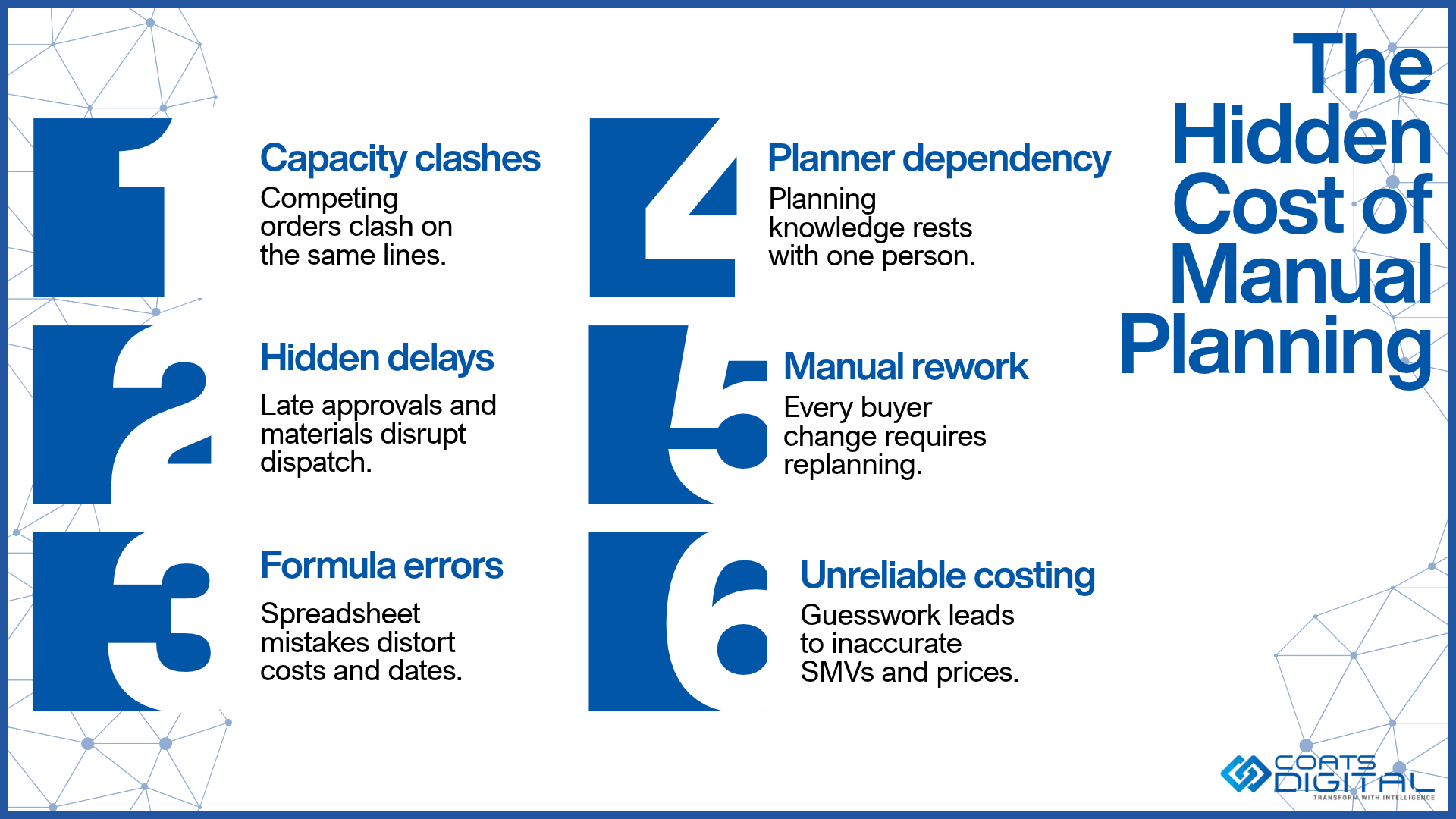
The case for changing is not that software is fashionable. It is that manual planning carries a running cost that never shows up as a single line in the accounts, which makes it easy to ignore and expensive to keep. Call it the hidden bill.
Most of it sits in six places:
- Capacity promised twice. Two merchandisers book the same line for the same fortnight. Nobody sees the clash until sewing, and the fix is overtime, a rushed subcontract or airfreight.
- Slippage you cannot see. A late trim approval or a delayed wash lot stays invisible in a disconnected T&A sheet until it surfaces at dispatch, when the only remaining options are expensive.
- Silent formula errors. A broken cell reference in a capacity or costing sheet does not announce itself. It quietly moves a ship date or understates a cost.
- One person holding the plan. When the planner takes leave or resigns, the logic behind the plan leaves too, because it was never written into a system.
- Planner-days spent rebuilding. Every buyer change (a quantity revision, a pulled-forward date, a new colourway) means rebuilding the plan by hand instead of improving it.
- Costings built on guesswork. If standard minutes come from stopwatch estimates or last season’s numbers, the plan and the price both rest on figures nobody can defend when a buyer challenges them.
What the research says about spreadsheet reliability: In field audits of real business spreadsheets conducted from 1997 onwards and summarised by Raymond Panko, 91% of the 54 spreadsheets examined contained errors. These were general business files, not garment production plans, so the figure is not a garment-industry statistic. The mechanism carries over, though, and so does the overconfidence described above. On a factory floor, a hidden error in the plan is not a typo. It is a ship date.
ERP vs Production Planning Software vs Spreadsheets: Which Tool Does Which Job?
A spreadsheet, an apparel ERP, and a dedicated production planning tool do not compete for the same job. Treating them as interchangeable is one of the most common reasons “we tried software” ends in “software doesn’t work for us”. Here is the distinction, only as far as this decision needs it.
The spreadsheet
A spreadsheet is flexible, free at the point of use, and understood by everyone. It has no built-in idea of a critical path, of capacity that changes when an order moves, or of line-level scheduling. Every dependency between cutting, sewing, washing and dispatch has to be maintained by hand, by the person who built the file.
Apparel ERP
An apparel Enterprise Resource Planning (ERP) system runs the business: orders, purchasing, inventory, finance, GST and compliance. It plans at the level of orders and materials, and tends to assume capacity rather than schedule it line by line. That makes it the right backbone and the wrong tool for detailed floor scheduling on its own.
The gap is not new. When Chennai knitwear exporter White House went looking for a planning tool in the mid-2000s, the problem it described was its own in-house ERP, which was “not dynamic enough to respond quickly to changes”.
Dedicated production planning and control (PPC)
Production planning and control (PPC) software schedules work against real capacity, line by line, and recalculates when anything changes. A tool in this category does one job well: it shows capacity versus load on every line, which order runs where and when, and what will be late if nothing changes. Dedicated production planning and control tools such as FastReactPlan combine capacity, the pre-production critical path and material requirements on one visual planning board, with colour-coded alerts for late events and drag-and-drop scheduling that can include bottleneck processes such as embroidery and printing. They sit alongside an ERP rather than replacing it, and exchange order and production data with it. For a closer look at how that connection works in practice, see our guide to ERP integration in Indian garment factories.
| Category | What it does best | Where it falls short for a small unit | Typical fit |
| Spreadsheet | Fast, flexible, no licence cost | No live capacity, no critical path, error-prone as complexity grows | One or two buyers, low style count, one experienced planner |
| Apparel ERP | Orders, materials, finance, GST, compliance | Assumes capacity rather than scheduling lines; heavy to implement for floor planning alone | Growing units that need business control and statutory records |
| Dedicated PPC tool | Line-level scheduling, dynamic capacity, T&A alerts | Needs a named owner and reasonably accurate standard minutes | Multi-buyer units where lines are shared, and dates overlap |
When Does a Garment Factory Need Production Planning Software? Watch the Triggers
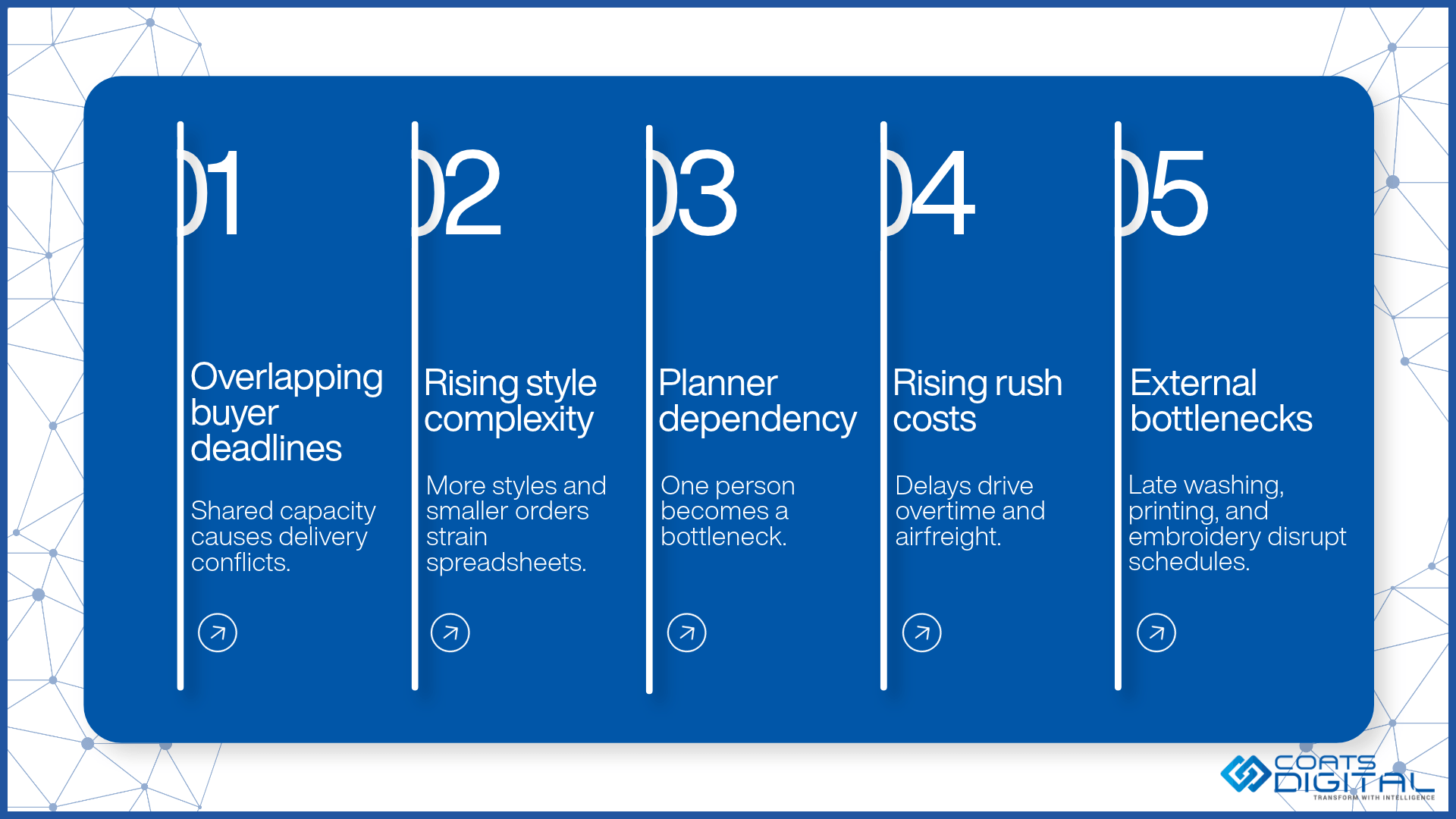
The wrong question is “how many machines before I need software?”. A 300-machine unit making basics for one buyer can often plan comfortably on paper, while an 80-machine unit juggling five buyers and three wash recipes cannot. The right question is: what has changed on my floor that my spreadsheet can no longer hold?
You have outgrown manual planning when:
- Buyers’ delivery windows overlap on the same lines. Once two or three buyers compete for shared capacity, every change to one order ripples into the others, and the planner can no longer see the knock-on effects in time. This is where on-time delivery across multiple buyers starts to slip.
- Style complexity is climbing. More styles, smaller orders, and higher work content multiply the dependencies a planner must track. Coats Digital’s SMV guidance for Indian MSMEs treats roughly 20 operations per style as the point where spreadsheet-based standard-minute methods start to strain. Treat that as a working rule of thumb, not a hard law.
- The planner has become a single point of failure. If one person’s leave would stall the factory, or if they spend more time rebuilding the plan than improving it, the system has hit its limit.
- Overtime and airfreight keep tracing back to surprises. When recurring rush costs come from slippage nobody saw coming, the problem is visibility, not effort.
- Outside processes have become the bottleneck. Washing, printing, and embroidery add lead time the sewing plan cannot see, so orders look on track until they come back late from the vendor.
Quick self-check: six habits that keep factories stuck
- Running the whole plan out of one head and one master sheet
- Treating the spreadsheet as free while it consumes planner-days every week
- Buying a heavy ERP to fix what is really a scheduling problem
- Waiting for a headcount or turnover milestone instead of watching the triggers
- Managing to a single factory-wide efficiency average that hides the real constraint
- Absorbing every spike with more hands instead of planning capacity
If three or more of these sound familiar, the hidden bill described above is probably already larger than you think.
What fits your factory now?
| Your situation | What fits now | Where to start |
| One or two buyers, low style count, one process flow | A disciplined spreadsheet is still fine | Planning discipline: one plan, one owner, a real T&A calendar |
| Growing multi-buyer unit hitting two or more triggers | A dedicated planning tool, cloud-first to keep IT overhead low | Accurate standards, then line-level planning on shared lines |
| Larger unit adding finance, compliance and material complexity | An ERP backbone plus a dedicated planning layer | Integration between the two, with planning owned by planners |
The cheapest first step costs nothing
Before buying anything, put three things in place. They remove a large share of the pain on their own, and they are the honest precondition for any tool working later.
- A single source of truth. One plan, one named owner, one current version. Merchandisers feed it; they do not keep rival copies.
- A real critical path. A T&A calendar with dates for every pre-production event, reviewed daily, even if it lives on paper or in one shared sheet.
- Accurate work standards. Replace stopwatch guesses and last season’s numbers with measured or predetermined standard minutes, the approach behind tools such as GSDCost. A plan is only as good as the minutes it is built on.
Does Moving Off Manual Planning Actually Improve Delivery Performance?

In the published cases, yes: factories that moved from manual planning to a dedicated tool report fewer delivery penalties, better on-time delivery, and far less time spent building plans. Most of those cases come from larger factories, though, so read them as evidence of the mechanism rather than a forecast for your unit.
The metrics worth tracking before and after any change are On-Time Delivery Performance (OTDP), On-Time In-Full (OTIF), delivery-penalty cost, time spent creating and updating plans, capacity utilisation, order-confirmation speed, and the overtime and airfreight bill.
An Indian case: Madura Garments
Madura Garments Exports, the shirt-making export arm of the Aditya Birla Group, is the clearest Indian example because its trigger story matches this article almost exactly. As it shifted from US to European customers and moved further into casual shirts and ladieswear, it faced shorter lead times, more styles in smaller orders, higher work content and more value-added processes such as printing, embroidery and washing. In the company’s words, its “manual planning systems could simply not cope with this complexity.”
After moving to a dedicated planning system from Fast React (now part of Coats Digital), Madura reported that delivery penalties fell from nearly US$ 1.3 million in 2009 to under US$ 67,000. Its OTIF ratio rose from 35% in 2009 to nearly 85% in 2011, and shirt output grew 34.5% on 25.5% more machines and labour, a 7.1% gain in operational efficiency over two years. These figures are around 15 years old and come from a large exporter, so treat them as an illustration of what removing planning chaos can do, not as a typical result.
More recent cases from South Asia
Newer announcements describe the same starting point: plans spread across disconnected files.
- White House (India). The Chennai knitwear manufacturer, with about 4,000 employees and 1,800 sewing machines, previously planned with Excel sheets, emails, and information spread across locations. In October 2026, it reported a 60–80% cut in the time needed to create, review, and update plans.
- Humana Apparels (Bangladesh). After replacing disconnected Excel files and manual reporting, the company reported a 15% improvement in capacity utilisation, 8% higher productivity, and roughly 5% better OTDP in 2026.
- South Asia Textiles (Sri Lanka). This knit fabric mill, not a garment factory, cut average machine idle time from 380 hours to 100 and capacity planning time from eight hours to two, with OTDP up 15%.
| Manufacturer | Segment and location | How it was planned before | Reported result |
| Madura Garments | Shirts, India (2009–2011) | Manual planning | Penalties nearly US1.3m→underUS67k; OTIF 35% → nearly 85%; +7.1% efficiency in two years |
| White House | Vertically integrated knitwear, India (2026) | Excel, email, information across sites | 60–80% less time to create and update plans; OTDP improved (no figure published) |
| Humana Apparels | Garments, Bangladesh (2026) | Disconnected Excel files and manual reports | Capacity utilisation +15%; productivity +8%; OTDP about +5% |
| South Asia Textiles | Knit fabric mill, Sri Lanka (2023–24) | Planning data siloed across departments | Machine idle time −74%; planning time −75%; OTDP +15% |
| FastReactPlan users overall | Apparel and footwear, 2,000+ factories worldwide | Varies | Vendor-stated typical range: productivity +3–10%, OTDP +10–30%, lead time −10–30%, ROI under 12 months |
How to read these numbers: every figure above is reported by the vendor or its customers and has not been independently audited. No single customer’s result is a benchmark, which is why the portfolio range is the fairer guide to what is typical. Most of these companies are also much larger than a 60-machine unit. A small factory’s gain depends on two things: whether it has genuinely hit the triggers, and whether its standards are accurate enough for any plan to be trusted.
“We Tried Software, and It Didn’t Help”: Why Planning Tools Fail in Small Factories
If an earlier software purchase disappointed, the tool was often not the main problem. Planning software makes your existing process visible; it does not repair a weak one. Without accurate standards, a maintained critical path, and a single source of truth, a new system simply shows the mess faster, and at a higher price.
Software reveals your process; it does not replace it
If planning discipline is weak, the software will display weak planning in colour. If standard minutes are estimates, the plan will be built on estimates, and the line will miss it on day one. Factories that get value from planning tools tend to put methods and discipline in place first, then use the tool to enforce and scale them.
That is why method-time standards matter before a planning layer. It is also why Humana Apparels, one of the recent cases above, implemented its planning tool alongside GSDCost, linking costing, capacity and execution rather than digitising the plan alone.
The abandonment autopsy
The classic failure is a category error. A small unit buys a heavy ERP to solve a floor-scheduling problem. The floor cannot use it for daily line plans, the merchandisers go back to their sheets, and management concludes that “software doesn’t work for us”.
The other failure patterns are just as familiar: plans built on stale standard minutes, plans that assume theoretical full capacity and ignore absenteeism and learning curves, plans that model only sewing while the wash house is the real bottleneck, and projects run as an IT installation rather than a change in how the factory plans. The lesson is to match the tool to the pain, not to the feature list, and to fix the inputs first. It is not to give up on software.
Are you ready to adopt planning software? Check these five conditions first:
- One plan with one named owner, not a sheet per merchandiser
- A real T&A calendar or critical path, maintained daily
- Work standards that are measured or predetermined, not guessed
- A named person who will run the tool every day, with time set aside to do it
- A specific pain the tool is bought to solve, such as overlapping buyers, a wash or finishing bottleneck, or penalty exposure
The Question Is No Longer “Why Manual?” but “For How Much Longer?”
Small garment factories in India stayed on manual planning for good reasons: software that did not fit their floors, labour that could absorb every spike, thin margins, scarce IT, and a spreadsheet the owner controls. They were not wrong to. But each of those reasons is weakening, so the honest question has moved from “why are we still manual?” to “how much longer does manual still make sense for us?”.
The practical path is the same for most units. Build planning discipline first. Match the tool category to the actual pain rather than to a feature list. Then switch when the triggers fire, not when a headcount is reached, so that OTDP, capacity, and margin improve together instead of being rescued with overtime.
Where to go next:
- Run the trigger self-check above with your planner and one merchandiser in the room. It is the honest starting point.
- If your standards are the weak link, start with how to calculate SMV in Indian garment factories.
- If you are ready to compare tools, see a planning-tool shortlist for Indian denim manufacturers, or how Bangladesh garment factories approach the same decision.
When your spreadsheet stops holding the plan, see what a planning tool built for the floor, not the boardroom, looks like.
Frequently Asked Questions
-
Why do small garment factories in India still use manual planning instead of production planning software?
Because for most of the past two decades, manual planning was the sensible choice. Most production planning software was designed for large exporters with industrial engineering and IT teams. Cheap labour could absorb order spikes. The payback showed up as avoided costs rather than visible savings. Few MSME units had IT staff, and owners trusted spreadsheets they had built themselves. Each of those conditions is now weakening.
-
Is manual production planning bad for a small garment factory?
Not by default. A unit with one or two buyers, a low style count, and a single process flow can plan well on a disciplined spreadsheet run by an experienced planner. Manual planning becomes a problem when buyers share lines, styles get more complex, or outside processes add dependencies. Then clashes stay hidden until dispatch, which is when they are most expensive to fix.
-
Why do garment factories still use Excel for production planning?
Excel is familiar, flexible, already paid for, and fully under the owner’s control. Those are real advantages. The weakness is reliability as complexity grows. In field audits summarised by researcher Raymond Panko, around nine in ten operational spreadsheets contained errors, and the people who built them consistently underestimated the risk. In a garment factory, a hidden formula error can quietly move a ship date.
-
How much does manual planning cost a garment factory?
There is no single figure, because the cost is spread across budget lines that never say “planning”: overtime, airfreight, buyer penalties and discounts, idle lines waiting for material, and planner-days spent rebuilding schedules. To estimate yours, tag last year’s rush costs to their root cause. The share caused by planning surprises is your hidden bill, and it is also the core of any business case for software.
-
When does a garment factory need production planning software?
When a trigger fires, not when the factory reaches a certain size. Common triggers are several buyers’ delivery windows overlapping on shared lines, styles with more operations and smaller orders, washing or printing becoming the bottleneck, a planner who has become a single point of failure, and recurring overtime or airfreight caused by slippage nobody saw coming. Two or more of these are a strong signal.
-
How can a garment factory improve production planning without software?
Start with three free disciplines. Keep one plan with one named owner and one current version. Maintain a real T&A calendar for every order, even on paper. Replace stopwatch guesses with measured or predetermined standard minute values (SMVs). These steps cut much of the daily firefighting on their own, and they are the precondition for any planning tool to work later.
-
Why does ERP or planning software fail in small garment factories?
Most failures are either a category error or a data problem. A heavy ERP bought to do floor scheduling cannot plan lines day to day, so merchandisers drift back to their sheets. Planning tools also fail on stale standard minutes, an unmaintained critical path, or no single owner. Choose a tool supervisors can actually use, test it on your own styles and lines, and name one person to run it daily.
-
What is production planning and control (PPC) in a garment factory?
Production planning and control (PPC) decides which order runs on which line, when and at what expected efficiency, then tracks actual progress against that plan. It covers capacity loading, the pre-production critical path (approvals, fabric and trims), material availability and line scheduling. Dedicated PPC software automates this work and recalculates the plan when orders, efficiencies, or material dates change, working alongside the ERP rather than inside it.
-
How much can production planning software improve OTDP and lead times?
On-Time Delivery Performance (OTDP) is the share of orders shipped on or before the agreed date. Coats Digital states typical FastReactPlan results of 10–30% better OTDP, 10–30% shorter lead times, and 3–10% higher productivity, with return on investment usually within 12 months. These are vendor-reported ranges, drawn mostly from larger factories. A small unit’s result depends on its triggers and the accuracy of its standard minutes.
-
Is there a government subsidy for production planning software in India?
Do not build your plan around one. The Ministry of Textiles’ main modernisation subsidy, the Amended Technology Upgradation Fund Scheme (ATUFS), supported investment in benchmarked machinery rather than software and ran only until March 2022. The Ministry of MSME and state governments offer digitalisation support from time to time, so check current eligibility directly, but make sure the business case works without a subsidy.



All Blog Categories
- Production Planning
- Corporate
- Method Time Cost Optimisation
- Supply Chain Solutions
- Sustainability
- Videos
