Production Planning Software for Large Garment Factories in Bangladesh (5,000+ Workers)
by Coats Digital
 8
Mins Read
Key Takeaways
- Production planning software for large garment factories in Bangladesh should prove three things: whole-floor replanning, dated references at your size, and local implementation support.
- Bangladesh’s National Industrial Policy 2022 classifies a garment factory as “large” above 1,000 workers. A 5,000-worker unit is five times that threshold.
- Published Bangladesh ratios of 86 to 167 people per line put a 5,000-worker garment factory at roughly 30 to 60 sewing lines.
- Most groups above 5,000 workers keep the ERP as the system of record and run a dedicated scheduler beside it, as Tusuka does.
- Grade vendor evidence in four steps: announced, live, measured, comparable. A launch press release only proves a contract was signed.
- Tusuka, Epyllion, Azim Group and Panam Group have published measured FastReactPlan results. All figures are customer-reported and vendor-published, not independently audited.
- Before signing, make each vendor replan your own peak month after a four-day fabric delay, and time how long it takes.
Past 5,000 workers, a spreadsheet plan rarely crashes. It drifts a little further from the floor each day.
Take a typical Monday in a Gazipur composite. One buyer’s fabric arrives four days late. The lines booked for it must be reloaded, and two other buyers’ Time and Action (T&A) dates move with them. The planner rebuilds the week in Excel while merchandising is already promising a ship date.
Production planning software for large garment factories has to close that gap between the plan and the floor. This guide shows which tools have done it in Bangladesh, how to grade the evidence, and how to test a vendor on your own data before you sign.
Disclosure: Coats Digital, which publishes this guide, makes FastReactPlan. Every customer result below is customer-reported and vendor-published, so we link to each source and show you how to check it yourself.
Which Production Planning Software Do Bangladesh’s 5,000+ Worker Garment Factories Use?
Most Bangladesh garment groups above 5,000 workers run two systems. An Enterprise Resource Planning (ERP) system holds orders, purchasing, and finance. A dedicated planning engine beside it schedules lines, materials, and the critical path.
In our review of public evidence, Coats Digital’s FastReactPlan had the most measured Bangladesh references at this size: Tusuka, Epyllion, Azim Group and Panam Group. This finding is based on published sources only and does not cover every product on the market.
Why planning speed matters more in 2026
Buyers are consolidating. The 2026 USFIA Fashion Industry Benchmarking Study surveyed 30 US fashion companies between April and June 2026. Only 21% plan to source from more countries through 2027 (down from 59% in 2025), and only 26% plan to add suppliers (down from 41%), as FashionUnited reported.
Bangladesh sits on both sides of that shift. Its utilisation rate among surveyed firms fell to 78.9% from 88.2%, yet 46.7% of respondents plan to increase sourcing from Bangladesh over the next two years. The same study flagged Bangladesh’s longer lead times as a competitive disadvantage.
Consolidated volume goes to suppliers who confirm dates quickly and then keep them. Keeping those dates depends mostly on planning.
What Does 5,000 Workers Mean for Production Planning?
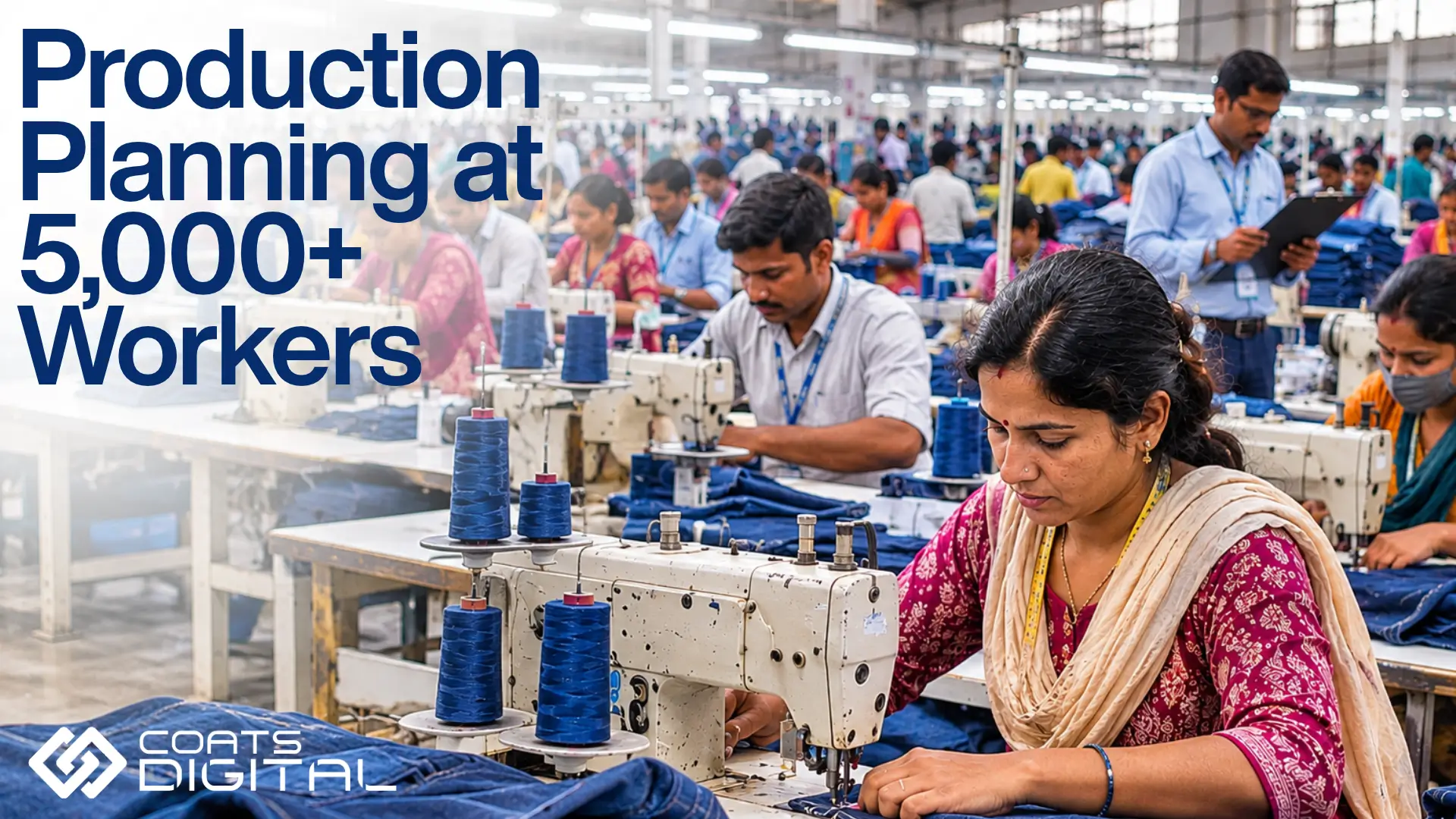
Vendors sell by headcount, but planners work in lines, style changes, and buyer calendars. Translate 5,000 workers into those units before you compare any software.
What counts as a large garment factory in Bangladesh?
A Ready-Made Garments (RMG) factory counts as a large industry in Bangladesh above 1,000 workers. Under the National Industrial Policy 2022, gazetted on 29 September 2022, most manufacturing crosses the “large” line above 300 workers. Garments and other labour-intensive sectors cross it only above 1,000 (OGR Legal summary).
A 5,000-worker factory is five times that threshold and far above the norm. Mapped in Bangladesh counted 3,555 export-oriented RMG factories employing about 3.04 million workers as of December 2024 (The Financial Express). That averages roughly 855 workers per factory.
How many sewing lines does a 5,000-worker garment factory run?
A 5,000-worker garment factory in Bangladesh typically runs roughly 30 to 60 sewing lines. The spread depends on how much of the headcount sits outside sewing, in knitting, dyeing, washing, finishing, and staff roles.
| Factory | People | Published line count | People per line (our arithmetic) | Source |
| Humana Apparels, Tangail | About 2,400 | 28 lines, about 1,800 machines | About 86 | The Interline, June 2026 |
| Panam Group, Dhaka | About 20,000 | 145 sewing lines across five sites | About 138 | Coats Digital testimonial |
| Tusuka, Dhaka | About 10,000 | 67 lines dedicated to denim | About 149 | Coats Digital testimonial |
| Ha-Meem Group | About 50,000 | 300 production lines in 26 garment factories, plus 7 washing plants | About 167 | Ha-Meem Group profile |
Divide 5,000 by these ratios, and you get about 30 lines for a heavily vertical group and about 58 for a sewing-focused unit. Tusuka’s 67 lines are its denim lines only, so its total headcount spread over them overstates people per line. Treat the higher ratios as upper bounds.
What multiplies past 5,000 workers?
Line count grows in step with headcount. Coordination grows much faster.
- Style changes pile up. Epyllion, with 18,000 employees, manages at least 300 style changes a month, at 500 to 100,000 pieces per order (Coats Digital testimonial).
- One washing plant or embroidery floor feeds many lines, so contention for shared processes grows faster than line count.
- Every buyer’s critical path competes for the same lines and the same wash slots.
- With 5,000 workers, each percentage point of absence is about 50 people, often more than one line’s operators.
- Planning moves from one person’s workbook to a central team. Epyllion set up its central planning team in 2008.
What does an idle hour cost at this size?
On a 2% absence day, about 100 of 5,000 workers are missing. If the plan does not move work to match, the lines they leave short lose 6,000 operator-minutes in every hour.
Cost of one lost hour = operators idled × loaded cost per minute × 60
Put your own loaded labour cost per minute into the formula. The exact taka figure matters less than the pattern: the loss repeats every hour until someone replans.
Is a 5,000-worker compound different from five 1,000-worker units?
Yes. The line counts are similar. The risks differ.
- One compound: the risk is shared bottlenecks. One wash plant, one cutting room, and one embroidery floor serve every line.
- Five sites: the risk is allocation, meaning which unit takes which order. Multi-site groups such as Panam plan projected and confirmed orders on a high-level board before they reach any line.
What Makes Production Planning Software Built for 5,000+ Workers?
Planning software is built for scale when it:
- holds every line, order, and constraint of a 5,000+ worker operation in one live plan
- replans it in minutes rather than days
- comes from a vendor that can name factories of that size running it
That definition gives you three proofs to check. A vendor needs all three. Two out of three is a real risk at this size.
Architecture proof: can the engine hold the whole floor?
Across 30 to 60 lines, the engine has to do more than draw orders on a board. Ask to see each of these working together in one plan:
- A master plan over line boards: Total demand and capacity across factories and subcontractors, with detailed line schedules beneath.
- Realistic line scheduling: Standard minute values (SMV), efficiency profiles by product, and start-up or learning curves at each style change.
- Bottlenecks driven by the sewing plan: Embroidery, printing, and washing loads that update when sewing moves.
- Materials and the critical path in the same engine: Material requirements and T&A target dates recalculated from the latest plan.
- Plan versus actual: Production updates imported from the floor, so the next replan starts from what really happened.
- What-if sandboxes: Scenarios tested in a copy, so the committed plan stays untouched until a planner releases the change.
- Automatic placement of large volumes: Rule-based planning under several constraints, so planners manage exceptions instead of dragging every order.
Each item on this list is documented on the FastReactPlan product page. Automatic volume planning is an optional advanced planning and scheduling (APS) module. Laundry and embellishment planning is another optional module. Hold every vendor, including Coats Digital, to the same list on your own data.
Reference proof: who at your size already runs it?
Reference proof means named, dated deployments in Bangladesh at a headcount and product mix like yours. Not all evidence carries equal weight, so grade it on a four-step ladder:
- Announced. A selection, signing, or launch event. It tells you a contract exists, nothing more.
- Live. The customer confirms the system is in use but publishes no metrics.
- Measured. A named customer, quantified results, and a date.
- Comparable. Measured at your headcount band and product mix, and confirmed by a call to that factory’s planning head.
Most vendor marketing sits at step 1. What matters is how many references a vendor can show at step 3, and whether any of them reach step 4 for you.
Operating proof: who makes it work in Bangladesh?
Operating proof starts with a team that implements and supports from Bangladesh and has connected the tool to an ERP like yours. The deployment also has to cope with local power and connectivity. A remote rollout across 50 lines is a different project from one led by consultants who can walk the floor in Ashulia.
Scale-proof checklist
| Proof | What to ask the vendor | Red flag |
| Architecture | “Replan our peak month across every line, with washing and the critical path recalculating.” | A five-line demo on clean data |
| Reference | “Show two Bangladesh factories above 5,000 workers at ladder step 3, with dates.” | Logos, or launch press releases only |
| Operation | “Who implements from Dhaka, and which ERP have you connected to here?” | Remote rollout; integration “to be scoped later” |
Which Planning Tools Have Proof Above 5,000 Workers?
At this size, the shortlist is short. Most large exporters pair an ERP backbone with a dedicated scheduling engine. Of the tools we compared, FastReactPlan was the only one with measured (step 3) Bangladesh results above 5,000 workers. Ask each vendor for its own step-3 references, because public evidence is never the full picture.
| Tool | Category | What it plans at this size | Best public Bangladesh evidence | Ladder step | Main limitation |
| FastReactPlan (Coats Digital) | Dedicated production planning and control | Control-tower master plan over line boards; SMV, efficiency and start-up curves; bottlenecks, materials and critical path in one engine | Tusuka, Epyllion, Azim Group, Panam Group (measured); Ha-Meem Group launch, 2024 | 3 (Ha-Meem: 1) | Not a finance or procurement system; exchanges data with the ERP through timed or triggered file exchange, with no live API described |
| WFX Cloud ERP and PLM | Apparel cloud ERP and PLM | Costing, material planning, capacity management and merchandising inside a broad suite | SQ Group went live on essential modules in 2015 | 2 | Planning is one module of many; test its scheduler at your line count |
| goRMG ERP (Skylark Soft) | Bangladesh-built garments ERP | Order-to-shipment lifecycle for RMG | Skylark says it has almost 98 clients; we found no published line-scheduling results at this size | Not established for line scheduling | ERP-first; test line scheduling separately |
| SAP, Oracle, Infor, Microsoft Dynamics 365 | Enterprise ERP backbone | Multi-plant finance, procurement and consolidation | No named Bangladesh line-scheduling results found | Not graded for line scheduling | Apparel line logic (SMV, changeovers, T&A) usually comes from a specialist scheduler or heavy configuration |
FastReactPlan (Coats Digital)
FastReactPlan runs a “control tower” master plan across factories above detailed line boards. It schedules on standard minutes, efficiency profiles, and start-up curves. It drives embroidery and screen printing from the sewing plan and recalculates materials and T&A dates as the plan moves. Coats Digital reports 500+ clients in 40+ countries and 2,000+ factories planned on it (FastReactPlan).
Locally, Coats Digital lists a Bangladesh office in Sector 4, Uttara, Dhaka (contact). It names Bangladesh customer success managers in its Tusuka, SQ Celsius, and Humana Apparels announcements.
IT should know about one limitation early. FastReactPlan runs alongside the ERP, and ERP data arrives on a scheduled or triggered exchange. Agree the refresh cadence before go-live.
WFX Cloud ERP
WFX is a cloud ERP and PLM built for apparel. When SQ Group chose it in 2015, its director of operations said existing tools such as FastReact would integrate with WFX. SQ Group’s knitwear arm, SQ Celsius, still reported FastReactPlan results in December 2024. That is the usual pattern at scale: the ERP and the scheduler run side by side.
goRMG ERP (Skylark Soft)
goRMG is a garments ERP from Skylark Soft, a Bangladeshi software company. Its client figures are self-reported on skylarksoft.com, and we found no published line-scheduling results above 5,000 workers. A local ERP can be a sound backbone choice. Test its scheduler separately against the stress tests below.
Enterprise ERP backbones
SAP S/4HANA, Oracle Fusion Cloud ERP, Infor CloudSuite Fashion and Microsoft Dynamics 365 are systems of record that a scheduler plugs into. One example is Crystal Group’s Elegance Industrial, a knits manufacturer in China, Vietnam, and Bangladesh with about 12,000 employees. It runs FastReact fully integrated with SAP and RFID.
Where SME ERPs and spreadsheets stop
Local ERPs and spreadsheets can run a single unit well. At 30 to 60 lines, they lose version control and replan speed. Two planners end up working on two copies, and the buyer gets a late answer. That is usually the moment a group moves to a dedicated planner.
What Have Bangladesh’s Largest Factories Actually Reported?
Four Bangladesh groups above 5,000 workers have published measured FastReactPlan results: Tusuka, Epyllion, Azim Group and Panam Group. SQ Group’s knitwear arm and the mid-size Humana Apparels add newer data points. Ha-Meem Group and The Hams Group have announced selections but published no results yet.
| Factory | Size | Reported result | Ladder step | What it proves at scale | Published |
| Tusuka | About 10,000 workforce; 67 denim lines; 22 million garments a year | Overall efficiency +5%; On-Time Delivery Performance (OTDP) +9%; absenteeism -7%; lower overtime. Later extended to high-level planning and integrated with its ERP and Power BI | 3 | Replanning a 60+ line floor alongside an ERP | February 2022 |
| Epyllion Group | 18,000 employees; 5 factories; about 14,000 standard hours a day | On-time production start +41% (up to 85%); OTDP +58% (up to 95%); fabric mill 95% on time | 3 | Changeover volume and a control tower across sewing, embroidery and washing | Testimonial last updated May 2025 |
| Azim Group | 20,000+ employees; 13 garment units and 4 backwards-linkage factories | Planning efficiency +15%; factory efficiency +7%; order confirmation 97% faster (two days to 30 minutes); report time -68% | 3 | Order-confirmation speed across many units | January 2022 |
| Panam Group | About 20,000 employees; 5 sites; 145 sewing lines | Efficiency +3%; forward plan visibility from 3 to 12 months; capacity utilisation up “by as much as 50%” (executive director) | 3 | Allocating projected and confirmed orders across units | April 2020 |
| SQ Celsius (SQ Group) | SQ Group workforce 18,000+; SQ Celsius headcount not published; two factories | Production efficiency +6%; OTDP +8%; overtime -7% since 2019 adoption | 3 at group scale; unit size unconfirmed | Knitwear planning across two factories | December 2024 |
| Humana Apparels | About 2,400 people; 28 lines (below the threshold); a Ha-Meem and Busana Apparel joint venture | Capacity utilisation +15%; productivity +8%; OTDP about +5%; run alongside GSDCost | 3, mid-size | The newest Bangladesh result, at a mid-size unit | June 2026 |
| Ha-Meem Group | About 50,000 workers; 26 garment factories; 300 lines | Digital transformation launched with Fast React planning; no results published | 1 | Selection at the largest scale; results still to come | November 2024 |
| The Hams Group | 12,000+ employees | Selected FastReactPlan with implementation partner Diverzent; no results published | 1 | Another large-group selection | August 2022 |
How to read this evidence. Results depend on the starting point, and several of these deployments are years old. They show the category works at this size. They do not forecast your result. Ask each reference for its baseline, then call its planning head.
Across its customers, Coats Digital reports typical gains of 3% to 10% in productivity, 10% to 30% in OTDP and 10% to 30% shorter lead times. It says return on investment typically comes in under 12 months (FastReactPlan). Use them as ranges to check in your own trial. More results are collected under manufacturer testimonials.
How Do You Stress-Test a Planning Vendor on Your Own Data?
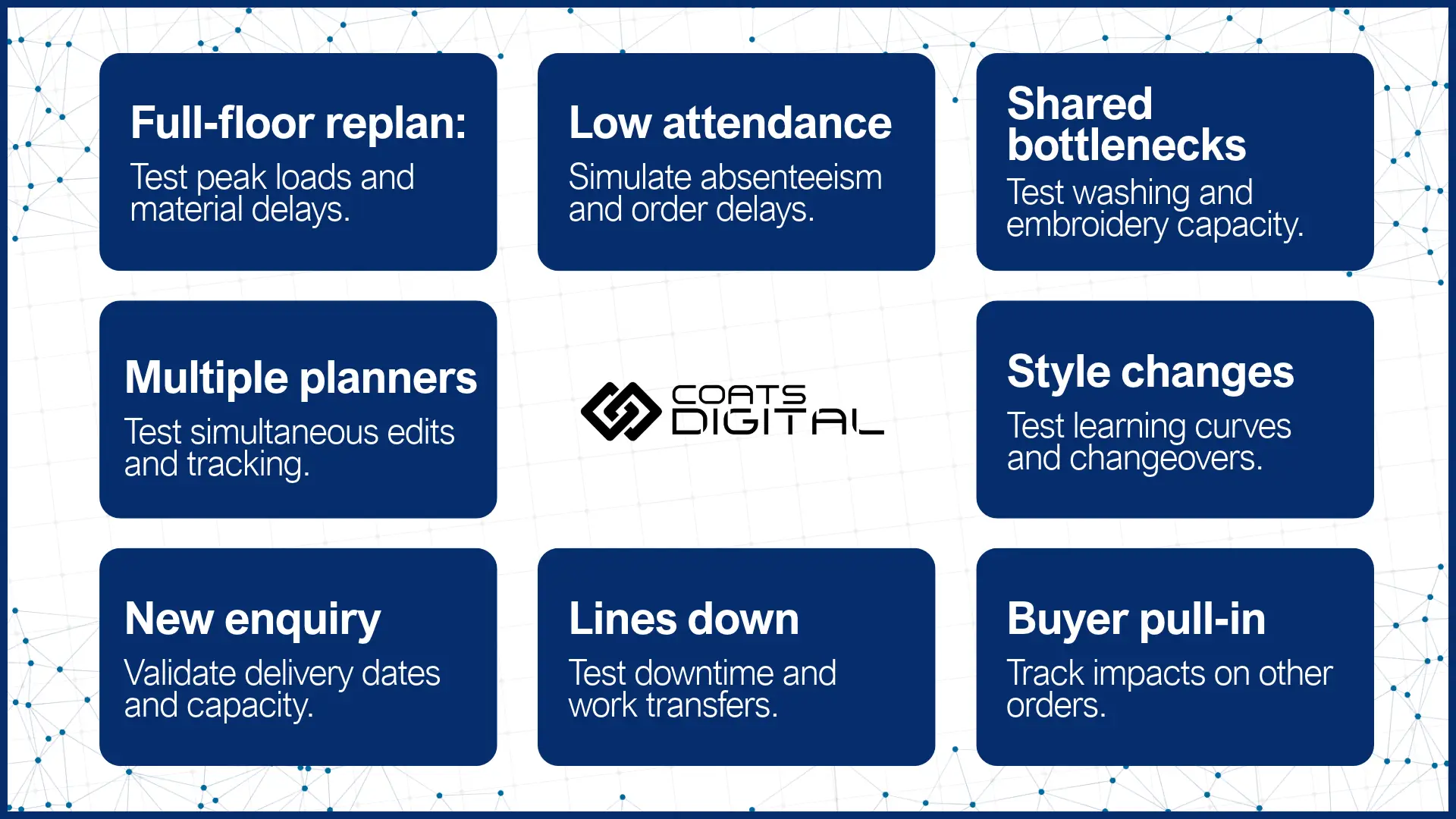
Run every shortlisted vendor through the same eight tests on your own order book, and time each one. Use your peak month. A quiet month hides the shared-bottleneck and changeover problems that break plans at this size.
- Full-floor replan: Load a real peak month: every line, every buyer. Delay one fabric delivery by four days. Pass: materials, the critical path, and every affected line recalculate inside the tool. Time it.
- Worst attendance day: Remove operators across lines at your own worst-day absenteeism rate. Pass: capacity falls line by line, and late orders are flagged by name.
- Shared bottleneck: Load the washing plant or embroidery floor to full for a week, then add a rush order. Pass: the conflict shows on both the wash schedule and the sewing lines feeding it.
- Style-change week: Load a week of short runs and new styles. Pass: the plan applies learning curves and changeover loss instead of simply filling minutes.
- Buyer pull-in: Bring one buyer’s delivery forward two weeks. Pass: the tool shows which other buyers’ orders and T&A milestones slip.
- Lines-down scenario: In a what-if copy, take a block of lines out for three days, as for a gas-pressure or power failure. Move the work to another unit or a subcontractor. Pass: the committed plan is untouched until you release the scenario.
- New enquiry: Quote a delivery date for a new multi-style order. Pass: the date is checked against true line capacity and material lead times. Time it.
- Two planners, one floor: Have two planners change different units at once. Pass: no overwritten work, and every change is attributable to a named user.
Don’t set target times in advance. Judge each vendor on its results with your data. For context, Azim Group reported order confirmation falling from two days to 30 minutes after implementation. When you are ready, arrange a demo and bring your own peak month.
What Should IT Check Before Signing?
Above 5,000 workers, a planning tool succeeds or fails on its data links. Use this checklist with every vendor. The third column shows what is on public record for FastReactPlan and what you still need to ask.
| Check | What to confirm | FastReactPlan: public record |
| Integration method | How orders, styles, inventory, and purchase orders move between ERP and planner | Automatic exchange through a shared intermediary file system, timed or triggered; the receiving system runs its own integrity checks. No live API is described |
| Refresh cadence | How stale the plan can be between ERP updates | Set by the interface schedule; agree it in the project scope |
| Integration record | Who has connected it to an ERP like yours | Tusuka: ERP and Power BI. FCI (BD): its ERP. Elegance Industrial: SAP and RFID |
| Standards source | Where standard minutes come from and who owns them | Schedules on SMV; Humana runs it alongside GSDCost method-based standards |
| Shop-floor feedback | How actual output returns to the plan | Production updates imported for plan-versus-actual monitoring |
| Reporting | Management KPIs without spreadsheet rebuilds | Built-in report writer; optional KPI dashboard in Microsoft Power BI; AI Analytics add-on with an “Ask Coats Digital” assistant |
| Access and audit | Roles, and who changed the plan and when | Ask for a live demonstration with your planners |
| Deployment | Cloud, hosted or on-premise, and behaviour during power or connectivity loss | Not stated on the product page; TrustRadius lists on-premise and SaaS. Confirm current options |
| Implementation timeline | Months to live use, by unit | FCI (BD): about 3.5 months. Esquire Knit Composite: about five months. Azim Group: within six months, per Coats Digital’s senior implementation consultant |
| Local support | Who implements and supports, from where | Office in Uttara, Dhaka; Bangladesh customer success managers named in the Tusuka, SQ Celsius and Humana releases |
| Security | Current attestations and data residency | Ask for current reports before contract |
FCI (BD) and Esquire are cited for timing only, because neither publishes a headcount. For how the ERP exchange works day to day, see our guide to production planning software that integrates with ERP in Bangladesh.
Deployment in the industrial belts. In Gazipur and Ashulia, power and connectivity often matter more than features when choosing between cloud and on-premises. One G2 reviewer named a good network connection and server as FastReactPlan’s main requirement. Run the demo on your own network, and agree on the fallback for an outage before go-live.
Six Mistakes Large Factories Make When Choosing Planning Software
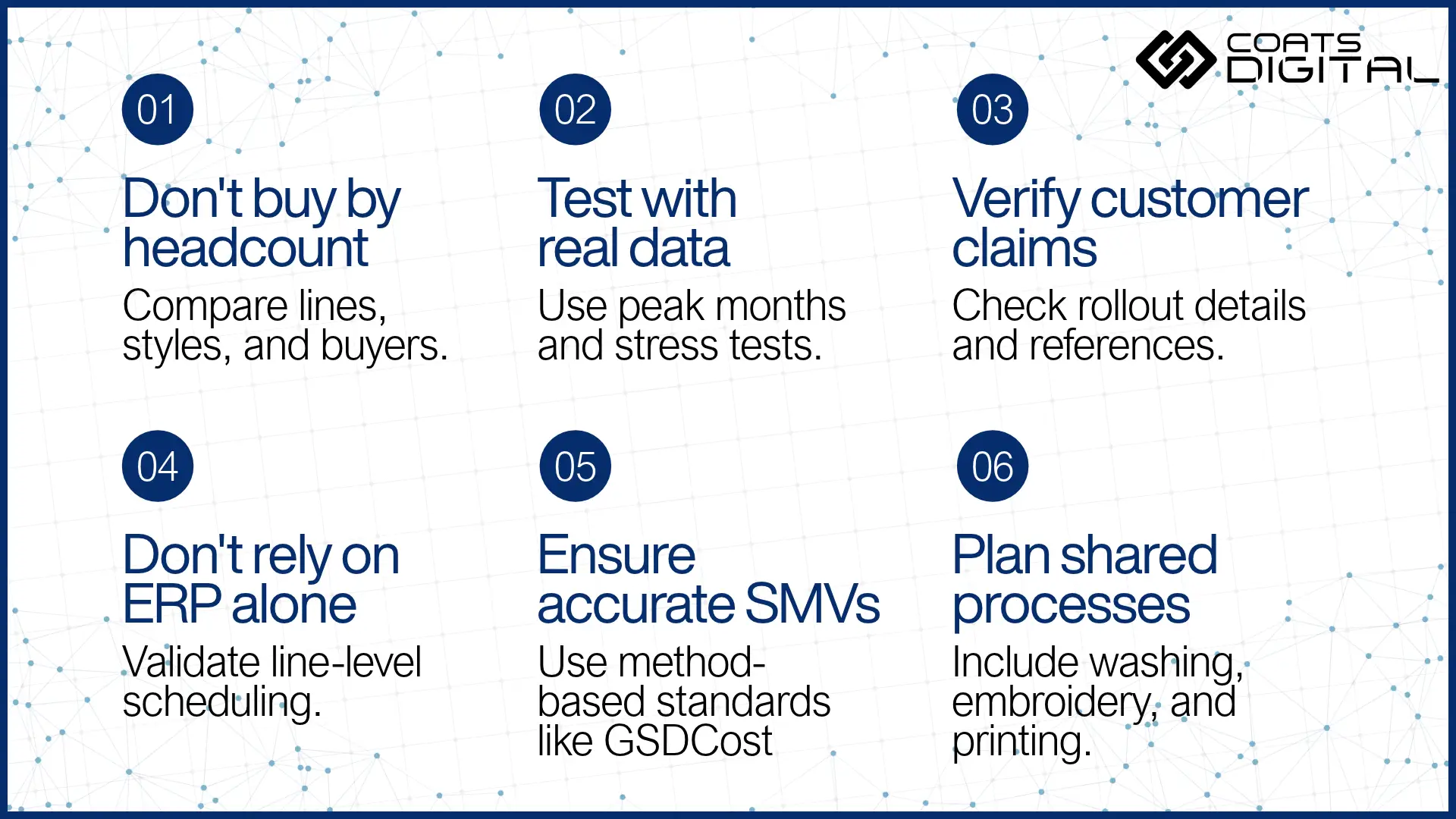
On large floors, problems usually start at the shared wash plant or in the Monday replan. These six buying mistakes make them worse.
- Buying by headcount. The plan is built from lines, style changes, and buyers. Compare vendors on those. How many workers their customers employ tells you little.
- Accepting a five-line demo on clean data. Any tool looks fast on a small, tidy plan. Insist on your own peak month and all eight stress tests.
- Treating a logo as proof. A launch is ladder step 1. Ask for step 3, with dates, and phone the reference’s planning head.
- Expecting the ERP planning module to schedule 50 lines. The ERP records the commitment. It rarely tests whether the floor can meet it, line by line and day by day.
- Scaling on estimated standard minutes. At this size, a small SMV error repeats across every line and every order. Method-based standards, such as those from GSDCost, keep capacity figures accurate.
- Leaving shared processes off the plan. Washing, embroidery, and printing are where large floors actually queue. If they are missing from the plan, delivery dates will be off.
Conclusion: How to Choose Planning Software at 5,000+ Workers
At 5,000+ workers, pick the tool that can replan your whole floor, show measured references at your size, and put a team in Dhaka. Compare vendors on line count and style changes, and make each one run your own peak month.
The ERP stays the backbone, and the scheduler sits beside it. Among the tools we compared, only FastReactPlan had published measured Bangladesh results above 5,000 workers. Ha-Meem Group’s 2024 launch suggests the largest groups are moving the same way, though its results are still to come.
Where to go next
- FastReactPlan: dedicated production planning and control, capability by capability.
- How Tusuka lifted OTDP by 9%: a 10,000-worker Bangladesh denim manufacturer’s results.
- Production planning software that integrates with ERP in Bangladesh: the integration guide for IT.
Bring your own peak month to the demo and see how the plan holds up. Arrange a demo.
Frequently Asked Questions
-
Which production planning software do Bangladesh’s largest garment factories use?
Most Bangladesh garment groups above 5,000 workers run an ERP for orders, purchasing, and finance, with a dedicated planning engine beside it for line scheduling. The ERP records commitments; the planner tests whether 30 to 60 lines can meet them. Among dedicated planners, Coats Digital’s FastReactPlan has the most measured Bangladesh references at this size in our review: Tusuka, Epyllion, Azim Group and Panam Group.
-
What counts as a large garment factory in Bangladesh?
Under Bangladesh’s National Industrial Policy 2022, a garment or other labour-intensive manufacturer is a large industry above 1,000 workers. Most other manufacturing crosses that line above 300. Mapped in Bangladesh data averages roughly 855 workers per export factory, so a 5,000+ worker garment factory belongs to a small, distinct group.
-
How many sewing lines does a 5,000-worker garment factory run?
Roughly 30 to 60, depending on how much of the workforce sits outside sewing. Published figures give about 86 people per line at Humana Apparels, 138 at Panam Group, 149 at Tusuka, and 167 at Ha-Meem Group. When comparing capacity planning software, look at line count and style-change volume rather than headcount.
-
Is FastReactPlan proven for factories with more than 5,000 workers?
Yes, at a measured-results level. Tusuka (about 10,000 workers), Epyllion (18,000), Azim Group (20,000+) and Panam Group (about 20,000) have all published results with it. The results are self-reported, so test it on your own peak month before you buy.
-
What results have Bangladesh garment factories reported with FastReactPlan?
- Tusuka (2022): 5% higher efficiency and 9% better OTDP.
- Epyllion: on-time delivery reaching up to 95%.
- Azim Group: order confirmation cut from two days to 30 minutes.
- Panam Group: forward plan visibility extended from three to 12 months.
- SQ Celsius (2024): OTDP up 8%.
- Humana Apparels (2026): capacity utilisation up 15%.
Ha-Meem Group’s 2024 launch has no published results yet.
-
How does FastReactPlan connect to an ERP?
FastReactPlan exchanges data with the ERP through a shared intermediary file system, on a timed or triggered basis. Each receiving system runs its own data-integrity checks. Coats Digital does not describe a live API, so IT should agree the refresh cadence early. Tusuka integrated FastReactPlan with both its ERP and Power BI.
-
How should a 5,000-worker factory test garment planning software before buying?
Run your own peak month through it instead of the vendor’s demo data. Delay a fabric delivery, remove a bad day’s absent operators, overload the washing plant, pull one buyer forward and quote a new order. Time each replan, check that materials and T&A dates recalculate, and score every vendor on the same eight tests.
-
How long does a production planning software rollout take in a large Bangladesh group?
Published Bangladesh rollouts took about three to six months. FCI (BD) implemented FastReactPlan in about 3.5 months, Esquire Knit Composite in about five, and Azim Group within six months. Data readiness, especially clean standard minutes and master data, usually decides the timeline more than headcount. A phased rollout by unit lowers the risk.
-
How does planning software handle absenteeism on a large garment floor?
It recalculates line capacity when operator numbers change, so orders at risk appear by name instead of at the end of the week. With 5,000 workers, each percentage point of absence is about 50 people. Tusuka reported staff absenteeism falling by 7% after moving to FastReactPlan, which it linked to higher job satisfaction.
-
Does Coats Digital have a local team in Bangladesh?
Yes. Coats Digital lists an office in Uttara, Dhaka, and names Bangladesh customer success managers in its Tusuka, SQ Celsius, and Humana Apparels announcements. Confirm current implementation capacity and support hours during evaluation. Ask how many consultants are based in Dhaka and how quickly they can be on-site.
Production Planning Software for Large Garment Factories in Bangladesh (5,000+ Workers)

All Blog Categories
- Production Planning
- Corporate
- Method Time Cost Optimisation
- Supply Chain Solutions
- Sustainability
- Videos
