Why Does Capacity Planning Software Fail in Bangladesh’s Garment Manufacturing Sector?
by Kunal Kapur
 9
Mins Read
9
Mins Read
- Key Takeaways
- The Quote Arrives as a Single Number
- Why a Supplier Quote Is Never Just a Price
- Why “just send me a breakdown” is not enough
- What “Accurate” Actually Means
- Why labour is the variable that decides the quote
- The Independent Anchor: Standard Minute Value
- SMV and SAM: same measure, different label
- Predetermined motion time systems vs stopwatch time study
- Building the Cost Breakdown Before You Order
- Reading the Gap Between Your Number and Theirs
- When a higher quote is the better deal
- Separating fair-wage cost from inflation
- Red flags in a supplier breakdown
- Comparing Breakdowns Fairly Across Multiple Suppliers
- Issue one Bill of Labour and lock the SMVs
- Build vs Buy: Do You Need Software for This?
- What a spreadsheet and a trained partner can do
- What breaks at scale
- What a costing platform adds
- Walk In With Your Own Number
- Frequently Asked Questions
Key Takeaways
- Capacity planning software rarely fails because the software is broken. It fails because the data, constraints, and habits feeding it are wrong.
- Guessed or stale SMVs are the most common root cause; one manufacturer found 30% variance in SMVs across its own lines.
- Plans set to theoretical 100% capacity ignore absenteeism, changeovers and learning curves, so they slip on the first bad day.
- Sewing-only plans collapse when the binding constraint is the wash house, the fabric-in date or, in Bangladesh right now, the gas pressure.
- Since April 2025, the US surcharge on Bangladeshi garments has been rebuilt on three legal bases; two announced rates never took effect.
- Diagnose before you re-buy: implementation failures need a process fix; fit failures need a different tool entirely.
- Poor planning drives overtime, which drives absenteeism, which breaks the plan again. Coats Digital reports Tusuka cut absenteeism 7% after digitising planning.
- Fix the inputs at source and the same software starts producing plans the floor can hold.
Most capacity planning software failures in garment manufacturing are not software failures. They are failures of data quality, constraint modelling, order stability, and process ownership that the software exposes rather than causes.
That is an uncomfortable answer, and it is the reason this article exists. Ask any Planning Head in Gazipur, Narayanganj or Chattogram what happened after go-live and you will hear a version of the same story: the system runs, the reports generate, and the plan people actually believe is still a colour-coded spreadsheet on somebody’s laptop.
Two readers usually arrive at this question. One has already bought a system that underdelivers and needs a diagnosis before spending again. The other is evaluating vendors and is reading failure analysis as risk research. Both need the same thing, which is an honest account of what actually breaks.
The stakes are not abstract. Bangladesh’s ready-made garment sector earned $38.70 billion in FY2025-26, over 80% of national merchandise exports, but RMG exports fell 1.64% year on year, and average unit prices into the United States dropped 2.26% across the first seven months of 2026 as exporters absorbed part of the tariff burden. Squeeze price, hold volume, and productivity become the only levers left. A planning rollout that delivers nothing is not neutral in that environment. It is capital spent, a productivity gain forfeited, and an organisation taught that digitisation does not work here.
What follows: what failure actually looks like, the twelve causes that produce it, how to tell a process problem from a tool problem, what it costs, how to recover, and what to demand before you sign anything.
What Does “Capacity Planning Software Failure” Actually Mean?
Capacity planning software failure in apparel manufacturing is when a planning system stops producing plans the business trusts or uses, because of inaccurate standards, unrealistic capacity assumptions, unmodelled constraints, unstable order inputs, weak integration or low adoption, even when the software itself is working exactly as designed.
Most of these failures never appear on a project status report. They take three forms, and knowing which one you have determines everything that follows.
Hard failure: The system is abandoned outright and the factory returns to spreadsheets. Rare, and paradoxically the easiest to diagnose because nobody pretends otherwise.
Silent failure: The software runs, data gets entered, and planners maintain a parallel plan they actually trust. The tool has become a reporting layer. This is by far the most common outcome and the hardest to see from head office, because every dashboard looks healthy.
Value failure: The system is genuinely used, but nobody can point to a movement in on-time delivery performance, line utilisation or lead time. Leadership starts asking what the investment bought. The honest answer is a tidier version of the same decisions.
The counterpoint is worth stating plainly, because it is the target: a single source of truth, plans that hold against the floor within an agreed tolerance, and delivery and utilisation numbers that moved.
Planning software is a mirror, not a magician. It reflects the quality of your standards, your constraints, and your discipline. Clean inputs produce a plan you can defend to a buyer. Dirty inputs produce a confident-looking plan that misses ship dates.
What Causes Capacity Planning Software to Fail in Apparel Manufacturing?
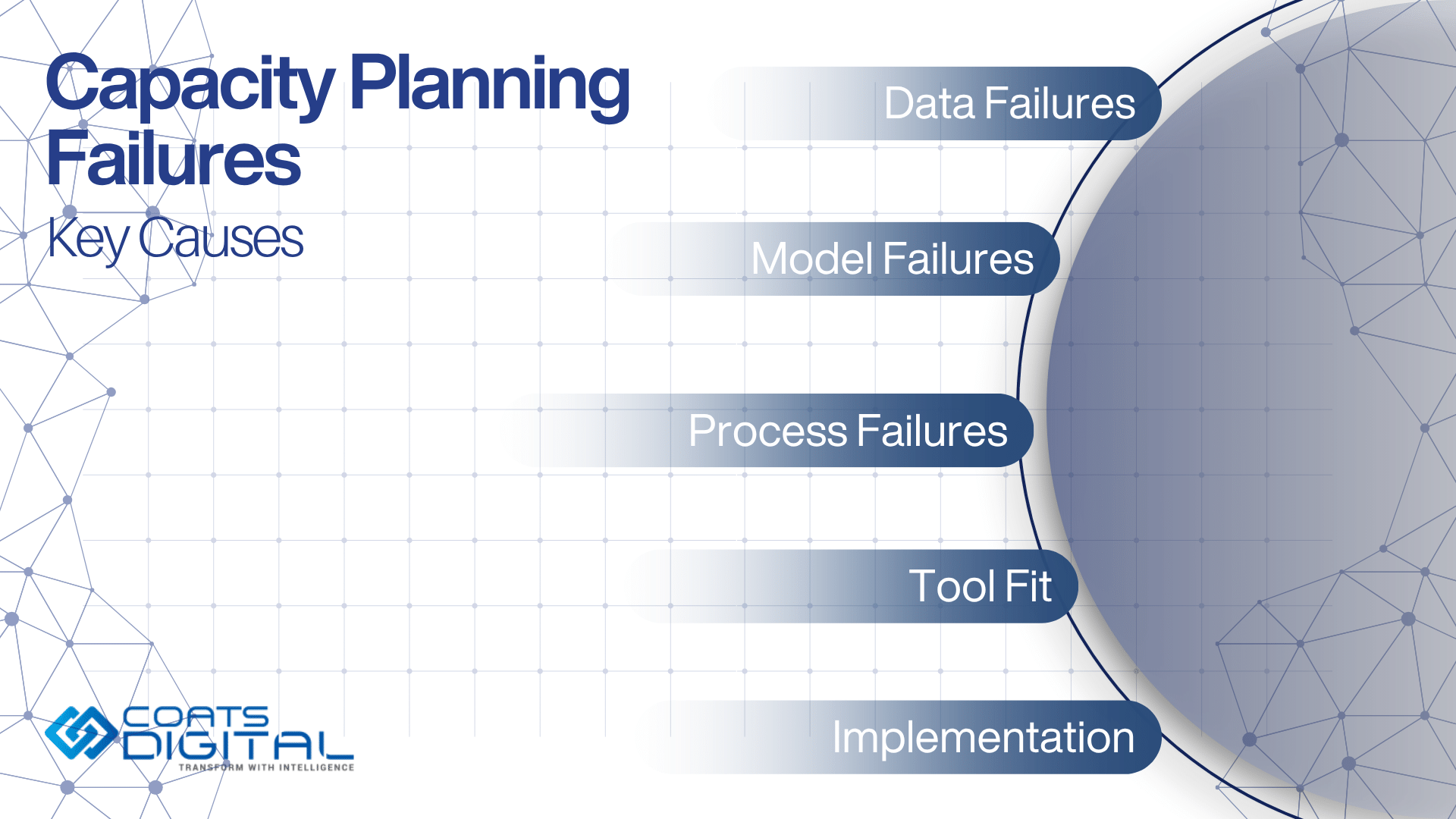
Thirteen causes account for nearly every case. They sort into three groups, and the grouping matters because each group has a different owner, a different fix, and a different price. Treating a data problem with more training, or an adoption problem with a new licence, is how factories fail twice.
Data failures: garbage in, garbage out
1. Inaccurate or missing SMVs:
Every capacity number in the system resolves to sewing minutes. If those minutes were estimated by an experienced supervisor rather than engineered, the entire plan inherits the error and multiplies it across every line and every style.
The scale of this is measurable, and it is larger than most factories assume. Coats Digital’s published account of Suzhou Tianyuan Garments records SMV calculations varying by as much as 30% across the company’s own production lines, because each rested on individual engineers’ judgement, reaching 98% accuracy company-wide after standardisation. Thirty per cent variance inside a single company is not a rounding error. It is a plan nobody can defend to a buyer, and a costing sheet nobody can defend to finance.
The discipline here is old and well documented. The ILO’s Introduction to Work Study, the standard reference on work measurement since its first edition in 1957 and now in its fourth revised edition, distinguishes stopwatch time study, which depends on an observer’s subjective performance rating, from predetermined motion time systems, which assign fixed values to defined motions regardless of who performs the analysis. GSDCost sits in the second category, building SMVs from 39 predetermined motion codes applied by licensed practitioners. The distinction is not academic: a rated time study is an opinion, and two engineers will produce two different plans from the same operation.
First fix: build an engineered, maintained standards database before configuring anything downstream.
2. Stale, ungoverned master data:
Lines get reconfigured, machines get added, skill matrices drift, calendars go un-updated. Master data rots quietly because nobody owns it, and the plan degrades in step. A group that reconfigured three lines in March and never told the planning system is planning a factory that no longer exists.
First fix: name an owner and set a review cadence. Not an annual clean-up.
3. No live link to the floor, no integration with ERP or PLM:
When actuals arrive by manual entry a day late, the plan describes yesterday. When order and style data sit in the ERP and PLM but do not flow into planning, someone re-keys them, and re-keying is where both errors and resentment originate. FastReactPlan exchanges data with ERP, PLM, shop-floor data collection, and inventory systems automatically on a timed or triggered basis, and GSDCost holds a native link to the Res.Q shop-floor suite that compares actual against standard minute value at operation level. Both directions matter. A plan that cannot see the floor is a forecast, not a plan.
First fix: get actuals flowing before adding any new planning functionality.
Model failures: when the plan doesn’t match the factory
4. Planning to theoretical 100% capacity.
This is the error that hides best, because the arithmetic is internally consistent and completely wrong.
Work it through. One line, 40 operators, a 10-hour shift, gives 24,000 available minutes. A 15-minute SMV suggests 1,600 pieces a day. Now apply reality. Daily absenteeism in Bangladeshi garment factories runs at around 4%, with annual turnover above 30%, based on the evidence of Menzel and Woodruff’s study of 60 factories published in Labour Economics, and 6.5% in Macchiavello and colleagues’ sample of 24 factories. At 4% absence and 55% line efficiency, the same line makes roughly 845 pieces. Put a new style on it and run week one at 40% average efficiency while the learning curve resolves, and you get about 614.
The system will happily schedule 1,600. The floor will deliver 614. Nobody configured a lie; somebody just never told the software what a Tuesday looks like. (Illustrative arithmetic, using published absenteeism ranges and typical efficiency assumptions.)
First fix: configure real efficiency profiles and plan at 80–90% of capacity.
5. Modelling only the sewing line, not the binding constraint:
Sewing is the default unit of capacity because it is the most visible, not because it is always the tightest. For denim, the wash house sets the ceiling. For woven programmes, the fabric-in date does. A sewing-minute plan will cheerfully over-commit a factory whose laundry is already full, and the work-in-progress stacks up in front of the constraint until somebody subcontracts washing at distress rates.
This is solvable, and Coats Digital’s Bangladesh work shows what solving it looks like: at Azim Group, the project covered detailed sewing-line planning alongside scheduling of cutting, laundry, and finishing inside its denim subsidiary Global Outerwear. FastReactPlan schedules bottleneck processes dynamically from the sewing plan, with an optional laundry and embellishment module that respects each process’s own minimum production runs and lead times.
First fix: model finishing, laundry, and material availability as first-class constraints. Plan to the tightest constraint per product, not the most familiar one. Our guide to balancing production capacity across the year covers the parallel-capacity-track mechanics in depth.
6. Planning to a calendar the grid cannot supply:
Available minutes assume the factory has power. In Bangladesh in 2026, that assumption has failed repeatedly. BGMEA told the Ministry of Power in April 2026 that inadequate gas and electricity had cut factory production capacity by 25–30%. By August, BGMEA-member factories were running 30–35% below capacity, with gas pressure in Ashulia, Savar, Gazipur, Kaliakair and Bhaluka falling to around 1 PSI against the 5–6 PSI factories need. Gas-dependent stages take it worst: denim, dyeing, finishing and spinning.
A planning system configured against nominal working hours will produce a month that cannot happen. This is not a software defect. It is a constraint nobody put in the model.
First fix: treat energy availability as a planned constraint with its own scenario, not an exception to be absorbed by overtime.
7. Ignoring the learning curve and changeover loss:
New styles do not hit target on day one, and scheduling four of them into one window compounds the loss three times over. With smaller order quantities and more styles now standard across the sector, this has grown from a rounding issue into a structural one. Specialist line-level planning uses standard minutes, efficiency profiles and start-up curves precisely so the schedule reflects achievable output, and accurate method standards shorten those curves at source.
First fix: build learning curves and changeover rules into the model, and sequence similar product families together.
8. Planning off unconfirmed s and volatile buyer forecasts:
A plan built on a speculative order book is wrong before it is saved. When buyers move quantities or dates, a system that treats every order as fixed produces a plan that looks wrong the moment demand shifts, and the software gets blamed for the instability. This is the apparel-defining version of the problem, and in Bangladesh right now it is acute: the US surcharge has been rebuilt on three separate legal bases in eighteen months, so buyers are forecasting through the same fog the factory is. The fix is not a steadier order book, which nobody controls, but a plan that expects movement.
First fix: stage plans by order-confirmation status and re-plan on a rolling basis as orders firm. The full scale of that tariff volatility is set out below
People and process failures: when the plan exists but nobody uses it
9. The cross-functional accountability gap:
Merchandising commits a ship date to secure an order. The planning system never validated it. PPC and production inherit a promise they cannot keep and spend the season recovering it. This is not a generic IT-versus-business problem; it is a specific hand-off gap, and it will defeat any software you buy.
Azim Group’s published experience is exactly this shape. Before implementation, capacity and line planning teams lacked the accuracy to respond to buyers’ latest changes, which meant extra effort and repeated reviews with merchandising just to keep everyone aligned on delivery. Coats Digital’s 2022 case study reports order confirmation subsequently dropping from two days to 30 minutes, alongside a 15% improvement in planning efficiencies.
First fix: no date reaches a buyer until the plan has validated it. Data-backed commitments, or no commitment.
10. Low adoption and the shadow spreadsheet:
Planners keep their Excel because, once, the system produced a plan they knew was wrong and they were the ones who had to explain the miss. Two versions of truth then coexist, and the one with a human owner wins every time. The spreadsheet is not the disease. It is the residue of a trust failure that happened earlier.
First fix: fix the standards first, then retire the parallel plan deliberately. Asking a planner to abandon a spreadsheet that is more accurate than the system is asking them to do worse work.
11. The wrong tool: generic ERP versus apparel-specialist planning:
Finance-led and general manufacturing ERPs are built around order and financial data. They tell you what is due and whether the materials exist, which is necessary but is not a plan. Many cannot model SMV-driven line capacity, critical path per product, wash-house batching, or the difference between a locally sourced knit and an imported woven. Asked to do work they were never designed for, they over-commit, and the planning team absorbs the blame.
First fix: recognise this as a fit problem. No change-management programme corrects a model that cannot represent your factory. Our comparison of ERP integration options for garment factories sets out where the boundary sits.
12. Big-bang go-live and unrealistic scope:
Switching every line, process, and user at once overwhelms the team and buries the early wins that build belief. It also propagates your data problems across the whole group before anybody has found them.
First fix: phase it. Prove the plan holds in one unit or product line, then extend.
13. Treating it as an IT project:
Related to the above but distinct, and worth separating because it predicts failure better than almost any other variable. Where the planning system is owned by IT alone, behaviour on the floor never changes, and the software becomes an administrative overhead.
Ahtashamul Khan, Customer Success Manager for Coats Digital in Bangladesh, attributes the speed of the Tusuka rollout, among the fastest the company has run in the country, to the seriousness with which users engaged from the start and the determination of the senior management team and every other stakeholder to finish on time. That is not a software variable. It is a leadership one, and it is available to any factory that chooses it.
First fix: the business owns the plan. IT owns the integration.
Cause, symptom and first fix
| Cause | What you see on the floor | Root type | First fix |
| Inaccurate SMVs | Plan says on target; floor isn’t | Data | Engineered standards |
| Stale master data | Plan uses lines and machines that changed | Data | Assign named ownership |
| No shop-floor or ERP link | Plan is always a day behind | Data | Integrate live data |
| Theoretical 100% capacity | Plan slips on the first absent day | Model | Plan at 80–90% |
| Only sewing modelled | Denim stacks up before the wash house | Model | Model the tightest constraint |
| Energy assumed available | Load-shedding erases planned hours | Model | Plan energy as a constraint |
| Learning curve ignored | New styles miss ramp-up | Model | Build in learning and changeover |
| Unconfirmed orders | Plan changes every time a buyer moves | Model | Stage by confirmation status |
| Accountability gap | Ship dates committed the plan never saw | People | Validate before committing |
| Shadow spreadsheets | Two versions of truth | People | One plan, no parallel |
| Generic ERP | Cannot model wash or critical path | Tool | Apparel-specialist system |
| Big-bang go-live | Teams overwhelmed, no early wins | Process | Phased rollout |
| Owned by IT alone | System used, behaviour unchanged | Process | Business owns the plan |
Is It a Fit Problem or an Implementation Problem?
Answer this before you scope a replacement, because the two need opposite responses.
Implementation failure means the right tool with the wrong data, process or adoption. The remedy is internal and usually costs a fraction of the original licence.
Fit failure means the tool cannot represent your manufacturing reality. The remedy is a different system, and no amount of user training substitutes.
The fastest test is functional rather than emotional. Can the tool model engineered SMVs, critical path per product, wash-house batching, and imported fabric-in dates? If not, every month spent on training is a month lost.
| Question | If the answer is “no”, you likely have a… |
| Are your SMVs engineered and current? | Data and process fix |
| Does the plan buffer to 80–90% of capacity? | Model and configuration fix |
| Are you planning against confirmed orders? | Input and process fix |
| Does the tool model finishing and wash as constraints? | Possible fit problem |
| Does the tool model imported fabric-in dates per order? | Possible fit problem |
| Can it show critical path per product? | Possible fit problem |
| Do planners still keep a shadow Excel? | Adoption fix |
| Are commitments validated against the plan? | Governance fix |
Note the asymmetry. Most of these are process fixes. That is the entire argument for diagnosing before re-buying.
Why Bangladesh Makes Every One of These Failures Worse
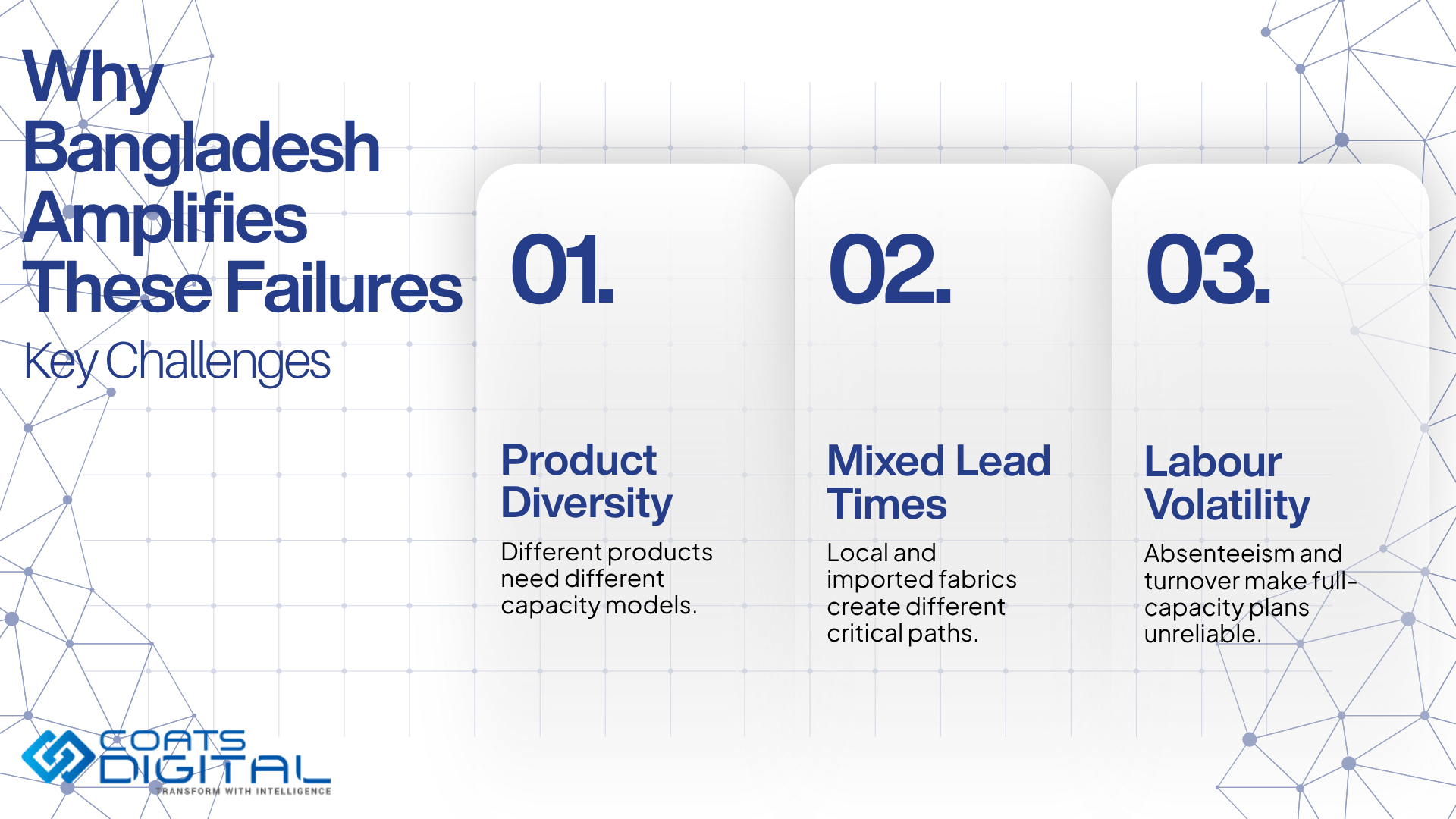
Every manufacturing sector has planning problems. Bangladesh currently has the sharpest combination anywhere, for reasons that have little to do with capability and a great deal to do with the operating environment.
Product diversity multiplies data demands: A group running knit, denim and woven cannot be represented by one capacity number, because each has a different constraint, critical path and learning curve. Weak standards do not fail once here. They fail in three directions, and the errors do not cancel.
Mixed backward linkage distorts critical paths: Deep local linkage in knit and largely imported fabric in woven give the two families fundamentally different lead-time profiles. One critical-path model across both will be wrong for at least one of them, every season.
Labour volatility makes every theoretical plan fragile by design: with daily absenteeism at roughly 4–6.5% and annual turnover above 30%, a factory that plans to full capacity is already wrong before the first shift. The volatility is not an exception to schedule around; it is a baseline the model has to carry.
Three legal bases in eighteen months
This is what turns “plan against confirmed orders” from best practice into a requirement. Trace what actually reached Bangladeshi exporters since April 2025.
Before April 2025, garments entering the United States paid a 15.62% most-favoured-nation rate that had held for years. The April 2025 reciprocal tariff order set a headline 37% for Bangladesh under the International Emergency Economic Powers Act. That figure never applied; after negotiation, the rate settled at 20% from August 2025. In February 2026, the two governments announced a framework that would have cut the reciprocal rate to 19% with a carve-out for apparel made using US inputs. It was never implemented.
On 20 February 2026, the Supreme Court ruled 6-3 in Learning Resources, Inc. v. Trump that IEEPA does not authorise tariffs, voiding the legal basis entirely. A flat 10% surcharge under Section 122 of the Trade Act of 1974 took effect four days later, carrying a hard 150-day statutory limit. When that expired on 24 July 2026, it was replaced the same day by a Section 301 forced-labour tariff, a two-tier 10% and 12.5% duty, with Bangladesh in the lower tier and total duty on garments at 25.62%.
Three legal bases, one Supreme Court ruling, two announced rates that never applied, inside eighteen months. No buyer forecasts cleanly through that, and the cost landed on the floor: apparel export value to the US fell 6.50% and volumes 4.34% across January to July 2026, unit prices dropped 2.26%, and exporters absorbed roughly a third to a half of the tariff cost in individual negotiations.
Layered on top, Bangladesh’s LDC status is itself unresolved. Graduation remains scheduled for 24 November 2026, but the government requested a three-year deferral to 2029 in February, the UN Committee for Development Policy backed it, and ECOSOC referred the decision to the General Assembly in July, with a vote expected during the current high-level session.
(Status as of 22 September 2026. The UN Committee for Development Policy has recommended deferring graduation to 24 November 2029, and ECOSOC referred Bangladesh’s three-year deferral request to the General Assembly without a specific recommendation. A decision was expected during the high-level session on 22–23 September; approval requires a two-thirds majority. This article will be updated once the General Assembly rules.)
Whichever way that goes, the planning implication is the same. Your buyers are forecasting through the same fog you are. Software that treats every order as fixed will look wrong the moment a buyer moves, and it will move.
The energy constraint nobody put in the model
Bangladesh’s average daily gas supply fell to a reported 2,235 mmcfd in August 2026, the lowest for that month in a decade, with a peak generation deficit near 3,000 MW. Trade reporting from the same period logged individual denim and garment units taking between roughly 37 and 82 hours of load shedding across the first fortnight of August. Factories switched to diesel generators and watched production costs climb around 30%.
Consider what that does to a plan. Every scheduled minute assumes electricity. The planning system has no field for “the grid failed on Tuesday,” so the shortfall surfaces as an efficiency miss, which gets attributed to the line, which gets attributed to the plan, which gets attributed to the software. The failure is upstream of all of it.
The absenteeism loop, and why it runs both ways
Absenteeism is usually discussed as an input to planning, something the plan must accommodate. The relationship is circular, and the second direction is where the opportunity sits.
A plan built on bad standards over-commits. Over-commitment produces overtime. Sustained overtime produces fatigue, dissatisfaction, and absence. Absence breaks the next plan. The loop tightens each season.
Run it the other way and the same mechanism works in your favour. At Tusuka in Dhaka, a 10,000-employee group running 67 dedicated denim lines and around 100,000 garments a day, planning teams previously cross-referenced spreadsheets, emails, phone calls and meeting logs to settle a single decision, with no reliable view of forward load capacity and, consequently, lost orders. Coats Digital’s published case study reports that after implementation the business recorded a 5% increase in overall efficiency, a 9% improvement in OTDP and a 7% drop in staff absenteeism, with reduced overtime cited as a contributing factor. The results were published in 2022 and are self-reported by the customer rather than independently audited.
That last number deserves more attention than it usually gets. Absenteeism fell because planning improved. Not because of a welfare programme, an attendance bonus or a wage revision. Better planning removed the overtime pressure and the repetitive manual work, and people came to work more often. Any factory treating absenteeism as a fixed environmental input is leaving that in the ground.
What Does a Failed Planning Rollout Actually Cost?
The cost leadership sees is the licence. The cost that hurts is everything downstream of a plan nobody believes.
Direct costs start with sunk licence, implementation, and consulting spend, but the recurring line is planner time. A team running the system and a shadow spreadsheet is doing the same job twice, permanently, and your best planners are the ones doing it.
For context, this pattern is not specific to apparel. Panorama Consulting’s 2026 ERP Report found more than a quarter of organisations exceeded their project budgets, with additional technology needs the leading cause. Wider published estimates of overrun and benefit shortfall range considerably higher, but they vary with how “failure” is defined, so treat any single headline figure sceptically. This is cross-industry data offered as context, not an apparel benchmark.
Compounding costs are where it gets expensive. Persistent over-commitment produces air freight to rescue ship dates, buyer chargebacks and markdowns, distress-rate subcontracting of wash and finishing, and reduced allocation next season from the buyer who stopped trusting your dates.
The reverse also holds, and it belongs in the business case: better planning removes the overtime pressure that drives absence, so the same discipline that lifts delivery also recovers attendance. Tusuka’s 7% absenteeism drop after digitising planning is the gain a failed rollout forfeits.
Then the cost nobody puts in the business case: the organisation concludes that software does not work here. The next proposal arrives into a room that has already decided.
| Cost dimension | Failed or half-used system | Well-adopted system |
| Software investment | Sunk cost, low return | Return via utilisation and OTDP gains |
| Planner time | Doubled across system and shadow Excel | Consolidated on one plan |
| Delivery | Slippage, air freight, chargebacks | Reliable, defensible commitments |
| Finishing | Distress-rate wash subcontracting | Planned and negotiated in advance |
| Buyer relationship | Lost allocation next season | Trust and repeat volume |
| Organisational confidence | “Software doesn’t work” cynicism | Appetite to scale digitisation |
A failed rollout usually costs more than doing nothing, because it also consumes the appetite for the change the business most needs.
How Do You Recover a Failing Planning Rollout?
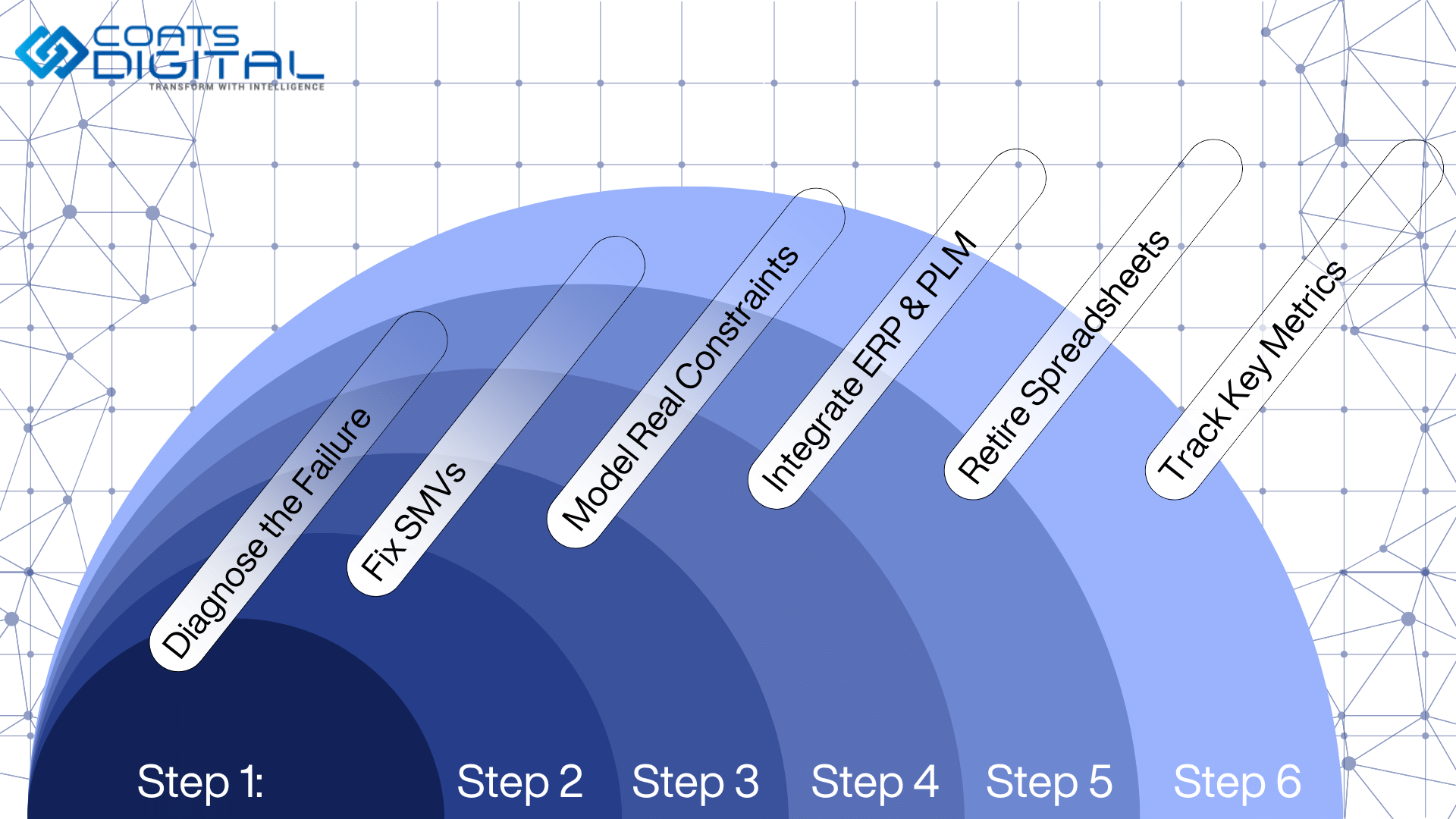
Six steps, in this order. The sequence matters: re-modelling constraints before fixing standards produces a more sophisticated wrong answer.
Step 1: Diagnose the failure type
Establish which failure you have (hard, silent, or value) and which root type dominates (data, model, or people and process). Use the fit-versus-implementation test above. This costs about a week and routinely saves a licence.
Step 2: Fix the standards first
Engineer and clean the SMVs. Everything downstream inherits their accuracy, which is why standards over estimates is the load-bearing decision rather than a slogan. Coats Digital publishes typical GSDCost benefits of a 5% reduction in SMVs, a 5% productivity increase, and a 10% OTDP improvement. Those are vendor-reported figures rather than independently audited results, so read them as directional. The direction is what matters: accuracy at this layer propagates to every other layer.
Step 3: Re-model the real constraints
Add wash-house throughput, fabric-in dates, and realistic energy availability. Drop theoretical capacity and set the buffer. Build learning curves for new styles. This is configuration work, not procurement, and it is where most recoveries find their largest single gain.
Step 4: Connect the floor and integrate ERP and PLM
Get actuals and order data flowing automatically. This is usually the step that converts a reporting layer back into a planning engine, because it removes the re-keying burden that drove planners to Excel in the first place.
Step 5: Retire the shadow spreadsheet deliberately
Make the system the only place a commitment gets made. Assign owners. Deliver the training the first rollout skipped. Do this after steps 2 to 4, never before.
Step 6: Baseline and track the metrics
Capture OTDP, line utilisation and lead time before you start. Review on a rolling cadence. Report the gain internally, because rebuilding organisational trust is a deliverable in its own right, not a by-product.
Who owns what
| Activity | Responsible | Accountable | Consulted | Informed |
| Standards accuracy | IE team | Planning Head | Merchandising | MD |
| Constraint modelling | Planning and IE | Planning Head | Wash house and finishing | Directors |
| Data integration | IT and Digital | Head of Digital | Vendor | Planning |
| Commitment validation | PPC | Planning Head | Merchandising | MD |
| Adoption and training | Planning Head | MD or Director of Operations | IT | All users |
Notice that IT is accountable for exactly one row. That distribution is the point.
What Should You Demand From Capacity Planning Software Before You Buy?
If you are evaluating rather than recovering, hold vendors to this. Each requirement maps to a specific failure above.
- Standards-driven: Accepts engineered SMVs and operation bulletins, not just user-entered target outputs.
- Constraint-aware: Models finishing, wash-house loads, and material availability as scheduling constraints.
- Critical path per product: Handles short local-knit and long imported-woven lead times differently within one plan.
- Realistic capacity: Supports efficiency profiles, buffers, and start-up or training curves.
- Order-aware. Separates forecast from confirmed demand and re-plans on a rolling basis.
- Integrated: Connects to ERP, PLM, and shop-floor data collection without manual re-keying.
- One visual planning board: Drag-and-drop, scenario testing, a version of truth everyone works from.
- Control-tower view: Visibility across units, subcontractors and wash houses for allocation decisions.
- Change-management support: Phased rollout, defined owners and real training, contracted rather than assumed.
- Agreed success criteria: OTDP, utilisation and lead-time targets defined and baselined before day one.
Readiness self-assessment
Score each red, amber or green before spending anything:
- Are your SMVs engineered and current?
- Have you identified the binding constraint for each product type?
- Is master-data ownership assigned to a named person?
- Do you have order-confirmation discipline?
- Is there executive sponsorship beyond IT?
If most are red, the highest-return investment available is not software. It is the four to eight weeks of standards and process work that will make software work once you buy it.
On ROI timelines
Payback is a function of data readiness, not vendor promise. Coats Digital publishes a typical return on investment of under 12 months for FastReactPlan, a vendor figure that plainly assumes a competent implementation into a reasonably prepared business. A factory starting from engineered standards and clear ownership will beat it. One starting from stale SMVs and spreadsheets will not, and expecting a transformed plan in week one is itself among the causes of failure listed above.
How Purpose-Built Apparel Planning Removes the Structural Failure Modes
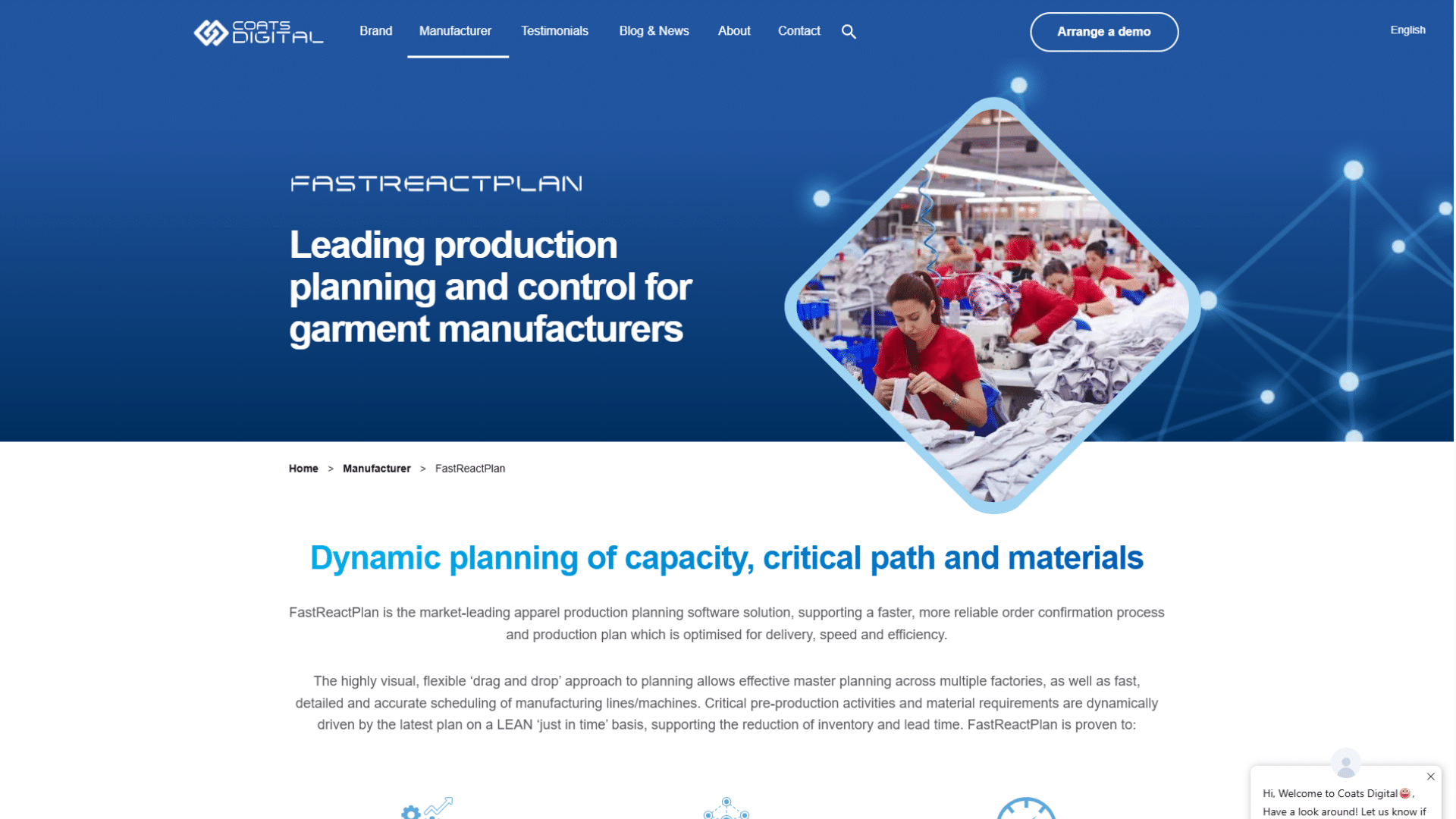
FastReactPlan integrates capacity, critical path, and materials into one visual planning board, with drag-and-drop master planning across factories and line-level scheduling built on standard minutes, efficiency profiles, and training curves. Master planning supplies the control-tower view across units and subcontractors, handling projected and confirmed demand separately with scenario sandboxing before anything is released. Material requirements are driven on LEAN pull principles from the live sewing plan. Optional modules cover advanced planning and scheduling, laundry and embellishment sequencing, and tooling constraints. Coats Digital reports 500+ clients across 40+ countries and 2,000+ factories planned on the system.
Upstream, GSDCost supplies the engineered standards the plan depends on. FastReactFabric addresses the woven fabric problem by connecting buying and cutting in a single platform.
The Bangladesh evidence is on the record rather than asserted. Beyond Tusuka and Azim Group, Coats Digital reports that Epyllion Group improved delivery performance by 58% with FastReactPlan and automated 70% of its fabric booking with FastReactFabric, saving 2% on fabric buying cost. Knitwear group Panam Group extended forward-plan visibility from three months to twelve, alongside a reported 3% efficiency gain. Fakir Fashion, producing around 300,000 garments a day, is documented as integrating GSDCost with its existing ERP.
What the software cannot do
This needs saying plainly, or the rest of this article is dishonest.
A purpose-built system removes the structural failure modes. It can represent wash-house batching. It can separate confirmed from forecast demand. It can carry efficiency and learning curves. It can integrate with your ERP.
It cannot engineer your standards, assign your data owners, stop merchandising from committing an unvalidated date, or delete the spreadsheet on a planner’s laptop. Those four sit with the organisation, and no vendor on earth sells them.
| Failure mode | Generic or misused tool | Purpose-built and well-adopted |
| Constraint blindness | Plans sewing only | Models wash house, finishing, fabric-in |
| Stale plan | Manual, a day late | Live shop-floor and ERP/PLM data |
| Two versions of truth | Shadow Excel survives | One visual planning board |
| Bad standards | Estimated SMVs | Engineered standards upstream |
| Multi-unit fragmentation | Site-by-site planning | Control-tower view |
| Volatile orders | Every order treated as fixed | Forecast and confirmed staged separately |
Fix the Inputs, Not Just the Interface
Capacity planning software rarely fails on its own merits. It fails when it is fed estimated standards, blinded to the real constraint, built on unconfirmed orders, run against hours the grid cannot supply, disconnected from the floor, or quietly ignored in favour of a spreadsheet somebody trusts more.
The right response depends entirely on which failure you have. A data failure needs standards work. A model failure needs reconfiguration. A governance failure needs merchandising and planning looking at the same numbers before a date leaves the building. Only a genuine fit failure needs a different system, and that is rarer than most procurement conversations assume.
Clean the inputs at source, and the same software starts producing plans the floor can hold and buyers can rely on. Fix the inputs, not just the interface.
If you want to see what a standards-driven, constraint-aware plan looks like on one board before committing to anything, arrange a FastReactPlan demonstration. If you are earlier in the process, our guide to production planning software used by Bangladesh garment factories maps the category before you shortlist.
Frequently Asked Questions
-
Why does capacity planning software fail in garment factories?
Usually not because the software is broken. It fails on estimated SMVs and stale master data, plans built to theoretical 100% capacity, unmodelled constraints such as the wash house or fabric-in date, order books that keep shifting, weak integration, and low adoption where planners keep a shadow spreadsheet. The tool exposes these gaps rather than causing them.
-
Is it the software or our processes that’s failing?
Most often the processes and inputs. If SMVs are estimated, the plan runs to full capacity, or ship dates are committed before the plan validates them, even excellent software produces plans that miss. The exception is fit failure: a generic tool that cannot model SMVs, critical path, or wash-house batching. Diagnose which before spending again
-
Why do garment factories go back to Excel after buying planning software?
Because trust broke. Bad standards produced plans that missed the floor, or the rollout was imposed without process change. Planners keep a familiar spreadsheet just in case, two versions of truth emerge, and the software becomes a data-entry chore. Fix the standards, connect the floor, assign ownership, then make the system the only place commitments are made.
-
What’s the single biggest cause of planning software failure in apparel?
Estimated or stale SMVs. Every capacity calculation depends on reliable sewing minutes. Coats Digital’s published data records one manufacturer whose SMVs varied by up to 30% across its own lines before standardisation. Where standards are that inconsistent, the system produces confident-looking plans that miss ship dates, and nobody can explain why.
-
What buffer should we plan capacity at?
Plan at 80–90% of theoretical capacity as a working default, then refine against your own data. The buffer absorbs absenteeism, machine downtime, changeovers, and ramp-up. Published research puts daily absenteeism in Bangladeshi garment factories at roughly 4% to 6.5%, so a 100% plan is already wrong before anything else goes wrong.
-
Can a generic ERP handle garment capacity planning?
Often poorly. An ERP planning module is built around order and financial data: it tells you what is due and whether materials exist. It rarely delivers line-level visual scheduling, real-time capacity recalculation, critical-path alerting, or OTDP tracking. Most high-performing exporters run a dedicated planning tool alongside a fit-for-purpose ERP rather than stretching the ERP module.
-
Can planning software work if our buyers keep changing orders?
Yes, if it is designed for it. Apparel planning must stage plans by order-confirmation status and re-plan on a rolling basis as orders firm. The US surcharge on Bangladeshi garments has been rebuilt on three separate legal bases since April 2025, so instability is structural rather than temporary. Pair order-aware software with the discipline of not committing capacity to unconfirmed volumes.
-
Does planning software need to integrate with our ERP and PLM?
For a reliable single source of truth, yes. Without integration, planners re-key data, plans go stale, and order, style, and material information drift apart across systems. Integration with ERP, PLM, and shop-floor data collection keeps the plan live and removes the duplicate-entry burden that pushes teams back to spreadsheets.
-
How do I know if my planning software is silently failing?
Look for the tells. Planners still keep a master spreadsheet. Plan and floor disagree beyond tolerance every week. Denim stacks up before the wash house. New styles miss ramp-up. Nobody can state the plan’s OTDP or utilisation impact. Any one of these means the tool is not functioning as your single source of truth.
-
Should we roll out planning software line-by-line or all at once?
Phased, in almost all cases. A big-bang switch across every line and process overwhelms teams and buries the early wins that build belief. Start with one product line or unit, prove the plan holds, then extend. Phasing also surfaces data and process gaps at small scale, before they propagate across the group.
-
What data do you need before capacity planning software will work?
At minimum: engineered SMVs or operation bulletins, accurate machine and line configurations, realistic efficiency curves, operator skill matrices, order-confirmation status, and downstream constraints including wash-house throughput for denim and fabric-in dates for woven. In Bangladesh currently, add realistic energy availability. All of it needs a named owner and a review cadence.
-
Who in the factory should own the planning system?
The business, not IT. The Planning or PPC Head owns the plan, industrial engineering owns the standards, IT and Digital own the integration, and merchandising owns the discipline of validating commitments before they reach the buyer. Where ownership is clear and cross-functional, adoption holds. Where it sits with IT alone, behaviour never changes, and the software fails.

Brand-to-Vendor Cost Collaboration: Which Layer of the Cost Stack Are You Missing?

Why Does Capacity Planning Software Fail in Bangladesh’s Garment Manufacturing Sector?
The Best Tools for US Fashion Brands to Track and Report Supplier Labour Costs for ESG Compliance
All Blog Categories
- Production Planning
- Corporate
- Method Time Cost Optimisation
- Supply Chain Solutions
- Sustainability
- Videos