Garment Capacity Planning Software in India: How to Size, Choose and Implement It (2026)
by Kunal Kapur
 9
Mins Read
Key Takeaways
- Garment capacity planning software in India matches orders to the capacity a factory can actually calculate, not the nameplate figure that overstates real output threefold.
- Standard minute values (SMV) are the precondition. Unreliable SMVs make a planning system confidently wrong rather than usefully right, faster than a spreadsheet ever did.
- ERP planning modules generally assume capacity. Dedicated finite-capacity systems compute it from standard minutes, efficiency profiles, and start-up curves.
- FY26 compressed margins and pushed exporters into new markets, making every planning error more expensive, not less.
- Factories sit on a five-rung planning maturity ladder. The right purchase depends entirely on which rung you occupy.
- The tools fall into five categories: dedicated planning, apparel ERP, standards and costing, materials, and the incumbent spreadsheet. No single tool covers all five well.
- Master data quality and a single plan owner determine whether an implementation succeeds; some factories should fix both before buying any software.
A garment order gets confirmed in a Monday meeting, booked against a capacity number nobody has audited in two years. Six weeks later the fabric lands late, the embroidery line is already committed to another style, and the buyer pulls the ex-factory date forward to make a vessel. The factory runs full the whole time and still ships late.
Busy and planned are not the same condition, and the gap between them is where garment capacity planning software earns its place. A unit can be loaded to the last machine and still miss its dates, because capacity that cannot be calculated cannot be promised in the first place. This guide takes the two problems in that order: how to work out what your factory can genuinely promise, and then how to choose the system that protects that promise once it is made.
What Garment Capacity Planning Software Actually Does
Garment capacity planning software matches confirmed and forecast orders to the real capacity of a factory’s sewing lines, machines, and supporting processes. It schedules production against standard minutes and achievable efficiency, tracks the pre-production critical path and material availability, and gives planners a live view of load against capacity.
Any planning system has to reconcile three constraints at once: capacity, the pre-production critical path, and materials. In most factories, these are owned by three different people working in three different systems, which is precisely why they collide in week six of an order rather than week one.
Capacity planning, production planning, and scheduling are three different jobs
| Discipline | The question it answers | Where it lives |
| Capacity planning | Can we take this order, on which lines, by when, without breaking another order? | Order confirmation |
| Production planning and control | How does that become a sequenced schedule, and how do we keep it on track? | The planning board |
| Scheduling | What runs on which line tomorrow? | The daily meeting |
Good tools do all three. The useful question for a buyer is which of the three you are actually short of.
Where planning sits in the factory technology stack
Planning sits between the systems that define a product and the systems that run the floor. Product Lifecycle Management (PLM) holds the tech pack and the specification. Enterprise Resource Planning (ERP) holds orders, materials, and finance. A Manufacturing Execution System (MES), or shop-floor data capture, records what actually happened on the line. Capacity planning is the layer that decides what the floor should be doing, and when.
That position explains the single most important distinction in this category. ERP planning modules generally assume capacity. Dedicated planning systems compute it. An ERP schedules at order and material level against a capacity figure that someone typed into a field, while a finite-capacity system derives capacity from standard minutes, efficiency profiles and start-up curves, and recalculates it every time the plan moves. When you read a feature list, that is the line to look for.
How to Calculate Your Factory’s Real Capacity
Before any software evaluation, run this calculation once, on paper, with your own numbers. It is the most useful hour a production head can spend, and the gap it exposes is the business case for everything that follows. Most factories never do it, which is why the number in the order-confirmation meeting and the number the floor can actually hit have drifted so far apart.
Start with nameplate capacity, the figure most factories quote against. Multiply operators by working minutes per day by working days in the month:
Operators × working minutes per day × working days = available standard minutes
A 500-operator unit on a single eight-hour shift across 26 working days gives 500 × 480 × 26 = 6,240,000 standard minutes a month. That is the number that goes into the order-confirmation meeting. It is also wrong by roughly a factor of three, because it assumes every operator is present every minute, every line is at full efficiency, no style changes, no bottlenecks, and every material on time.
Here is what happens when you de-rate it step by step. Every percentage below is an illustrative assumption carried through one example factory. Substitute your own twelve-month data at each step; the numbers are the method, not a benchmark.
| Step | What it removes | Illustrative assumption | Standard minutes remaining |
| 1. Nameplate | Nothing | 500 operators, 480 minutes, 26 days | 6,240,000 |
| 2. Attendance-adjusted | Absenteeism, attrition, post-festival returns | 92% attendance | 5,740,800 |
| 3. Efficiency-adjusted | Gap between standard minutes and actual performance | 55% average line efficiency | 3,157,440 |
| 4. Changeover-adjusted | Style changeover time and the learning curve on each new style | 8% loss across the month | 2,904,845 |
| 5. Bottleneck-constrained | The tightest supporting process for this style mix | Embroidery supports 85% of sewing output | 2,469,118 |
| 6. Material-constrained | Fabric and trims arriving after the planned cut date | 10% of load gated by late material | 2,222,206 |
In this illustration, promisable capacity lands at about 36% of nameplate. At a standard allowed minute (SAM) of 15 minutes per garment, that is roughly 148,000 garments a month rather than the 416,000 the nameplate figure implies. A factory quoting against nameplate is not being optimistic. It is committing to close to three times what it can actually deliver.
Each step removes a specific, identifiable loss, and each is worth understanding in floor terms.
- Attendance: Migrant and seasonal workforces make attendance move sharply around festival returns, which in many units arrive in staggered waves over two or three weeks. Plan against your own twelve-month attendance record, not against headcount, or you build a shortfall into every month.
- Efficiency: Line efficiency varies by line, by product category, and by how long a line has been running a given style. A single factory-wide efficiency figure is the most common source of planning error in the industry, because it averages away exactly the differences that decide whether an order ships.
- Changeover: This is the multi-style penalty. A factory running eight styles a month genuinely has less capacity than one running three with the same operators and machines, because every new style carries changeover time and a fresh learning curve before the line reaches speed.
- Bottleneck: Sewing is rarely the real constraint. Your capacity is set by whichever supporting process is tightest for this month’s style mix, whether that is embroidery, screen printing, washing, or finishing. Plan as though sewing is always the binding step and you will over-commit on every embellishment-heavy style.
- Materials: A plan that starts before fabric and trims arrive is a wish, not a plan. Late material caps everything downstream of it, however much sewing capacity sits idle waiting.
Run the ladder with your own figures before you evaluate a single tool. If the distance between your nameplate number and your promisable number surprises you, that distance is the reason to keep reading. The 36% here is arithmetic on stated assumptions and nothing more; it is not an industry benchmark, and your own result will land somewhere else.
Why Indian Factories Miss Dates in 2026
The trade reality, dated
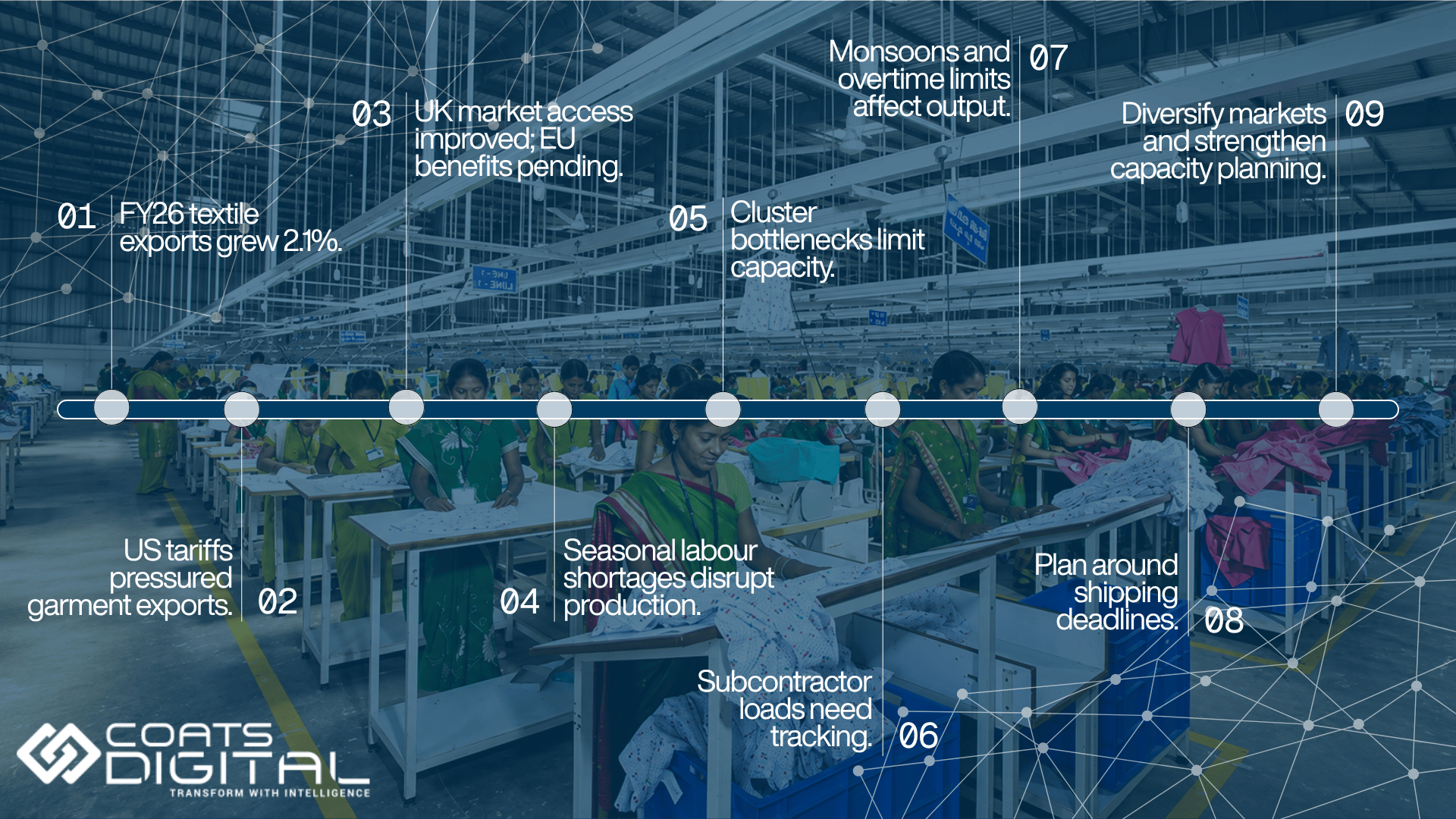
FY26 was a harder year than the headline numbers suggest. India’s textile exports, including handicrafts, still grew 2.1% to ₹3.16 lakh crore in the year to March 2026, and ready-made garments, the largest segment, rose 2.9% to ₹1.39 lakh crore (Ministry of Textiles). That growth masks a sharp mid-year shock.
From 27 August 2025, the United States applied a 50% tariff on Indian garments, and the effect was immediate. A Confederation of Indian Textile Industry (CITI) survey in October 2025 found roughly one in three exporters reporting US business down by more than half, with inventory piling up, discounts of up to 25% offered to hold orders, and credit cycles stretching across the supply chain (CITI survey). CRISIL Ratings cut its FY26 garment revenue growth forecast to 3 to 5%, about half the previous year’s pace, and expected the US share of India’s garment exports to fall from 33% toward 20 to 25% (CRISIL).
The position has since eased, and the date matters. A February 2026 interim understanding brought the headline tariff down from 50% to 18%, and by mid-2026 a permanent 10% rate had settled on the majority of Indian exports, with a large share exempted; textiles remain among the lines carrying the additional duty and did not win the tariff-rate-quota exemption the sector asked for (Reuters).
As of October 2026, Indian apparel competes in the US at a materially lower tariff than the autumn-2025 peak, but still at a disadvantage to several Asian rivals, with a bilateral trade agreement still under negotiation. Market access elsewhere improved in parallel.
The India–UK CETA entered into force on 15 July 2026, giving Indian textiles and clothing duty-free access across 1,143 tariff lines and removing UK duties of up to 12% (PIB); the India–EFTA agreement has been in force since October 2025; and the India–EU FTA, concluded in January 2026, is expected to take effect later. FY26 export growth was strongest to the UAE, Japan, and several African markets.
The structural constraints, treated concretely.
- Attendance is seasonal, not stable: Migrant workforces return from festivals in staggered waves over two or three weeks. Planning against headcount builds a shortfall into every month.
- Cluster specialisation sets the bottleneck: A system configured as though sewing is always the constraint will mis-plan most of the clusters below.
- Job work is structural capacity, not overflow: A large share of Indian capacity sits with subcontractors. A board that cannot show subcontractor load beside in-house load is missing half the picture.
- Overtime is legally capped: Statutory limits under the Factories Act, as amended by each state, cap the “just add hours” response. Verify the current limit for your state rather than assuming a single national number.
- Monsoon constrains wet processing: Washing and drying throughput drops in humid months where drying capacity is short, which moves the bottleneck seasonally.
- Plan back from the vessel cut-off, not the ex-factory date: Multi-buyer shipment consolidation means the real deadline is the sailing, and factories that plan only to the ex-factory date lose the buffer they thought they had.
Cluster bottlenecks:
- Tiruppur: knits
- Ludhiana: winter wear and knits
- NCR (Noida, Gurugram): embellishment-heavy ladies’ woven, where handwork rather than sewing is usually the binding constraint
- Bengaluru: structured woven in large organised units
- Ahmedabad and Surat: denim and fabric, where the wash programme dominates the schedule
Diversifying away from US volume buyers is not a like-for-like swap. It means smaller orders, more styles per line, unfamiliar lead-time norms and new compliance expectations, which together make a harder planning problem than the one these factories spent a decade solving. The factories that hold delivery through the transition keep the new buyers. The ones that do not trade a tariff problem for a reputation problem.
How Garment Capacity Planning Software Works
Underneath the dashboards, a capacity planning system does five things in sequence.
1. Master planning: load against capacity
The high-level board balances total demand, both confirmed and forecast, against total capacity across factories, lines, and subcontractors. It makes order allocation a calculation rather than an instinct, and it is where a planner first sees that next month is already over-committed.
2. Line and machine scheduling against standard minutes
Lines and machines are scheduled using standard minute values (SMV), efficiency profiles, and start-up or training curves, so the schedule reflects achievable output rather than ideal output. This is the mechanism that separates computing capacity from assuming it, and it is the single largest determinant of how accurate the plan turns out to be.
3. Critical path and the Time and Action calendar
The pre-production milestones are tracked against dynamic target dates: fabric approval, lab dips, trims, sampling, and purchase-order placement. Because the Time and Action (T&A) calendar back-schedules from the ship date, an upstream slip becomes visible weeks before it reaches the sewing line, while there is still time to act on it.
4. Bottleneck synchronisation
Embroidery, screen printing, washing and finishing are scheduled dynamically off the sewing plan rather than planned in isolation, so when the sewing plan moves, the supporting processes move with it. This is what stops the embroidery line becoming a surprise in week four.
5. Live re-planning and what-if simulation
When an order changes, the system recalculates load, flags the conflicts the change creates, and lets planners test scenarios before committing to any of them.
The difference shows up the moment reality breaks the plan. A buyer holds shipment on a confirmed order. On a spreadsheet, the planner works out the knock-on effects style by style across the following week while the lines run half-loaded. On a live plan, the planner pulls the held order out, sees which orders can move forward into the gap, checks whether their fabric has already landed, and reloads the lines the same afternoon. The gap between those two responses is a month of line time.
Three Things That Decide Whether the Software Will Work
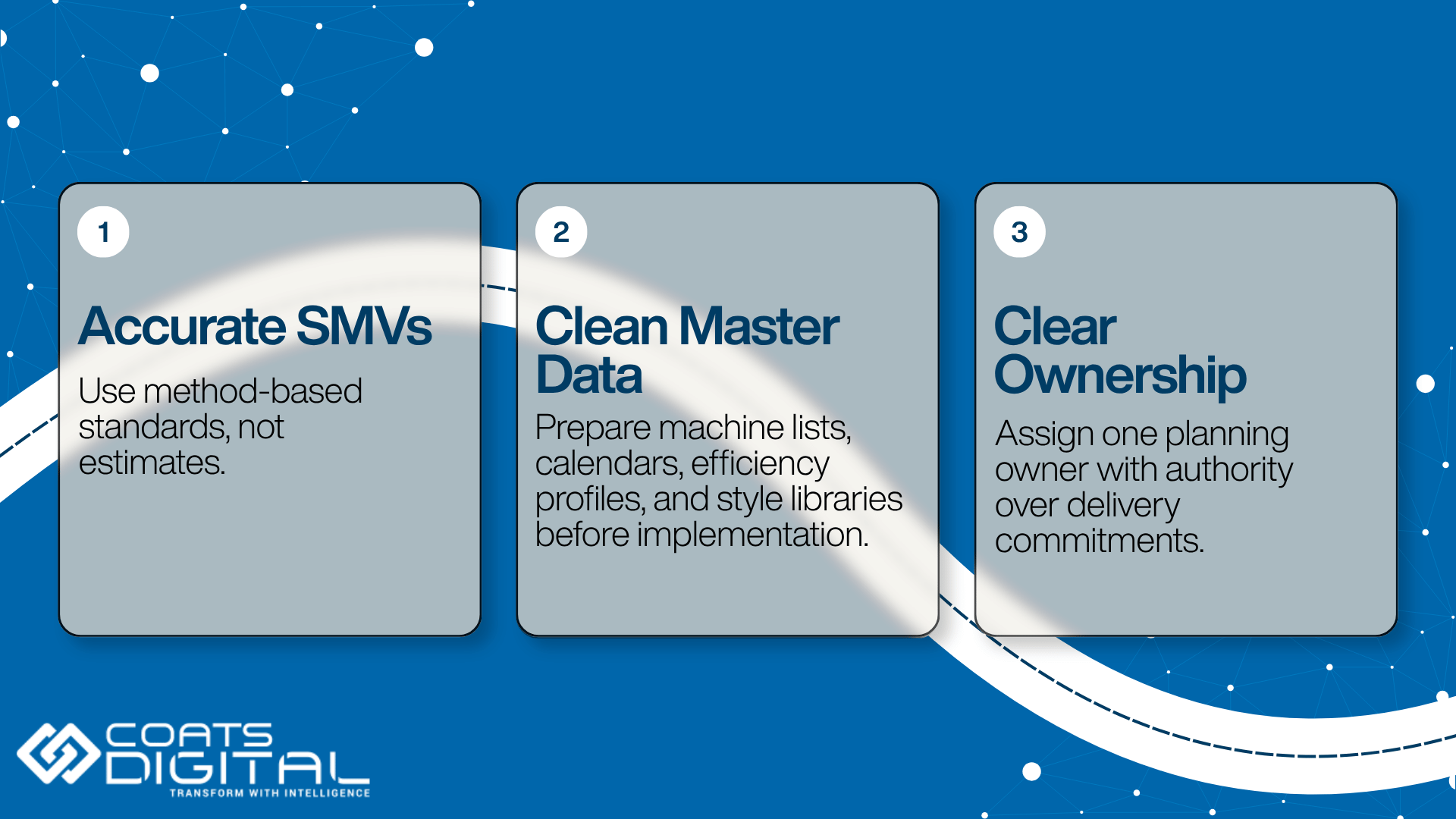
Buying the system is the easy part. Three conditions decide whether it earns its keep, and none of them is a feature.
Your standard minutes have to be real.
A planning system inherits the quality of the standards behind it. Where SMVs are negotiated with buyers, carried over from an old file, or estimated from last season’s output, a finite-capacity system will produce confident, precise, wrong answers faster than the spreadsheet did. Buyers who skip this step do not get a worse plan; they get a worse plan delivered with more authority, which is harder to argue with on the floor.
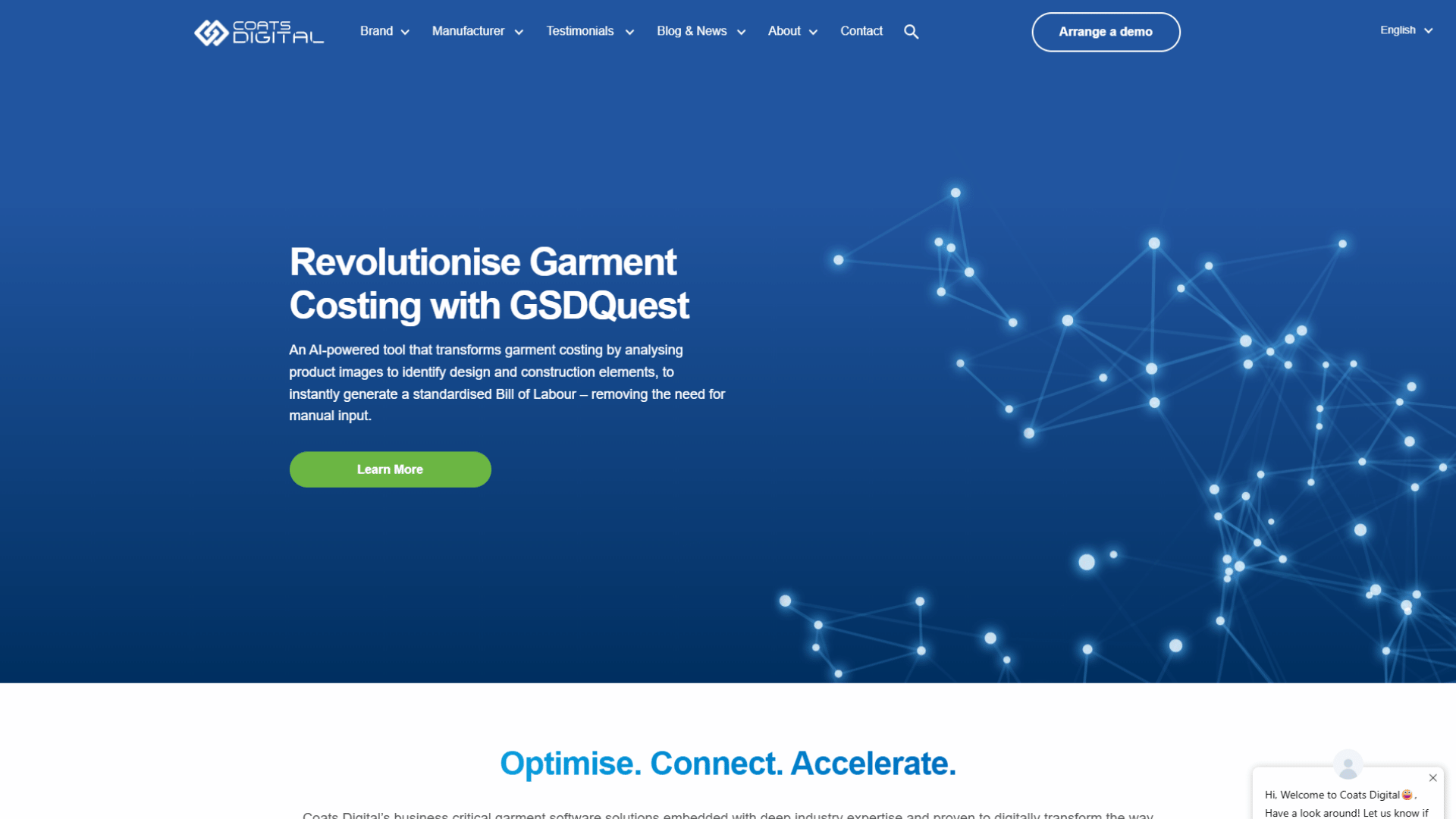
The distinction that matters is between a negotiated SMV and one derived from method analysis using predetermined motion data. This is the problem GSDCost is built to solve: it establishes accurate standard minute values from a predetermined motion-code library rather than from negotiation or history, and its companion GSDQuest generates an image-based Bill of Labour from a photograph or tech pack. One published customer result: PT Sumbiri improved productivity by 13% with GSDCost.
Your master data has to exist before go-live
Line and machine lists, working calendars, efficiency profiles by line and product category, bills of material, and a maintained style library all have to be in place before the system can plan anything. Dirty or missing master data is the most common reason implementations stall in small and mid-sized Indian units. This work belongs before procurement, not during implementation, where it quietly becomes the reason a six-week rollout takes six months.
Somebody has to own the plan.
Merchandising commits dates, industrial engineering (IE) owns the standards, planning owns the board, and production owns the outcome. Where those four are split with no single owner, the plan becomes a negotiation, and the software becomes a reporting tool that records slippage after the fact. The plan needs one owner with the authority to say no to a date. In practice, the test is simple: when a buyer pushes for a date the board cannot hold, is there one person who can decline it, and does the organisation back them? That is an organisational fix, not a software one, and no vendor can supply it.
Stated plainly: if your SMVs are unreliable and nobody owns the plan, fixing those two things will deliver more than any software purchase, and should come first.
How We Selected These Tools: Four Criteria
- Adoption: Evidence of use in Indian garment manufacturing or comparable export operations.
- Planning depth: Depth of capacity planning and finite-capacity scheduling capability.
- India readiness: Deployment readiness in India, covering Goods and Services Tax (GST) compliance, local support, and a workable cloud or on-premises model.
- Scale fit: Suitability across small, mid-size, and large factories.
The Tools Indian Garment Manufacturers Use: At a Glance
| Tool | Category | Deployment | Best-fit size | India & GST readiness | Core planning strength | Pricing signal |
| FastReactPlan | Dedicated planning | Cloud / on-prem | Mid to large, multi-site | Via implementation | Finite-capacity planning and control | Custom quote |
| BlueKaktus | Dedicated planning + ERP | Cloud | Mid to large | India-origin, GST-ready | Auto-planning (iPPC) with MES | Contact vendor |
| Datatex NOW ERP | Textile ERP + APS | Cloud / on-prem | Large, vertically integrated | Via partner | APS with dye-lot control | Contact vendor |
| LOGIC ERP | Apparel ERP | Cloud / on-prem | Small to mid | India-origin, GST-native | MRP and job-work tracking | Contact vendor |
| Oracle NetSuite | Cloud ERP | Cloud | Mid to large | Strong partner ecosystem | Capacity requirements planning | Custom quote |
| VasyERP | SME ERP | Cloud | Small to mid | India-built, GST-ready | Production planning + job work | Low tens of thousands/yr (verify) |
| WFX | Cloud ERP + PLM | Cloud | Mid to large | Gurgaon tech centre | T&A and production tracking | Contact vendor |
| GSDCost / GSDQuest | Standards and costing | SaaS | Any unit with IE staff | Global standard | Accurate SMVs (not a planner) | Custom quote |
| FastReactFabric | Materials and cutting | Cloud / on-prem | Mid to large | Via implementation | Fabric buying and cutting | Custom quote |
| Microsoft Excel | The incumbent | Desktop/cloud | One line, few styles | Universal | None native | Licence only |
Best Garment Capacity Planning Software in India, by Category
Dedicated production and capacity planning
FastReactPlan (Coats Digital):
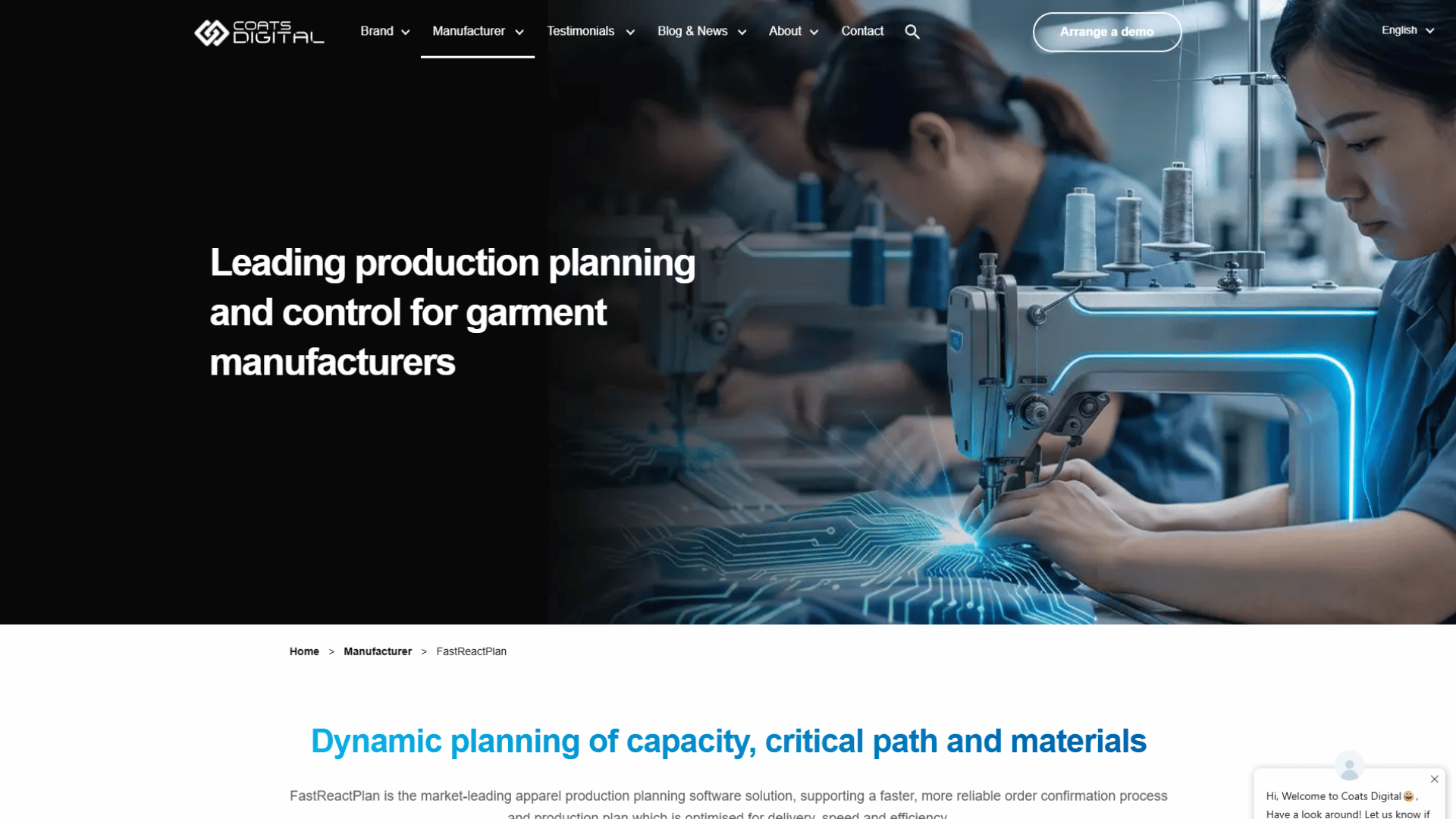
FastReactPlan is a part of Coats Digital’s Manufacturing Solution Suite, dedicated planning and control built for apparel and footwear, not adapted from a generic ERP.
- How it plans: brings capacity, materials, and the pre-production critical path into one visual, drag-and-drop system.
- Master planning: control-tower view across factories and subcontractors.
- Line scheduling: driven by standard minutes, efficiency profiles, and start-up curves; embroidery and screen printing schedule dynamically off the sewing plan.
- Scale: reports 500-plus clients, 40-plus countries and over 2,000 factories.
- Reported benefits: 3 to 10% productivity, 10 to 30% better OTDP, 10 to 30% lead-time reduction, payback usually under twelve months.
- Honest limitation: a planning specialist, not a full ERP, so it connects to finance and inventory systems rather than replacing them.
BlueKaktus:
BlueKaktus is an India-origin cloud platform pairing intelligent production planning and control with a full apparel ERP.
- How it plans: iPPC module auto-plans by batch, shift, material, and deadline, drawing on MES data.
- Access: mobile access for line workers on the floor.
- Scale: reports 350-plus factories and over 50,000 users across ten-plus countries.
- Reported benefits: up to 10% higher efficiency, up to 5% lower costs, around ₹30 lakh a year saved for a 300-operator unit.
- India fit: built and supported in India, GST-ready from the start.
- Honest limitation: less international brand recognition than the global ERPs, which can matter under a global buyer’s systems audit.
Apparel and textile ERP with planning modules
Datatex NOW ERP:

A textile-vertical ERP with a genuine advanced planning and scheduling (APS) engine, plus dye-lot and shade control, suited to vertically integrated mills.
- How it plans: a genuine advanced planning and scheduling (APS) engine, with dye-lot and shade control, inside a full manufacturing backbone.
- Best for: large operations that spin, dye, and stitch under one roof.
- India fit: GST handling and rollout typically run through an implementation partner.
- Honest limitation: enterprise-grade, so both the fit and the budget assume a large, proc₹ess-heavy operation.
LOGIC ERP (Apparel):

India-origin and GST-native, covering production planning, material requirements planning (MRP), multi-level bills of material, a size-and-colour matrix, job-work tracking, and production costing with variance analysis.
- How it plans: production planning, material requirements planning (MRP), multi-level bills of material, a size-and-colour matrix, job-work tracking, and production costing with variance analysis.
- Track record: Killer Jeans has run it across four manufacturing units for close to two decades.
- India fit: GST-native, strong in retail and distribution.
- Honest limitation: less suited to complex multi-factory export operations that need deep industrial-engineering integration and finite-capacity scheduling.
Oracle NetSuite for Apparel and Footwear
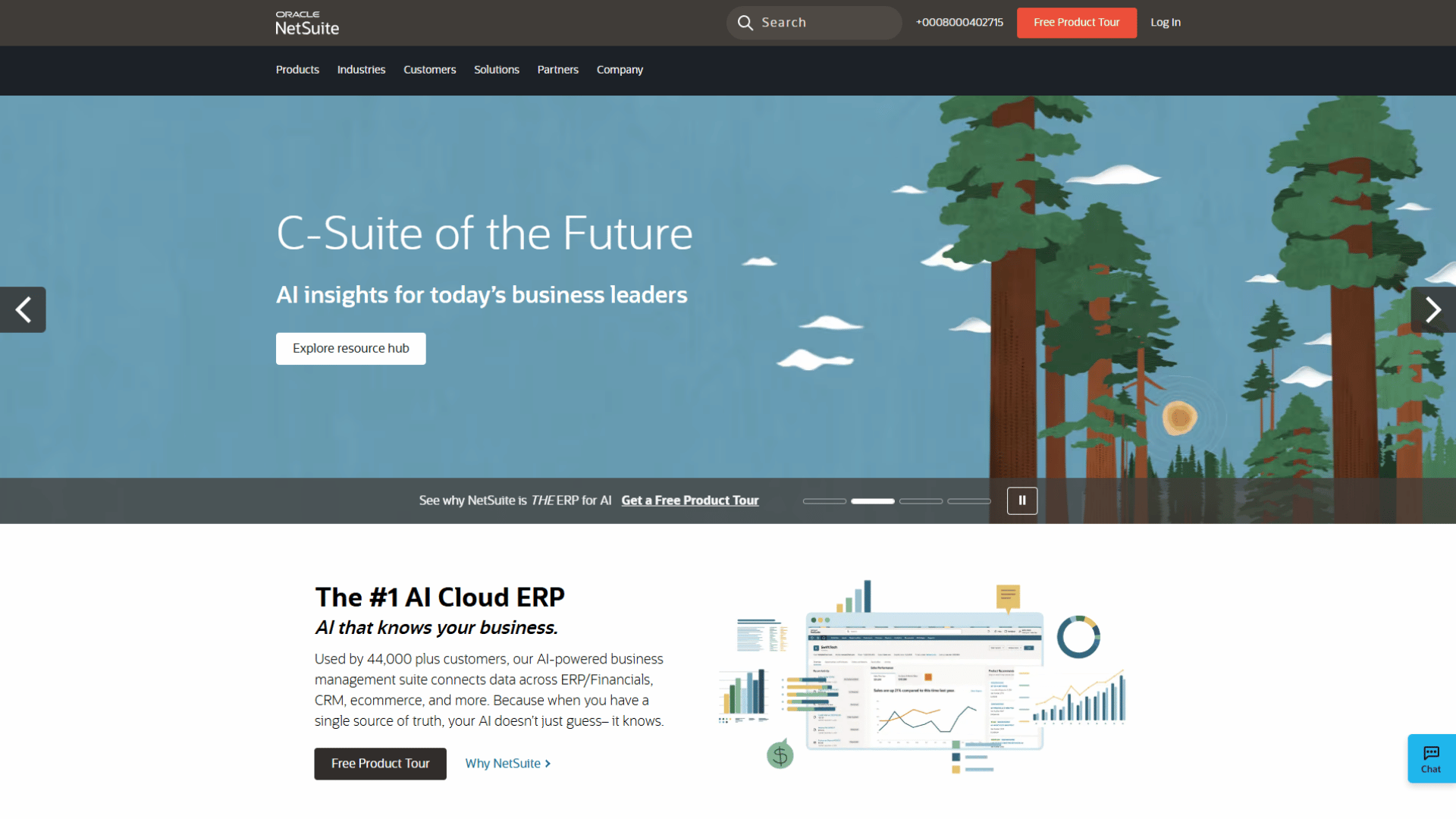
Cloud ERP with matrix inventory, landed-cost tracking and capacity requirements planning, supported by a strong Indian partner ecosystem.
- How it plans: matrix inventory, landed-cost tracking, and capacity requirements planning, with garment features added through apparel SuiteApps.
- Best for: groups wanting finance, inventory, and planning on one global platform.
- India fit: strong local partner ecosystem, GST handled as standard.
- Honest limitation: garment-grade line scheduling depends on the SuiteApp chosen, so evaluate that add-on rather than the core.
VasyERP
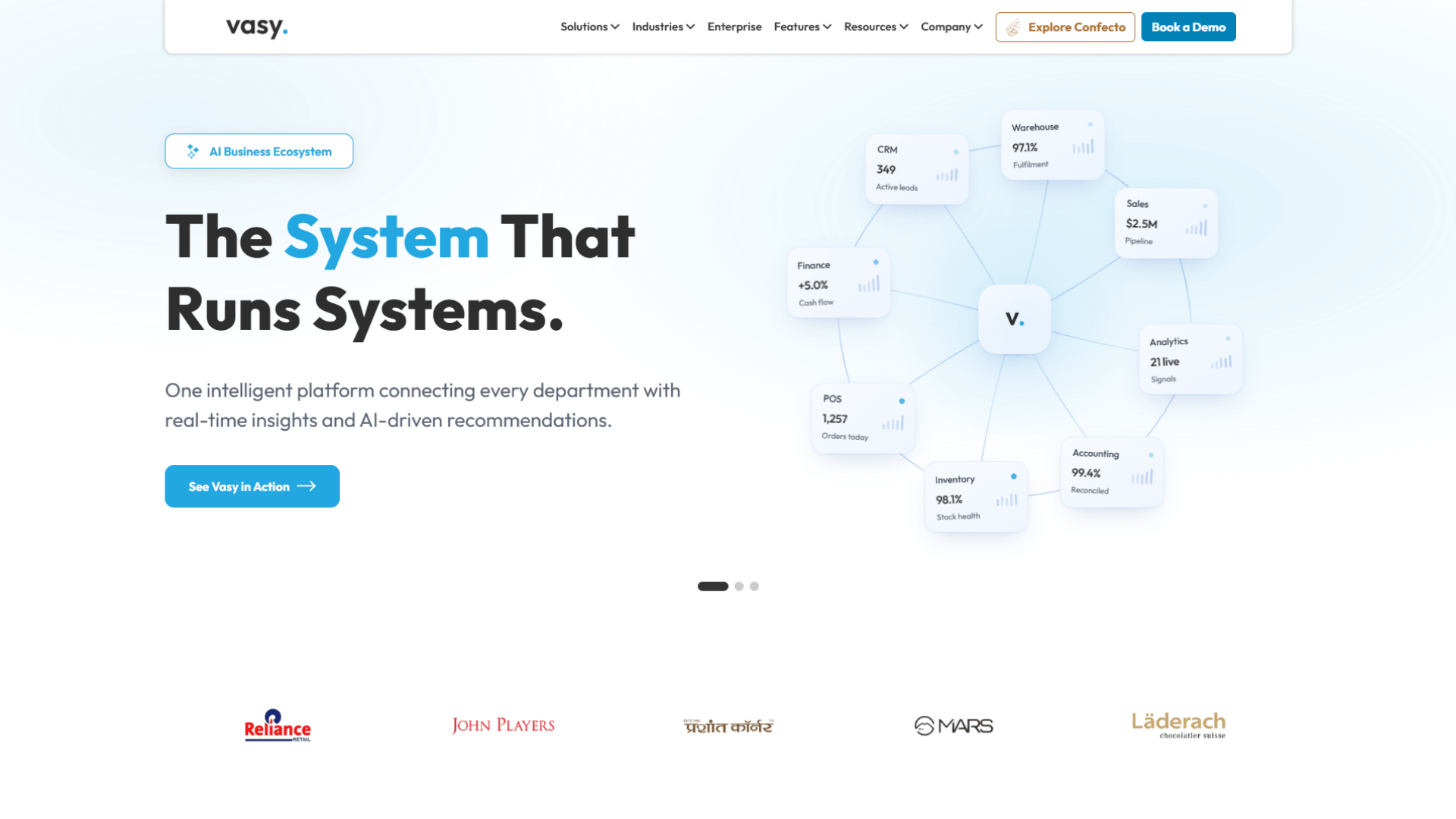
An India-built, GST-ready ERP aimed at small and mid-sized units.
- How it plans: style-and-colour matrix, bills of material, fabric-consumption tracking, production planning, job-work management and export documentation in one package.
- Pricing: entry plans advertised in the low tens of thousands of rupees a year; confirm current pricing with the vendor.
- India fit: built for Indian compliance and the SME price point from day one.
- Honest limitation: suits SME and mid-market scale rather than large, multi-country export operations.
WFX (World Fashion Exchange)
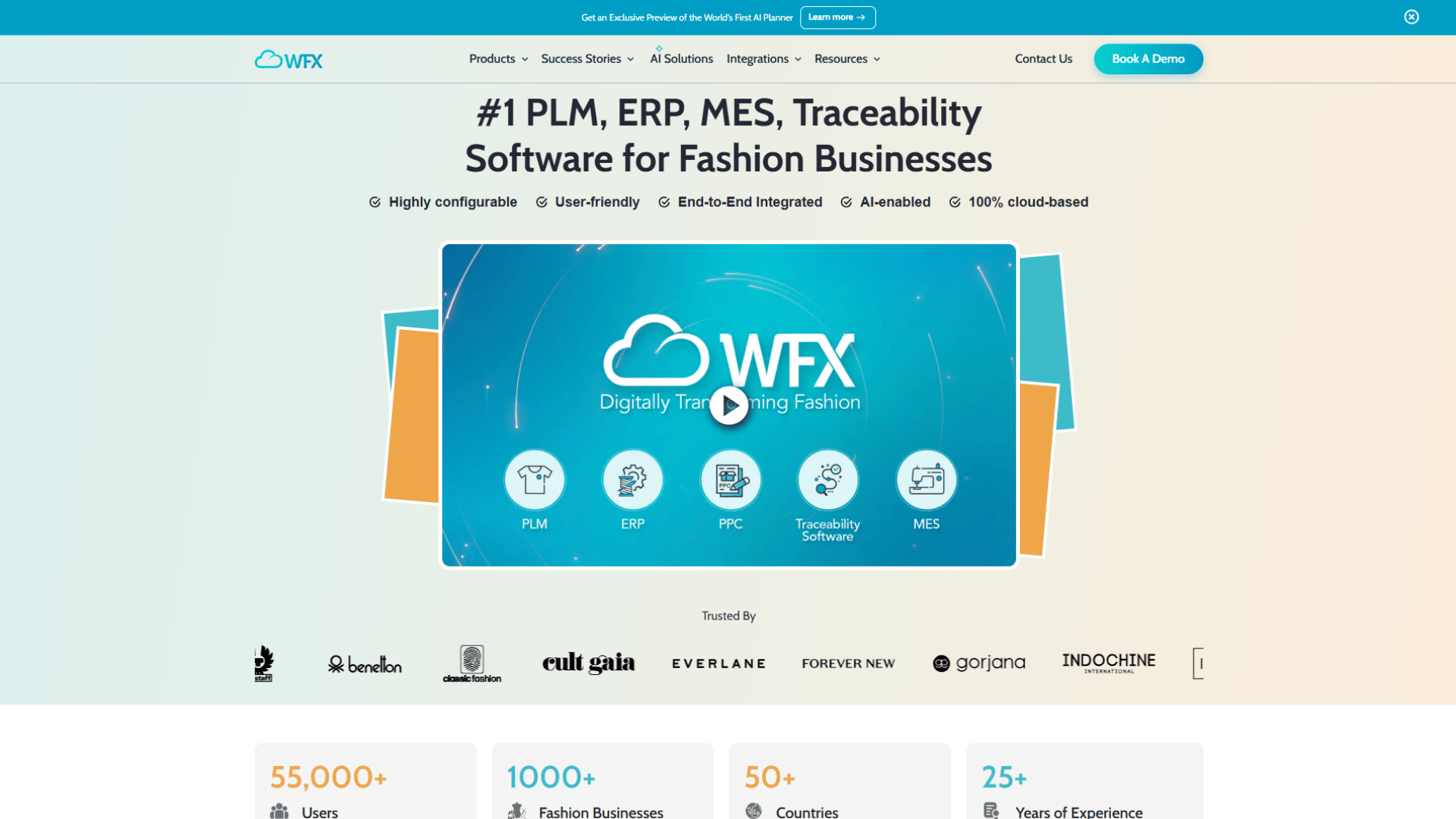
A cloud apparel ERP and PLM, supported from Gurgaon.
- How it plans: a Time and Action calendar, production tracking at line and process level, and a cut-plan fabric tool.
- Best for: manufacturers wanting planning and PLM joined up rather than bought separately.
- India fit: local development and support presence.
- Honest limitation: planning is one module inside a broader suite, so test the scheduling engine directly against your line-balancing needs.
Standards and costing that feed the plan
GSDCost and GSDQuest (Coats Digital)

Method-time-cost optimisation that feeds reliable standards into the plan.
- How it works: establishes accurate standard minute values from a predetermined motion-code library rather than from negotiation or history.
- GSDQuest: generates an image-based Bill of Labour from a photograph or tech pack.
- Why it is here: the capacity calculation at the heart of this guide is only as reliable as the standards feeding it.
- India fit: widely used across Indian export houses with industrial-engineering teams.
- Honest limitation: not a planning tool; it delivers most value where trained IE staff are already in place.
Materials and cutting room that protect the plan
FastReactFabric (Coats Digital)
Fabric planning that connects buying and cutting in one platform.
- How it works: aligns what is bought with what is actually cut, targeting the largest single material cost in most garments; brought together the former IntelloCut and IntelloBuy solutions in 2022.
- Reported benefits: up to 2.5% lower fabric cost and up to 90% less time spent on fabric planning and buying.
- Why it is here: runs alongside FastReactPlan, which handles dynamic capacity planning.
- India fit: relevant to any cutting-room-heavy operation managing fabric at scale.
- Honest limitation: protects materials and the cutting room rather than scheduling lines, so it complements a planning system rather than replacing one.
The incumbent
Microsoft Excel
Where almost every factory starts, and the honest baseline every tool here is measured against.
- Strengths: free, universally understood, endlessly flexible, and good enough for one line and a handful of styles.
- The gap: no concept of finite capacity, the critical path, or dynamic re-planning, so every dependency between sewing, embroidery, and washing is held together by hand.
- India fit: still the default across units of every size, which is the gap a planning system is bought to close.
- Honest limitation: the real cost is errors and staleness that creep in as orders multiply, not the licence fee.
How to Choose, by Factory Size and by Bottleneck
Name your single biggest planning failure before comparing a single feature. Is it promise dates you cannot hold, fabric arriving after the cut date, lines colliding mid-season, or an OTDP number that will not move? Buy for that, not for the longest feature list.
The planning maturity ladder
| Rung | Where you are | Where it breaks |
| 1 | Ad-hoc spreadsheets, one file per planner | At the second concurrent buyer |
| 2 | Structured spreadsheet with a capacity sheet | When order changes outpace manual recalculation |
| 3 | ERP planning module | When line-level scheduling and changeover sequencing start to matter |
| 4 | Dedicated finite-capacity planning | When capacity spans multiple sites and subcontractors with no consolidated view |
| 5 | Multi-factory consolidated planning with subcontractor visibility | Scales with the business |
Locate yourself on the ladder first, so the recommendation follows from a diagnosis rather than a preference. Most buying mistakes are a factory on rung two paying for rung five, or a factory on rung four still planning as though it were on rung two.
The decision matrix
| Primary bottleneck | Small (under 500 operators) | Mid (500 to 2,000) | Large (2,000+) |
| Sewing-bound | Structured spreadsheet or SME ERP | ERP planning module or dedicated planning | Dedicated finite-capacity planning |
| Embellishment or hand work | SME ERP with job-work tracking | Dedicated finite-capacity planning | Dedicated planning with bottleneck sync |
| Wash and finish | SME ERP, manual wash scheduling | Dedicated planning plus a materials tool | Dedicated planning plus a materials tool |
| Materials-bound | SME ERP with BOM and fabric tracking | Materials and cutting tool plus planning | Planning plus a dedicated fabric tool |
Specialist planning tool or ERP module?
If the factory already runs a working ERP and the pain is planning accuracy and OTDP, a specialist planning system that integrates with it is usually the faster route to value. If there is no coherent ERP, and finance, inventory, and planning are broken together, an apparel ERP with a planning module may be the better first purchase, accepting that its scheduling depth will be shallower. The expensive mistake is buying a feature-heavy ERP when the real need is planning accuracy; it is the costliest way to leave the actual problem unsolved.
Cloud or on-premise, and what it costs to own
The cloud-or-on-premise call turns on floor connectivity, multi-site access, internal IT capability and data control. The industry has shifted toward cloud, though established units with strong infrastructure still have sound reasons to prefer on-premise. Look past the licence to the total cost of ownership: implementation, master-data cleanup, integration, training and change management. Model the return from OTDP improvement, overtime reduction, air freight avoided and capacity unlocked, against a baseline captured at implementation. A few mistakes recur here: planning against ideal rather than achievable efficiency, confirming dates on instinct rather than against available-to-promise, treating materials and capacity as separate problems, and going big-bang across every factory instead of piloting one.
What to Ask in a Vendor Demonstration
Take these ten into every demonstration, not only the Coats Digital one. The useful information is in what the vendor cannot show you live.
- Add a rush order to a full plan, live, right now: Show me what moves and what breaks. Weak answer: a pre-built slide instead of a live re-plan.
- How does the system handle one line running two styles at once? Weak answer: it assumes one style per line.
- Fabric for Monday’s cut arrives Thursday: Show me what the plan does. Weak answer: materials sit in a screen that does not talk to the plan.
- Show me subcontractor capacity on the same board as my own lines: Weak answer: job work lives in a separate spreadsheet.
- What does the system do with a style it has never seen, with no efficiency history? Weak answer: it cannot plan until history exists.
- How do standard minutes get in, and what happens when they are wrong? Weak answer: SMVs are typed in once and never challenged.
- Which of my existing systems does this integrate with, and how long does that take? Weak answer: a vague “we integrate with everything.”
- What master data do I need ready before implementation, and who builds it? Weak answer: “we’ll sort that out during the project.”
- Who is on site, for how long, and are they industry people or software people? Weak answer: remote-only, software-only support.
- Give me two India customer references at my scale that I can call: Weak answer: references in a different country or a different size band.
Implementing It, and Proving It Worked
A planning system succeeds or stalls on the rollout, not on the software. Seven steps, in order.
- Baseline first: Record current OTDP, capacity utilisation, plan accuracy, and overtime hours and cost before anything changes. Without this, improvement cannot be proved, and the investment cannot be defended upstairs.
- Clean the master data: SMVs, line and machine lists, efficiency profiles, calendars, and bills of material, before go-live rather than during it.
- Pilot on one factory or one line: Prove the model on a contained scope before it carries real orders.
- Integrate: Connect to ERP, PLM, and shop-floor data capture so the plan runs on live data, not re-keyed data.
- Train and embed: Train planners and merchandisers, and make the Time and Action calendar part of the daily routine rather than a report nobody opens.
- Roll out with master planning: Extend across factories once the pilot holds.
- Tune continuously: Review and adjust efficiency curves as the lines and the style mix change.
Measure the same things throughout, not as a separate exercise: OTDP; capacity utilisation; plan accuracy, meaning planned against actual output; order-confirmation lead time; overtime hours and cost; line efficiency and idle time; cut-to-ship lead time; and penalty and air-freight cost avoided.
The pitfalls are consistent: dirty SMV data, planning against ideal rather than achievable output, treating go-live as the finish line, under-investing in change management, and rolling out big-bang across every factory at once.
Published benchmarks give a sense of what good looks like. Each is customer-reported and not independently audited. South Asia Textiles cut capacity planning time from eight hours to two, improved OTDP by 15%, and reduced machine idle time from 380 hours to 100. Madura Garments Exports, a subsidiary of the Aditya Birla Group and one of India’s largest shirt manufacturers, improved operational efficiency by more than 7% over two years. Paddock’s Jeans improved capacity forecasting accuracy by 15% and critical path monitoring by 13%. Treat these as what good looks like, not as what your own factory will get.
Conclusion: Promise What You Can Actually Deliver
In a year when margins have been compressed, and buyers are being replaced rather than repeated, the factory that can promise accurately keeps the buyers it has only just met. Capacity that cannot be calculated cannot be promised.
There is no single fix. One honest capacity number, standards you trust, one owner for the plan, and a system that recalculates when reality moves: those four together are what hold a delivery date.
Where to go next
- Calculate your promisable capacity on paper using the six-step de-rating ladder.
- Audit where your standard minutes actually come from.
- Shortlist two tools and take the ten demonstration questions into both meetings.
For manufacturers that want dedicated, factory-grade capacity and production planning, FastReactPlan is the category specialist. For factories whose standards need work first, GSDCost is where that starts. See your load against real capacity on one visual board with a FastReactPlan demonstration.
Frequently Asked Questions
-
How much does garment capacity planning software cost in India?
Costs vary widely. India-built ERPs with planning modules start in the low tens of thousands of rupees a year, while enterprise apparel-ERP deployments run to lakhs or crores annually. Dedicated planning systems are usually custom-quoted against factory size, line count, and module scope. Published pricing is rare in this category, so contact vendors directly, and budget separately for implementation, master-data cleanup, and training.
-
Can a factory with fewer than 500 operators justify capacity planning software?
Often yes, but the tier matters. A single-site unit with a handful of styles can plan credibly on structured spreadsheets in standard minutes. The case for dedicated software strengthens as buyer count, concurrent styles and subcontracting grow, because that is when manual tracking stops showing where every order actually stands. India-built ERPs bring the entry cost within reach of smaller units.
-
Can capacity planning software handle job work and subcontractors?
The better systems do, and in India this matters more than almost anywhere, because a large share of capacity sits outside the factory gate. Look for a planning board that shows subcontractor load beside in-house lines rather than treating outsourced work as a separate spreadsheet. If subcontracted capacity is invisible to the planner, half the real picture is missing from every decision.
-
What happens to the plan when a buyer holds or cancels a confirmed order?
On a spreadsheet, the knock-on effects surface style by style over the following week while lines run half-loaded. On a live plan, the planner removes the held order, sees which orders can move forward into the gap, checks whether their fabric has landed, and reloads the lines the same day. The difference is weeks of recovered line time.
-
Do I need accurate standard minutes before buying planning software?
Yes, and it is the most commonly skipped step. A finite-capacity system inherits the quality of the standards behind it, so SMVs that were negotiated with buyers or estimated from last season’s output will produce confident, precise, wrong answers faster than a spreadsheet did. Standards derived from method analysis using predetermined motion data are what make a capacity plan trustworthy.
-
What is a Time and Action (T&A) calendar?
A Time and Action calendar, also called a critical path, back-schedules every pre-production and production milestone from the buyer’s ship date. It lists each activity, from lab dip and fit approval through fabric in-house date, planned cut date and line loading to ex-factory, assigns each an owner, and tracks planned against actual dates so slippage surfaces early rather than in the final week.
-
What is On-Time Delivery Performance (OTDP)?
On-Time Delivery Performance is the percentage of orders shipped on or before the committed date. It is the metric capacity planning software is built to improve, because most late shipments trace back to a date promised against capacity the factory did not have, or to materials and approvals arriving after the planned cut date. Buyers increasingly treat it as a scorecard input.
-
How does capacity planning software handle multiple factories?
Through master planning, a consolidated view that balances total demand against total capacity across every unit and, in better systems, across subcontractors too. It lets a planner allocate an order to the factory and line that can actually take it, and model moving work between sites before committing, rather than discovering the collision once both plans are already running.
-
Is cloud or on-premise better for Indian apparel manufacturers?
Cloud suits multi-site access, lower internal IT overhead, and real-time use on the floor, and the industry has shifted decisively toward it. On-premise still appeals where data control is a board-level concern or where existing infrastructure makes it the pragmatic choice. Assess floor connectivity honestly first, because a cloud board nobody can open on the shop floor helps nobody.
-
How long does implementation take?
It varies with scope, from a few weeks for a single-line pilot to several months for a multi-factory rollout. The two variables that move the timeline most are master-data readiness and whether the plan has a clear owner. Factories that clean SMVs, line lists, calendars, and bills of material before procurement, rather than during implementation, consistently go live faster.
-
How do I measure return on investment from capacity planning software?
Capture a baseline before implementation: current OTDP, capacity utilisation, plan accuracy, and overtime hours and cost. Then measure the same figures after go-live and add the costs you stopped paying, including air freight, penalty deductions, and distress-rate subcontracting. Without a baseline captured beforehand, improvement cannot be proved, and the investment cannot be defended internally.

Garment Capacity Planning Software in India: How to Size, Choose and Implement It (2026)
How Production Planning Tools Improve on Spreadsheet-Based Planning in the USA

How Bangladesh Knitwear Factories Improve Operator Efficiency Across Sewing, Linking and Finishing
All Blog Categories
- Production Planning
- Corporate
- Method Time Cost Optimisation
- Supply Chain Solutions
- Sustainability
- Videos