The Best Software for Indian Garment Exporters to Handle Audit Documentation and Comply With EU Sustainability Standards
by Kunal Kapur
 9
Mins Read
- Key Takeaways
- The Quote Arrives as a Single Number
- Why a Supplier Quote Is Never Just a Price
- Why “just send me a breakdown” is not enough
- What “Accurate” Actually Means
- Why labour is the variable that decides the quote
- The Independent Anchor: Standard Minute Value
- SMV and SAM: same measure, different label
- Predetermined motion time systems vs stopwatch time study
- Building the Cost Breakdown Before You Order
- Reading the Gap Between Your Number and Theirs
- When a higher quote is the better deal
- Separating fair-wage cost from inflation
- Red flags in a supplier breakdown
- Comparing Breakdowns Fairly Across Multiple Suppliers
- Issue one Bill of Labour and lock the SMVs
- Build vs Buy: Do You Need Software for This?
- What a spreadsheet and a trained partner can do
- What breaks at scale
- What a costing platform adds
- Walk In With Your Own Number
- Frequently Asked Questions
Key Takeaways
- No single tool covers EU compliance. A working stack layers audit documentation, a converged data standard, production planning, and labour costing.
- Audit-management platforms like Sedex/SMETA, amfori, and Worldly/Higg store and share evidence well. That is a necessary first layer, not the whole answer.
- Your EU buyer usually dictates which documentation platform you file on, so start from their mandated system rather than a generic shortlist.
- EU rules reach Indian factories mainly through buyer due-diligence questionnaires and audit clauses in purchase orders, not direct regulation.
- Excessive overtime and unauthorised subcontracting, the two most cited social-audit failures, usually begin as planning problems, not filing problems.
- In 2025, 80% of amfori BSCI-audited factories fell short on working-hours requirements; no documentation platform can fix that.
- Production planning strengthens audit readiness by preventing the overbooking that forces hidden overtime and off-site subcontracting.
- Method-based costing documents standard times and wages, producing defensible labour data for social audits and buyer questionnaires.
Picture a Tuesday in a Tirupur knitwear house. Two emails land within hours of each other.
The first is from a German retailer’s responsible-sourcing team: a due-diligence questionnaire asking for documented working hours, wage data, and evidence that no order was quietly subcontracted to an unapproved unit. The second is an audit firm confirming an unannounced SMETA re-audit this quarter, not next.
The certificates are all filed and current. GOTS, OEKO-TEX, and a valid amfori BSCI report on Sedex. And yet the worry is real, because the worry is not about paperwork. It is about whether the records will hold up when someone cross-checks them against what actually happened on the floor.
Here is the framing worth holding onto for the rest of this guide: passing an audit is not a documentation task. It is a production task with a documentation output.
The stakes are rising, not falling. The EU already absorbs roughly a quarter of India’s apparel exports, a record USD 4.66 billion in FY 2025–26, according to the Ministry of Textiles, and the newly concluded India–EU trade agreement, expected to take effect in 2027, removes the tariff wall that held Indian volumes back against Bangladesh, Vietnam and Türkiye. More EU orders are coming precisely as EU sustainability rules tighten. The exporters who convert that opportunity will be the ones whose data is already clean.
Two kinds of software sit under every clean audit. One files your evidence. The other makes the evidence true. Most exporters buy only the first, then wonder why the certificates on file did not save them when a buyer started checking the records underneath.
This guide fixes that. It gives you the honest software shortlist an EU-facing exporter should evaluate, and it explains why the software that stores your evidence is not the software that makes your evidence defensible.
What EU Sustainability Standards Actually Require From Indian Exporters
The regulatory landscape shifted significantly through 2025 and early 2026, and a good deal of older guidance is now simply wrong. Before buying anything, it helps to see not just what each instrument is, but what each one forces an exporter to be able to produce.
| Instrument | What it is | What an Indian exporter must be able to produce | Status (verified) |
| Forced Labour Regulation | Ban on placing goods made with forced labour on the EU market | Evidence rebutting forced-labour risk across the chain; excessive overtime is an ILO-recognised risk indicator | In force; applies from 14 Dec 2027 |
| CSDDD | Corporate due-diligence duty on the largest EU-facing companies | Labour, wage and human-rights data on buyer request, via questionnaires and contract clauses | Narrowed by Omnibus I; applies to in-scope firms from July 2029 |
| CSRD / ESRS | EU value-chain sustainability reporting standard | Value-chain worker and wage data feeding buyers’ disclosures | Scope reduced under Omnibus I; large buyers still report |
| ESPR + Digital Product Passport | Ecodesign rule creating product-level data passports; textiles a priority | Style-level composition, durability and supply-chain data | Textile delegated act expected 2027; compliance ~2028–29 |
| EUDR | Due diligence on deforestation-linked commodities | Geolocation and legality data for leather (cattle); cotton not currently in scope | Applies to large operators from 30 Dec 2026 |
| Buyer certifications | GOTS, OEKO-TEX, amfori BSCI, SMETA, SLCP, SA8000, WRAP, ZDHC | Valid certificates plus the underlying operational records | Buyer-driven and ongoing |
The mechanism that catches exporters: the due-diligence cascade
Here is the part that trips people up. A factory in Tirupur or Noida with no legal entity in Europe is not directly regulated by most of these rules. The CSDDD, after the 2025 Omnibus I amendments, now applies directly only to very large companies those with more than 5,000 employees and over €1.5 billion in turnover and narrows their formal due diligence largely to their own operations and direct business partners.
That does not let you off the hook. It changes how the obligation reaches you. Your EU buyer is in scope. To satisfy its own duty, and to protect itself under the Forced Labour Regulation, it pushes requirements down the chain as a due diligence questionnaire and an audit clause in the purchase contract. You never read the directive. You read the questionnaire.
Product-level data is the next wave.
The old question was “is your factory compliant?” The next one is “what is in this specific product, and where did it come from?” The ESPR Digital Product Passport names textiles and apparel as a priority category, with the defining delegated act expected in 2027 and compliance likely in 2028–2029. That shifts the premium from filed factory certificates to structured, style-level data you can generate on demand a very different capability to buy.
Regulatory position verified 18 September 2026. The 2025 Omnibus I package materially changed CSDDD and CSRD scope, thresholds and timelines; the Forced Labour Regulation guidelines and risk database went live on 26 June 2026; the EUDR application date is now 30 December 2026 for large operators. These dates continue to move. Verify against the European Commission before acting on specifics.
In short: Indian garment exporters must satisfy EU rules including the Forced Labour Regulation, CSDDD cascades, the ESPR Digital Product Passport and EUDR, but these usually arrive through buyer due-diligence questionnaires and audit clauses rather than as direct regulation.
What “Audit Documentation” Actually Covers
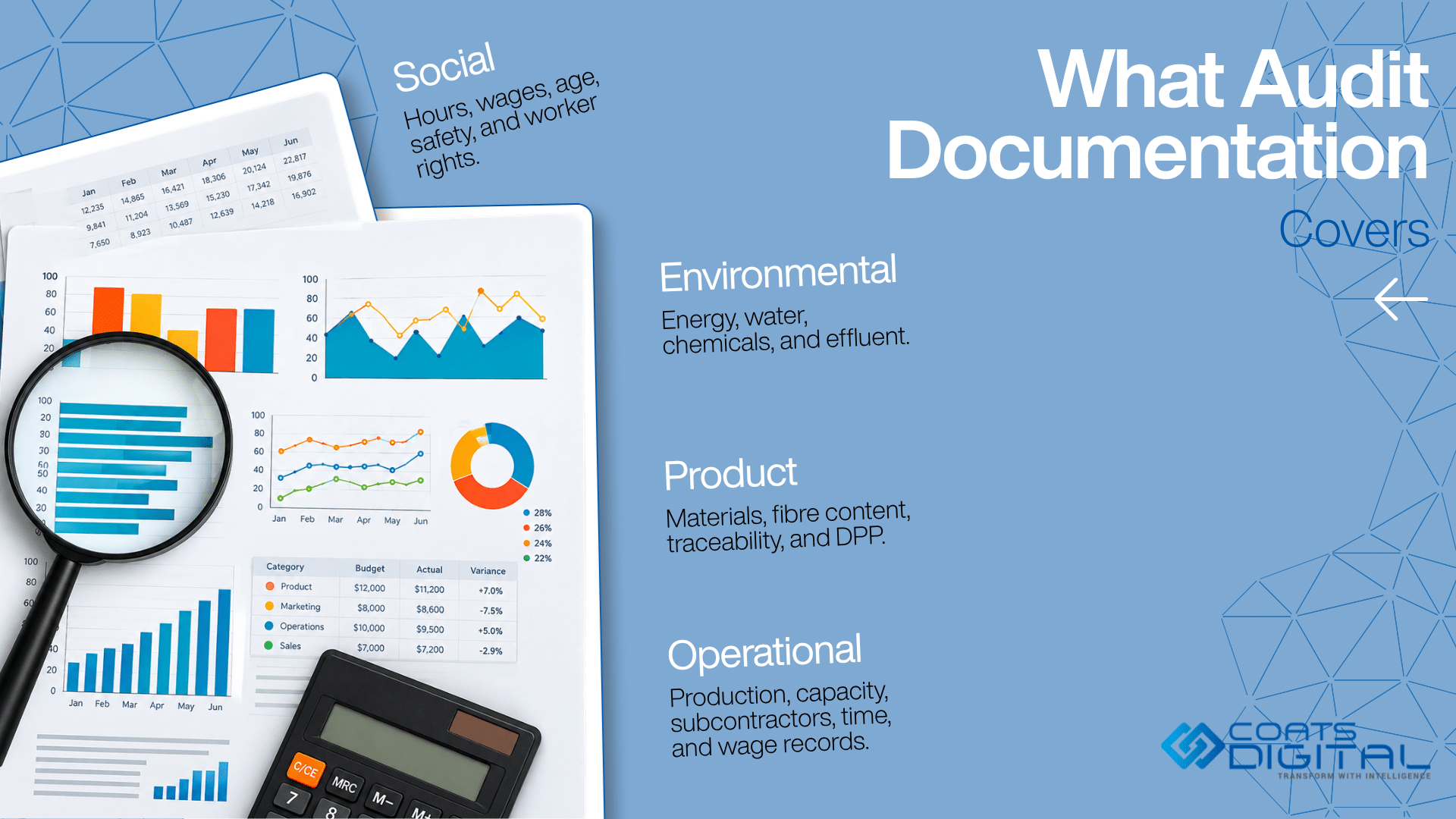
Audit documentation for garment exporters covers three record families: social compliance, environmental and chemical, and product and material, all resting on a fourth: operational data such as working hours, wages, and production logs
“Audit documentation” is not one thing. It is four distinct families of records, and knowing the difference is what stops you from buying a platform that solves a problem you do not have.
- Social compliance: working hours, wages, age verification, freedom of association, health and safety. Assessed by SMETA, amfori BSCI, SA8000, SLCP.
- Environmental and chemical: energy, water, effluent, restricted-substance lists, chemical inventory. Covered by Higg FEM, ZDHC, OEKO-TEX.
- Product and material: fibre content, GOTS/organic status, traceability, and the coming Digital Product Passport.
- Operational records: production logs, capacity data, subcontractor declarations, and the time and wage records that sit beneath all of the above.
The distinction that decides your software choice is simple. Certificates are outputs. Operational records are the source. Auditors and buyer questionnaires increasingly check the source. A factory can hold every certificate and still fail on the underlying records, because those records were manual, inconsistent, or impossible to reconcile with what production actually did.
Audit-ready means: records that are accurate, consistent, traceable to a system rather than a hand-kept register, and reproducible when an auditor cross-checks them against production data.
The Software Landscape: The Honest Shortlist
The best approach is a layered stack, not a single tool, and in practice your EU buyer often decides which documentation platform you file on. With that framing, here are the categories that matter, and the one column most listicles never include: whether the tool actually generates clean source data, or only stores what you give it.
| Category | Primary job | Named examples | Generates clean source data? |
| Audit/compliance management | Store, share and track evidence and corrective actions | Sedex (SMETA), amfori platform, QIMA/Intertek/LRQA portals | No stores it, doesn’t produce it |
| Converged data standard | Standardise social & labour data collection, once | SLCP (Converged Assessment Framework) | Standardises collection, not operations |
| Facility ESG data platform | Aggregate facility environmental/social data | Worldly / Higg FEM & FSLM (Cascale) | Facility-level, not order-level |
| Traceability/product data | Map supply chain and product-level data | DPP-readiness and traceability platforms | Provenance, not operational records |
| Production planning | Plan capacity, orders and delivery | FastReactPlan | Yes order & capacity records |
| Method-based costing | Document labour time, method and wages | GSDCost (with the Fair Wage Tool) | Yes labour & wage records |
Audit and compliance management platforms Sedex, the amfori platform, and third-party portals store evidence, track corrective-action plans, and share reports with buyers. They are essential. But they document what happened; they do not change what happens on the floor.
Converged data standards mean, in practice, SLCP. It is a data-collection standard, not software or a scorecard. A factory completes one converged assessment and shares the verified dataset with multiple buyers instead of repeating similar audits for each. It standardises how social and labour data is collected. It does not fix operations, and it does not grade you.
Facility ESG data platforms: Worldly, hosting the Higg FEM and FSLM modules, aggregate facility-level environmental and social data for buyer scorecards. Useful, but facility-level rather than order-level or labour-time detail.
Traceability and product-data platforms handle provenance and composition for EUDR and the Digital Product Passport. They map where material came from; they are not working-hours or wage records.
Production planning is where the operational layer begins. Accurate capacity and order planning keeps overtime lawful and subcontracting authorised. FastReactPlan is one example in this category.
Method-based costing and time study document the standard time for every operation and the wage logic behind piece rates. GSDCost sits here.
From the Coats Digital Manufacturing Excellence team: “When we sit with a factory after a difficult audit, the corrective-action plan rarely traces back to a missing certificate. It traces back to an order book that was bigger than the floor could lawfully hold, and to labour records kept in a register no one could reconcile with the plan. Those are engineering problems wearing a compliance costume.”
The short version: exporters use several categories together: audit-management platforms store evidence, SLCP standardises collection, and production-planning and costing software generate the clean operational records that all the evidence depends on.
The Gap Most Exporters Miss: Documentation Stores Evidence, It Doesn’t Make It True
An audit-management platform is a filing cabinet with a dashboard. It is necessary. But it cannot generate an hour of accurate working time, and it cannot stop an order being subcontracted at 2 a.m. to hit a delivery date. The most common social-audit non-conformities are operational in origin, and the biggest two share a single root cause: a plan the factory could never actually meet.
The data backs this up plainly. In 2025, 80% of amfori BSCI-audited factories failed to meet working-hours requirements, and amfori itself attributes the drivers to buyer purchasing practices and factory operations, not to poor record-keeping. The ILO treats persistently high overtime as a forced-labour risk indicator, which is exactly why it now carries weight under the EU Forced Labour Regulation. Working hours are not a filing failure. It is a capacity failure that shows up in the file.
We call the lens for this the Symptom-vs-Source Model: separate where a failure appears from where it actually starts. Once you do, the software conversation changes completely.
| Audit failure | Where it looks like a problem | Where it actually starts | What fixes it |
| Excessive overtime | Working-hours records | Overbooked capacity, unrealistic lead times | Realistic capacity planning |
| Unauthorised subcontracting | Subcontractor declarations | Orders exceeding own capacity | Order-to-capacity visibility |
| Wage & benefit gaps | Payroll records | No documented labour standard behind piece rates | Method-based costing |
| Inconsistent hours data | Time registers | Manual, unversioned records | System-based production data |
Buying a documentation platform to fix an operational failure is like buying a better camera to fix bad lighting. The record improves. The underlying problem does not. Exporters who pass cleanly are usually the ones whose plans and labour standards were already sound before the auditor arrived.
Why do garment factories fail social audits? Because the two most common failures, excessive overtime and unauthorised subcontracting, usually start with overbooked capacity. They are planning problems that documentation software cannot fix.
How Production Planning Strengthens Audit Readiness
If overbooking causes the two biggest audit failures, then accurate capacity planning is a compliance control, not just an efficiency tool. There are three concrete ways it works.
Capacity visibility prevents the overbooking that forces overtime
When a factory can see line-level capacity against its confirmed order book, it can decline or reschedule work it cannot deliver within lawful hours rather than absorbing that work as hidden overtime. That directly attacks the single most cited social-audit non-conformity. It is not a coincidence that manufacturers who tighten planning report the effect on hours: one GSDCost adoption, by Globalindo, was announced specifically around improving cost accuracy and reducing overtime.
Order-to-capacity control reduces unauthorised subcontracting
Subcontracting to unapproved units is often a pressure valve for orders that never fit in the first place. Realistic planning removes the pressure at source and keeps production where the buyer approved it. This matters more every quarter, because buyers increasingly ask exporters to evidence where production actually happened, not just that it happened.
A production trail that corroborates the documentation
A planning system creates an order and production record that supports your working-hours and subcontracting declarations. That gives an auditor a system-based trail to cross-check against, instead of a manual register that falls apart under scrutiny. FastReactPlan users report on-time delivery rising and planning time falling; the same discipline that lifts delivery performance is the discipline that keeps hours lawful.
Scope note. FastReactPlan is a production-planning system, not an audit or compliance platform. It reduces the operational causes of audit failure and produces corroborating production data. It does not store certificates, manage corrective-action plans, or guarantee an audit outcome.
Directly answered: production-planning software supports audit readiness by matching orders to real capacity, which prevents the overbooking that forces unrecorded overtime and unauthorised subcontracting.
How Time Study And Costing Document Labour And Wages
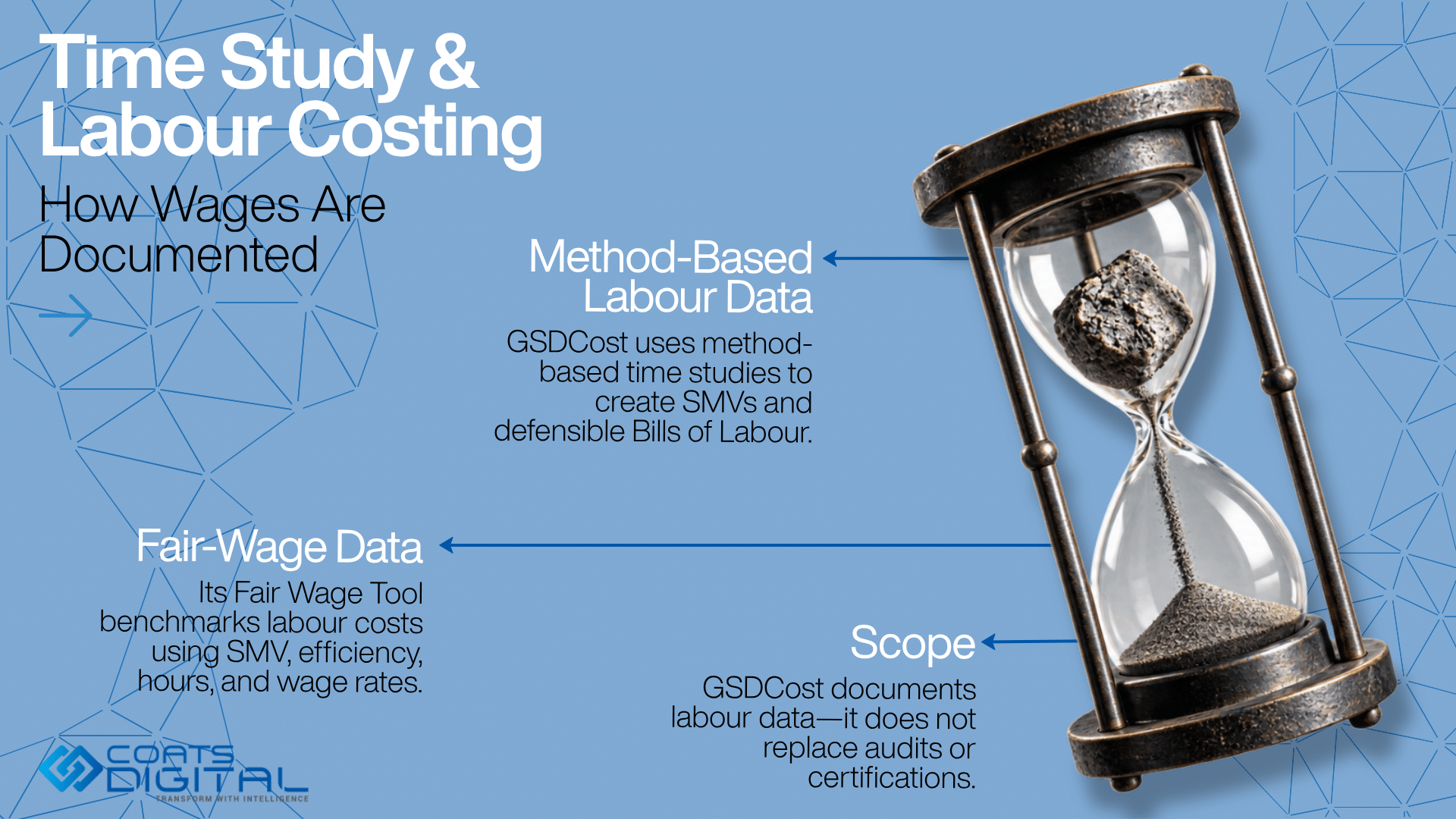
Living wage is usually framed as an ethics topic, and that conversation is crowded. Reframe it as a data-defensibility problem and it becomes far more useful and far less crowded. A due-diligence questionnaire or a fair-wage clause is, underneath, a request for evidence: show us the standard behind the rate. Piece rates alone cannot provide that. A method-based labour standard can.
A documented method behind every operation
Method-based time study builds a Standard Minute Value (SMV) for each operation from predetermined motion codes. GSDCost uses a library of 39 such codes, a methodology recognised by the ILO and treated across the sewn-products industry as the de-facto standard. The output is an operation-level Bill of Labour: a standardised, defensible record of how long each task should take. That supports working-hours credibility and gives you consistent, non-arbitrary pay documentation to put in front of a buyer.
The fair-wage data buyers now ask for
GSDCost’s Fair Wage Tool draws on Fair Wage Network data and combines a style’s SMV with factory efficiency, contracted hours and the agreed wage rate to document and benchmark a wage allowance against international fair-wage references. It produces a reportable wage line a European buyer can accept: a garment-level figure with a method behind every input.
Illustrative figures for illustration only. Take a style with 15 standard minutes of labour content (from the Bill of Labour). Suppose the documented effective wage rate is X per minute and the fair-wage benchmark is Y per minute. The documented fair-wage position per unit is 15 × (Y − X). Notice that every term except the benchmark comes from the factory’s own method-based standard, which is precisely what makes the wage evidence defensible in a buyer questionnaire rather than an assertion.
Scope note. GSDCost documents labour time, method, and wage data. It does not conduct social audits, verify payroll, or issue certifications. It is the labour-documentation engine that sits alongside your audit platform, not a replacement for it.
Directly answered: method-based costing documents the standard time for every operation and combines it with wage data, giving exporters a defensible labour and fair-wage record for social audits and buyer due-diligence questionnaires.
How To Choose And Phase Your Software Stack
The governing insight is a manufacturer’s-eye one that no generic listicle offers: do not start by picking a documentation tool. Start by mapping what your buyers already mandate, then work backwards to the operational data that makes their evidence true. In practice, that gives you a sequence.
- List your buyers’ actual requirements: which certifications, questionnaires, and platforms they mandate (Sedex, Worldly, SLCP).
- Separate storage needs (a documentation platform) from source-data needs (planning, costing).
- Fix the operational causes of audit failure first: capacity planning and labour documentation.
- Add or align an audit-management platform for filing and buyer sharing.
- Adopt SLCP to cut duplicate audits if your buyer set accepts it; its Converged Assessment Framework is accepted by more than 100 organisations.
- Check IT fit: cloud versus on-premise, integration with your existing ERP/PLM, data ownership, and shop-floor training.
A practical first move by exporter profile
| Exporter profile | Dominant compliance risk | Practical first move |
| Small, 1–2 EU buyers | Duplicate audits, thin labour records | SLCP + a trained partner for a labour standard on core styles |
| Mid-size, several EU buyers | Working-hours findings, audit fatigue | SLCP + production planning + costing on core styles |
| Fast-growing, volatile order book | Overbooking, subcontracting risk | Production planning + an audit-management platform |
| Living-wage buyer commitments | Wage documentation gaps | Method-based costing + Fair Wage data |
| Group, multiple units | Cross-site consistency, traceability | Centralised planning + audit management + traceability |
India cluster realities
The risk profile is not uniform across India’s clusters, and your first move should reflect yours.
| Cluster | Typical product | Dominant risk profile |
| Tirupur | Knitwear | Seasonal overtime peaks; working-hours findings |
| Ludhiana | Woollens/knits | Subcontracting to home-based and small units |
| NCR (Gurugram–Noida) | Fashion/woven | Short lead times → overbooking → overtime |
| Bengaluru | Formal / structured woven | Scale and multi-unit consistency |
| Kolkata | Embellished / hand-work | Subcontracting and outworker traceability |
Cost, ERP fit and where manual is still enough
Total cost is really four line items: documentation-platform fees, SLCP assessment cost, planning and costing licences, and implementation and integration. Weigh that against the cost of the problems avoided: lost orders from a failed audit, air-freight to recover a delivery failure, and duplicate-audit spend. Ask for tailored quotes and confirm integration cost with your IT team.
On integration: most Indian export houses run Tally, SAP, Datatex, or ERPNext. These record transactions, inventory, and payroll outputs but not defensible capacity plans, method-based labour standards, or benchmarked fair-wage lines. Planning and costing tools should complement the ERP and feed a single source of truth, not duplicate it. GSDCost, for instance, feeds SMVs directly into FastReactPlan.
And a candid concession: you may not need everything at once. A factory with one or two long-standing EU buyers can start with SLCP plus disciplined manual planning and a trained partner for a core-style labour standard. Manual planning breaks as the order book grows and volatility rises; manual working-hours and wage records break the moment an auditor cross-checks them against production. The point is to know which threshold you are approaching before you cross it.
Directly answered: choose software by starting from your buyer’s mandated documentation platform, then separating storage needs from source-data needs, and fixing the operational causes of audit failure: capacity planning and labour documentation first.
An Illustrative Scenario: Preparing For A Buyer’s Due-Diligence Request
Return to that Tirupur knitwear exporter, mid-size, supplying two German retailers. In one quarter, it receives a due diligence questionnaire and an unannounced SMETA re-audit. It already holds GOTS, OEKO-TEX, and a current amfori BSCI report on Sedex. To answer with confidence, it does four things.
It adopts SLCP to standardise its social-data collection and cut duplicate audits. It tightens capacity planning so the season’s order book fits within lawful hours and no work leaks to unapproved units. It uses method-based costing to document standard times and produce a benchmarked fair-wage line. And it files the results on its existing audit platform.
The certificates were never the problem. The defensible operational data behind them was, and now it exists. Four components documentation platform, data standard, planning, and costing combine into one audit-ready position. No single one of them is the whole answer.
Common Mistakes Exporters Make When Buying Compliance Software
Competing guides rarely warn about buying errors. These are the ones that recur.
- Buying a documentation platform to fix an operational failure: Better filing does not remove excessive overtime or subcontracting.
- Treating certificates as compliance: Buyers increasingly check the records beneath the certificate, not the certificate itself.
- Ignoring capacity planning as a compliance control: Overbooking is the hidden cause of the most common audit failures.
- Living with undocumented, arbitrary piece rates: Pay with no method-based standard behind it is hard to defend in a due-diligence questionnaire.
- Running duplicate audits instead of adopting SLCP: Audit fatigue drains time and money a converged assessment would save.
- Buying tools your buyers do not recognise: Confirm which platforms your specific buyers mandate before investing.
- Assuming your ERP already handles it: Most ERPs record transactions, not defensible capacity, method, or fair-wage data.
- Skipping the IT and integration review: Software that does not connect to your ERP/PLM creates a new data silo.
- Relying on manual, unversioned working-hours records: They fail the moment an auditor cross-checks them against production.
Measuring Audit Readiness: A Management Scorecard
A short set of metrics a compliance head or MD can take into a management review.
| Metric | What it tells you | Cadence |
| Overtime hours vs contracted / legal limit | Exposure to the top social-audit non-conformity | Monthly |
| Orders exceeding own capacity | Subcontracting and overtime risk at source | Per season/order book |
| Share of production on a system-based trail | Corroboration for working-hours records | Ongoing |
| Styles with a method-based labour standard | Defensibility of labour and wage data | Quarterly |
| Fair-wage position documented per core style | Readiness for wage questions in due diligence | Per season |
| Duplicate audits vs SLCP-shared assessments | Audit-fatigue and cost efficiency | Annual |
| Open corrective actions past due date | Compliance-management discipline | Monthly |
Where Garment-Export Compliance Software Is Heading
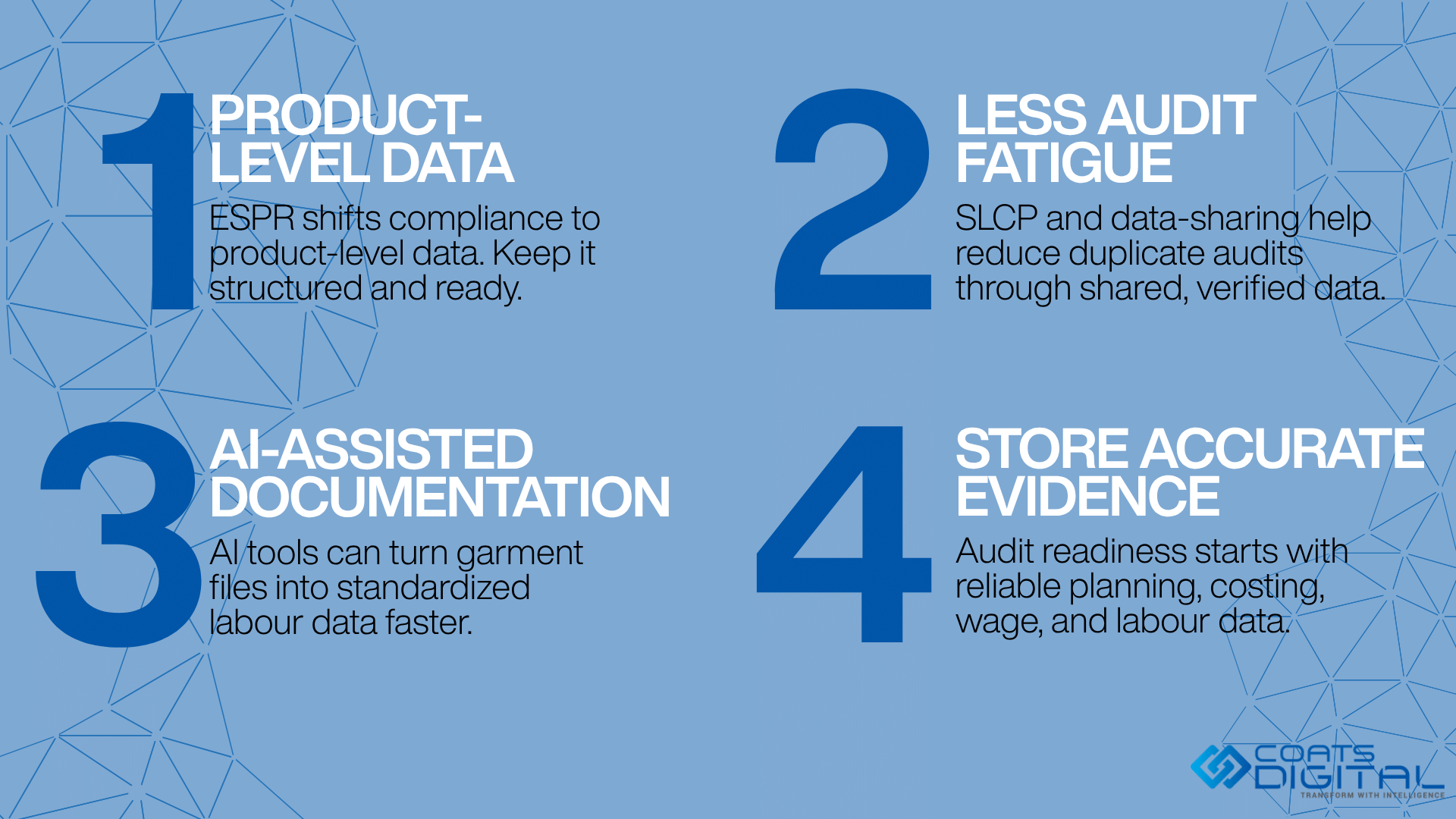
From factory-level to product-level data
The ESPR Digital Product Passport pushes requirements from “is your factory compliant?” toward style-level composition and supply-chain data. That raises the value of structured product and labour data over filed certificates. Future-proofing looks like holding clean, structured, style-level data now, before the textile delegated act lands.
Convergence and less audit fatigue
SLCP adoption and data-sharing are reducing duplicate audits; the direction of travel is one verified dataset shared with many buyers. Future-proofing means getting the underlying data sound, so a shared assessment holds up rather than exposing gaps to every buyer at once.
AI-assisted documentation at the source
Labour documentation is starting to generate itself. Coats Digital’s GSDQuest, an AI tool within the GSDCost ecosystem, reads a garment image, PDF, or tech pack and generates a standardised Bill of Labour in seconds using the proprietary QED Library, putting method-based labour documentation in the hands of a compliance team, not only an industrial engineer. The defensible data becomes faster and cheaper to produce, which is what makes doing it at scale realistic.
Store The Evidence, But Make It True First
EU rules now reach the Indian factory floor through buyer due diligence, and they check the records beneath the certificate. Audit-documentation platforms are necessary but incomplete; they store evidence they cannot themselves generate. The exporters who pass cleanly and answer a due-diligence questionnaire with confidence are the ones whose plans keep working hours lawful and whose labour standards make wages defensible before the auditor arrives.
With buyer due diligence cascading down and product-level data coming next, the operational layer planning and costing is where audit readiness is actually won. Not with alarm, but with the quiet discipline of a plan the factory can meet and a labour standard it can defend.
See the operational layer in action:
- FastReactPlan matches orders to real capacity to keep production lawful and approved.
- GSDCost and the Fair Wage Tool document standard times and benchmark a fair-wage line.
To see how these systems help Indian exporters produce audit-ready operational and labour data, arrange a demo with the Coats Digital team.
Frequently Asked Questions
-
How can production planning software help pass a social audit?
By preventing the overbooking that causes the most common failures. When a factory matches orders to real line capacity, it can avoid work it cannot deliver within lawful hours, reducing unrecorded overtime and the pressure that drives subcontracting. A planning system such as FastReactPlan also creates a production trail that corroborates working-hours and subcontracting declarations, giving auditors a system-based record instead of a manual register. It supports audit readiness; it is not an audit-management platform.
-
How does GSDCost help with audit documentation?
GSDCost builds a method-based Standard Minute Value for each operation using predetermined motion codes, creating a documented, defensible labour standard behind piece rates and working hours. Its Fair Wage Tool, using Fair Wage Network data, combines the SMV with factory efficiency, contracted hours, and the agreed wage rate to document and benchmark a fair-wage position. This gives exporters credible labour and wage evidence for social audits and buyer questionnaires. It documents labour data; it does not conduct audits or verify payroll.
-
What is SLCP, and do Indian factories need it?
The Social & Labor Convergence Program is a data-collection standard, not software or a scorecard. A factory completes one converged assessment that multiple buyers accept, instead of repeating similar audits for each. For exporters facing several EU buyers and frequent audits, it reduces audit fatigue and cost its Converged Assessment Framework is accepted by more than 100 organisations. It standardises how social and labour data is collected; it does not grade the factory or fix operational issues such as overtime.
-
What is the difference between SMETA, amfori BSCI, SLCP and Higg?
SMETA (Sedex) is a social-audit methodology producing an audit report. amfori BSCI is a social-compliance system with its own audit and platform. SLCP is a converged data-collection standard that gathers verified data without scoring. Higg, hosted on Worldly by Cascale, provides facility environmental and social modules. They overlap in subject but differ in function: audit, compliance system, standardised collection, and facility-data aggregation.
-
Does the Digital Product Passport apply to Indian garment exporters?
It will. The Digital Product Passport, introduced under the EU ESPR, attaches product-level data on composition, durability, and supply-chain information to items on the EU market. Textiles are a priority category, so exporters supplying the EU will increasingly need structured, style-level data, not just factory certificates. The defining delegated act for textiles is expected in 2027 with compliance around 2028–2029. Verify the timeline with the European Commission.
-
Does the EU Deforestation Regulation apply to garments?
Partly. The EUDR covers cattle, which brings leather (and leather footwear and accessories) into scope. Cotton is not currently a covered commodity, so most cotton garments fall outside it. Exporters of leather goods need geolocation and legality data for their raw material. The application date for large operators is 30 December 2026. Verify the current commodity list with the European Commission.
-
What is the EU Forced Labour Regulation, and when does it apply?
It bans placing on, or exporting from, the EU market any product made with forced labour, at any stage of the supply chain. It entered into force in December 2024, its implementation guidelines and risk database went live on 26 June 2026, and the prohibition applies from 14 December 2027. It imposes no specific due-diligence steps itself, but persistent excessive overtime is an ILO-recognised forced-labour risk indicator which links it directly to the working-hours data your planning and costing systems produce.
-
Can my existing ERP handle EU compliance data?
Usually only partly. Most ERPs Tally, SAP, Datatex, ERPNext record transactions, inventory, and payroll, but not defensible capacity plans, method-based labour standards, or benchmarked fair-wage lines. They store outputs, not the operational logic auditors and questionnaires increasingly check. The practical approach is to let planning and costing tools generate that source data and feed the ERP, rather than duplicating systems or assuming the ERP already answers the question.
-
Can one software handle all EU compliance for a garment exporter?
No. Compliance spans social, environmental, chemical, and product-level requirements, and different tools address each: audit-management platforms store evidence, SLCP standardises collection, traceability tools handle provenance, and planning and costing generate operational and labour data. The realistic goal is a coherent stack where each tool does one job well and the data connects, not a single system that claims to do everything.
-
How does unauthorised subcontracting cause audit failures?
Unauthorised subcontracting moves work to unapproved units the buyer has not vetted, breaking the chain of custody and the labour conditions the buyer relies on. It is frequently a pressure valve for orders the main factory cannot deliver on time within lawful hours. Auditors treat it as a serious finding because it hides risk. Accurate capacity planning removes the pressure at source and keeps production where the buyer approved it.”
-
How much does compliance and planning software cost for a garment factory?
It varies by factory size, number of units, deployment model and modules, and breaks into four line items: documentation-platform fees, SLCP assessment cost, planning and costing licences, and implementation and integration. Rather than a single figure, weigh total cost against the problems avoided: lost orders from failed audits, air-freight from delivery failures, and duplicate-audit spend. Request tailored quotes and confirm integration costs with IT before committing.
-
Do small Indian garment exporters need all this software, and what happens if I fail an audit?
Not all of it at once. A small exporter with one or two EU buyers can start with SLCP to cut duplicate audits and a trained partner to establish a labour standard on core styles, alongside disciplined manual planning. But a serious non-conformity or a failed audit can mean held shipments, corrective-action deadlines, lost orders, or removal from a buyer’s supplier list. Most exporters reach the point where planning and costing software pay for themselves around the first serious due-diligence questionnaire or first unannounced re-audit

How Bangladesh Knitwear Factories Improve Operator Efficiency Across Sewing, Linking and Finishing

Best Lean Manufacturing Software for the Indian Garment Industry

Brand-to-Vendor Cost Collaboration: Which Layer of the Cost Stack Are You Missing?
All Blog Categories
- Production Planning
- Corporate
- Method Time Cost Optimisation
- Supply Chain Solutions
- Sustainability
- Videos