How Bangladesh RMG Factories Plan Capacity Across Knitwear, Denim and Woven Lines on One Floor
by Kunal Kapur
 9
Mins Read
9
Mins Read
- Key Takeaways
- The Quote Arrives as a Single Number
- Why a Supplier Quote Is Never Just a Price
- Why “just send me a breakdown” is not enough
- What “Accurate” Actually Means
- Why labour is the variable that decides the quote
- The Independent Anchor: Standard Minute Value
- SMV and SAM: same measure, different label
- Predetermined motion time systems vs stopwatch time study
- Building the Cost Breakdown Before You Order
- Reading the Gap Between Your Number and Theirs
- When a higher quote is the better deal
- Separating fair-wage cost from inflation
- Red flags in a supplier breakdown
- Comparing Breakdowns Fairly Across Multiple Suppliers
- Issue one Bill of Labour and lock the SMVs
- Build vs Buy: Do You Need Software for This?
- What a spreadsheet and a trained partner can do
- What breaks at scale
- What a costing platform adds
- Walk In With Your Own Number
- Frequently Asked Questions
Key Takeaways
- Multi-product capacity planning sizes knitwear, denim, and woven as separate capacity tracks, then confirms orders through one shared master plan.
- Piece counts mislead across products. The same line-month can yield about 18,700 jeans or 42,800 tees, so plan in standard minutes.
- Denim capacity is usually set by the wash house, woven by imported fabric-in dates, and knitwear by the sewing line itself.
- Spare minutes do not transfer. An idle knit line cannot sew jeans, and no amount of sewing capacity clears a laundry backlog.
- Load every constraint, including the laundry, to 80–90% of realistic capacity so absenteeism, re-washes and learning curves do not break ship dates.
- The level, chase or hybrid choice can differ by product: knitwear flexes easily, while denim rewards a steady load around specialist teams.
- Steady load per product protects retention, because denim and wash skills lost in a lean month cannot be rebuilt from the knit floor.
- One planning board covering cutting, sewing, laundry and materials exposes cross-line clashes weeks before a buyer sees a missed shipment.
A Bangladeshi garment group can have every knit, denim and woven line booked for the month and still miss shipments. The sewing plan looks healthy. Meanwhile, sewn jeans queue in front of the laundry, a woven shirt programme waits on fabric that has not cleared Chattogram, and two knit lines finish early with nothing cut for them. The factory is busy. The margin is leaking.
The cause is nearly always the same. Production capacity planning was done product by product, in sewing minutes, while the real limits sat elsewhere: in the wash house, in the imported-fabric pipeline, and in the cutting room that all three products share.
Multi-product capacity planning closes that gap. It treats knitwear, denim, and woven as parallel capacity tracks, plans each one to its own tightest constraint, and holds all three on a single master plan. The pressure to get this right is rising. Bangladesh exported $21.16 billion of knitwear and $18.19 billion of woven garments in FY2024-25, according to Export Promotion Bureau (EPB) data reported by The Business Standard, and in 2025 it was the largest denim supplier to both the United States and the European Union, per US Office of Textiles and Apparel (OTEXA) and Eurostat figures compiled by The Daily Star. Groups keep adding categories to spread buyer and market risk, with Least Developed Country (LDC) graduation approaching and US tariffs reset repeatedly since April 2025.
This guide explains what multi-product capacity planning is, why the three products cannot share one capacity number, how to build the plan step by step with a worked example, and where planning software helps and where it does not.
What Is Multi-Product Capacity Planning In Garment Manufacturing?
Multi-product capacity planning is the process of matching each product line’s available capacity (its sewing minutes plus its own critical constraint, such as wash-house throughput for denim or fabric-in dates for woven) to forecast and confirmed demand, then coordinating every line on one master plan so the factory commits only to what all of its constraints can deliver.
Week to week, it answers three practical questions. How many realistic minutes does each product line have? What actually limits each line? Which orders can be confirmed without breaking any of those limits?
What “one floor” usually means in Bangladesh
“One floor” is rarely literal. Very few Bangladeshi factories alternate a single sewing line between T-shirts and five-pocket jeans. What groups actually run is dedicated knit, denim and woven lines or units inside one campus or one group, often spread across clusters such as Gazipur, Narayanganj and Chattogram.
Those lines share more than a name on the gate. They draw on the same cutting room, laundry, finishing and packing space, planning and merchandising team, working capital and senior management attention. Azim Group, for example, runs 13 garment units producing woven, sweater, and denim products, supported by four backwards-linkage factories. The planning problem is not the physical floor. It is one order book, one pool of shared resources, and three very different production routes.
Why capacity is planned in standard minutes, not pieces
A standard minute value (SMV) is the time a trained operator needs to complete an operation at standard pace, including allowances. Pieces are not comparable across products: 10,000 jeans are a far heavier commitment than 10,000 tees. Standard minutes put demand and capacity in the same currency, which is why large groups talk about capacity in time. Epyllion Group’s five knitwear factories, for instance, produce around 14,000 standard hours a day.
Sewing minutes are necessary but not sufficient. Denim needs a second unit for the laundry (pairs or kilograms per day), and woven needs a material gate: the date the imported fabric is in-house and approved.
Available minutes: the formula
Available minutes = operators (or manned workstations) × working minutes per day × working days × planned efficiency.
Count operators or manned machines, never both, or the figure doubles. A 40-operator line working 480 standard minutes a day for 26 days at 60% planned efficiency has 299,520 available minutes a month. At 16 SMV, that is about 18,700 jeans; at 7 SMV, about 42,800 tees. Same line-month, very different piece counts.
The tightest-constraint rule
For each product track, usable capacity in a period is the lowest of three figures: sewing capacity, finishing or wash capacity, and material-ready capacity. For denim, the lowest is usually the wash house. For woven, it is often the fabric-in date. For knitwear, it is most often the sewing line itself.
Why Can’t Knitwear, Denim And Woven Share One Capacity Number?
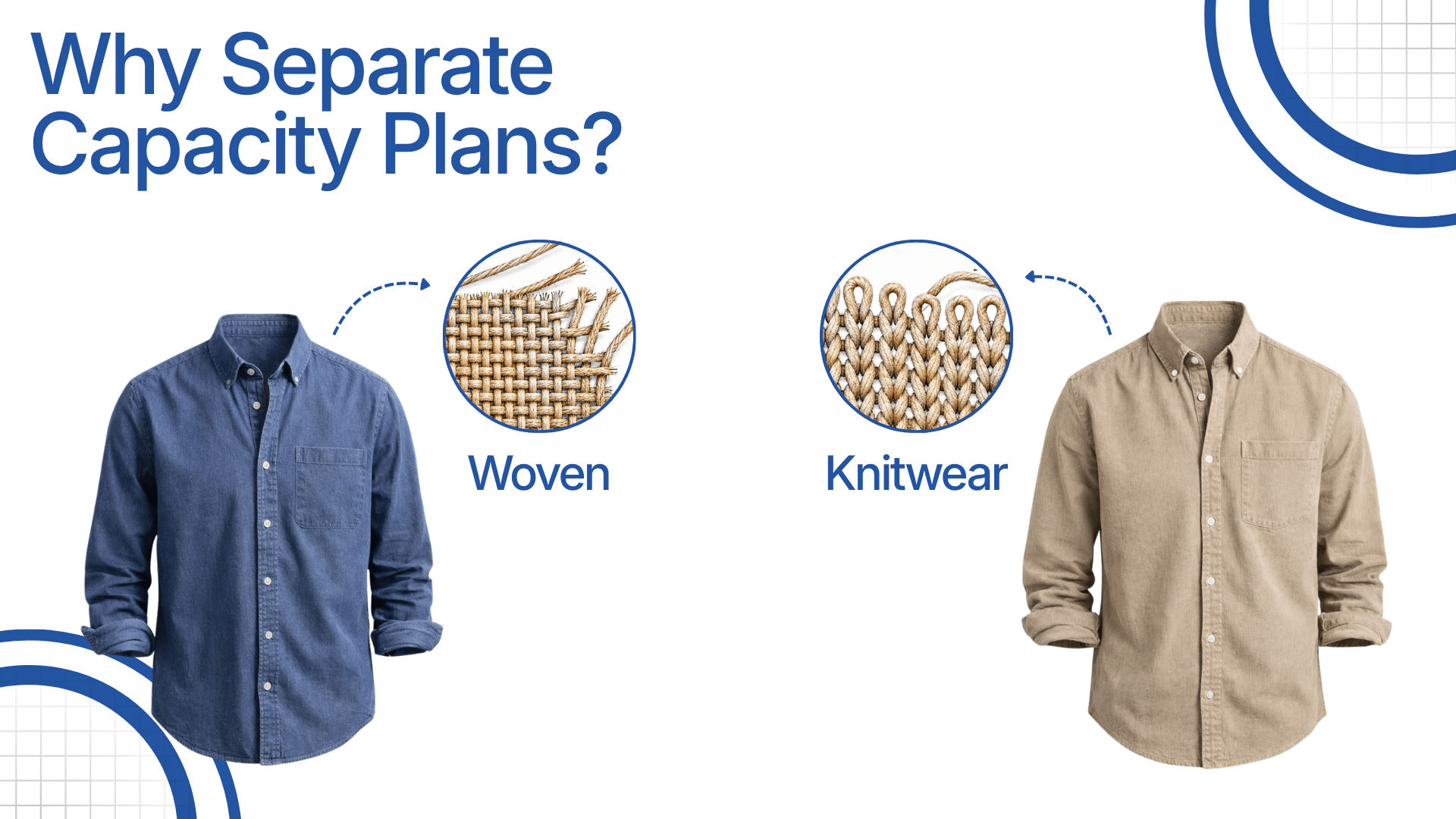
Because each product has different work content, different machines, a different finishing route, and a different material lead time. Standard minutes make styles comparable. They do not make lines interchangeable, and spare minutes on one track cannot be spent on another.
Different work content and machines.
A basic knit tee is a short, light build on overlock, flatlock, and coverstitch machines, typically around 15–25 operations in published breakdowns for basic styles. A formal woven shirt is a small-parts garment (collar, cuff, placket, yoke) of around 40 operations with a heavy pressing load. A five-pocket jean runs on heavy-duty chainstitch, feed-off-the-arm, multi-needle waistband and bartack machines across roughly 30–45 sewing operations, and it has not yet been near a washer.
So a knit line sitting at 70% load cannot absorb a denim overflow, however many minutes it has free. The machines are wrong, and so are the skills.
Denim has a second factory after sewing: the wash house
Most capacity advice stops at the needle, which is exactly where denim planning goes wrong. A knit tee leaves sewing close to finished: trim, check, press, pack. A woven shirt needs a substantial pressing stage, but it follows the line closely. A raw pair of jeans is only half made. Its look, hand feel, and much of its value are created downstream.
Denim finishing combines dry processes, such as laser whiskering and hand-sanding, with wet processing. In the wet stage, loomstate jeans are loaded into rotary washers, desized, stone or enzyme washed, extracted, tumble-dried, and inspected, with bleaching, tinting, and softening depending on the look, as CottonWorks’ denim finishing guide sets out. Each step runs in batches, on machines rated by load weight, to recipes and shade lots, with a re-wash always possible.
That gives the laundry its own capacity logic:
- Throughput depends on the wash, not the garment count. A rinse and a multi-stage vintage wash consume very different machine hours for the same number of pairs.
- Batching makes capacity lumpy. Machines run full loads by recipe and shade, so many small orders and many shades erode real output.
- Drying and dry processes can quietly become the bottleneck while the washers still have headroom.
- Utilities set a ceiling too. Water, steam, gas for boilers and dryers, and effluent treatment plant (ETP) capacity all limit how much wet processing a site can run. Gas supply is a live risk: in September 2026 the knitwear exporters’ association said an ongoing gas crisis was disrupting domestic textile mills, as reported by the Dhaka Tribune.
- Other products may share the laundry. Garment-washed or garment-dyed knit and woven styles compete for the same machines.
Sewing 5,000 pairs a week does not mean 5,000 pairs clear the laundry that week. Plan denim to the wash house, not the needle. Given that Bangladesh supplied roughly 26% of US denim imports and roughly 30% of EU denim imports in 2025, according to The Daily Star’s analysis, the wash house is one of the most consequential capacity constraints in the country’s garment sector.
Different material lead times and backward linkages.
Bangladesh’s knitwear sector has deep local backward linkages; its woven sector does not. Bangladesh Textile Mills Association (BTMA) figures have put local mills’ share at 75–80% of knitters’ fabric demand but only 35–40% for woven, as reported by The Financial Express. More recent industry estimates quoted by The Business Standard put knit at around 80% local and woven at roughly half.
In planning terms, that difference is decisive:
- Knit critical paths are short: Fabric can often be booked, dyed, and delivered in weeks, so knit orders are the easiest to pull forward into a gap.
- Woven critical paths are long: Imported fabric sets the earliest possible cut date, so the woven plan is gated by fabric-in dates rather than sewing minutes.
- Denim fabric is specialised: Indigo shade, stretch, weight, and buyer-nominated mills limit substitution, even where local denim mills can supply.
Policy can move these lead times as well. An Import Policy Order gazetted on 24 August 2026 stated that knit fabrics would not be importable, and both the Bangladesh Garment Manufacturers and Exporters Association (BGMEA) and the Bangladesh Knitwear Manufacturers and Exporters Association (BKMEA) have asked for the clause to be withdrawn, The Business Standard reported. If it stands, knit groups relying on imported speciality or buyer-supplied fabrics will need to rebuild some critical-path assumptions.
Buyer calendars rarely line up
Knit, denim and woven programmes seldom peak in the same weeks. Sometimes that helps: a knit replenishment order fills the gap left by a denim lull. Sometimes it hurts: all three converge on the same holiday ship window, and the spare capacity on paper disappears.
How the three tracks compare
| Dimension | Knitwear (tee, polo) | Denim (five-pocket jean) | Woven (formal shirt) |
| Typical sewing SMV, basic styles* | ~5–9 min (tee); ~9–14 min (polo) | ~12–20 min, sewing only | ~20–25 min; more for complex styles |
| Typical operation count* | ~15–25 | ~30–45 | ~35–45 |
| Key machines | Overlock, flatlock, coverstitch | Chainstitch, feed-off-the-arm, bartack, multi-needle | Lockstitch, small-parts, heavy pressing |
| Binding constraint | Usually sewing | Wash house: dry and wet processing, drying, utilities | Fabric-in date, then pressing |
| Material lead time | Short: strong local backward linkage | Medium: specialised fabric | Long: largely imported fabric |
| Planning units | Standard minutes | Standard minutes + wash capacity (pairs or kg per day) | Standard minutes + fabric-in dates |
| Skill transferability | Low into denim or woven | Specialist heavy-machine and wash skills | Small-parts precision |
*Directional ranges from published operation breakdowns for basic styles. They vary by construction, buyer, and factory. Replace them with your own standards, ideally built on a consistent method such as GSDCost.
What Does Unbalanced Capacity Cost A Multi-Product Group?
Unbalanced capacity costs money in two ways. Across lines, one track chokes while another idles. Within each line, load swings between too little work and too much.
Mismatch between product lines
This is the failure single-product factories never see. The wash house runs at 120% while knit lines wait for work. Woven lines stand still for late fabric while sewing capacity is free. The shared cutting room and the merchandising team become the bottleneck because all three products need them in the same fortnight.
Poor visibility makes it worse. Before moving to a dedicated planning system, Azim Group found capacity was often overbooked or underbooked because decisions rested on data scattered across email, spreadsheets, and phone calls, which led to late deliveries and the unnecessary rejection of new orders, according to its case study.
Over- and under-loading within one track
Under-loading spreads fixed overhead over fewer minutes, so cost per garment rises. Idle specialists drift to competitors, and the rehiring and retraining bill lands at the next peak.
Over-loading has its own price: overtime premiums, rushed washing subcontracts at poor rates and uneven quality, too many new styles crammed into the same weeks, and the learning-curve and changeover losses that follow. There is a subtler version too. Tusuka, a Dhaka manufacturer with 67 lines dedicated to denim, found that without forward load visibility, shorter buyer lead times pushed it to open more lines than necessary for the same product, driving up operating costs.
| Cost dimension | Under-loaded or mismatched | Over-loaded |
| Unit cost | Fixed overhead over fewer minutes | Overtime premiums and rush subcontract rates |
| Labour | Idle specialists; denim and wash teams drift away | Fatigue, strained morale, more errors |
| Quality | Out-of-practice lines after gaps; wash inconsistency after idle spells | Rework from rushing and crammed style changes |
| Delivery | Missed revenue; woven held by late fabric | Slipped ship dates and damaged buyer trust |
| Cross-line effect | Wash house choked while knit lines idle | All three products peak into one ship window |
| Hidden cost | Rehiring and retraining specialist teams | Learning-curve and changeover losses |
Idle, overloaded, and mismatched capacity look like three problems. They share one cause: no single, forward-looking plan across all products.
The Three Horizons of Multi-Product Capacity Planning
Multi-product capacity planning runs on three horizons at once. Strategic decisions set the product mix, seasonal decisions distribute volume, and line-level decisions load and sequence the work. Well-run groups keep the three connected, so a rush denim order on the floor still respects the wash-house limit, the seasonal plan, and the strategic mix.
Long range (about 1–3 years): which product mix to run
The Managing Director (MD) decides which categories to run and at what scale: whether to add a wash house or a denim line, build man-made fibre (MMF) or woven capability, or invest further in backward linkage.
Trade policy now shapes those choices directly. Bangladesh is scheduled to graduate from LDC status on 24 November 2026. In June 2026, the UN Committee for Development Policy (CDP) recommended extending the preparatory period to 24 November 2029, while warning that the extra time must be used for reforms, manufacturing diversification among them. The UN Economic and Social Council (ECOSOC) forwarded the request to the General Assembly in July 2026, with a decision expected during the session that opened in September 2026.
Whichever date applies, preferential access tapers after graduation, and value addition and diversification become the main routes to protecting margin. For an MD, the product mix is a capacity decision, not a sales afterthought.
Medium range (about 3–18 months): distributing volume
The planning head spreads knit, denim, and woven volumes across months, against buyer calendars that rarely align. The level, chase, or hybrid choice gets made here for each product, along with the make-or-subcontract split, particularly for denim washing.
Short range (weeks to days): line loading and the wash schedule
Planners and industrial engineering (IE) teams put the right product on the right line, sequence styles within each product family to cut changeovers, and balance the wash-house batch schedule against sewing output so jeans do not pile up in front of the laundry.
| Horizon | Time frame | Key multi-product decisions | Typical owner |
| Long range | ~1–3 years | Product mix; wash-house or denim-line investment; backward linkage; LDC positioning | Managing Director |
| Medium range | ~3–18 months | Volume by product and month; level or chase per product; make or subcontract washing | Planning head |
| Short range | Weeks to days | Line loading by product; style sequencing; wash house against sewing | Planners, IE, line supervisors |
Level, Chase Or Hybrid: Which Strategy Suits Each Product?
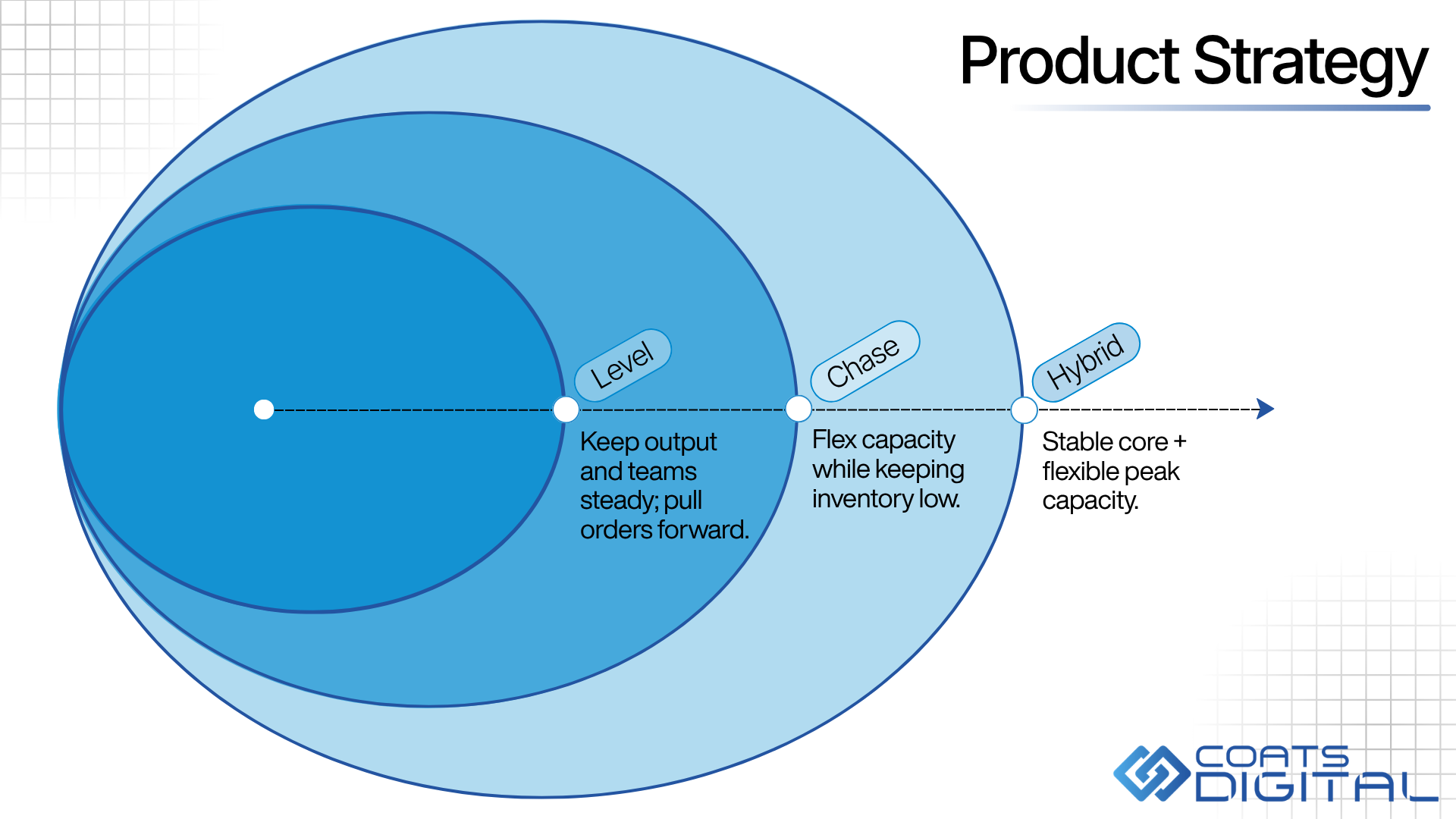
Most multi-product groups should run a hybrid, with the balance set per product rather than per factory. Knitwear can lean towards chase because its fabric is local and its lead times are short. Denim usually rewards a steadier, level-leaning load because its skills are specialised and its wash house runs in batches.
Level: steady output, steady teams
A level strategy holds output and headcount steady and uses lean windows to get ahead. In a make-to-order business, getting ahead rarely means speculative finished stock. It means pulling confirmed orders forward, producing reliable forecast orders from nominated programmes, or running carry-over and replenishment styles early.
The pay-off is retention, practised lines and a smoother laundry load. The price is working capital tied up in fabric and work in progress, plus the risk that a buyer changes an order you have already pulled forward.
Chase: capacity follows demand
A chase strategy flexes output through hiring, overtime, and subcontracting. Inventory stays light. In a high-turnover labour market, though, the penalty is real: attrition, retraining, morale and quality variance, all of which hit specialist denim and wash teams hardest.
Chase also has a compliance ceiling. Most major buyers expect subcontractors, laundries included, to be disclosed and approved in advance, so the approved list effectively defines how much flex capacity a group really has.
Hybrid: a loaded core per product, buffered peaks
A hybrid keeps a stable, loaded core on every track and absorbs peaks with planned overtime and vetted subcontracting. The balance point shifts by track:
- Knitwear leans towards chase: Local fabric and short critical paths make it the most flexible track.
- Denim leans towards level: Specialist sewing, wash-house batching, and long wash lead times reward a steady load.
- Woven sits in between: Fabric-in dates limit how far orders can move, so woven plans depend on early fabric booking more than late flexing.
Decision-comparison table:
| Dimension | Level | Chase | Hybrid |
| Approach | Steady output; get ahead in lean windows | Flex via hiring, overtime, subcontracting | Stable core per product; buffered peaks |
| Inventory and work-in-progress cost | High | Low | Moderate |
| Workforce stability | High | Low | High for the core |
| Cash-flow impact | Ties up cash | Lighter stock, higher variable cost | Balanced |
| Quality risk | Low | Higher | Controlled |
| Best fit | Forecastable programmes, room to carry work in progress | Volatile demand, thin working capital | Most multi-product groups |
A quick rule of thumb: if a track has forecastable programmes and you can carry the work in progress, lean level (often denim). If demand is volatile and cash is tight, lean chase and accept the labour penalty (often knitwear). For a mixed buyer book, which describes most groups, run a hybrid and load each constraint to 80–90% of realistic capacity.
How To Build A Multi-Product Capacity Plan In Six Steps
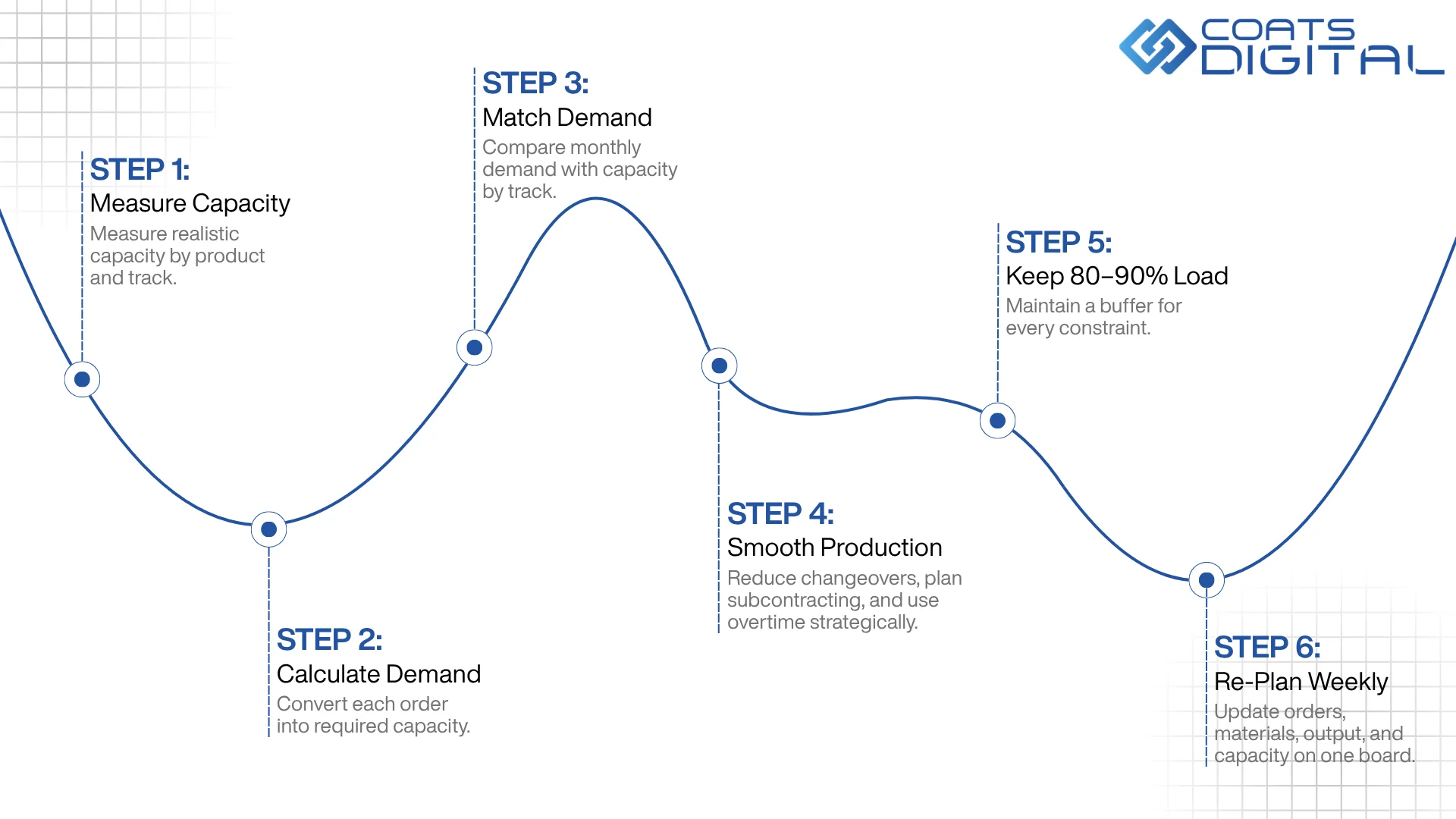
A multi-product capacity plan is built by measuring realistic capacity per track, converting orders into required capacity with product-specific standards, comparing the two across all tracks, applying smoothing levers and buffers, and re-planning continuously on one board.
Step 1: Measure realistic capacity per track, in the right units
Calculate sewing capacity in standard minutes for each line, using efficiency profiles by product type rather than one factory-wide average. For denim, add wash-house capacity in pairs or kilograms per day by wash type, including drying and dry processes. For woven, record the confirmed fabric-in date of every order. Never plan against theoretical 100%.
Step 2: Convert every order into required capacity
For each style, required minutes = order quantity × style SMV, taken from the method standard or operation bulletin. Do it separately for knit, denim, and woven. Convert denim quantities into wash load by recipe. Add learning-curve allowances for new styles, and flag projected orders from nominated buyers so they are never mistaken for confirmed ones.
Step 3: Lay demand against capacity for each track, month by month
Express each track’s load as a percentage of its available capacity. Then look across tracks and at shared resources such as cutting-room minutes and finishing space. You are looking for two things: overload or idleness within a track, and mismatch between tracks, such as a wash house at 120% while knit sewing sits at 70%.
Step 4: Pick smoothing levers that fit each product
- Sequence styles within a product family to reduce changeovers. Nice Group, for example, focuses its planning on running similar product families for longer periods.
- Pull confirmed, non-urgent denim forward into lean wash-house windows.
- Book wash subcontracting early, with approved partners, at planned rates.
- Pull knit orders forward to fill sewing gaps, using short local fabric lead times.
- Align woven fabric-in dates with line availability before confirming ship dates.
- Build overtime into the plan deliberately instead of using it as a rescue.
Step 5: Apply the 80–90% buffer to every constraint
Load each constraint, the wash house included, to 80–90% of realistic capacity. Check delivery dates against realistic learning curves for new styles, and avoid launching several new denim washes into the same peak window.
Step 6: Re-plan on a rolling basis, on one board
Update the plan as orders confirm, fabric moves, absenteeism shifts, and actual output comes in: weekly for line loading, monthly for the seasonal view. Keep every track on one board so a change on one product is visible on the others.
Worked example: sewing looks fine; the wash house does not
These figures are illustrative, not real factory data. A group plans a peak month of 26 working days at 480 standard minutes a day.
- Knit: 360 operators at 65% planned efficiency give 2,920,320 available minutes. The order book, 290,000 tees at 7 SMV, needs 2,030,000 minutes: 70% load.
- Denim sewing: 360 operators at 60% give 2,695,680 minutes. The order book, 150,000 jeans at 16 SMV, needs 2,400,000 minutes: 89% load.
- Denim wash house: realistic capacity is 5,400 pairs a day, or 140,400 a month. At a 90% planning ceiling, that is about 126,000 pairs. Demand of 150,000 pairs runs about 19% over the ceiling.
- Woven: 200 operators at 55% give 1,372,800 minutes. The order book, 55,000 shirts at 22 SMV, needs 1,210,000 minutes: 88% load, provided the imported fabric for the largest order lands on time.
A sewing-only view says the month is healthy. A constraint view says denim will miss dates and knit will lose money. The planner makes four moves:
- Pulls 12,000 pairs forward from a confirmed, non-urgent denim order with fabric in-house into the previous month, after checking that denim sewing and the wash house both had headroom then.
- Books 10,000 pairs with an approved subcontract laundry four weeks ahead at a planned rate, sending a simple wash that travels well and keeping shade-critical recipes in-house.
- Covers the remaining 1–2% over the ceiling with one planned extra wash shift rather than weeks of emergency overtime.
- Pulls 60,000 tees forward from a confirmed knit replenishment order, which local fabric makes feasible, to reload the knit lines.
The woven plan stays as it is, but the largest order’s fabric-in date becomes the critical-path item to watch, with a fallback style that already has fabric in-house.
| Track | Before | After |
| Knit sewing | 70% | 84% |
| Denim sewing | 89% | 82% |
| Denim wash house (against 90% ceiling) | ~119% | ~101%, closed by one planned extra shift |
| Woven sewing | 88%, fabric-dependent | 88%, fabric-in date on watch |
Every track now sits inside or at its buffer. The specialist teams stay loaded, and nobody is paying distress rates to a laundry in the last week before shipment.
Why Is Capacity Balancing A Worker-Retention Strategy?
Because skills in a multi-product group do not transfer between tracks, and steady load keeps pay predictable. Predictable pay keeps operators.
The stakes are higher when skills are product-specific
A single-product factory that loses operators in a lean month can at least rehire for the same skills. A multi-product group cannot replace a denim wash operator or a heavy-machine denim sewer from the knit floor. Release a specialist team during a lean denim window, and the group may be unable to backfill when denim peaks. It then pays to rehire, retrain and absorb the quality dip.
The Bangladesh workforce picture
The sector employs more than four million workers across more than 4,000 factories, according to Menzel and Woodruff’s research on Bangladeshi garment workers. That research found daily absenteeism of about 4% and annual turnover above 30% across 60 factories, and a separate study of 24 factories recorded absenteeism of 6.5%, as summarised in a peer-reviewed study published by the Centre for Economic Policy Research (CEPR). The same literature describes absenteeism and turnover as disrupting production and draining factory-specific knowledge.
Wage costs have risen at the same time. The minimum wage for garment workers moved to Tk 12,500 a month from 1 December 2023, and a tripartite committee later agreed a 9% annual increment. With labour costs up and preferential access set to taper, retention is a productivity issue, not an HR afterthought.
One nuance changes how planners should think about smoothing. Overtime is a meaningful slice of earnings: a Reuters estimate cited in that academic literature puts it at around a fifth of take-home pay. The aim is predictable overtime, not zero overtime. Chronic, reactive overtime burns people out, while cutting it to nothing in a lean month cuts pay and pushes people towards the gate.
Better planning shows up in people metrics as well as output. After moving planning onto one system, Tusuka reported a 7% reduction in absenteeism and lower overtime costs alongside a 5% efficiency gain, which its case study links to better visibility and less manual chasing of information. Standards matter here too: Coats Digital notes that standardised methods and sustainable times support worker motivation and retention.
What that looks like on the floor:
- Steady load per product gives predictable take-home pay and lower voluntary attrition.
- A loaded specialist core through lean windows keeps denim and wash teams in place, so there is no scramble at peak.
- Planned rather than chronic overtime means less burnout and steadier quality.
- Early wash subcontracting for peaks protects the core team from unsustainable hours.
When Should A Multi-Product Group Move From Spreadsheets To Planning Software?
When the group needs to see sewing, wash-house, and fabric constraints across all products at the same time, and test changes before committing to buyers. For most groups, that point arrives as soon as a second product track shares cutting, laundry or merchandising with the first.
Why spreadsheets break with three products
One spreadsheet per product produces several versions of the truth. Nobody sees sewing against wash against fabric in one view, no product has a live critical path, and testing the effect of moving an order takes hours. Planning heads spend their week reconciling files, and the first warning of a clash is often a missed ship date.
What a dedicated planning system adds
For multi-product planning, four capabilities matter most:
- Line planning in standard minutes, with efficiency profiles and start-up or learning curves, so the plan reflects what each line can realistically produce.
- Bottleneck processes scheduled from the sewing plan, including laundry, embroidery, and printing.
- Master planning across units, with a control-tower view of total demand and capacity across factories and subcontractors, plus “what if” scenarios before anything is committed.
- Materials and critical path driven by the latest plan, so woven fabric-in dates sit on the same board as sewing capacity.
FastReactPlan, Coats Digital’s apparel production planning solution, is built around those constraints. It plans sewing lines on a visual, drag-and-drop board using standard minutes, efficiency profiles, and training curves; schedules bottleneck processes such as laundry from the sewing plan; offers an optional embellishment and laundry planning module that reschedules connected processes around minimum runs and lead times; and calculates material requirements on a lean, pull basis from the live plan.
Coats Digital reports more than 2,000 factories planned on FastReactPlan for over 500 clients in more than 40 countries, with typical customer-reported gains of 3–10% in productivity, 10–30% in on-time delivery performance (OTDP) and 10–30% in lead-time reduction.
Two Bangladeshi groups show the multi-product picture in practice:
- Azim Group (woven, sweater, denim): Its project covered detailed sewing-line planning plus scheduling of cutting, laundry, and finishing at its denim subsidiary, Global Outerwear Ltd, with plan targets that reflect efficiency by product type and learning-curve requirements. The group reports a 15% improvement in plan-versus-actual efficiency, a 7% gain in factory efficiency, 68% less time spent on reports, and order confirmation cut from two days to about 30 minutes, according to the Azim Group case study.
- Epyllion Group (vertically integrated knitwear): Handling at least 300 style changes a month, it runs line-level boards for sewing and for critical processes such as embroidery and washing, with a control-tower view for management. It reports a 41% increase in on-time production starts and a 58% improvement in OTDP, according to the Epyllion case study.
Two connected tools round out the picture. GSDCost builds SMVs from 39 predetermined motion codes, so knit, denim, and woven minutes are measured the same way. FastReactFabric connects fabric buying estimates with cut planning, which matters when one cutting room serves three product families and imported woven fabric has to be booked the first time accurately.
That combination of standards, constraints, and live actuals turned into decisions a planner can act on before a problem reaches the line is what Fashion Intelligence means on a multi-product floor.
What planning software will not do for you?
Software makes a good planning process faster and more visible. It does not replace judgement, and groups that expect it to usually struggle.
- It will not fix weak standards: If SMVs are guesses, a planning board simply produces wrong answers faster. Standards come first.
- It will not make commercial calls: Which buyer gets the constrained wash slot, or whether to take a thin-margin order to keep denim loaded, remains a management decision.
- It will not replace laundry expertise: Whether a recipe can travel to a subcontractor without shade risk is a technical judgement made by people who know the wash.
- It depends on discipline: Actuals must be fed back daily, and merchandising must stop confirming ship dates outside the plan.
Implementation effort is real but bounded. Groups need clean master data (style SMVs, efficiency and learning curves by product, wash capacity by recipe, working calendars), connections to ERP and shop-floor data, and planners trained to manage by exception. Azim Group completed its FastReactPlan project within six months, and Tusuka later extended its use to high-level planning integrated with its ERP and Power BI.
Match the tool to group size and planning maturity
| Group tier | Typical profile | Sensible starting point |
| Small or single-product unit | One site, lean team, planning in Excel | Structured spreadsheets planned in standard minutes with consistent SMVs; move to dedicated software as products or buyers multiply |
| Mid-size multi-product exporter | Two or more product tracks; buyer pressure on OTDP and lead time | Dedicated apparel planning software such as FastReactPlan as the single source of truth, with GSDCost for consistent standards |
| Large multi-factory group | Several units, in-house wash house, backward linkage, subcontractors | Master planning with a control-tower view, laundry scheduling linked to sewing, material planning, and FastReactFabric for shared cutting and fabric buying |
For a wider view of the tools used locally, Coats Digital’s guide to production planning software for Bangladesh garment factories compares planning, ERP, PLM, costing, and shop-floor systems.
Six Multi-Product Capacity-Planning Mistakes: A Self-Diagnostic
If two or more of these show up in a normal month, the group is planning product by product rather than as one system.
| Warning sign | What it usually means | First fix |
| Overtime on one track in the same week another track has idle line-hours | Tracks are planned separately, and peaks are not mapped across products | Put every track on one board and review cross-track load weekly |
| Sewn denim waiting in front of the laundry for more than a few days | Denim is loaded to sewing capacity, not wash capacity | Re-plan denim to wash throughput by recipe and book subcontract capacity early |
| Ship dates confirmed by merchandising before a capacity check | Commitments rest on hope rather than data | Make a plan-based capacity check a gate for every order confirmation |
| Wash subcontracting booked in the final fortnight before shipment | Peaks are being discovered late | Forecast wash load by recipe well ahead and pre-agree capacity with approved laundries |
| Woven lines logging “waiting for fabric” hours | Fabric-in dates are not on the same plan as sewing | Track fabric-in dates as critical-path events and hold a fallback style with fabric in-house |
| Plan-versus-actual efficiency reported only as a factory average | Product-level problems are hidden in the average | Measure plan against actual per track and per new style |
Conclusion: Plan The Mix, Not The Panic
Diversification only pays when the plan keeps up with it. Multi-product capacity planning gives a Bangladeshi group three parallel tracks, each planned to its own tightest constraint and all held on one plan, so that adding denim or woven strengthens the business instead of multiplying its firefighting. Commitments to buyers should rest on standards, constraints and buffers, not on hope.
The right mix of level, chase and hybrid will differ by product, scale, cash position and buyer book. What does not change is where the binding constraint usually sits: rarely at the needle. And every season of clean standards, actual output and re-planning becomes intelligence that compounds, with truer SMVs, sharper efficiency curves by product and an honest picture of what the wash house can really do.
Where to go next
- Get the foundation right with accurate standard minutes.
- See how visual production planning schedules sewing, laundry and materials on one board.
- Read how Azim Group plans woven, sweater and denim capacity on one system.
To see knitwear, denim and woven capacity on a single board with your own order book, arrange a FastReactPlan demo.
Frequently Asked Questions
-
How do Bangladesh RMG factories run knitwear, denim and woven orders on the same floor?
Most groups run dedicated knit, denim and woven lines within one campus or group, sharing cutting, laundry, finishing, planning and merchandising. Well-run groups plan each product as a separate capacity track with its own standard minutes, machines and binding constraint, then hold all three tracks on one master plan. Orders are confirmed only when sewing minutes, wash-house capacity for denim, and fabric-in dates for woven all line up.
-
Should garment capacity be planned in pieces or standard minutes?
In standard minutes. Pieces are not comparable across styles: a basic knit tee may carry around five to nine standard minutes of sewing and a formal shirt more than 20, so a piece count hides the real load. Planning in standard minute values (SMVs) puts capacity and demand in the same unit, making months, styles, and lines comparable. Denim also needs a second unit for laundry capacity.
-
What is the biggest bottleneck when running denim alongside knitwear and wovens?
Usually the denim wash house rather than the sewing line. Wet processing (desizing, enzyme or stone washing, bleaching, tinting, softening, extraction and drying) runs in batches through rotary machines with their own recipes, shade lots, utilities and re-wash risk. Sewing 5,000 pairs a week does not mean 5,000 pairs clear the laundry that week, so denim must be planned to wash-house throughput.
-
Why is woven production harder to plan than knitwear in Bangladesh?
Because woven fabric is largely imported, while knit fabric is mostly made locally. Bangladesh Textile Mills Association figures have put local supply at 75–80% of knitters’ fabric needs but only 35–40% for woven, with more recent industry estimates nearer half. Woven critical paths are therefore longer and gated by fabric-in dates, so a woven line can sit idle waiting for a shipment while sewing capacity is free.
-
Can operators move between knit, denim and woven lines?
Not easily, and never without cost. Knit work centres on overlock, flatlock and coverstitch machines; woven shirts demand small-parts precision and pressing; denim uses heavy-duty chainstitch, feed-off-the-arm and bartack machines. Each has its own learning curve, so transferred operators start well below target efficiency. Treating people as interchangeable across products is one of the most common multi-product planning mistakes.
-
How should a garment group choose between level, chase and hybrid strategies?
Most multi-product groups run a hybrid, with the balance set per product. Knitwear, with short local lead times, can lean towards chase. Denim, with specialist skills and wash-house batching, usually rewards a steadier, level-leaning load. Keep a stable loaded core on every track, absorb peaks with planned overtime and approved subcontractors, and load each constraint to 80–90% of realistic capacity.
-
Why plan at 80–90% of capacity instead of 100%?
Because a 100% plan assumes nothing goes wrong. Absenteeism, machine downtime, changeovers, wash-house re-runs, late trims, and learning curves on new styles all consume capacity. A 10–20% buffer stops one bad day from cascading into missed ship dates and leaves room for an urgent order without emergency overtime or distress-rate subcontracting. The buffer applies to every constraint, including the laundry.
-
When should denim washing be subcontracted instead of done in-house?
When forecast wash demand exceeds in-house capacity at sustainable hours, and the wash can move without risking shade or quality. Book early, with buyer-approved partners, at planned rates. Send washes that travel well, such as simpler rinse or enzyme programmes, and keep complex or shade-critical recipes in-house. Because wet processing is its own constraint, planned wash subcontracting is often the main lever for absorbing denim peaks.
-
How does the learning curve affect capacity planning for new styles?
A new style does not reach target efficiency on day one. Output per minute starts low and climbs as operators learn the method, and the effect is largest on denim, with many operations followed by a wash, and on complex wovens. Build learning curves into required minutes and delivery dates, keep similar product families on the same lines for longer, and avoid launching several new styles into one peak window.
-
What software do Bangladeshi factories use for multi-product capacity planning?
Smaller units often start with structured spreadsheets, but these break down once several products share one order book: multiple versions of the truth, no cross-line view and no quick way to test scenarios. Dedicated apparel planning software, such as Coats Digital’s FastReactPlan, plans sewing lines in standard minutes, schedules bottleneck processes such as laundry from the sewing plan, manages critical path and materials, and gives management a multi-factory control-tower view.
-
How does capacity planning affect worker retention in a multi-product factory?
Steady load per product keeps take-home pay predictable, which reduces voluntary turnover in a sector where research on Bangladeshi factories has found annual turnover above 30%. The stakes are higher in multi-product groups because skills do not transfer: a denim or wash team released in a lean month cannot be rebuilt from the knit floor when denim peaks, and rehiring and retraining cost both time and quality.
-
How is LDC graduation changing product-mix decisions in Bangladesh?
Bangladesh is scheduled to graduate from Least Developed Country status on 24 November 2026. The UN Committee for Development Policy has recommended a three-year extension to 2029, and the General Assembly is expected to decide on it in its current session. Whatever the final date, preferential access will taper, so groups are diversifying into denim, wovens, man-made fibre and higher-value products, which makes coordinated multi-product capacity planning a commercial necessity.

How Indian Garment Exporters Manage On-Time Delivery for Multiple Global Buyers at the Same Time
How US Clothing Brands Protect Profit Margins When Supplier Production Costs Go Up

Apparel Production Planning Software For Large Garment Manufacturers In Bangladesh
All Blog Categories
- Production Planning
- Corporate
- Design and Develop
- Fabric Optimisation
- Method Time Cost Optimisation
- Shop floor execution
- Supply Chain Solutions
- Sustainability
- Videos