How US Fashion Brands Get Accurate Cost Breakdowns from Overseas Suppliers Before Placing an Order
by Kunal Kapur
 9
Mins Read
9
Mins Read
- Key Takeaways
- The Quote Arrives as a Single Number
- Why a Supplier Quote Is Never Just a Price
- Why “just send me a breakdown” is not enough
- What “Accurate” Actually Means
- Why labour is the variable that decides the quote
- The Independent Anchor: Standard Minute Value
- SMV and SAM: same measure, different label
- Predetermined motion time systems vs stopwatch time study
- Building the Cost Breakdown Before You Order
- Reading the Gap Between Your Number and Theirs
- When a higher quote is the better deal
- Separating fair-wage cost from inflation
- Red flags in a supplier breakdown
- Comparing Breakdowns Fairly Across Multiple Suppliers
- Issue one Bill of Labour and lock the SMVs
- Build vs Buy: Do You Need Software for This?
- What a spreadsheet and a trained partner can do
- What breaks at scale
- What a costing platform adds
- Walk In With Your Own Number
- Frequently Asked Questions
Key Takeaways
- A supplier quote is a single number at the end of a calculation the brand never sees. Accuracy starts with reconstructing that calculation.
- Free On Board (FOB) and Cost-to-Make (CM) quotes bundle materials, labour, overhead and margin. Only an itemised breakdown shows where the money goes.
- Asking a factory for “a breakdown” returns the factory’s own numbers, built on its own method and efficiency assumptions. That is a disclosure, not an independent check.
- Labour time is the component brands can least verify, and factories have most latitude to inflate, which makes it the right place to anchor.
- The reliable anchor is a Standard Minute Value (SMV) multiplied by an agreed cost per minute, giving the brand its own expected CM to set beside the quote.
- SMVs can be built from a tech pack or product image before a sample exists, while construction choices can still be changed.
- With US duty layers elevated and legally contested through 2026, over-paying on CM compounds a landed-cost burden brands cannot control.
The Quote Arrives as a Single Number
A VP of Sourcing opens an email and reads $4.20 FOB for a knit style. No working. No operation list. No efficiency assumption. Just the figure, and an implicit request to trust it.
That figure is the last line of a calculation the factory performed and did not share. Inside it sits fabric and trim at supplier prices, the labour to cut, sew and finish the garment, an allocation of factory overhead, and a margin. A brand can price the fabric from the market. It can negotiate the margin. The labour portion is the one it has no independent way to test, and it is almost always the portion under dispute.
- The average applied tariff rate on US apparel imports (Harmonised System Chapters 61 and 62) climbed from 14.7% in January 2025 to 35.1% by December 2025, the highest level in decades, according to Dr Sheng Lu at the University of Delaware, working from US International Trade Commission and Office of Textiles and Apparel data.
- The legal basis then shifted twice inside six months. The Supreme Court invalidated the International Emergency Economic Powers Act (IEEPA) tariffs in February 2026. A temporary 10% Section 122 surcharge ran from 24 February to its 150-day statutory limit.
- On 24 July 2026, it expired and Section 301 forced-labour tariffs took effect the same day across 60 economies, adding either 10% or 12.5% to the Most Favoured Nation rate, which averages roughly 16.5% for apparel. Those duties are already being challenged at the Court of International Trade.
None of that changes what a garment should cost to make. It changes how much a costing error hurts. Duty sits on top of the factory price as a layer no brand can negotiate. CM is the layer it can.
Why a Supplier Quote Is Never Just a Price
What sits inside the number
Whether the quote arrives as FOB, Cost Insurance and Freight (CIF) or Cut-Make-Trim (CMT), it is the output of arithmetic the brand does not receive. Four components sit inside it:
- Bill of Materials (BOM): Every fabric, trim, label and packaging item at supplier price, plus wastage allowance. The most verifiable component, since a sourcing team can price the same yarn or zip in the same market.
- Cost-to-Make (CM or CMT): The labour to cut, sew and finish. A product of time and rate, and the time is where factory-favourable assumptions live.
- Factory overhead: Rent, utilities, supervision, quality control, compliance, administration, allocated across output. Reasonable in principle, opaque in practice.
- Margin: The factory’s profit. Negotiable, and rightly so.
Definition: garment cost breakdown. A garment cost breakdown itemises a quoted price into its components: Bill of Materials, Cost-to-Make, factory overhead and margin. An accurate breakdown lets a brand see and challenge each component rather than accept a single bundled figure.
Formula:
FOB Price = BOM Cost + CM + Factory Overhead + Margin
Landed Cost = FOB + Freight + Import Duty + Inbound Handling
Why “just send me a breakdown” is not enough
Most sourcing teams have already asked. The factory obliges. A cost sheet arrives with materials, labour, overhead, and margin split out, and it feels like progress. It is, but it does not solve the problem.
A factory-supplied cost breakdown discloses how the factory allocates its number. Only an independent, method-based estimate tells a brand whether that number is right.
Every line in that sheet rests on the factory’s own construction method, its own self-reported operation times, and its own efficiency assumption. There is nothing to check it against. The underlying times are often unstable even inside a single factory.
Suzhou Tianyuan Garments, a 5,000-employee Chinese sportswear manufacturer supplying adidas, FILA and The North Face, reported that before adopting method-based costing its SMV calculations rested largely on individual engineers’ experience, producing variations of up to 30% across its own production lines. After standardising, it reported SMV accuracy of 98% and cost estimation accuracy of 95%.
Sit with that number before the next vendor call. If a well-run manufacturer holding four consecutive adidas Global Supplier Awards can carry 30% variance in its own time data between its own lines, a figure arriving by email from a factory nobody has audited deserves the same scepticism, in either direction. Two factories can quote identical FOB prices with entirely different CM and efficiency underneath, which is how the cheaper quote turns out to be the worse deal.
What “Accurate” Actually Means
Open costing vs closed costing
Closed costing gives the brand a single bundled price and no visibility into how it was reached. Open costing discloses each component as a separate line.
Definition: open costing A costing approach in which the supplier discloses each cost component (materials, labour, overhead, margin) as separate line items, allowing the brand to review and negotiate each element rather than a single lump-sum price.
Open costing is a term worth pinning down, because it trips people up. It simply means the supplier discloses each part of the price as a separate line: materials, labour, overhead and margin, instead of handing over one bundled figure. Closed costing is the reverse: a single number with no working shown. Open costing is the precondition for any genuine discussion of price, because a brand cannot question a cost it cannot see.
GSDCost is the tool that turns that check into a standard. It builds the labour line from a Method Standard, an objective, operation-by-operation account of how the garment is made, and prices it with the 39 predetermined motion codes that each carry an internationally established time. Because brand and factory now read from the same benchmark, open costing shifts from two parties disclosing their own numbers to both working in one shared language: the labour time is fixed, and the discussion narrows to cost per minute, efficiency and margin, each of which can be evidenced rather than asserted. Its fair wage tool sits inside the same view, so any part of the labour line funding wage compliance is named rather than buried in the rate. Open costing establishes that the lines exist; GSDCost makes the most contested of them, labour, an agreed standard instead of a claim.
Open costing is the precondition for accuracy, not accuracy itself. An open cost sheet is only as trustworthy as the labour figure inside it. Accuracy needs three properties together:
- Itemised. Components separated, not bundled.
- Method-based. The labour figure derived from a defined construction method, not an estimate or a historical average.
- Independent. The brand is able to generate or verify that labour figure without relying on the factory’s word.
Most brands have the first. Very few have the third, and the third is what turns a cost sheet into a negotiating position.
The International Labour Organisation’s working paper Redistributing value added towards labour in apparel supply chains sets out how open costing works in practice, deriving the CMT cost before overhead and profit by multiplying a labour minute value by the number of standard minutes in the garment. The structure is well established. What has been missing on the brand side is the ability to produce that minute figure independently.
Why labour is the variable that decides the quote
CM is time multiplied by rate, and the two behave very differently.
The rate, or cost per minute, is partly public. Statutory minimum wages, contracted working hours and social charges are published. A brand can build a defensible cost-per-minute range for Bangladesh, Vietnam or Guatemala without the factory’s help.
The time is not public. It depends on how the garment is built, and the factory is the one telling the brand how long that takes.
So of the four components in a quote, materials can be priced from the market, margin can be negotiated, overhead can at least be pressure-tested against volume, and labour time is the single component a brand cannot check without a method of its own. On a construction-heavy style, it is also the largest swing factor.
A cost breakdown is only accurate when the labour component is anchored to a Standard Minute Value derived from a defined construction method, rather than accepted from the factory’s own estimate.
The Independent Anchor: Standard Minute Value

Standard Minute Value (SMV): The standard time, in minutes, for a qualified operator working at standard performance to complete a specific garment operation, inclusive of allowances. It is the unit that converts a garment’s construction into a labour cost.
Formula: Cost-to-Make from SMV
CM Cost = Total Garment SMV × Factory Cost Per Minute
Cost Per Minute = Monthly Labour Cost ÷ Available Productive Minutes Per Month
Once a brand holds an independent SMV for a style, it can calculate its own expected CM and set it beside the factory’s. The gap becomes the negotiation.
The critical property is that SMV is method-anchored. It reflects the agreed way of constructing the garment, not any one factory’s current line performance, which is why it travels across vendors and can be established before a sample is cut.
SMV and SAM: same measure, different label
Standard Minute Value and Standard Allowed Minute are used interchangeably across the industry and cause more confusion than they should. Both express standard allowed time inclusive of allowances.
- SMV is the term used in predetermined-motion-time contexts;
- SAM is more common in traditional time-study work.
What matters commercially is not the label but whether both sides agree on the calculation method and the allowances applied, which are specific to a factory’s environment and shift pattern rather than a universal percentage. Settle that in writing before the first quote arrives.
Predetermined motion time systems vs stopwatch time study
A stopwatch study measures a real operator on a real line in a specific factory. Valuable for validating performance in production. Useless before an order exists, because no line is running the style.
A predetermined motion time system solves that.
Definition: predetermined motion time system (PMTS) A method of establishing standard times by breaking an operation into basic motions and assigning each a pre-established time value, producing an SMV independent of any single factory’s current line performance.
General Sewing Data (GSD) is the PMTS most widely used in apparel, and GSDCost, the method-analysis solution built on it, is widely acknowledged as the de facto international standard across the sewn products industry. It applies 39 standard motion codes as building blocks, combined into thousands of operations and an unlimited range of styles, each carrying an internationally established time value. Because those values are fixed, the resulting SMVs are comparable across factories and geographies.
| Factor | PMTS / GSD | Stopwatch study |
| Runs pre-order, before a sample exists | Yes | No |
| Needs a live production line | No | Yes |
| Factory-independent | Yes | No |
| Comparable across vendors | Yes | No |
| Best use | Brand-side should-cost, pre-order | In-production performance validation |
A factory that cuts its SMVs by 15% had been quoting on inflated times. Not necessarily in bad faith; it simply had no better data. The brand paid for the gap either way.
Building the Cost Breakdown Before You Order
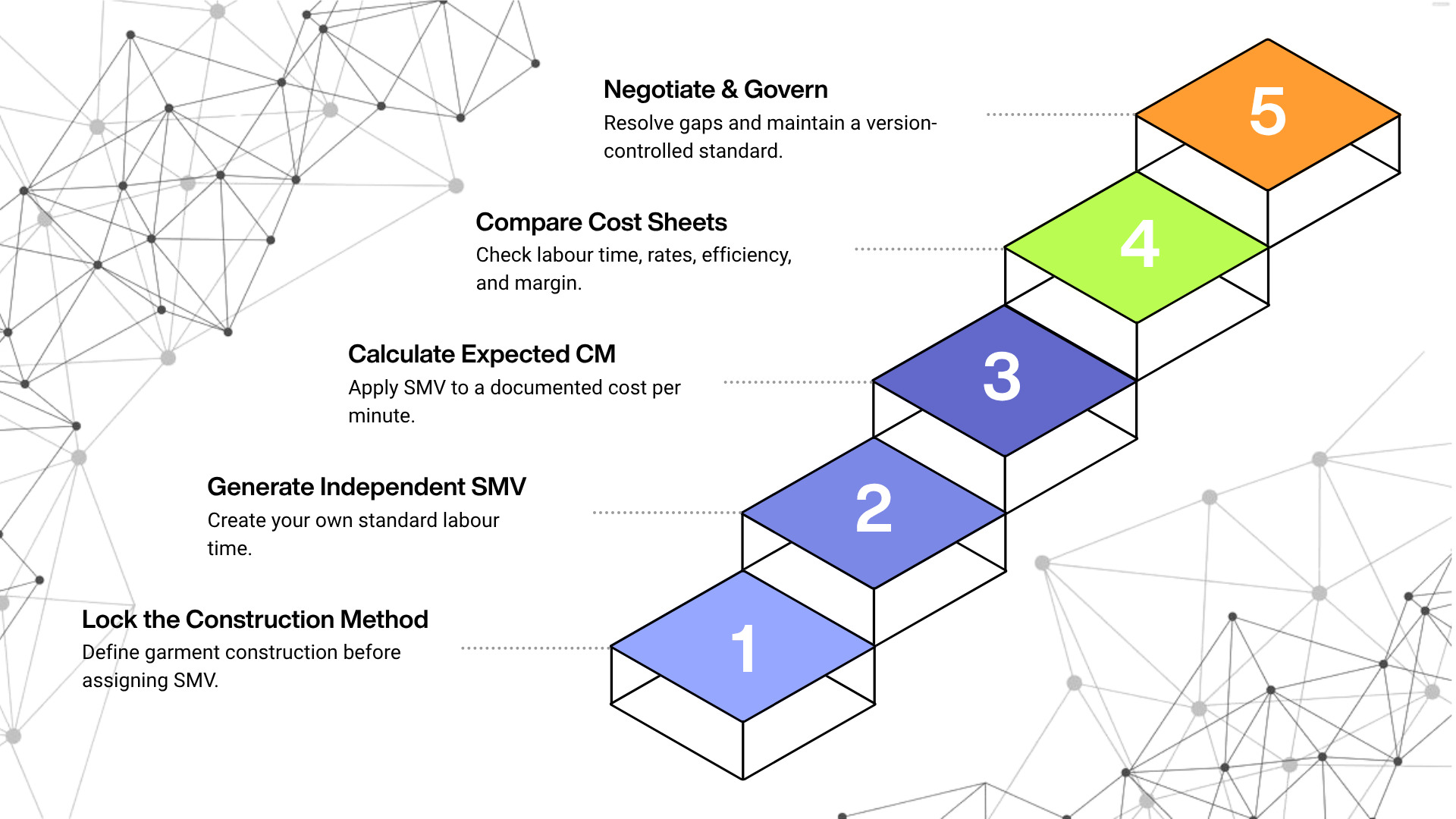
Five steps take a brand from a tech pack to a defensible independent number.
Step 1: Lock the construction method first, then the time
No SMV can be assigned until the construction method is defined. The tech pack and operation bulletin specify how the garment is built: seam types, stitch classes, closures, trims, finishing sequence. If the method is ambiguous, the SMV is ambiguous, and so is the CM.
Method first, then time. Every disagreement about cost that is really a disagreement about construction gets resolved here, before it turns into a pricing argument.
Step 2: Generate an independent SMV for the style
Build the garment’s total SMV using a predetermined motion time system rather than accepting a factory figure. This is the step that gives a brand its own labour-time number, and historically it is the step that stopped brands doing any of this. Manual method analysis is slow, and slow does not survive a seasonal calendar.
GSDQuest, the artificial intelligence enhancement to GSDCost launched in 2025, compresses it. A user uploads product images, a tech pack or a PDF. Computer vision detects visible and hidden construction features including seams, stitching types, closures, pockets and trims. Those features are matched to validated construction methods in Coats Digital’s proprietary QED Library, and a standardised Bill of Labour with SMVs is generated in seconds. Coats Digital reports a reduction of roughly 90% in costing time, and the tool is built for any supply-chain professional rather than only certified GSD practitioners.
Definition: Bill of Labour (BOL): An operation-level breakdown of every cutting, sewing and finishing step in a garment style, each assigned a Standard Minute Value. Where the Bill of Materials covers what the garment is made of, the Bill of Labour covers what it takes to make it.
Step 3: Convert SMV into an expected CM using a defensible cost per minute
Combine the independent SMV with a cost per minute appropriate to the sourcing country, built from statutory minimum wage, contracted working hours, social charges and a realistic efficiency assumption. Document the inputs. A cost per minute the brand can source and explain is a negotiating asset. One pulled from a spreadsheet nobody owns is not.
The output is the brand’s own expected CM, the figure that goes next to the supplier’s.
Step 4: Request the itemised breakdown and compare like-for-like
Now ask the factory for an open cost sheet. The request lands differently when the brand already holds an independent estimate, because the sheet can be interrogated line by line rather than read and accepted.
Four variables isolate the difference: labour time, cost per minute, efficiency and margin. Efficiency is the one most often missed, because it hides inside the rate.
Formula: effective cost per minute: Effective Cost Per Minute = Quoted Cost Per Minute ÷ Factory Efficiency
A factory quoting $0.10 per minute at 55% efficiency has an effective cost of $0.182 per minute. A factory quoting $0.13 per minute at 80% efficiency has an effective cost of $0.163. The higher headline rate is the cheaper garment. Sourcing teams that rank vendors on quoted rate alone pick the wrong one with some regularity.
Step 5: Negotiate the gap, then govern the standard
With both numbers visible, the supplier is asked to explain a difference rather than defend a price. That is a better conversation and a more durable relationship, because it separates disagreement about facts from disagreement about money.
After agreement, the Bill of Labour becomes a controlled brand asset: version-controlled, updated when the method changes, reused across styles and vendors instead of rebuilt in scattered spreadsheets. Brands skip this step more than any other, which is why the same argument recurs every season.
Worked scenario (illustrative). A US accessories brand preparing a core woven style generates an independent SMV from the tech pack, applies a documented cost per minute for the sourcing country, and arrives at an expected CM. The factory’s open cost sheet comes back 18% higher. Line-by-line comparison traces most of the gap to a single sewing operation where the quoted time exceeds what the agreed method warrants. A smaller portion is a genuine efficiency difference the factory can evidence. The brand concedes the second and renegotiates the first.
Reading the Gap Between Your Number and Theirs
A gap between an independent estimate and a supplier quote is not automatically evidence of over-charging. It has legitimate and challengeable sources, and telling them apart is what separates a costing function from a haggling function.
When a higher quote is the better deal
Effective cost per minute is the first test, and it regularly reverses a ranking. Beyond that, several drivers legitimately push a quote up:
- Genuinely lower factory efficiency, which is a capability signal worth knowing rather than only a cost
- Higher machine investment or automation that lowers defect rates and improves consistency
- Fair living wage and compliance costs
- Small-order surcharges, which are real and routinely understated by brands ordering short runs
- A more complex approved construction method than the brand assumed
Separating fair-wage cost from inflation
Fair living wage cost is a legitimate upward driver and should be treated as one, not negotiated away. A brand that squeezes CM without knowing which portion funds wage compliance risks pushing its own supplier below the standards its code of conduct requires, and doing so without realising.
Making that portion visible is the fix. GSDCost includes a globalised fair wage tool, backed by data from the Fair Wage Network and aligned to International Labour Organisation standards, which combines the SMV for a style with factory efficiency, contracted hours and the agreed wage rate. Brand and factory can then agree the wage allowance for a specific order and benchmark it against international fair wage standards, so a higher CM attributable to fair-wage compliance is identified as such and defended rather than treated as padding.
Red flags in a supplier breakdown
- Operation times that do not match the agreed construction method
- An efficiency assumption well below the factory’s known or audited capability
- Overhead that scales with margin rather than with volume
- Margin padding relocated into the labour line
- Refusal to provide operation-level detail once an itemised sheet has been agreed
| Legitimate gap drivers (a higher quote can be fair) | Challengeable gap drivers (interrogate these) |
| Lower factory efficiency reflecting a genuine capability profile | Inflated time assumptions on individual operations |
| Higher machine investment and automation | Suppressed efficiency figure used to justify a higher CM |
| Fair living wage compliance cost | Margin padding disguised as labour |
| Small-order surcharge | Overhead that scales with margin, not volume |
| A more complex approved construction method | Operation times inconsistent with the agreed method |
Comparing Breakdowns Fairly Across Multiple Suppliers
Why FOB-to-FOB comparison fails
Quoting one style to four factories and ranking the FOB numbers is the most common comparison in sourcing and one of the least informative. FOB bundles materials, labour, overhead and margin, and each factory bundles them differently. When material sourcing, freight pre-payment and margin allocation vary by vendor, the comparison collapses into noise. The brand ends up comparing four accounting choices rather than four manufacturing capabilities.
Issue one Bill of Labour and lock the SMVs
The fix is structural. Issue the same independent Bill of Labour, with locked SMVs, to every vendor. Each factory then quotes against identical time and method. The only variables left are cost per minute and efficiency, which are precisely the variables worth comparing, and no vendor can self-report a time that flatters its own margin.
The mechanism, using illustrative figures to show the arithmetic rather than market rates:
| Vendor A | Vendor B | Vendor C | |
| Locked total SMV (set by brand) | 14.0 min | 14.0 min | 14.0 min |
| Quoted cost per minute | $0.095 | $0.110 | $0.130 |
| Stated efficiency | 52% | 65% | 82% |
| Effective cost per minute | $0.183 | $0.169 | $0.159 |
| Resulting CM | $1.33 | $1.54 | $1.82 |
Vendor A has the lowest headline rate and the highest effective cost of labour. Whether A is still the right choice depends on volume, lead time, quality history and compliance profile. That is now a real sourcing decision rather than a guess, because the time variable has been taken out of the comparison.
GSDCost’s Costing Excellence functionality was built for this workflow: a brand creates a credible Bill of Labour style request, issues it to multiple vendors simultaneously, and compares the returned CM responses from a single platform, all anchored to the same international standard time benchmarks. The same standardisation works at scale on the supplier side. SAE-A Trading, one of the largest apparel manufacturers in the world, has implemented GSDCost across all 41 of its production facilities in ten countries, giving brand partners a consistent method and time baseline regardless of which facility takes the order.
Build vs Buy: Do You Need Software for This?

What a spreadsheet and a trained partner can do
A brand ordering a handful of styles from one or two factories, with a dedicated costing lead, can produce a workable independent estimate using a structured cost-sheet template and a GSD-trained consultant to establish the SMV baseline. This is a genuine option and worth saying plainly. At that scale, the constraint is not capability; it is governance.
What breaks at scale
Three things, reliably. Spreadsheet-based should-cost models drift across teams and seasons without version control, so two people cost the same style differently. SMV assumptions become undocumented and unowned. And building SMVs by hand is slow, which means the costing gets skipped exactly when the calendar is tight, which is exactly when the quotes are least scrutinised.
Most brands hit the inflexion point at four or more vendors quoting the same styles, or when the cost of costing errors starts to exceed the cost of the tooling.
The platform most brands reach for at that point is Coats Digital’s GSDCost, a costing solution built on the GSD predetermined motion time standard.
What a costing platform adds
Speed at the design stage, so an independent number exists before the negotiation rather than after it. Simultaneous multi-vendor comparison anchored to one standard. Fair-wage data inside the cost view rather than handled separately by compliance. And a single source of truth for costing, versioned and auditable.
| Brand profile | Costing challenge | Practical approach |
| Small brand, 1 to 2 factories, dedicated costing lead | No independent labour benchmark | Structured cost sheet plus a GSD-trained partner for the SMV baseline |
| Growing brand, 3 to 5 vendors | Spreadsheet drift; pre-order costing too slow to finish | AI-assisted Bill of Labour generation plus a centralised BOL |
| Multi-category brand, 6 or more vendors | Cross-vendor comparability, fair-wage compliance, speed | GSDCost Costing Excellence with GSDQuest and the fair wage tool |
Walk In With Your Own Number
The brands that get accurate cost breakdowns are not the ones with the toughest negotiators. They are the ones that arrive already holding an independent, method-based number. The supplier’s quote stops being the opening position and becomes something to be explained.
That shift also produces a better commercial relationship. A supplier asked to justify a gap against a defensible standard is being treated as a partner with a case to make. A supplier squeezed on a bundled number, with no shared basis for the squeeze, learns to build the squeeze into the next quote.
The 2026 context sharpens the point. Duty layers are elevated, contested, and outside any brand’s control. CM is the part of the price a brand can genuinely influence, and influencing it starts with owning the time assumption.
To see how GSDCost gives brands an independent cost breakdown before a purchase order is signed, arrange a demo with Team Coats Digital.
Frequently Asked Questions
-
How can a fashion brand tell if a supplier’s quote is fair?
By generating its own independent estimate and comparing. The most reliable anchor is labour: calculate the garment’s Standard Minute Value from its construction method, multiply by a defensible cost per minute, and compare the result to the factory’s Cost-to-Make. GSDCost builds that SMV from a Method Standard rather than a factory estimate, so the comparison rests on an international standard time benchmark. A gap the supplier cannot explain through efficiency, compliance or method complexity is a negotiation point. Without an independent number, the brand is accepting the quote on trust.
-
What should be included in a garment cost breakdown?
An accurate breakdown itemises four components: the Bill of Materials (every fabric, trim and label at supplier price), the Cost-to-Make or CMT (labour to cut, sew and finish), factory overhead, and margin. For a landed view, add freight, import duty and inbound handling on top of FOB. A single bundled price is not a breakdown. Each component should be visible and separately reviewable.
-
Why can’t I just ask the factory to send me a cost breakdown?
You can and should, but a factory-supplied breakdown reflects the factory’s own construction method, self-reported operation times and efficiency assumptions. It is a disclosure, not an independent check. Without your own method-based labour estimate to compare it against, you have nothing to verify it with. The breakdown tells you how the factory allocates its number, not whether the number is right.
-
What is a should-cost model in apparel?
A should-cost model is an independent estimate of what a garment ought to cost to make, built from the brand’s own inputs rather than the supplier’s quote. It combines a method-based labour estimate (Standard Minute Value multiplied by cost per minute), market material prices, and reasonable overhead and margin assumptions. Brands use it to benchmark supplier quotes and negotiate from data rather than instinct.
-
What is a Standard Minute Value and why does it matter for costing?
A Standard Minute Value is the standard time, in minutes, for a qualified operator at standard performance to complete a garment operation, inclusive of allowances. It matters because labour is the component factories have most room to inflate and brands have least ability to verify. Anchoring labour to an independent SMV, derived from the agreed construction method rather than the factory’s estimate, gives the brand a defensible number to check the quote against.
-
Can I calculate a garment’s cost before a sample is made?
Yes. Using a predetermined motion time system such as GSDCost, a Standard Minute Value can be built from a tech pack, construction description or product image before any sample is cut. AI-assisted tools such as GSDQuest generate a standardised Bill of Labour in seconds from an image or PDF. This lets a brand enter the quoting conversation already holding an independent labour cost, and change construction choices while they still affect price.
-
What is the difference between FOB and CMT costing?
FOB (Free On Board) is the price of the finished garment loaded for shipment, bundling materials, labour, overhead and margin. CMT (Cut-Make-Trim) is the factory’s charge for labour only, with the brand supplying materials. FOB hides the labour variable inside a single number. CMT isolates labour but still depends on the SMV and efficiency assumptions behind it. Accuracy depends on itemisation and an independent labour benchmark, not on which term is used.
-
What is a Bill of Labour and how is it different from a Bill of Materials?
A Bill of Materials lists every material component of a garment at supplier price. A Bill of Labour lists every cutting, sewing and finishing operation, each with an assigned Standard Minute Value. The Bill of Materials covers what the garment is made of. The Bill of Labour covers what it takes to make it. Together they form the itemised, method-based foundation of an accurate cost breakdown.
-
How do I compare quotes for the same garment from different factories?
Issue the same independent Bill of Labour, with locked Standard Minute Values, to every factory. Because you fix the labour time, each quote varies only by cost per minute and efficiency, which is the variable worth comparing. This prevents each factory from self-reporting a time that flatters its own margin. Then adjust for effective cost per minute, since a lower headline rate at low efficiency can cost more than a higher rate at high efficiency.
-
Is a lower factory quote always the better deal?
No. A lower headline rate can hide lower efficiency, weaker compliance or a simpler method that raises risk. Effective cost per minute (quoted rate divided by efficiency) often reverses the ranking: a factory quoting $0.10 per minute at 55% efficiency costs $0.182 effectively, more than one quoting $0.13 per minute at 80% efficiency, at $0.163. Capability, reliability and fair-wage compliance also carry value a headline price does not capture.
-
How does GSDCost help brands get an accurate cost breakdown?
GSDCost builds labour cost from a Method Standard, an objective breakdown of every operation, combined with factory efficiency and an agreed cost per minute, at the design stage before a sample is cut. Its Costing Excellence functionality lets brands issue a standardised Bill of Labour to multiple vendors at once and compare Cost-to-Make responses from one platform, anchored to the same international standard time benchmarks. A globalised fair wage tool uses Fair Wage Network data.
-
What is GSDQuest and who can use it?
GSDQuest is an AI-powered enhancement to GSDCost, launched in 2025, that generates a standardised Bill of Labour in seconds from a garment image, tech pack or PDF. It detects visible and hidden construction features, maps them to Coats Digital’s proprietary QED Library, and produces an SMV-based labour estimate without manual analysis. It is designed for any supply-chain professional, not only certified GSD practitioners, and Coats Digital reports roughly 90% less costing time.
-
How do US tariffs affect what I should pay for a garment in 2026?
Tariffs sit on top of the factory price as a separate landed-cost layer, so they do not change the Cost-to-Make you should negotiate, but they raise the cost of getting it wrong. Average applied US apparel tariffs rose from 14.7% in January 2025 to 35.1% by December 2025. After the Supreme Court invalidated the IEEPA tariffs, a temporary Section 122 surcharge ran to 24 July 2026 and was replaced the same day by Section 301 forced-labour duties of 10% or 12.5% on 60 economies, above the MFN rate. Verify the live position before quoting.
-
Do small brands need costing software to verify supplier quotes?
Not necessarily. A brand ordering a few styles from one or two factories can build a workable independent estimate with a structured cost sheet and a GSD-trained partner. The limitation is governance and speed: spreadsheet models drift across seasons and vendors, and building SMVs by hand is slow enough that the costing gets skipped under deadline. Most brands reach the point where a platform pays for itself at four or more vendors.

Brand-to-Vendor Cost Collaboration: Which Layer of the Cost Stack Are You Missing?

Why Does Capacity Planning Software Fail in Bangladesh’s Garment Manufacturing Sector?
The Best Tools for US Fashion Brands to Track and Report Supplier Labour Costs for ESG Compliance
All Blog Categories
- Production Planning
- Corporate
- Method Time Cost Optimisation
- Supply Chain Solutions
- Sustainability
- Videos