The Best Tools for US Fashion Brands to Track and Report Supplier Labour Costs for ESG Compliance
by Kunal Kapur
 9
Mins Read
9
Mins Read
- Key Takeaways
- The Quote Arrives as a Single Number
- Why a Supplier Quote Is Never Just a Price
- Why “just send me a breakdown” is not enough
- What “Accurate” Actually Means
- Why labour is the variable that decides the quote
- The Independent Anchor: Standard Minute Value
- SMV and SAM: same measure, different label
- Predetermined motion time systems vs stopwatch time study
- Building the Cost Breakdown Before You Order
- Reading the Gap Between Your Number and Theirs
- When a higher quote is the better deal
- Separating fair-wage cost from inflation
- Red flags in a supplier breakdown
- Comparing Breakdowns Fairly Across Multiple Suppliers
- Issue one Bill of Labour and lock the SMVs
- Build vs Buy: Do You Need Software for This?
- What a spreadsheet and a trained partner can do
- What breaks at scale
- What a costing platform adds
- Walk In With Your Own Number
- Frequently Asked Questions
Key Takeaways
- ESG reporting has shifted from audit findings to auditable, supplier-level data, including whether pay clears a living-wage benchmark.
- No single platform covers it. A working stack layers social compliance, data standards, traceability, wage benchmarks, and labour costing.
- Social audits assess conditions at a site. They cannot tell you how many minutes of labour sit inside a garment.
- SLCP standardises how social and labour data is collected. Higg FSLM is that assessment with Cascale’s scoring applied.
- The 2026 EU Omnibus cut who must report by around 90 per cent. It did not change what customers ask suppliers for.
- The EU Forced Labour Regulation applies from December 2027 to every operator selling into the EU, with no size threshold.
- Auditable labour data must be standardised, traceable, independent and repeatable. A vendor’s own quote fails at least two.
- You cannot report a wage gap you have not costed.
A due-diligence questionnaire lands from a European retail customer. Most of it is familiar: policies, grievance mechanisms, tier-one factory list, audit coverage, corrective action status. Then, near the bottom, one cell asks for the living-wage gap by supplier, in dollars per unit.
The brand has three years of social-audit reports. It has a traceability platform that maps tier-two mills. It has a sustainability report full of commitments about fair pay. None of it fills that cell.
That gap is the subject of this article. Below, the named tools are mapped by the reporting job each one actually performs, so you can work out which combination fits your situation, and why the labour-cost field is the one most brands still cannot produce even after heavy investment in ESG software.
One framing point first. ESG is not a single data problem. It is several, with different owners, different sources, and different failure modes, and supplier labour cost is the one most platforms quietly skip.
What “Supplier Labour Cost” Actually Means In An ESG Report
Supplier labour cost data in an ESG report is not a factory’s audit status. It is the verifiable labour time embedded in a product, multiplied by an assured wage rate.
Three different things get called “labour data” inside a fashion business, and most bad tooling decisions start with conflating them.
Three data types people call “labour data.”
Compliance status: What an assessor found at a site on a given date, measured against a code of conduct. The unit is the facility, and the shelf life is short.
Wage data: What workers are paid, compared against the statutory minimum and against a living-wage benchmark. Again, the unit is the facility, expressed as a rate per hour or month.
Labour-cost data: How much labour a product consumes, expressed in standard minutes and converted into a cost per unit. The unit here is the style, which is why this layer is the one that connects a wage commitment to a garment.
Most brands hold the first two in some form. The third usually exists only as a supplier’s quoted cost-to-make, with no method behind it and no way to test it.
Why the living-wage gap is the field that breaks
The arithmetic is simple and unforgiving. The gap equals the benchmark wage minus the wage actually paid, multiplied by the labour time in the product.
Take away the time component and the calculation stops dead. You can publish a policy, a target and a supplier commitment, and still have nothing to put in a numeric field.
In apparel manufacturing, that time component has a precise name: the Standard Minute Value. The SMV is the input that turns a facility-level wage rate into a product-level disclosure, and it is the input that sits outside the scope of every social compliance platform on the market.
What “auditable” means to an assurance provider
The assurance picture settled during 2026, and it settled at a lower level than most teams had budgeted for. Omnibus I permanently removed the planned escalation from limited to reasonable assurance under CSRD, and the European Commission’s deadline for adopting a harmonised limited-assurance standard has moved to 1 July 2027, with CEAOB interim guidelines filling the gap.
Running alongside it, ISSA 5000, the first comprehensive global sustainability assurance standard, takes effect for engagements covering periods beginning on or after 15 December 2026. It is framework-neutral, so it shapes assurance well beyond the EU.
Limited assurance is not the soft option teams assume. The practitioner still asks where a number came from, what method produced it, who produced it, and whether the same inputs would produce the same answer next year. Four tests follow from that, and they are set out later in this article.
Why US Brands Are Still Being Pulled Into Labour-Cost Reporting
US fashion brands face labour-data pressure from two directions: EU obligations that reach them through customer contracts and product-level bans rather than direct reporting scope, and US enforcement law that demands supply-chain evidence rather than annual disclosure.
The EU reporting net got much smaller.
The Omnibus I Directive (EU) 2026/470 entered into force on 18 March 2026 and rewrote both headline directives.
CSRD now applies only to companies with more than 1,000 employees and more than €450 million net turnover. For non-EU groups, it applies where the third-country parent generated more than €450 million of net EU turnover in each of the last two consecutive years and has an EU subsidiary or branch that itself exceeds €200 million net turnover. The Commonwealth Climate and Law Initiative’s analysis puts the effect at roughly 90 per cent of previously expected filers, around 42,000 companies, dropping out of scope.
CSDDD moved further, to 5,000 employees and €1.5 billion net turnover, which Clifford Chance estimates as about a 70 per cent reduction in the in-scope population. Transposition is due by 26 July 2028, and the rules apply from 26 July 2029. The EU-wide civil liability regime was deleted and reverts to national law.
The simplified ESRS, adopted as a delegated act on 3 July 2026, cut mandatory data points by around 60 per cent and apply from financial years beginning on or after 1 January 2027, with voluntary early application for 2026.
The value-chain cap is the detail almost nobody has priced in
Omnibus: I also introduced a protection that cuts directly against the idea that a customer can ask a supplier for anything it likes.
Undertakings with no more than 1,000 employees sitting in a reporting company’s value chain now have the right to decline information requests that go beyond the new Voluntary Standard, and the Commission’s own staff working document confirms the cap extends to non-EU partners of equivalent size.
Read it in both directions. A US brand with fewer than 1,000 employees supplying a European retailer now has a defensible basis for narrowing an expansive questionnaire. A larger US brand gets no such protection, and may find its own suppliers invoking the cap in response to its data requests.
Three things that did not shrink
The EU Forced Labour Regulation: Regulation (EU) 2024/3015 bans products made with forced labour from being placed on, made available on, or exported from the EU market. It applies from 14 December 2027, covers every product and sector regardless of origin, and carries no employee or turnover threshold at all. The Commission published implementation guidelines, launched the Forced Labour Single Portal and released the risk database on 26 June 2026. Crucially, it is an obligation of result rather than a due-diligence obligation: the question is whether the product is clean, not whether your process looked reasonable, and an inability to produce supply-chain evidence inside tight deadlines counts against you.
The adequate-wage disclosure in ESRS S1: The requirement to state whether employees are paid an adequate wage, and to name the countries and percentages where they are not, survived simplification, with the revised text making the benchmark choice explicit and country-specific. Shift’s technical note is the clearest explanation available. Note the boundary precisely, because it is frequently misreported: this sits in S1, covering a company’s own workforce. Value-chain worker disclosure sits in S2, is driven by materiality, and concentrates on material human rights risks rather than a fixed per-unit wage-gap datapoint.
Customer contracts: Nothing in the simplification package tells a European retailer to stop asking its suppliers for wage data. In-scope buyers still need value-chain information to complete their own materiality assessments, and they will get it from the companies that sell to them.
The US layer changed shape, not severity.
The Uyghur Forced Labor Prevention Act creates a rebuttable presumption that goods made wholly or partly in the Xinjiang Uyghur Autonomous Region, or by an entity on the UFLPA Entity List, are made with forced labour. Rebutting it requires clear and convincing evidence, and there is no de minimis exemption: any traceable quantity can justify detaining an entire shipment.
The enforcement posture has shifted noticeably. Detention volumes fell sharply, with Sourcing Journal reporting in September 2026 that CBP’s dashboard showed $443.11 million of shipments detained across 2025 and 2026 against $3.19 billion in the two preceding years. Designations moved in the opposite direction. On 31 July 2026, the Department of Homeland Security announced the addition of 43 companies to the Entity List, effective 3 August, taking the total to 187 entities. That was a 30 per cent increase and the largest single expansion since the Act took effect, and the listed sectors include apparel and cotton. DHS also stated that CBP has denied entry to more than 24,300 shipments worth nearly $1 billion since enactment.
One detail from that expansion deserves attention from anyone running a sourcing map. A substantial share of the newly listed companies are headquartered outside Xinjiang, in provinces including Shandong, Jiangsu and Henan. Entity List exposure is not a geography question, which is precisely why tier-two and tier-three visibility matters more than a clean tier-one list.
At the state level, the California Transparency in Supply Chains Act still requires retail sellers and manufacturers doing business in California with annual worldwide gross receipts above $100 million to disclose their efforts across verification, audits, certification, internal accountability, and training. New York’s Fashion Sustainability and Social Accountability Act, which would impose mandatory due diligence on large fashion sellers, was reintroduced for the 2025-26 session and has not passed.
What each framework actually makes you hold
| Framework | Who it captures | Labour or wage data it forces you to hold | Status, verified |
| EU Forced Labour Regulation 2024/3015 | Every operator placing products on the EU market. No threshold | Supply-chain evidence sufficient to answer an investigation | In force; applies from 14 Dec 2027; guidelines issued June 2026 |
| EU CSRD / ESRS | EU firms >1,000 employees and >€450m turnover; qualifying non-EU parents | Own-workforce adequate-wage disclosure; value-chain worker disclosure where material | Narrowed by Omnibus I; simplified ESRS apply from FY2027 |
| EU CSDDD | EU firms >5,000 employees and >€1.5bn; non-EU firms >€1.5bn EU turnover | Risk-based due diligence on adverse impacts including wages | Transposition by 26 Jul 2028; application from 26 Jul 2029 |
| German LkSG | Firms above thresholds with German operations | Internal documentation of human-rights risk, including wages | Due-diligence duties live; BAFA reporting suspended since autumn 2025; abolition bill still before parliament |
| US UFLPA | US importers | Evidence rebutting the forced-labour presumption, including deep-tier provenance | In force; Entity List at 187 entities; detention volumes down |
| CA Transparency in Supply Chains Act | Retailers and manufacturers over $100m doing business in California | Disclosure of verification, audit, certification, accountability and training efforts | In force since 2012 |
| GRI, ISSB / SASB | Any reporting brand | Wage and labour-practice metrics referenced by investors | Voluntary |
Regulatory position verified for September. EU sustainability law has moved repeatedly since February 2025 and continues to move. Check the European Commission, BAFA and CBP sources linked above before relying on any status in this table.
The honest summary
The mandatory reporting population shrank. The data question did not.
What changed is where the pressure originates. Less of it now comes from a directive that names your company. More of it comes from a customer contract, from a forced-labour ban with a fixed 2027 start date, and from commitments your own board has already published.
That distinction matters for tool selection more than it first appears. A compliance-driven purchase buys the minimum a regulator will accept. A commitment-driven purchase has to survive scrutiny with no regulator around to define what “enough” looks like.
The Tool Landscape: Which Platforms Actually Do What
Social-audit, data-standard, traceability, and wage-benchmark tools each cover part of the picture. Only method-based costing produces the standardised per-unit labour cost a living-wage gap disclosure requires.
| Tool category | Primary job | Named examples | What it serves best | Produces auditable labour-cost data? |
| Social compliance and audit | Assess site conditions, hours, safety; drive corrective action | SMETA (Sedex), amfori BSCI, SA8000 | Buyer codes of conduct, forced-labour evidence | No. Conditions, not cost |
| Converged data standard | Standardise how social and labour data is collected, once | SLCP Converged Assessment Framework | Cutting duplicate audits; feeding buyer and regulatory reporting | No. Collects data, does not cost it |
| Facility ESG data platform | Aggregate and score facility social and labour data | Higg FSLM (Cascale), hosted on Worldly | Buyer scorecards, value-chain reporting inputs | No. Facility-level, not per unit |
| Supply-chain traceability | Map suppliers and material flow across tiers | Traceability and mapping platforms | UFLPA and Forced Labour Regulation evidence | No. Provenance, not labour |
| Wage benchmark | Supply a living-wage reference point | Fair Wage Network, WageIndicator, Anker Methodology (GLWC) | Living-wage disclosure and target setting | Partially. The benchmark, not the gap |
| Method-based costing | Calculate labour time and cost per product | GSDCost with Fair Wage Tool | Living-wage gap per unit, assured labour cost | Yes. SMV multiplied by wage rate, vendor-neutral |
Social compliance and audit: necessary, and on the wrong axis
SMETA, the Sedex Members Ethical Trade Audit, assesses a site against the ETI Base Code, ILO conventions and local law across labour standards, health and safety, environment and business ethics. Sedex launched version 7.0 in October 2025, introducing a management-systems approach and revised issue titles that sharpen detection of concerns, including living wages and recruitment fees. It secured Consumer Goods Forum SSCI recognition in January 2026, after completing the SSCI benchmarking process.
A precision point worth holding onto, because it changes how you model the data: SMETA is not a certification and produces no pass or fail. It produces findings and corrective actions. amfori BSCI applies a graded rating. SA8000 is a certifiable standard. Treating all three as one binary “audit pass” field is the first modelling error many brands make, and it propagates into every downstream report.
None of them produces a labour cost. An audit can confirm a wage was paid and hours were recorded. It cannot apportion that wage to the garment you are reporting on.
Converged data standards: SLCP is a standard, not a scorecard
The Social & Labor Convergence Program provides a Converged Assessment Framework so a facility completes one standardised social and labour data collection rather than a dozen overlapping audits. The framework pairs a data collection tool with a verification methodology and verifier guidance, and it is deliberately agnostic: it gathers data without passing judgement on it.
Facilities own their data and share it through the SLCP Gateway or an Accredited Host. SLCP reports the average assessment was shared 2.96 times during 2024, and its 2025 impact reporting puts the potential value released by avoided duplication at around $35 million for that year. CAF v1.7 arrived in 2025 with stronger risk assessment and regulatory alignment, and a v2.0 with deeper human-rights due diligence alignment has been signalled as the programme marks ten years.
SLCP standardises how the data is gathered. It does not grade the facility, and it does not cost the labour.
Facility ESG data platforms: Higg FSLM on Worldly
This relationship is the one most often described incorrectly, so it is worth stating flatly. The Higg Facility Social & Labor Module is built on SLCP’s Converged Assessment Framework. Completing the Higg FSLM means completing the SLCP assessment process, using the same questions and the same verification protocol. Cascale adds a scoring layer so buyers can track annual performance, and the module is hosted exclusively on Worldly.
So the real question is not “SLCP or Higg FSLM”. It is whether your customers want the underlying verified dataset, the scored version, or both, and which Accredited Host your supply base already uses.
Either way, the output is facility-level. Working hours, wages, health and safety, and worker rights are recorded against a site, never apportioned to a style.
Traceability: provenance is not the same as labour cost
Traceability answers where something was made and by whom, across tiers. With the Forced Labour Regulation applying from December 2027, and with UFLPA designations increasingly landing on companies outside Xinjiang, that capability is becoming the difference between answering an investigation and losing a container.
It is also silent about labour content. A perfectly mapped chain tells you nothing about how many minutes of work sit inside the garment.
Wage benchmarks: the reference point, not the gap
Three sources dominate the field.
The Anker Methodology, used by the Global Living Wage Coalition, builds estimates from detailed local studies of what a basic but decent life costs, and is fully aligned with the living-wage estimation principles agreed at the ILO in 2024. The Fair Wage Network, founded in 2009 by Daniel Vaughan-Whitehead and Auret van Heerden, maintains living-wage thresholds covering more than 200 countries and over 3,500 localities. WageIndicator draws on survey and crowd-sourced cost-of-living data for broad reference points.
A benchmark is a rate. It becomes a reportable gap per unit only once it is multiplied by labour time, which no benchmark provider supplies.
Method-based costing: where the labour number is actually made
Method-based costing builds a Bill of Labour operation by operation from predetermined motion times. The output is a labour cost that is standardised, vendor-neutral and independent of any single factory’s self-report.
GSDCost is the established example in apparel. It applies a library of 39 predetermined motion codes to each step in a Method Standard, generating International Standard Time Benchmarks and an SMV for every operation. Because those motion codes carry internationally established time values, the resulting figures compare across factories and geographies instead of reflecting one line’s performance on the day someone held a stopwatch.
Coats Digital states that GSDCost has been in use for more than 40 years, is recognised by the International Labour Organisation, and is used by over 5,000 customers in 65 countries. Those are company figures rather than independently audited ones, and are presented here as such.
That profile, standardised and reproducible by a third party, is exactly what an assurance practitioner is looking for. Which brings us to the test itself.
What Makes Labour-Cost Data Auditable: The Four Tests
Auditable labour-cost data must be standardised, traceable, independent and repeatable. A supplier’s self-reported figure fails at least two of those four tests.
Apply all four to any figure you intend to disclose.
Standardised: Built on a consistent method, so numbers compare across styles, factories and seasons rather than reflecting local estimating habits.
Traceable: Every figure resolves to a defined operation, a time source and a wage input. An assurer can walk backwards from the total to its components without your team improvising.
Independent: Not solely self-reported by the party being assessed. A vendor quoting its own cost-to-make is reporting on itself, in a negotiation.
Repeatable: A third party using the same method and inputs arrives at the same answer. If two competent engineers produce materially different numbers, you have an estimate, not a disclosure.
| Data source | Standardised | Traceable | Independent | Repeatable |
| Supplier’s own labour-cost quote | No | Partial | No | No |
| Social-audit wage record | Partial | Yes | Partial | No |
| Spreadsheet SMV estimate | Partial | Partial | Depends | Low |
| Method-based SMV from predetermined times | Yes | Yes | Yes | Yes |
A wage figure you cannot reproduce is a claim, not a disclosure. Limited assurance engagements are designed to find that distinction, and ISSA 5000 puts explicit weight on data quality, internal controls, and management representations.
There is a governance corollary that rarely gets airtime. Method assumptions drift. If your SMV library is not versioned, this season’s figure cannot be reconciled against last season’s, and a year-on-year wage-gap trend becomes unverifiable even though every individual number looked defensible when it was produced.
How Brands Actually Collect Supplier Wage Data
Every framework assumes a brand can obtain reliable wage data from suppliers it does not own. In practice, this is the hardest step in the entire exercise, and no dashboard removes it.
Brands collect supplier wage data through social-audit records, SLCP-standardised assessments and direct disclosure. Piece-rate pay, overtime patterns and subcontracting make effective earnings hard to verify.
Payslip wage versus effective earnings
The figure on a payslip is rarely the whole picture on a sewing floor. Piece-rate and time-rate systems behave differently. Overtime premiums vary by jurisdiction. Production bonuses, attendance incentives and skill-grade uplifts can make up a meaningful share of take-home pay.
That variation matters for an honest gap calculation. A machinist on piece rate may clear a benchmark comfortably during peak and fall well below it in a slow week, and an annual average tidily conceals both.
It also matters for causation, which is the part brands find uncomfortable. If your order pattern creates the peaks and troughs, then purchasing practice is part of what the disclosure is describing, not just the factory’s pay policy.
Where the data thins out
Visibility is weakest exactly where wage risk concentrates: unauthorised subcontracting and homeworking. These are the tiers where no facility assessment was ever performed, and where the only figure available is self-reported.
Peak season is when the exposure compounds. A vendor that accepts more volume than its line capacity can absorb has to place work somewhere, and the placement is not always declared. Capacity data and planning discipline are therefore part of your labour-risk picture, not a separate operational concern.
Self-reported data from those tiers fails the independence test. It remains useful for risk triage. It should not sit underneath a published number.
Standardising collection, then costing it.
SLCP exists precisely to standardise the collection step, which is why it belongs in the stack even though it produces no cost figure.
Method-based costing supplies the missing denominator. Collection tells you what was paid. Costing tells you how much labour that pay was meant to cover. A brand holding one without the other cannot complete the calculation, which is the position most brands are currently in.
From SMV to Living-Wage Gap: How The Numbers Connect
A living-wage gap per unit equals the product’s labour time multiplied by the difference between the living-wage benchmark and the wage actually paid. The labour time comes from a method-based Bill of Labour.
A gap disclosure needs three inputs. Traceability supplies none of them. Social audits supply the paid wage. Benchmark providers supply the reference rate. Only method-based costing supplies the labour time that converts facility data into a per-unit figure.
The calculation, worked through
The figures below are illustrative and are used only to show the structure of the calculation.
| Input | Illustrative value | Source |
| Product labour content | 15 standard minutes | Bill of Labour, built from predetermined motion times |
| Effective wage rate paid | X per minute | Payroll and verified assessment data, adjusted for effective earnings |
| Living-wage benchmark rate | Y per minute | Anker or GLWC, Fair Wage Network, or WageIndicator |
| Gap per unit | 15 × (Y − X) | Calculated |
The valuable property here is not the arithmetic. It is that every term except the benchmark comes from your own standardised method, and the benchmark comes from a named external provider with a published methodology.
That is what makes the result defensible. An assurer can trace 15 minutes back to a list of operations, each carrying a motion-code-derived time, and can trace the benchmark back to a third-party source whose selection you documented.
Choosing a benchmark is a governance decision.
There is no single official living wage. The OECD’s comparative analysis of living-wage methodologies makes the point directly: methodological variety has real value, and it also reduces transparency when estimates get compared.
What does exist is an agreed concept. At a tripartite meeting of experts in February 2024, endorsed by the ILO Governing Body on 13 March 2024, the ILO settled on a formulation describing a living wage as the pay level needed to afford a decent standard of living for workers and their families, judged against country circumstances and calculated for normal hours of work. The ILO has since published a methodology for estimating workers’ needs for wage-setting purposes, tested in countries including Indonesia, Viet Nam and Ethiopia.
| Benchmark | Basis | Best used when |
| Anker Methodology / GLWC | Detailed local cost-of-living studies, aligned with ILO estimation principles | You need the most rigorous location-specific figure, and coverage exists for your sourcing countries |
| Fair Wage Network | Thresholds across 200+ countries and 3,500+ localities | You have a wide sourcing footprint and need consistent coverage across all of it |
| WageIndicator | Survey and crowd-sourced cost-of-living data | You need broad, fast reference points for screening |
Document which benchmark you use and why, and expect to be asked. Switching benchmark between reporting cycles will move your gap without anything changing on a single production line.
GSDCost’s Fair Wage Tool uses data provided by the Fair Wage Network, as Coats Digital set out when the functionality was extended in 2024.
The Bill of Labour is the ledger ESG reporting has been missing
A Bill of Materials answers what a garment is made from. A Bill of Labour answers how much human work is in it: an operation-level record of every cutting, sewing, and finishing step, each carrying its own SMV.
GSDCost manages a digital Bill of Labour as part of its costing process, with CMT, full-factory and open costing options linked to operation libraries. Because the times derive from predetermined motion codes rather than a stopwatch study of one line, the figures stay comparable when the same style moves to a different vendor.
That comparability is what makes vendor analysis possible rather than anecdotal. Coats Digital’s 2024 costing enhancements let brands issue a Bill of Labour style request to several vendors at once and compare the cost-to-make responses in one place. When two factories quote differently for the same garment, a method-based standard tells you whether the difference is efficiency, wage rate, or negotiating position, which is a materially different conversation from haggling over a lump-sum CM.
Why the wage line has to be ring-fenced
Here is the commercial reality that quietly undermines most living-wage commitments. In the BoF-McKinsey State of Fashion 2026, 45 per cent of executives named sourcing costs as the part of their economic model under the greatest pressure, and 76 per cent expected trade disruption and tariffs to define the year.
A fair-wage allowance buried inside a negotiable cost-to-make will not survive that environment. It has to be identified as its own line, agreed separately, and reported separately.
Coats Digital’s brands commercial director, Stuart McCready-Stocks, made the underlying point in a published discussion with Sourcing Journal: brands have traditionally built their costing data around minimum wage rather than a living wage. Moving from one to the other is not a data exercise. It is a decision about what the cost sheet is allowed to contain.
That is the specific job the Fair Wage Tool inside GSDCost performs. It combines the international SMV for a style with factory efficiencies, contracted hours and the agreed wage rate, so brands and manufacturers can settle the wage allowance for an order in any factory and benchmark it against international fair wage standards.
Coats Digital reports typical GSDCost outcomes of a 5 per cent reduction in SMVs, a 5 per cent productivity increase and a 10 per cent improvement in on-time delivery performance. These are customer-reported figures published by the company rather than independently audited results.
What Implementing This Actually Involves, And What It Will Not Do For You
Buying a costing capability is straightforward. Getting a defensible labour-cost figure out of it takes longer than most ESG project plans allow, so it is worth being blunt about the work and the limits.
What the work actually looks like
Someone has to own the number: In most brands, labour cost is an orphan. Sourcing produces it, finance consumes it, compliance reports it, and nobody owns its definition. Assign ownership before you assign a budget, because assurance questions go to whoever owns the method, not whoever bought the licence.
Method libraries need building and maintaining: Predetermined-time systems come with standard data libraries by product type, which shortens the runway considerably, but your own construction standards still have to be built, reviewed, and kept current as styles evolve.
Practitioner capability matters, though less than it did: Traditionally, building a Method Standard required trained practitioners, which is why coverage tended to stop at core styles. AI-assisted Bill of Labour generation has loosened that constraint, but someone still has to sense-check the output against how the factory actually sews.
Efficiency and contracted hours are negotiated inputs: An SMV is objective. The factory efficiency percentage and contracted hours applied alongside it are agreed between the parties, and those assumptions deserve the same versioning discipline as the times themselves.
Vendor engagement is the long pole: A method-based standard changes how negotiations run. Suppliers who have priced on experience and relationship for twenty years will want to understand the method before they accept its output, and that conversation is worth having properly rather than by email.
What method-based costing does not do
It does not tell you what workers were actually paid. It tells you what the labour content of the garment is, which is only half of the gap calculation. The paid wage still has to come from payroll records, verified assessments, or direct disclosure.
It does not audit a factory, screen for forced labour, or map your tiers. Anyone claiming a costing system delivers ESG compliance is overselling it.
It does not settle the benchmark question, which remains a governance choice with disclosure consequences.
And it does not replace judgement about purchasing practice. If lead times and order volatility push a vendor into unplanned overtime or undeclared subcontracting, a precise wage allowance on the cost sheet does not fix the underlying behaviour. The number tells you what fair should cost. It does not make you a fair customer.
How To Choose Your Stack: A Selection Framework
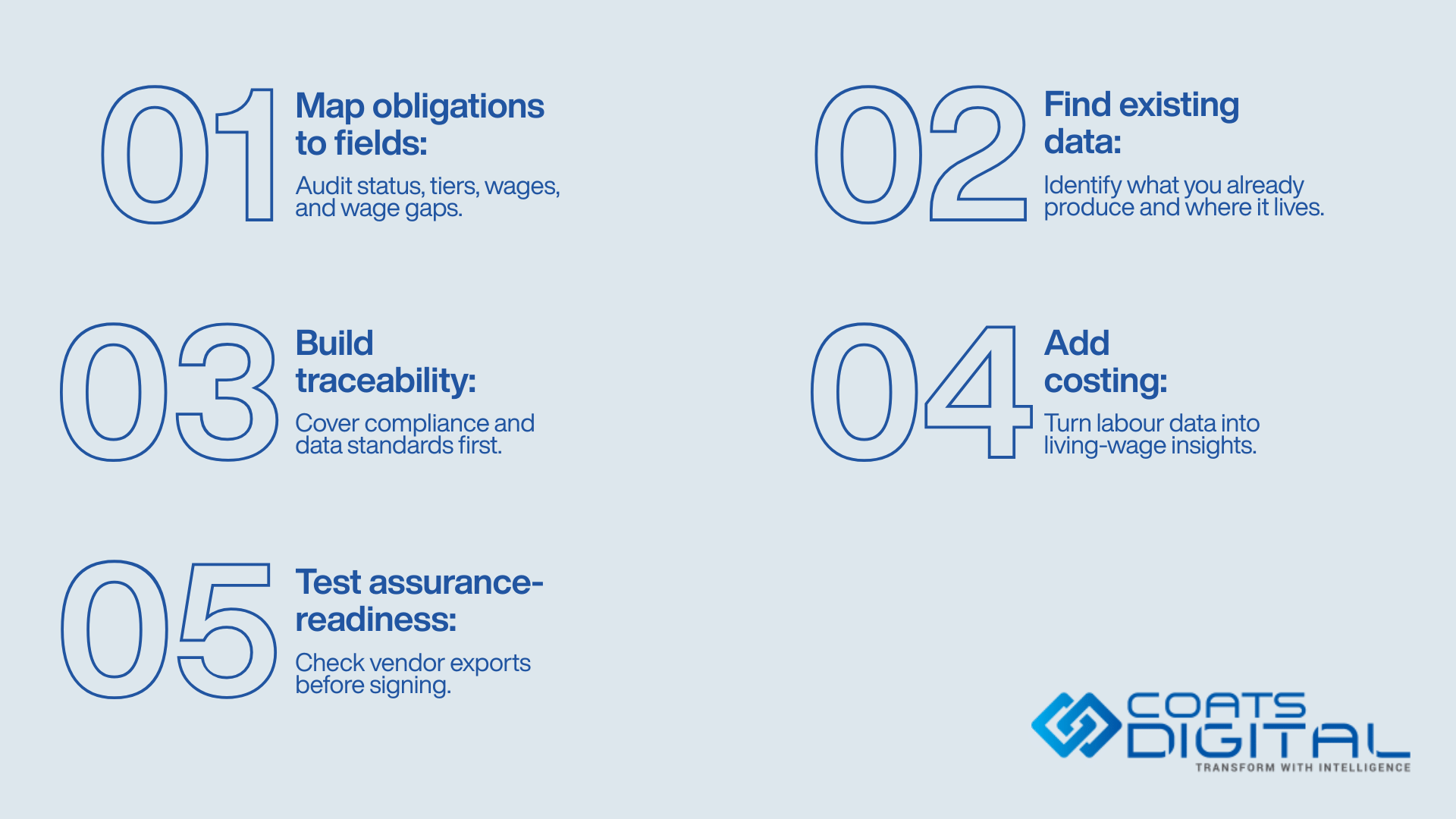
Choose ESG tools by mapping each obligation to a specific data field, then buying the tool that produces that field. Source data comes before disclosure software.
- Map each obligation to a field: Audit status, tier map, wage data, wage-gap figure. Write them as fields rather than as regulations. Regulations change faster than data requirements do, as 2026 demonstrated at some length.
- Identify which fields you already produce, and where: Most brands find labour cost sitting in a sourcing spreadsheet, owned by nobody who reports.
- Fill the compliance, data-standard, and traceability layers first if they are missing: These are table stakes for forced-labour evidence and customer due-diligence requests.
- Add the costing layer to generate the labour-cost field: This is what makes living-wage reporting possible rather than aspirational.
- Choose disclosure and aggregation software last: A reporting platform inherits the credibility of its inputs and adds none of its own.
- Test assurance-readiness before signing: Ask each vendor to show you the export a third-party assurer would receive, and whether method versions are retained and retrievable.
| Brand profile | Dominant reporting gap | Priority |
| US brand, EU customers, no EU entity | Cascaded due-diligence requests | Traceability plus method-based labour cost |
| Brand selling into the EU before December 2027 | Forced-labour evidence at depth | Traceability plus audit management plus SLCP data |
| Large brand inside CSRD scope | Assured workforce and value-chain disclosure | Costing layer plus assurance-ready export |
| Brand with a public living-wage commitment | A reportable wage-gap figure | Method-based SMV plus a documented benchmark |
Does your PLM or ERP already do this?
Usually not, and it is worth knowing why before commissioning an internal build.
PLM and ERP systems hold master data and will store a labour-cost field without difficulty. What they generally do not do is generate it. Producing a method-based SMV requires a predetermined motion-time database and a method standard. Producing a living-wage benchmark requires a licensed external dataset.
They are systems of record, not method engines. The workable architecture for most brands is to calculate the figure in a method-time-cost system and write it back against the style in PLM, so product development, sourcing, and compliance all read the same number rather than three versions of it.
Common Mistakes Brands Make When Buying ESG Labour Tools
The most common mistake is buying reporting software before securing auditable source data, especially the labour-cost figure that underpins living-wage disclosure.
Buying the disclosure layer first: A reporting platform makes weak inputs look finished. It does not make them auditable.
Treating an audit result as labour-cost data: An assessment describes conditions at a site on a date. SMETA does not even produce a pass or fail.
Relying on supplier self-reported labour figures: These fail the independence test, which is the one an assurer probes hardest.
Treating traceability as the whole answer: Provenance is essential for forced-labour evidence and says nothing about labour content.
Confusing SLCP with a scorecard: It standardises collection. Cascale’s scoring sits on top of it in the Higg FSLM. Neither costs the labour.
Under-scoping tier coverage: Wage risk sits deepest in the chain, where data is thinnest, and self-reporting is most common, and where UFLPA designations are increasingly landing.
Letting the wage line compete with cost-down targets: A negotiable fair-wage allowance is a preference, not a commitment, and it will not survive a tariff cycle.
Ignoring versioning: Un-versioned method assumptions drift, and a trend you cannot reproduce is worse than no trend at all.
Reading the 2026 Omnibus as an all-clear: Scope narrowed. The Forced Labour Regulation did not, and your customers’ questionnaires have not either.
Technology Trends: Where ESG Labour Data Is Heading
The direction of travel is towards assured, machine-readable, standardised data, which favours method-based labour costing over self-reported or spreadsheet estimates.
Labour data is moving upstream into design.
Generating a Bill of Labour has historically required a trained practitioner and real time per style, which is why coverage stopped at key items, and everything else got estimated.
That constraint is lifting. GSDQuest, launched by Coats Digital in August 2025, uses AI to read garment images, tech packs or PDFs, identify visible and hidden construction features, map them to construction methods in the company’s QED Library, and generate a standardised Bill of Labour in seconds. Because the output rests on the same motion codes and SMVs as GSDCost, the figures stay comparable across styles and factories.
The compliance consequence is coverage. A brand that can cost an assortment rather than a sample can report a portfolio wage gap instead of an illustrative one, and can do it early enough in development for the number to change a decision.
The check to apply is that the output stays method-based and version-controlled. Speed only helps if the result still clears the four tests.
Benchmark methodology becomes a governance question.
As living-wage reporting matures, the choice between Anker or GLWC, Fair Wage Network and WageIndicator stops being a procurement detail and becomes a disclosure position with consequences.
Different methodologies produce different thresholds in the same country. Investors, NGOs and assurers will increasingly ask which you chose, when, and what your gap would look like under an alternative.
Brands that document the choice now will field that question calmly. Brands that inherited a benchmark from a spreadsheet will not.
Assured, machine-readable disclosure raises the premium on source data.
EU sustainability statements are moving towards structured digital tagging, and assurance has settled at limited assurance as a permanent level rather than a staging post. Both reward the same thing: data that was standardised when it was created, not reconciled afterwards. The same logic runs through the wider digital transformation of sourcing and manufacturing, where standardised cost-to-make data has become the basis for comparing vendor performance on more than price.
The labour market is already pricing this in. The 2026 USFIA Fashion Industry Benchmarking Study, published in July 2026 from a survey of executives at 30 leading US fashion companies, found around 87 per cent planning to increase hiring over the next five years, with demand strongest for data scientists, trade compliance specialists and environmental sustainability specialists.
The same study found managing forced-labour risks climbing from tenth place among business concerns in 2025 to sixth in 2026, and half of respondents using AI for sustainability tracking and risk management. Concern is rising while detention volumes fall, which tells you where experienced sourcing executives think this is going.
Conclusion: Report the Number You Can Defend
ESG reporting in fashion has moved from proving a factory passed an assessment to producing an auditable, supplier-level labour number, with the living-wage gap sitting at the centre of it.
The 2026 simplification round changed who is legally obliged to report, and changed it substantially. It did not change what a European customer asks a US supplier for. It did not touch a forced-labour ban that applies to every operator selling into the EU from December 2027. And it did nothing at all about the commitments brands have already published on their own websites.
Social audit, data standard, traceability and benchmark tools all do real work, and a stack without them is not credible. None of them quantifies the labour inside the product. The brands that will report with confidence are the ones holding a standardised, method-based labour cost underneath every wage commitment they have made.
Where to go next
- See how GSDCost builds a method-based, vendor-neutral labour cost per product from 39 predetermined motion codes, including the Fair Wage Tool that benchmarks the wage allowance for an order in any factory.
- See how GSDQuest generates a standardised Bill of Labour from an image or tech pack in seconds.
- Read how Gürmen Giyim adopted GSDCost to advance costing and capacity planning against its sustainability targets.
To see how GSDCost gives brands an independent, auditable view of labour cost and living-wage gap at supplier level, arrange a demo with the Coats Digital team.
Frequently Asked Questions
-
What tools do US fashion brands use to track supplier labour costs for ESG compliance?
Brands use a combination rather than one platform. Social-compliance methodologies such as SMETA or amfori BSCI assess site conditions; SLCP standardises data collection; Higg FSLM on Worldly aggregates and scores facility data; traceability platforms map suppliers across tiers; Fair Wage Network, WageIndicator or the Anker Methodology supply the benchmark; and method-based costing such as GSDCost produces the standardised per-unit labour cost. The costing layer is the one most brands lack.
-
What is SLCP and is it a tool?
SLCP, the Social & Labor Convergence Program, is a data-collection standard rather than a scorecard or a software product. Its Converged Assessment Framework lets a facility complete one standardised social and labour data collection instead of many duplicative audits. Facilities own the verified data and share it with multiple buyers through the SLCP Gateway or an Accredited Host platform. SLCP standardises how data is gathered; it does not grade the facility or calculate labour cost.
-
What is the difference between SLCP, SMETA and Higg FSLM?
SMETA is a Sedex audit methodology assessing a site against the ETI Base Code, ILO conventions, and local law, producing findings rather than a pass or fail. SLCP is a converged data-collection standard that gathers verified data without scoring it. Higg FSLM, owned by Cascale and hosted exclusively on Worldly, is built on SLCP’s framework with a scoring layer added, so completing it means completing the SLCP assessment process.
-
Can social-audit platforms report supplier labour costs?
Not directly. SMETA, amfori BSCI and SA8000 assess conditions, working hours, safety and whether wages were paid, which places them on a compliance axis rather than a costing one. They can confirm a wage rate. They cannot tell you how many minutes of work went into a specific garment. Living-wage gap reporting needs the labour time in the product, which comes from a method-based Bill of Labour.
-
What is a living-wage gap and how do brands measure it per garment?
The main options are the Anker Methodology used by the Global Living Wage Coalition, built from detailed local cost-of-living studies; the Fair Wage Network, covering more than 200 countries and over 3,500 localities; and WageIndicator, using survey and crowd-sourced data. Anker is the most rigorous where coverage exists, while the other two offer wider reach. The OECD has noted that methodological variety reduces comparability, so document your choice and keep it stable between cycles.
-
Which living-wage benchmark should I use?
Most multi-product groups run a hybrid, with the balance set per product. Knitwear, with short local lead times, can lean towards chase. Denim, with specialist skills and wash-house batching, usually rewards a steadier, level-leaning load. Keep a stable loaded core on every track, absorb peaks with planned overtime and approved subcontractors, and load each constraint to 80–90% of realistic capacity.
-
Has the ILO defined a living wage?
In concept, yes. At a tripartite meeting of experts in February 2024, endorsed by the ILO Governing Body in March 2024, the ILO agreed on a formulation describing a living wage as the pay level needed for a decent standard of living for workers and their families, taking country circumstances into account and calculated for normal hours of work. It sets principles for estimation rather than publishing benchmark figures, which is why third-party benchmark providers remain necessary.
-
How do brands collect wage data from suppliers they don’t own?
Through social-audit records, SLCP-standardised assessments and direct supplier disclosure. The difficulty is reliability rather than availability. Payslip wages can differ from effective earnings once piece-rate pay, overtime and production bonuses are counted, and visibility thins sharply in unauthorised subcontracting and homeworking. Self-reported data from deep tiers fails the independence test that assurers apply.
-
What makes labour-cost data auditable for ESG reporting?
It should pass four tests. Standardised, meaning built on a consistent method so figures compare across styles and factories. Traceable, meaning every figure resolves to a defined operation, time source, and wage input. Independent, meaning not solely self-reported by the party being assessed. Repeatable, meaning a third party using the same method and inputs reproduces the result. A supplier’s own quote fails independence and repeatability.
-
What is a Bill of Labour and why does it matter for ESG?
A Bill of Labour is an operation-level breakdown of every cutting, sewing, and finishing step in a product, each carrying a Standard Minute Value. Where a Bill of Materials records what a garment is made from, a Bill of Labour records how much human work is in it. For ESG, it supplies the labour-time figure that converts a wage rate into a per-unit cost, making a living-wage gap calculable and defensible.
-
Did the 2026 EU Omnibus mean US fashion brands can stop preparing?
No, though it changed who is legally in scope. Omnibus I Directive (EU) 2026/470 took effect on 18 March 2026, raising CSRD thresholds to more than 1,000 employees and €450 million turnover, and CSDDD thresholds to 5,000 employees and €1.5 billion, with CSDDD application deferred to July 2029. Unchanged are the EU Forced Labour Regulation, which has no threshold, customer questionnaires, and any commitment a brand has already published.
-
What is the CSRD value-chain cap, and does it protect my company?
Omnibus I gives undertakings with no more than 1,000 employees in a reporting company’s value chain the right to decline information requests beyond the new Voluntary Standard, and the cap extends to non-EU partners of equivalent size. A smaller US supplier to a European retailer can use it to narrow an expansive questionnaire. Larger companies get no protection, and may find their own suppliers invoking it.
-
Does the EU Forced Labour Regulation apply to US brands?
Yes, if you place products on the EU market, make them available there, or export from it. Regulation (EU) 2024/3015 applies from 14 December 2027 with no employee or turnover threshold, covering every product and sector regardless of origin. It is an obligation of result rather than a due-diligence obligation, so the question is whether the product is clean. Authorities can demand supply-chain evidence within tight deadlines.
-
Is UFLPA still being enforced?
The law is unchanged, and designations are expanding. DHS added 43 companies to the Entity List effective 3 August 2026, taking the total to 187 and covering apparel and cotton among other sectors. Detention volumes have fallen substantially since 2024, but the rebuttable presumption, the clear-and-convincing evidence standard and the absence of any de minimis exemption all remain. Lower activity is not lower exposure.
-
Is the German LkSG still in force?
Partly, and the position is unsettled. Core due-diligence obligations remain, but reporting to BAFA has been suspended in practice since autumn 2025; the reporting portal was deactivated that November, and a bill abolishing the reporting duty retroactively has not completed its passage. The stated intention is to replace the LkSG when the CSDDD is transposed, due by 26 July 2028. German customers may still request the underlying documentation.
-
What is the difference between wage data and labour-cost data?
Wage data is what workers are paid, usually compared against a statutory minimum or a living-wage benchmark, and it attaches to a facility. Labour-cost data is how much labour a product consumes, expressed in standard minutes and converted into a cost per unit, and it attaches to a style. Wage data alone cannot produce a per-product figure because it contains no time component.
-
Can AI generate the labour data needed for ESG reporting?
Increasingly, yes. Tools such as GSDQuest read a product image, tech pack, or PDF, identify construction features and generate a standardised Bill of Labour in seconds, putting costing data within reach of compliance and sourcing teams rather than certified engineers alone. The gain is coverage: costing an assortment rather than a sample. The check is that output stays method-based and version-controlled, so it still clears the auditability tests.
-
How does GSDCost help with ESG labour reporting, and what does it not do?
GSDCost applies 39 predetermined motion codes to each step in a Method Standard, producing a standardised, vendor-neutral labour cost per product that does not depend on a factory’s self-report. Its Fair Wage Tool combines that SMV with factory efficiencies, contracted hours and the agreed wage rate to set and benchmark a wage allowance, using Fair Wage Network data. It supplies the labour-cost field. It does not perform social auditing, traceability or compliance assurance.
-
Will my PLM or ERP produce this data instead?
Rarely. PLM and ERP are systems of record and will store a labour-cost field against a style without difficulty. Generating the field is a different task requiring a predetermined motion-time database, a method standard, and a licensed living-wage dataset. The practical architecture is to calculate the figure in a costing system and write it back to PLM, so development, sourcing and compliance all read the same number.
-
How is supplier labour-cost reporting likely to change by 2028?
Expect three shifts. Labour data moving earlier into design as AI-generated Bills of Labour make full-assortment coverage practical. Costing, wage and compliance data converging into fewer systems of truth. And assured, machine-readable disclosure formats raising the premium on data standardised at the point of creation. Each favours method-based costing over spreadsheet estimates, and each makes an undocumented benchmark choice harder to defend.

Brand-to-Vendor Cost Collaboration: Which Layer of the Cost Stack Are You Missing?

Why Does Capacity Planning Software Fail in Bangladesh’s Garment Manufacturing Sector?
The Best Tools for US Fashion Brands to Track and Report Supplier Labour Costs for ESG Compliance
All Blog Categories
- Production Planning
- Corporate
- Method Time Cost Optimisation
- Supply Chain Solutions
- Sustainability
- Videos