How Indian Garment Exporters Manage On-Time Delivery for Multiple Global Buyers at the Same Time
by Kunal Kapur
 9
Mins Read
9
Mins Read
- Key Takeaways
- The Quote Arrives as a Single Number
- Why a Supplier Quote Is Never Just a Price
- Why “just send me a breakdown” is not enough
- What “Accurate” Actually Means
- Why labour is the variable that decides the quote
- The Independent Anchor: Standard Minute Value
- SMV and SAM: same measure, different label
- Predetermined motion time systems vs stopwatch time study
- Building the Cost Breakdown Before You Order
- Reading the Gap Between Your Number and Theirs
- When a higher quote is the better deal
- Separating fair-wage cost from inflation
- Red flags in a supplier breakdown
- Comparing Breakdowns Fairly Across Multiple Suppliers
- Issue one Bill of Labour and lock the SMVs
- Build vs Buy: Do You Need Software for This?
- What a spreadsheet and a trained partner can do
- What breaks at scale
- What a costing platform adds
- Walk In With Your Own Number
- Frequently Asked Questions
Key Takeaways
- Multiple buyers share one cutting room, one set of lines, and one fabric window, so their orders compete rather than queue.
- Each buyer runs its own Time and Action calendar; the exporter’s real job is running all of them against finite capacity.
- The binding constraint is rarely sewing speed. It is approvals, fabric, and trims on the pre-production critical path.
- Late approvals or fabric move the planned cut date, which slides line loading and the ship date downstream.
- Global buyers score suppliers on on-time-in-full. A miss means a chargeback, a scorecard hit, and less future order share.
- Prioritise colliding ship dates by delivery risk and buyer value, never by order size or the loudest email.
- Absorb peaks with planned overtime and vetted subcontracting booked early, not distress-rate rescues in the final week.
- Past a handful of concurrent orders, spreadsheets stop showing where styles stand; one shared planning board restores forward visibility.
Why On-Time Delivery Gets Harder With Every Buyer You Add
Any planning head knows the scene. Three or four buyers, each with a fixed ship date, each convinced their order comes first, all pulling on the same cutting room, the same skilled lines, and the same fabric window. Delivering on-time delivery on a single order is straightforward. Delivering several at once, when they overlap on shared capacity, and one slipping start date knocks the others off schedule, is where an export business protects or loses its reputation.
The stakes sit higher than a single late parcel. Among major apparel exporters, India is the only one whose export value actually shrank over the past seven years, from $18.41 billion in 2017 to $16.36 billion in 2024, while global apparel trade grew. Its share of the global apparel market fell from 4.05% to 2.94% across the same period, on WTO data analysed by the Indian Chamber of Commerce’s National Textiles Committee, while Bangladesh, Vietnam and Cambodia expanded theirs. Buyers now consolidate volume with suppliers they can trust to deliver. In that context, reliable delivery across a full order book is not an operational nicety. It is a commercial defence.
The honest point, and the one most operational reviews skip, is that late shipments are usually decided weeks before the sewing line. They are decided in the pre-production critical path: samples, approvals, fabric and trims. By the time trouble is visible on the floor in the final week, the schedule is already lost.
What follows is a method-first walkthrough of how well-run Indian exporters coordinate several buyers’ timelines against one finite capacity, so commitments rest on data rather than hope. It moves from what the metric actually measures, through where delay originates and what it costs, into a step-by-step workflow, a prioritisation framework for colliding ship dates, and the planning tools that hold it together.
What On-Time Delivery Means in Garment Exports, and Why Buyers Now Measure OTIF

On-time delivery, defined
On-time delivery (OTD) in garment exports is the share of orders shipped by the buyer’s agreed ex-factory or ship date. On-time-in-full (OTIF) is stricter: the order must arrive on the promised date and in the complete quantity ordered, both conditions at once, or it fails. An order that ships on time but short still misses OTIF.
Why the metric matters more than it used to
Major global buyers run vendor scorecards, and OTIF sits at the centre of them. The reference point most exporters cite is Walmart, whose On-Time In-Full programme measures, at case level, whether shipments reach its distribution centres within the Must-Arrive-By-Date window and in the correct quantity. Walmart moved off a single blanket target in February 2024. Its published thresholds are now 98% for Collect Ready (goods staged when Walmart’s carrier arrives), 90% On-Time for prepaid suppliers who arrange their own freight, and 95% In-Full across both, measured separately by merchandise alignment, apparel among them. Missing any of these triggers a deduction of around 3% of the cost of goods on the non-compliant cases. The detail that catches new suppliers out: arriving outside the assigned window counts against you in either direction. General merchandise carries a two-day window and perishables one, and an early arrival outside it is treated as non-compliant, because distribution centres plan dock capacity tightly.
Beyond the direct deduction, a weak score erodes future order share, which usually costs far more than any single penalty. That is the real reason OTIF has moved from a back-office metric to a boardroom one.
There is a second, quieter point of vocabulary that decides whether any of this can be planned. Capacity and every buyer’s demand are best measured in standard minutes, not pieces. A simple tee and a lined jacket carry very different work content, so pieces are not comparable across styles. Standard minutes put every buyer’s order and the factory’s capacity into the same unit, which is the only way to see the real load each order places on a line. This is why credible planning starts from an SMV or standard-minute-value baseline rather than a piece count.
OTIF, in one line
OTIF (%) = deliveries made on time and in full ÷ total deliveries × 100.
Both conditions must be met. A delivery that is on time but short still fails. Thresholds are set by the buyer and measured at case or order-line level, not at whole-order level: Walmart, the most-cited example, currently requires 98% Collect Ready, 90% On-Time for prepaid suppliers, and 95% In-Full, and deducts roughly 3% of the cost of goods on the non-compliant cases.
The Real Reason Multi-Buyer Delivery Slips: Shared Capacity and the Upstream Critical Path
Everything shares one capacity
Several buyers’ orders draw on the same cutting room, the same skilled sewing lines, the same finishing and packing, and often the same fabric-delivery window. When two ship dates fall close together, the orders do not queue politely. They compete for the same minutes. Without a single view of that shared capacity, a planner solves one buyer’s crisis by quietly creating another’s, and the factory ends up firefighting a problem it caused a week earlier.
Most delay is decided upstream, not on the line
The Time and Action calendar shows why. An export order is a network of interlinked pre-production activities, not a single handoff. A buyer’s own TNA may specify only four target dates, typically lab-dip approval, fit sample approval, size-set approval, and the planned cut date. A manufacturer’s working TNA for the same order routinely tracks 15 to 20 activities or more: pattern and grading approval, trim and artwork sign-off, fabric performance tests, fabric and accessory receipt, dyeing loading, and so on. These form what merchandising research calls a non-linear network, and the longest dependent chain through it is the critical path, the same concept that PERT and Gantt planning were built to manage.
A handful of merchandisers each carry several of these networks at once. A slipped approval or a late fabric delivery moves the planned cut date, which moves the line-loading date, which slides the ship date. The same congestion then repeats for every order queued behind it. Understand this, and the counter-intuitive truth follows: adding sewing capacity rarely fixes chronic late delivery, because the bottleneck was never the sewing line.
The table below is a mental model of where delay originates, not a prescriptive audit. Read it as a sequence: a failure high in the list forces every stage under it to absorb the slippage.
| Stage | Typical failure | Effect on on-time delivery |
| Sampling and approvals | Fit, size-set or lab-dip sign-off slips | Planned cut date moves; the whole order shifts right |
| Fabric and trims | Late or short material delivery | Cutting cannot start; the line sits idle or reloads another buyer |
| Cutting room | Shared capacity, no priority rule | A higher-risk order waits behind a lower-risk one |
| Sewing line | Line overloaded across concurrent orders | Output splits; no order finishes cleanly |
| Finishing and packing | Bottleneck at inspection or packing | On-time production, late ship |
What a Late Delivery Actually Costs Across Multiple Buyers

The direct and contractual costs
Late or short shipments trigger OTIF chargebacks and scorecard penalties. Buyers may demand air freight at the exporter’s cost to recover the date, ask for a discount, or, in the worst case, cancel the order. Each of these quietly turns a profitable order into a break-even or loss-making one. A 3% deduction on the cost of goods sounds survivable until it lands on a thin-margin export order already priced tightly to win the business.
The relationship and cascade costs
A missed date damages buyer trust and future order share, which matters more than any single penalty in a market where buyers can and do move volume to Bangladesh, Vietnam or Cambodia. The WTO market-share shift is not abstract; it is thousands of individual sourcing decisions, and delivery reliability is one of the factors behind them.
Internally, the damage compounds. One slipped order triggers reactive overtime and rushed, distress-rate subcontracting, which then puts the next buyer’s order at risk. A single miss propagates through the order book.
| Cost dimension | What it looks like |
| Contractual | OTIF chargebacks, discounts, penalty deductions |
| Logistics | Air freight at the exporter’s cost to recover the date |
| Commercial | Lost or reduced repeat orders; the buyer moves share elsewhere |
| Operational | Reactive overtime and distress-rate subcontracting |
| Cascade | The recovery effort pushes the next buyer’s order off schedule |
So the true cost of a late shipment is rarely the one order. It is the chargeback, plus the recovery scramble, plus the erosion of the next order’s schedule and the buyer relationship.
The Time and Action Calendar: The Backbone of Multi-Buyer Delivery
What a TNA calendar does
A Time and Action calendar, also called a T&A or critical path, back-schedules every pre-production and production milestone from the buyer’s ship date. It assigns each milestone an owner and a planned-versus-actual date, and flags slippage early. Each buyer order carries its own TNA. Run well, it is the single tool that keeps an order on track. Run on memory and email, it is where orders quietly slip.
Why one TNA per buyer is not enough
Here the standard advice stops short. Most factories already keep a TNA per order. The problem is that the TNA, on its own, tells you whether one order is on track, not whether two orders are about to demand the same lines in the same week. Work by Prabir Jana of NIFT Delhi, Alistair Knox of Nottingham Trent University and A.S. Narag of FMS Delhi, examining conventional TNA practice, found that most organisations schedule these activities in Excel, that the network of dependencies has to be built by hand, and the decisive limitation that when an activity’s duration or sequence changes, the spreadsheet cannot recalculate the critical path.
The finding dates from 2009, and the tooling has moved on, but the underlying practice has not: a calendar that cannot recalculate cannot warn you, and a calendar that cannot warn you is a record, not a control.
The exporter is not managing one calendar. It is managing many overlapping calendars that all draw on shared capacity. The step most export houses miss is layering every buyer’s TNA against one capacity view, so a planner sees both the individual order status and the collisions between orders. That is the difference between managing orders and managing the order book.
Key TNA milestones (planned vs actual, each with an owner):
- Order confirmation and tech pack receipt
- Lab dip and fabric approval
- Fit sample and size-set approval
- Fabric and trims in-house date
- Planned cut date (PCD)
- Sewing line loading date
- Finishing, inspection, and packing
- Ex-factory / ship date
How to Coordinate Multiple Buyer Deadlines: A Step-by-Step Workflow
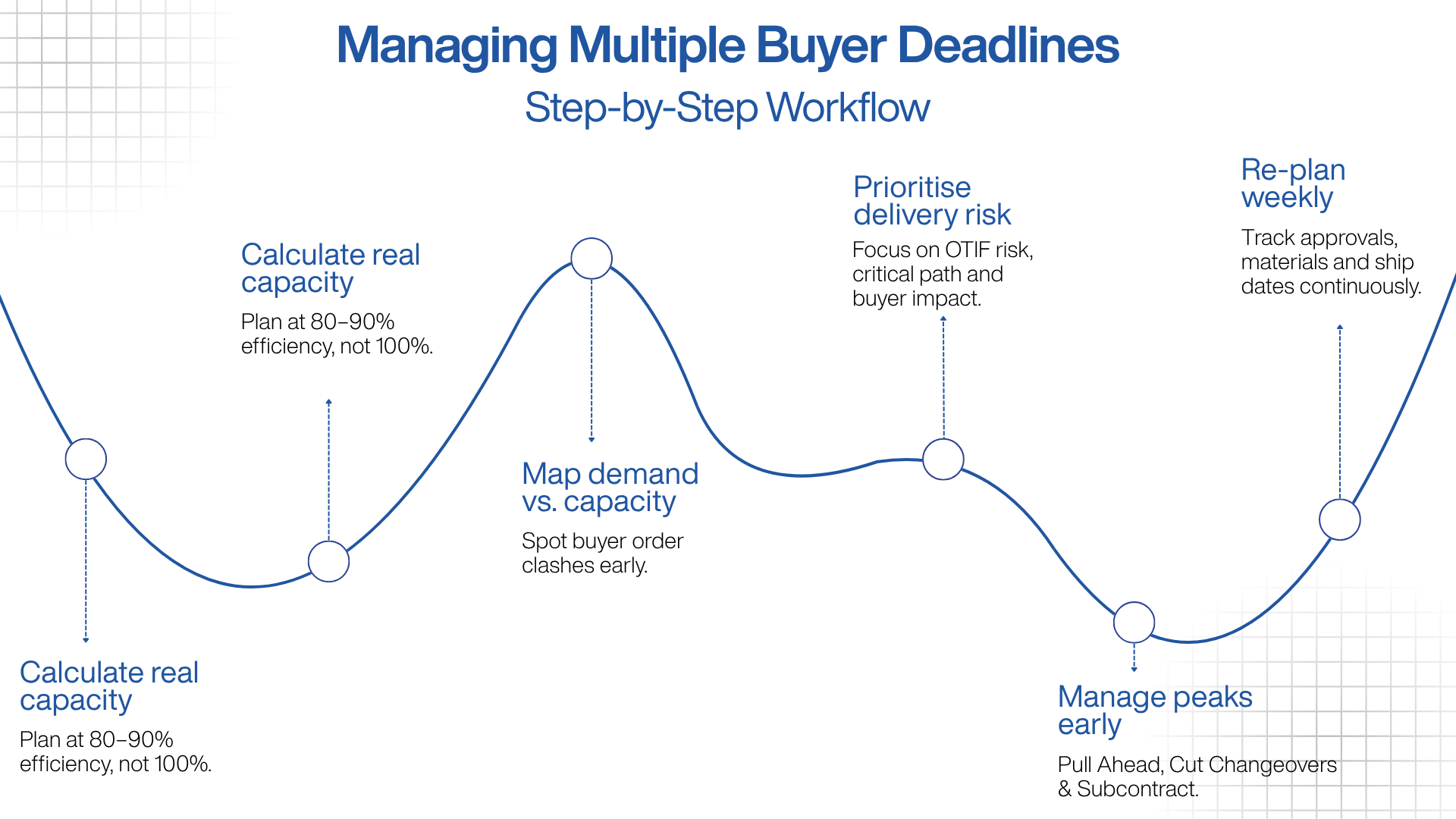
This is the method that turns the ideas above into a repeatable planning routine. Each step assumes the previous one is in place.
- Convert every open order into required minutes: Translate each buyer’s order book and forecast into standard minutes per style per week, using the SMV or operation-bulletin database, so all buyers’ demand sits in one comparable unit.
- Establish true available capacity per line: Convert each line into available minutes operators (or machines) × working hours × 60, then apply the efficiency that line actually achieves, taken from its own past performance rather than a theoretical 100%. Then load the plan to roughly 80% to 90% of that figure, holding the balance as buffer for absenteeism, downtime, and changeovers. Two separate discounts, in that order: the efficiency factor tells you what the line can produce; the loading buffer decides how much of it you dare promise. A plan built on paper-perfect efficiency, loaded to the last minute, fails in its first week.
- Lay all buyers’ demand against one capacity view, week by week: This exposes exactly where two or more orders collide on the same lines in the same window, before it becomes a shop-floor fire.
- Prioritise the collisions by delivery risk, not by whoever shouts loudest: Rank competing orders by ship-date proximity, current critical-path status (is fabric in-house? are approvals done?), buyer scorecard sensitivity and order value. The order closest to failing OTIF, not the largest, usually goes first.
- Absorb the peak deliberately: Pull non-urgent work forward into slack weeks, sequence styles to cut changeover loss, book vetted subcontracting early at planned rates, and treat overtime as a decision rather than a last-minute reaction.
- Drive the critical path in a pull system and re-plan on a rolling basis: Make approvals, fabric, and trims arrive just ahead of each planned cut date, and re-check every buyer’s ship date weekly as orders confirm and conditions shift.
Worked example: two ship dates in the same week
Figures are illustrative and directional, chosen to show the method rather than any single factory’s data.
- Buyer A and Buyer B both ship in the same week. Combined, they need roughly 2,400,000 minutes against about 2,000,000 available, so demand runs about 20% over capacity.
- Buyer A’s fabric is in-house, and approvals are closed. Buyer B is still awaiting a size-set sign-off, so Buyer A carries lower delivery risk this week.
- Resolution: load Buyer A now; pull roughly 150,000 minutes of Buyer B’s non-urgent work into the prior slack week; place about 150,000 minutes with a pre-booked vetted subcontractor; and absorb roughly 100,000 through planned overtime, instead of a last-minute scramble that risks both orders.
When Ship Dates Collide: A Prioritisation Framework
Given two or more orders competing for the same lines, which goes first? The wrong instinct is “biggest buyer” or “loudest email.” The right basis is delivery risk weighted against buyer value.
| Factor | Question the planner asks | Why it matters |
| Ship-date proximity | How many days until each order’s ex-factory date? | The nearest date has the least room to recover |
| Critical-path status | Is fabric in-house and are approvals closed? | An order still awaiting approval cannot start, whatever its priority |
| OTIF sensitivity | How strict is this buyer’s scorecard and penalty? | A high-penalty buyer’s miss costs more per day late |
| Order value and share | Volume, margin and share of the exporter’s book | Protects the relationships that carry the business |
| Recovery options | Can this order absorb overtime or move to subcontracting? | The more flexible order can yield to the less flexible one |
Reading the framework in practice:
- Nearest ship date with fabric already in-house → load first. It has the least slack.
- Order still awaiting a critical approval → cannot jump the queue, whatever the buyer. Chase the approval instead of the line.
- High-penalty, scorecard-sensitive buyer at equal risk → give it the buffer, since a miss there costs most.
- Flexible order that can take overtime or vetted subcontracting → let it yield the shared lines to the order that cannot.
The framework has one non-negotiable rule that overrides the rest: an order without materials or approvals cannot be prioritised onto a line, no matter how important the buyer. Priority buys sequence on the floor. It does not manufacture fabric that has not arrived.
Synchronising Materials, Approvals and Subcontracting So Nothing Waits on the Floor
A capacity plan is only as good as the fabric and approvals feeding it. If material for one buyer arrives three days late, its cutting slips and the freed lines get filled with another buyer’s work, which then disrupts that buyer in turn. A pull-based material and critical-path schedule, where approvals and fabric are timed to land just ahead of each planned cut date, keeps the plan intact and the lines fed. This is also where fabric optimisation connects to delivery: procuring and cutting the right fabric at the right time is not only a cost lever; it protects the start of production.
Subcontracting is a planned lever, not a rescue
Vetted subcontracting booked early, at planned rates and with quality and IP protected, is how exporters absorb genuine peaks without missing a buyer’s date. Booked late as a rescue, at distress rates, it becomes a quality and delivery risk of its own. The discipline is to decide the subcontracting split during planning, not in the final week.
Levers and what each protects:
- Approvals timed just ahead of the planned cut date → no order starts late for want of a sign-off.
- Fabric and trims pulled to arrive just before cutting → lines stay fed; no idle reshuffle that disrupts another buyer.
- Subcontracting booked early from vetted partners → peaks absorbed without missing a ship date or risking quality.
- Overtime planned, not reactive → recovery capacity kept in reserve for the order that actually needs it.
From Spreadsheets to a Single Planning Board: Software for Multi-Buyer Delivery
Why spreadsheets and email break down across multiple buyers
The same research put numbers on it. A single order’s critical path commonly runs to 50–60 interlinked activities. With 5–6 executives covering 8–10 live orders between them, one merchandiser ends up following an average of 64–80 discrete activities spread across 8–10 separate networks from memory, a diary and email. There is no live view of where each style stands, no single source of truth when a date moves, and no fast way to test “what if we shift this buyer.” The method described above is sound, but past a certain order count it cannot be held in a spreadsheet. The merchandising research noted earlier reached the same conclusion: the full requirements of multi-order critical-path management exceed what a typed spreadsheet can deliver.
A dedicated production-planning system replaces that with one visual, drag-and-drop board that integrates every buyer’s capacity, critical path, and materials, plus a head-office control-tower master view across factories, early-warning flags when a ship date is about to slip, and pull-based material scheduling. Coats Digital’s FastReactPlan is the market-leading apparel example, with 500+ clients across 40+ countries and 2,000+ factories planned on the system, and an integrated pre-production critical-path module and control-tower view built specifically for this coordination.
The directional evidence is public. After implementing FastReactPlan, Tunicotex Group lifted its on-time delivery performance from 75% to 85%, reduced planning time by 25%, and unlocked additional capacity to take on more orders. The point is not the software as such. It is that one shared, forward view is what makes the multi-buyer method executable at scale.
The directional evidence is public, though it is customer-reported rather than independently audited. After implementing FastReactPlan across knitting, sewing, washing, printing, embroidery, ironing and packing on a single board, Tunisian knitwear manufacturer Tunicotex Group reported lifting on-time delivery from 75% to 85%, cutting planning time by 25%, and unlocking around 40% additional capacity to take on more orders. Closer to home, Madura Garments Exports, an Aditya Birla Group subsidiary and one of India’s largest shirt manufacturers, reported operational efficiency gains of more than 7% over two years on the same platform. The point is not the software as such. It is that one shared, forward view is what makes the multi-buyer method executable at scale.
A word of realism on implementation. Software does not fix a broken planning discipline; it enforces a good one. A factory that has never worked in standard minutes, or whose approvals routinely run late, will need to fix those foundations alongside any tool. The technology gives visibility and early warning. Human judgement still decides which buyer yields when two dates collide, and no dashboard removes the need for a planner who understands the buyers, the lines and the trade-offs.
Match the starting point to buyer count and planning maturity
| Factory tier | Typical profile | Recommended starting point |
| Small unit | Single site, few buyers, moving off Excel | Structured TNA templates in standard minutes; move to dedicated software as buyer count and order overlap grow |
| Mid-size exporter | Multiple lines, several concurrent buyers, scorecard pressure on OTD | Dedicated apparel planning software (for example, FastReactPlan) for one source of truth across all buyers’ critical paths |
| Large / multi-factory group | Many buyers across multiple units | Multi-factory master planning with a control-tower view, plus connected shop-floor and material data |
Common Multi-Buyer Delivery Mistakes: A Self-Diagnostic
Six patterns account for most avoidable slippage. Read them as a checklist against your own planning routine.
- Managing each buyer’s TNA in isolation, with no single view of how they collide on shared capacity.
- Prioritising by buyer size or the loudest email, instead of by delivery risk and critical-path status.
- Treating on-time delivery as a sewing-floor problem, while the real slip happens weeks earlier in approvals and fabric.
- Over-committing ship dates to win orders, without checking real efficiency, bottlenecks, and the material calendar.
- Leaving subcontracting to the final week, so it becomes a distress-rate rescue rather than a planned lever.
- Running the whole order book on spreadsheets and memory, past the point where anyone can see where every style actually stands.
The pattern behind these six is the same: collisions that stay invisible until the final week cannot be planned around, only survived. Coats Digital’s published benchmarks for factories that move onto a single connected planning board are a 3–10% increase in productivity, a 10–30% improvement in on-time delivery performance, and a 10–30% reduction in lead time customer-reported ranges rather than guarantees, but a useful indication of what becomes possible once the collisions are visible early.
Conclusion: Deliver the Order Book, Not the Emergency
On-time delivery across multiple buyers is a coordination discipline, not a matter of running faster. It is decided by whether an exporter can see every buyer’s critical path against one finite capacity, prioritise collisions by delivery risk, and feed the lines with approvals and materials on time.
There is no single silver bullet. There is a connected method: one comparable unit in standard minutes, one shared capacity view, a clear prioritisation rule, and a pull-based critical path, so commitments to every buyer rest on data rather than hope. For an industry working to defend and grow its place in global sourcing, that discipline is how an exporter delivers the order book rather than the emergency.
Where to go next:
- Understand the costing foundation the whole plan rests on: Standard Minute Value and method-time-cost benchmarking.
- See how critical path and delivery planning work on one board: FastReactPlan.
- Connect fabric timing to on-time starts of production: FastReactFabric.
See every buyer’s critical path, capacity, and materials on a single visual board with a FastReactPlan demo.
Frequently Asked Questions
-
How do garment exporters manage on-time delivery for multiple buyers at once?
They run each buyer’s order on a Time and Action (TNA) critical-path calendar, then layer all of those calendars against one shared capacity view measured in standard minutes. This exposes where two orders collide on the same lines. Planners then prioritise collisions by delivery risk and buyer value, absorb peaks through planned overtime and pre-booked vetted subcontracting, and keep approvals and materials arriving just ahead of each planned cut date.
-
What is the difference between on-time delivery (OTD) and on-time-in-full (OTIF)?
On-time delivery measures whether an order shipped by the buyer’s agreed date. On-time-in-full is stricter: the order must arrive on the promised date and in the complete quantity ordered, both at once. An order that ships on time but short still fails OTIF. Global buyers increasingly score suppliers on OTIF because it captures punctuality and completeness in a single reliability metric.
-
What is a Time and Action (TNA) calendar in garment manufacturing?
A Time and Action calendar, also called a T&A or critical path, back-schedules every pre-production and production milestone from the buyer’s ship date. It lists each activity (lab dip, fit and size-set approval, fabric in-house, planned cut date, line loading, ex-factory), assigns an owner, and tracks planned versus actual dates so slippage is caught early. Each buyer order carries its own TNA.
-
Why do garment shipments get delayed most often?
Most delay is decided upstream, not on the sewing line. An export order is a non-linear network of interlinked pre-production activities, and a slipped approval or a late fabric delivery moves the planned cut date, which slides the line-loading and ship dates. By the time a problem shows on the floor in the final week, the schedule was usually lost weeks earlier in sampling, approvals or materials.
-
How do exporters decide which buyer’s order to prioritise when ship dates collide?
Not by buyer size or the loudest email. They rank competing orders by ship-date proximity, critical-path status (is fabric in-house and are approvals closed?), the buyer’s OTIF scorecard sensitivity, and order value. The order closest to failing OTIF, with material ready, usually goes first, while an order still awaiting a critical approval cannot jump the queue regardless of the buyer behind it.
-
What are OTIF chargebacks and how much do they cost?
OTIF chargebacks are penalties retailers deduct from a supplier’s payment when an order arrives late or short. Walmart, the most-cited example, sets separate thresholds 98% Collect Ready, 90% On-Time for prepaid suppliers and 95% In-Full and deducts around 3% of the cost of goods on the non-compliant cases. Thresholds and penalty structures vary by retailer and are revised periodically, so check the current scorecard terms in each buyer’s supplier portal. Beyond the direct deduction, repeated failures lower a supplier’s scorecard rating and reduce future order share, which usually costs far more than any single penalty.
-
Should an exporter add overtime or subcontract to meet a deadline?
Use overtime for short, controllable spikes close to the core’s normal output. Subcontract when peak demand genuinely exceeds what the core workforce can deliver at sustainable hours, the work can move without risking quality or IP, and the partner is vetted and booked early at planned rates. Subcontracting arranged late as a rescue, at distress rates, becomes its own delivery and quality risk, so decide the split during planning.
-
How do buyer scorecards affect Indian garment exporters?
Global buyers run vendor scorecards that roll up on-time-in-full performance alongside quality and compliance into a single supplier rating. A strong rating protects and grows order share; a weak one invites scrutiny, chargebacks, harder pricing conversations and, ultimately, volume moving to competitors. With India having lost apparel market share to Bangladesh and Vietnam since 2017, a consistent OTIF record is one of the strongest defences an exporter has.
-
Why should capacity and orders be planned in standard minutes, not pieces?
Pieces are not comparable across styles: a simple tee and a lined jacket carry very different work content, so counting pieces hides the real load each buyer’s order places on a line. Standard minutes (SMV) express every buyer’s demand and the factory’s capacity in the same unit, which is what lets a planner lay several orders against one capacity view and see exactly where they collide.
-
How does software help manage multiple buyers’ deliveries?
Dedicated apparel planning software replaces spreadsheets and email with one visual, drag-and-drop board that integrates every buyer’s capacity, critical path and materials, plus a control-tower view across factories. It flags a ship date before it slips and lets planners test changes quickly. Coats Digital’s FastReactPlan is a widely used apparel-specialist example, with an integrated critical-path module built specifically for this coordination.
-
Can a small exporter manage multiple buyers without expensive software?
Yes, up to a point. A small unit can coordinate credibly with well-structured TNA calendars in standard minutes, provided it applies realistic efficiency and an 80% to 90% capacity buffer and updates the plan as orders confirm. The limits appear with growth: more buyers, more concurrent styles, and stricter scorecards make manual tracking error-prone, and dedicated software then pays back by giving one live source of truth.
-
How often should an exporter review delivery plans across buyers?
Continuously, not once per order. Orders confirm and change, buyers move ship dates, approvals slip, and fabric arrives late, so every buyer’s critical path should be re-checked on a rolling basis, commonly weekly at the line-loading level. Treating multi-buyer delivery as a living plan rather than a set of fixed spreadsheets is what keeps commitments realistic as reality moves across the whole order book.

How Bangladesh Knitwear Factories Improve Operator Efficiency Across Sewing, Linking and Finishing

Best Lean Manufacturing Software for the Indian Garment Industry

Brand-to-Vendor Cost Collaboration: Which Layer of the Cost Stack Are You Missing?
All Blog Categories
- Production Planning
- Corporate
- Method Time Cost Optimisation
- Supply Chain Solutions
- Sustainability
- Videos