Top Production Planning Software Used by Bangladesh Garment Factories (2026 Guide)
by Kunal Kapur
 9
Mins Read
9
Mins Read
- Key takeaways
- Why Bangladesh’s RMG factories cannot plan on spreadsheets anymore
- How We Picked These Ten Tools
- Tools at a glance
- Top Ten Production Planning Software reviewed
- FastReactPlan vs. an ERP Planning Module: Why the Difference Matters
- How to choose the right tool for your factory
- Factory-tier decision matrix
- The right planning stack wins the order
Key takeaways
- The ten tools span five categories: production planning, ERP, PLM, costing, and MES. No single tool covers all five well.
- High-performing factories pair a dedicated planning tool with an ERP, rather than stretching an ERP’s built-in planning module. FastReactPlan is the planning benchmark.
- Spreadsheets break when multi-buyer windows, style complexity, and compressed lead times combine, causing missed ship dates and costly airfreight.
- There is no universal winner. The right choice depends on factory size, export orientation, and IE maturity. This guide maps tools to context.
- Bangladesh-readiness, local support, export documentation (LC, UD, BGMEA compliance), and cloud-versus-on-premise fit matter as much as the feature list.
- LDC graduation is scheduled for 24 November 2026. EU duty-free access continues to 2029, after which tariffs of roughly 9.6 to 12 per cent apply.
- Knitwear factories need yarn-to-finished-goods critical-path control; woven exporters need fabric-sourcing T&A calendars and cutting-room scheduling.
Why Bangladesh’s RMG factories cannot plan on spreadsheets anymore
Choosing production planning software for Bangladesh garment factories has become a ‘margin’ decision, not an ‘IT’ one. Three pressures now sit on every export floor at the same time. The country is scheduled to graduate from Least Developed Country status on 24 November 2026. Although the EU has agreed to continue duty-free access for a three-year grace period to 2029, standard tariffs of around 9.6 to 12 per cent then apply unless GSP+ or a free trade agreement is secured. At the same time, buyers such as H&M, Zara, Primark, and PVH keep compressing lead times while multiplying styles across knit and woven programmes.
The EU continues to tighten supply-chain due diligence and traceability requirements, while competitors in Vietnam and India already hold trade agreements with the bloc. With ready-made garments accounting for over 80 per cent of national export earnings, the cost of weak planning is now measured at the national level, not just on a single P&L.
On a spreadsheet, those pressures surface as specific failures rather than vague inefficiency. Missed Time and Action (T&A) milestones. Fabric and trim stockouts on multi-buyer programmes. Capacity over-promised at order confirmation, then clawed back with overtime and airfreight. Cost-to-make (CM) estimates that drift away from reality and quietly thin already-slim margins. Factories that have since moved on describe an identical before-state: planning teams forced to cross-reference a tangle of spreadsheets, emails, phone calls, and meeting logs to settle a single decision, which is precisely what Tusuka in Dhaka did before it digitised.
What follows is a category-based buyer’s guide to tools genuinely deployed on Bangladeshi floors, not a generic global roundup. Each tool below has a named local reference or a verifiable regional deployment, and every performance figure carries a named source.
On this page
- How we chose these ten tools
- The ten tools at a glance
- The ten tools, reviewed
- FastReactPlan versus an ERP planning module
- How to choose the right tool for your factory
- The right planning stack wins the order
- Frequently asked questions
How We Picked These Ten Tools
This is not a single-ranked leaderboard. It is a curated set across five functional categories, ordered by how directly each tool addresses RMG’s primary pain point, planning discipline, which is why the specialist planning tool leads. Four criteria shaped the selection.
- Evidence of Bangladesh RMG adoption. Preference went to tools with named local customer references or verifiable regional deployments, rather than global brands with no floor presence here.
- Bangladesh-relevant functionality. That means a T&A calendar built for multi-buyer programmes, SMV-based capacity planning, knit yarn planning, woven fabric and trim MRP, line scheduling, and EU and US export-compliance documentation.
- Deployment readiness. Local support in Dhaka and Chattogram, a sensible cloud-versus-on-premise fit for sites outside the metro hubs, multi-currency handling, and export documentation such as letters of credit and utilisation declarations.
- Scale fit. Small (under 500 operators), mid (500 to 3,000), and large or group operations (3,000 and above).
Tools at a glance
This table is your shortlisting starting point. Each tool maps to its primary category, deployment model, best-fit factory size, Bangladesh-readiness, and the single capability that matters most in a Bangladesh export context. No tool scores across all five categories, and that is the point.
| Tool | Category | Deployment | Best factory size | Bangladesh-ready | RMG-specific strength |
| FastReactPlan (Coats Digital) | Production planning & control | Cloud / on-prem | Mid and large export factories | ✓ Local customer success team in Dhaka | Visual line-level scheduling for multi-buyer T&A windows, critical-path alerts, and dynamic capacity recalculation. Proven at Tusuka (10,000 staff, 67 denim lines) |
| WFX Cloud ERP | Cloud apparel ERP + PLM | Cloud | Multi-buyer mid-to-large exporters | ✓ Bangladesh deployments incl. SQ Group | T&A calendar plus PLM in one platform; suits long fabric-sourcing and lab-dip lead times and fast-fashion style collaboration |
| MS Dynamics 365 Business Central (Apparel) | Mid-enterprise ERP | Cloud / on-prem | Mid-to-large multi-entity factories | ◑ Configurable; Microsoft partner network in Dhaka | Unified financials, production orders, and inventory; strong multi-entity consolidation for group operations |
| SAP S/4HANA (Fashion) | Enterprise ERP | Cloud / on-prem | Large vertically integrated groups | ◑ Via global SI partners | Single-system visibility from yarn and greige through finished garment for large conglomerates |
| Oracle NetSuite (Apparel) | Cloud ERP | Cloud | Mid-to-large denim/woven exporters | ◑ Configurable via partner | Style-colour-size matrix inventory with raw-material-to-shipment traceability for EU/US compliance |
| Centric PLM | PLM | Cloud | Design-led exporters & buying houses | ◑ Via integration | Full development pipeline, from fabric sourcing and fit approval to bulk sign-off, to compress time-to-market |
| PrismERP (Divine IT) | Bangladesh-origin ERP | Cloud / on-prem | SMB to emerging mid-size | ✓ Dhaka-headquartered provider | Garment modules plus local export documentation (LC, UD, bonded warehouse); widely deployed in Dhaka and Gazipur |
| iBOS Managerium ERP | Bangladesh-origin ERP | Cloud | Growing mid-size, cloud-first SMEs | ✓ Built in Bangladesh | Affordable all-in-one cloud ERP (HR, payroll, production, inventory, finance) that scales without heavy IT overhead |
| MultiTech Garments ERP / Planner | Garment ERP | Cloud / on-prem | SMB & mid-size leaving manual planning | ✓ Dhaka-based, RMG-focused | Order-to-shipment workflow with RMG-specific cutting, sewing, and finishing logic |
| ERPNext (Frappe) | Open-source ERP | Cloud / self-hosted | Small factories & startups | ✓ Active Bangladesh partner community | Lowest-cost route off spreadsheets, with BOM, planning, inventory, and procurement for Tier-2/3 units |
How to read this. The Bangladesh-ready column distinguishes native local support (✓) from tools that need a third-party implementation partner (◑). The RMG-specific strength column names the one capability that matters most in a Bangladesh export context, not a general feature list.
FastReactPlan leads the table because the central argument of this guide is that planning discipline is RMG’s primary pain point. WFX sits second as the strongest cloud ERP plus PLM with a named Bangladesh deployment. The ordering is editorial and defensible, not arbitrary.
Top Ten Production Planning Software reviewed
1. Coats Digital FastReactPlan
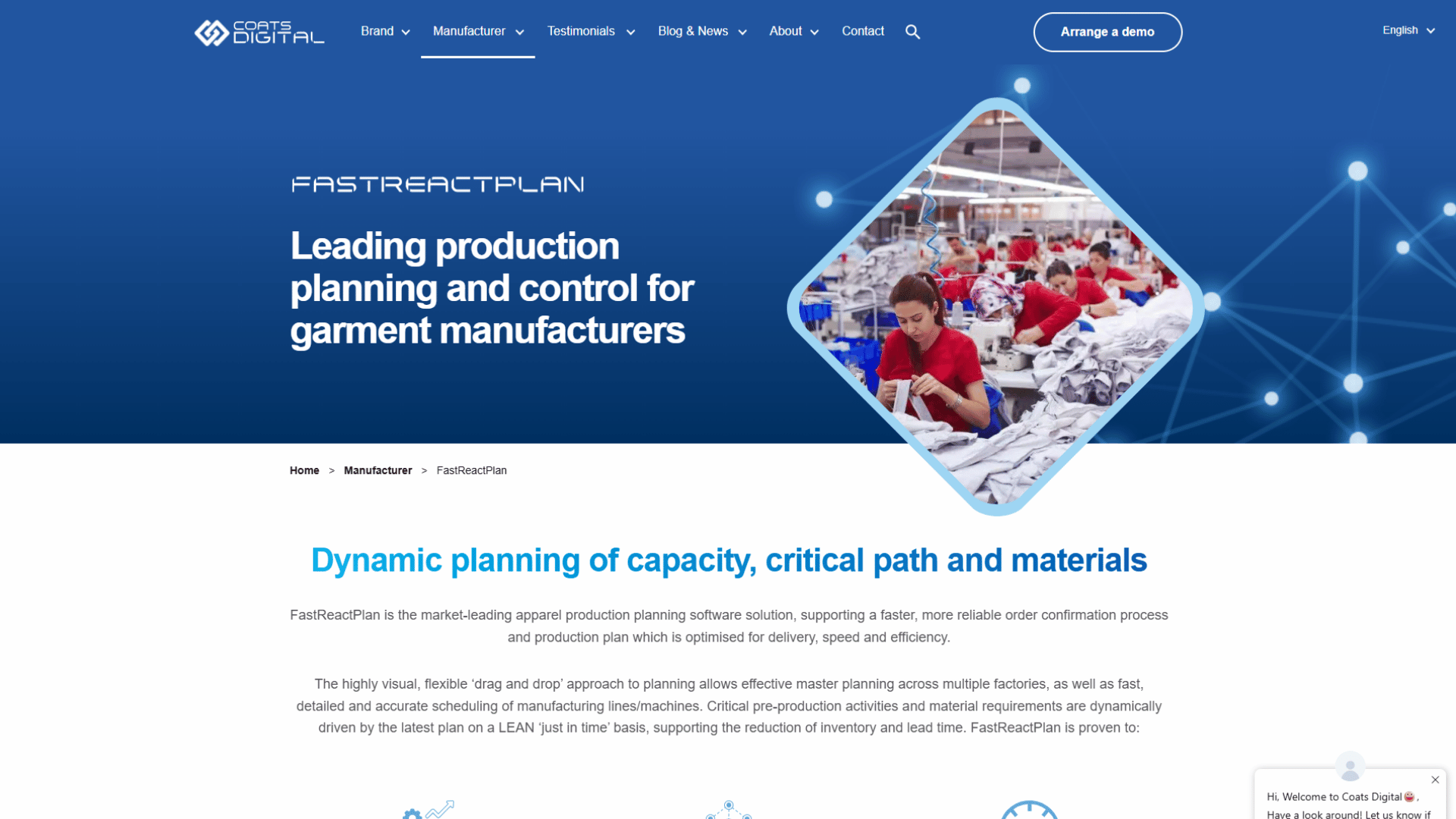
Category: Production planning & control. A dynamic, visual production planning and control tool built specifically for apparel, textile, and footwear manufacturers, and the benchmark for planning discipline in Bangladesh’s RMG sector.
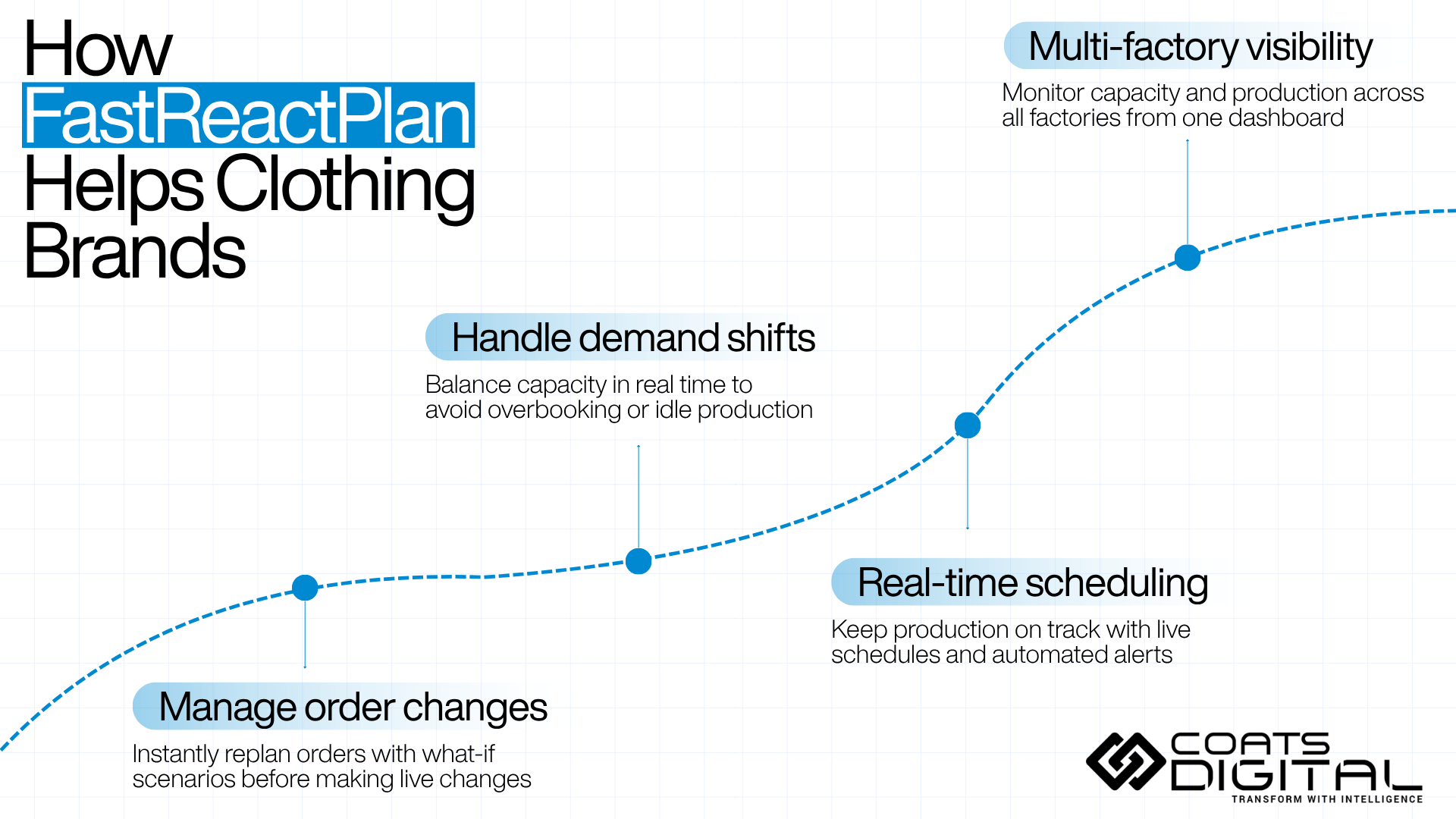
At its core is a drag-and-drop visual planning board that works across multiple lines and factories, with dynamic capacity planning that recalculates in real time. Critical-path management uses colour-coded alerts and failure-reason codes so planners act before a late event becomes a missed shipment, and pre-production activities and materials are driven on a LEAN, just-in-time basis (MRP). It integrates with ERP and surfaces KPIs through a Microsoft Power BI dashboard, giving every planning stakeholder a single source of truth.
The proof points are documented, not asserted. FastReactPlan is used in more than 2,000 factories across 40 countries with a typical return on investment of under 12 months. At Tusuka in Dhaka, a 10,000-staff denim manufacturer running 67 dedicated lines and a sewing capacity of 100,000 garments a day, implementation delivered an overall efficiency increase of 5 per cent, an OTDP improvement of 9 per cent, and a 7 per cent drop in staff absenteeism. At knitwear group Panam Group, forward-plan visibility extended from 3 months to 12 months, alongside a reported 3 per cent efficiency gain.
Bangladesh and RMG relevance. It holds the multi-buyer T&A windows, knit yarn-to-finished-goods critical paths, and style-changeover complexity that spreadsheets cannot manage at scale. The Tusuka denim operation demonstrates direct applicability to the country’s largest programmes, and Coats Digital runs a local customer success team in Dhaka.
Best for: mid-size and large Bangladeshi exporters where planning discipline and on-time delivery to EU and US buyers is the sharpest pain point.
Consideration: it is a planning and scheduling specialist. Pair it with an ERP for full order-to-shipment financial and commercial visibility.
2. WFX Cloud ERP
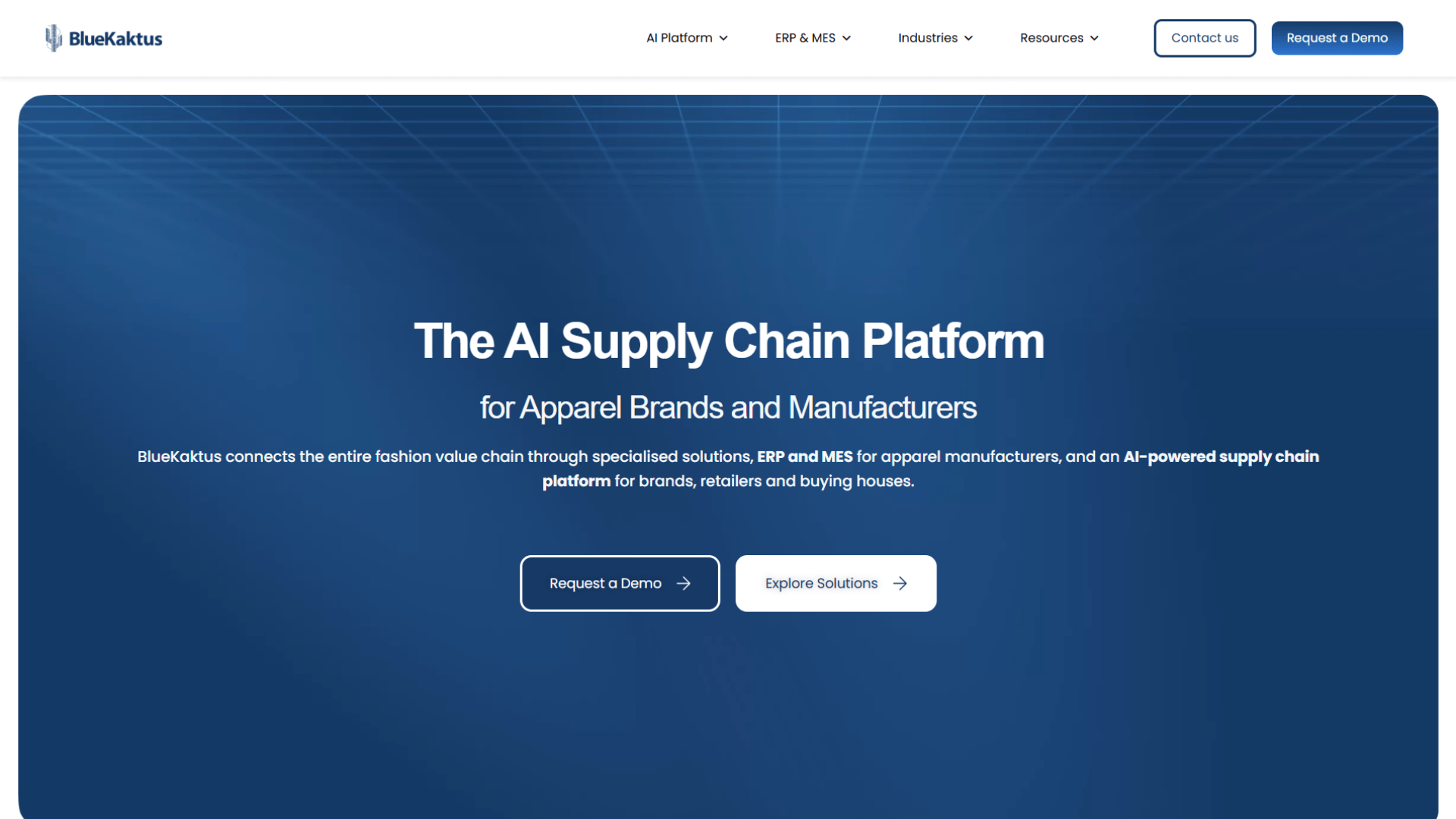 Category: Cloud apparel ERP + PLM. An end-to-end cloud ERP for apparel manufacturers and exporters with built-in PLM, active in Bangladesh and across South and Southeast Asia.
WFX combines a T&A calendar, order processing, QC, and dispatch with a front-end PLM layer for style management and sampling, and it supports real-time collaboration with EU and North American design teams, multi-currency operation, and multi-buyer export documentation. The platform reports serving more than 600 businesses with 35,000-plus users across over 50 countries.
Bangladesh and RMG relevance. Its T&A handles the longer fabric-sourcing and lab-dip lead times common across multi-buyer programmes, and its PLM strength suits fast-fashion buyer collaboration. The named local deployment is SQ Group, a leading Bangladeshi manufacturer of sweaters, knitwear, lingerie, and shirts, which rolled out WFX cloud PLM and ERP across its divisions. Notably, SQ Group also runs FastReact alongside WFX, which is exactly the planning-tool-plus-ERP pattern this guide recommends.
Best for: mid-to-large exporters running multi-buyer, multi-style programmes, particularly knitwear and shirt manufacturers wanting cloud ERP with integrated PLM.
Consideration: it is stronger on front-end style management than on factory-floor execution scheduling, and it expects reliable connectivity, making it a better fit for Dhaka and Gazipur headquarters than remote zones.
3. Microsoft Dynamics 365 Business Central (Apparel configuration)
Category: Mid-enterprise ERP. Microsoft’s cloud-first mid-enterprise ERP, increasingly adopted by Bangladeshi groups that have outgrown local ERPs but cannot yet justify full SAP.
Business Central unifies financials, production orders, inventory, and procurement, with multi-entity and multi-currency consolidation and native Power BI dashboards. Apparel depth comes through Microsoft ISV add-ons such as Volt 365 Apparel, which extend the platform with style, size, and colour matrices, SKU generation, and seasonal-collection handling natively inside Business Central. It deploys on Azure or on-premise, and a Microsoft partner network operates in Dhaka and Chattogram.
Bangladesh and RMG relevance. It is a credible upgrade path for groups outgrowing PrismERP or iBOS; the local partner ecosystem reduces implementation risk, and Power BI suits buyer-facing KPI dashboards.
Best for: mid-to-large factories and multi-entity groups (1,000 to 5,000-plus operators) wanting a globally recognised ERP with local support and growing financial-reporting needs.
Consideration: out-of-the-box apparel depth, such as SMV capacity, line scheduling, and wash-stage sequencing, is limited without an ISV add-on, so confirm the local partner has genuine RMG experience.
4. SAP S/4HANA (Fashion & Vertical Business)
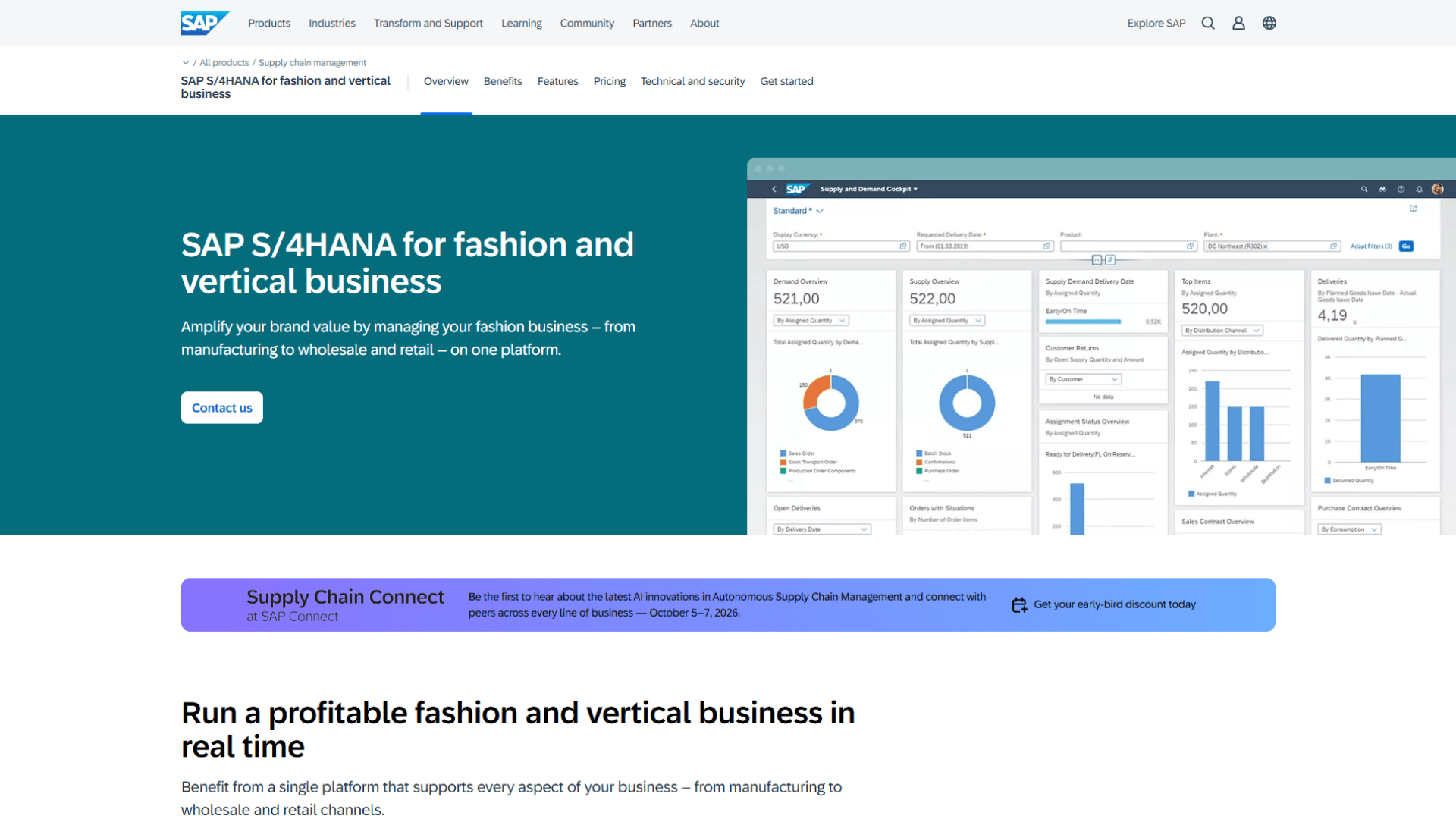
Category: Enterprise ERP. An enterprise ERP for large, vertically integrated apparel groups, covering yarn, textile, garment, and export in a single consolidation.
SAP’s fashion solution is built around native style-colour-size logic and integrates garment manufacturing with textile manufacturing, including subcontracting processes. It delivers financial consolidation, multi-currency sourcing, multi-plant visibility, audit-grade yarn-to-shipment traceability, and compliance and sustainability reporting that aligns with EU due diligence expectations.
Bangladesh and RMG relevance. It suits conglomerates spanning spinning, weaving or knitting, garment, and export that need one group system, and it grows more relevant as EU buyers demand documented traceability of origin and labour practices.
Best for: large vertically integrated groups with spinning, fabric, and garment divisions under one ownership.
Consideration: high cost and complexity, an interface less modern than purpose-built SaaS, and a requirement for a major system-integrator partner. It is not the right fit for mid-size or owner-managed factories.
5. Oracle NetSuite (Apparel configuration)
Category: Cloud ERP. A cloud ERP with native matrix inventory and seasonal planning for exporters managing complex SKU matrices for EU and US buyers.
NetSuite’s matrix items use a parent item and sub-items to track each style, colour, and size combination separately, and landed-cost tracking captures freight, duties, and agent fees at the item level for a true cost of goods, supporting raw-material-to-shipment traceability and multi-currency financial visibility.
Bangladesh and RMG relevance. That traceability supports EU supply-chain documentation and US customs compliance, both of which carry more weight as LDC graduation raises scrutiny of origin, wages, and environmental practice.
Best for: mid-to-large exporters supplying EU and US brands that need full traceability alongside standard ERP.
Consideration: apparel-specific workflows are configurable and usually need a specialist implementation partner or SuiteApp, and Bangladesh-based NetSuite partners are fewer than for SAP or the local ERPs.
6. Centric PLM
Category: Product lifecycle management. One of the most mature global apparel PLM platforms, linking product development through sourcing and production, and a subsidiary of Dassault Systèmes.
Centric covers the seasonal calendar, material tracking, costing approvals, supplier-performance visibility, fabric development, and bulk sign-off, with ERP integration for downstream execution. It is relied on by more than 20,000 brands across consumer-goods verticals and reports up to 50 per cent productivity improvement and up to a 60 per cent decrease in time to market.
Bangladesh and RMG relevance. It manages the development pipeline, from fabric sourcing and lab testing to fit approval and bulk sign-off, to compress time-to-market. Buying offices that span several Bangladeshi suppliers benefit from a centralised PLM layer.
Best for: design-forward exporters with complex development cycles, and buying houses managing multiple factories and brands.
Consideration: it is a development tool, not a production-execution system. It needs ERP or FastReactPlan integration to connect development calendars to floor scheduling.
7. PrismERP (Divine IT Limited)
Category: Bangladesh-origin ERP. One of Bangladesh’s most widely deployed garment ERPs, built by Dhaka-based Divine IT with deep local process and regulatory knowledge.
PrismERP covers merchandising, order costing, production planning, inventory, quality, compliance, and finance, with VAT and local-tax handling, a style-size-colour matrix, and on-premise or cloud deployment. For exporters, the decisive feature is that it handles export documentation including letters of credit, utilisation declarations, and bonded-warehouse management natively, and Divine IT reports over 400 businesses running on the platform.
Bangladesh and RMG relevance. It is purpose-built for the local context, including back-to-back LC handling and bonded-warehouse logic that global ERPs must be customised to replicate, and the local team removes the implementation-partner bottleneck.
Best for: SMB and emerging mid-size factories needing a locally supported, export-ready ERP without global-enterprise cost.
Consideration: it is less suited to complex multi-country group operations or to deep planning-specialist and IE integration.
8. iBOS Managerium ERP
Category: Bangladesh-origin cloud ERP. A Bangladesh-built, cloud-first ERP that combines HR, production, inventory, CRM, and finance in one scalable platform.
Managerium is an all-in-one cloud ERP, developed and supported from Dhaka, with real-time dashboards and KPIs and an affordable model aimed at budget-constrained factories. It scales from SME to enterprise without major infrastructure spend, and the vendor reports more than 1,500 companies using the platform.
Bangladesh and RMG relevance. It offers a practical consolidation path for owner-managed factories leaving manual planning and standalone HR and accounts behind. Integrated payroll matters here, given the wage and overtime-compliance scrutiny that global buyers now apply.
Best for: growing factories (500 to 2,000 operators) wanting cloud-first ERP and HR consolidation without heavy IT overhead.
Consideration: the production module offers order-level scheduling only. For line-level capacity planning, critical-path management, and OTDP tracking, pair it with a dedicated planning tool.
9. MultiTech Garments ERP / Planner
Category: Bangladesh RMG-specialist ERP. A Dhaka-based garment ERP with a dedicated planning module built for RMG workflows, covering order management through cutting, sewing, finishing, and export.
The Garments Planner runs master production scheduling, capacity booking, and allocation across cutting, sewing, and finishing lines, with backlinked planning that automatically adjusts downstream operations when an upstream step slips, plus dynamic rescheduling when an order changes or a machine breaks down. It offers line loading and capacity monitoring, real-time floor reporting, inventory and warehouse modules, cloud or on-premise deployment, and local support.
Bangladesh and RMG relevance. Its modules are pre-configured with local logic, including bonded warehouse, back-to-back LC, and utilisation declarations, and it suits Dhaka and Gazipur multi-shift operations.
Best for: SMB and mid-size factories wanting a locally developed system with floor-level planning depth.
Consideration: it has a smaller vendor footprint than global providers, so verify the customer base, support responsiveness, and product roadmap before multi-factory rollouts.
10. ERPNext (Frappe)
Category: Open-source ERP. An open-source ERP with a growing Bangladeshi implementation community, and the lowest-cost entry point beyond spreadsheets for small factories and startups.
ERPNext provides production planning, BOM, inventory, procurement, QC, and accounting on a single open-source platform, licensed under GPLv3 and free on GitHub. For apparel specifically, it handles the thousands of style, colour, and size permutations through item templates and item variants, with multi-level BOMs and capacity planning. It runs on Frappe Cloud or self-hosted, and a local Frappe partner such as Invento Software Limited has delivered more than 100 implementations in Bangladesh since 2015, including garment-accessory manufacturers.
Bangladesh and RMG relevance. It is a viable first ERP for small Tier-2 and Tier-3 factories, and local partners can configure RMG workflows such as style BOM, cutting plan, and line scheduling at a fraction of proprietary cost.
Best for: small, cost-conscious factories and startups (under 500 operators) wanting structure beyond spreadsheets without a large licence cost.
Consideration: it needs an in-house or partner technical resource for RMG customisation and maintenance; there is no apparel-specific support from the Frappe core team, and quality depends heavily on the local partner.
FastReactPlan vs. an ERP Planning Module: Why the Difference Matters
This is the comparison every shortlisting team eventually runs, so it is worth being precise. The two tools answer different questions.
An ERP planning module is built around order and financial data. It tells you what is due, what has been ordered, and whether the materials exist. That is necessary, but it is not a plan. A dedicated planning tool takes the same order data and turns it into an executable, line-level, time-phased schedule, then recalculates dynamically when an order, a delivery date, or available capacity changes. The Tusuka implementation makes the distinction concrete: FastReactPlan was eventually extended to high-level planning and integrated into the group’s ERP and Power BI systems, rather than one replacing the other.
Where ERP modules consistently fall short is in four places:
- line-level visual scheduling,
- real-time capacity recalculation,
- critical-path and T&A alerting with failure-reason codes, and
- OTDP tracking.
These are precisely the capabilities a specialist tool such as FastReactPlan is built to deliver, and they are the difference between confirming a realistic ship date and over-promising one.
The conclusion is straightforward. High-performing Bangladeshi exporters tend to run both a dedicated planning tool, with FastReactPlan as the benchmark, and a fit-for-purpose ERP, rather than stretching an ERP module to do planning it was never designed for. The decision matrix below shows how to combine them by factory tier.
How to choose the right tool for your factory
Four selection lenses
- Functional fit. Is the sharpest pain planning discipline (a planning tool), commercial and financial integration (an ERP), product-development speed (a PLM), or floor-level execution visibility (an MES)? Map the category to your most costly failure mode first, not to the longest feature list.
- Bangladesh deployment readiness. Is there local customer success and support in Dhaka or Chattogram? Cloud-only tools can struggle with connectivity in some Gazipur and Chattogram zones, so confirm that any partner has RMG-specific, not generic, experience.
- IE capability on the floor. Dedicated planning tools deliver the most where IE staff can maintain SMV and capacity data. Factories with limited IE capability should run a parallel IE capability-building programme alongside rollout.
- Buyer audit and traceability. EU brands increasingly require supply-chain due-diligence documentation, and US buyers require customs-compliance traceability. Tools with raw-material-to-shipment audit trails, such as SAP, NetSuite, Dynamics 365, and WFX, serve this need.
Factory-tier decision matrix
| Factory tier | Typical scale | Recommended combination |
| Small (under 500 operators) | Single or few lines, growing startup | ERPNext or MultiTech for order and inventory, plus manual SMV. Add FastReactPlan when scale justifies dedicated planning |
| Mid-size (500 to 3,000) | Multi-line, multi-buyer, export-focused | FastReactPlan for planning discipline, plus PrismERP, iBOS, or Dynamics 365 as the ERP layer. WFX for PLM if development-heavy |
| Large / multi-factory (3,000+) | Group with knit, woven, and export divisions | FastReactPlan across all units, plus SAP S/4HANA or Dynamics 365 for group ERP, plus Centric PLM for multi-brand development |
The consistent pattern among high-performing exporters is a dedicated planning tool paired with a fit-for-purpose ERP, not an ERP planning module alone.
The right planning stack wins the order
In 2026, planning software is an operational foundation, not overhead. As the LDC-graduation transition reshapes the EU tariff outlook toward 2029 and buyer-compliance demands keep rising, the factories that win orders will be the ones that confirm capacity accurately, start on time, and show cost transparency. That depends on the right tools, not better spreadsheets.
The right choice still turns on scale, export orientation, and IE maturity. A small Gazipur knit unit does not need the same stack as a 10,000-person vertically integrated group in Narayanganj. Start where the pain is sharpest, whether that is planning, costing, ERP, PLM, or the cutting room, and build out from there.
Where to go next: Book a FastReactPlan demo for your Bangladesh factory.
Frequently Asked Questions
-
What is the best production planning software for Bangladesh garment factories?
For planning discipline specifically, FastReactPlan is the benchmark, with line-level visual scheduling, dynamic capacity recalculation, and OTDP tracking proven at scale on Bangladeshi denim and knit floors. But “best” depends on which pain is sharpest. ERP, PLM, and costing tools are complementary, not substitutes, so most high-performing exporters pair a dedicated planning tool with a fit-for-purpose ERP rather than relying on one system alone.
-
How is FastReactPlan different from an ERP’s planning module?
An ERP planning module is built around order and financial data; it tells you what is due and whether materials exist. FastReactPlan turns that into an executable, line-level, time-phased plan and recalculates dynamically when an order, delivery date, or capacity changes. ERP modules typically fall short on line-level visual scheduling, real-time capacity recalculation, critical-path alerting with failure-reason codes, and OTDP tracking, which is why exporters run both.
-
What is the best production planning software for a small garment factory in Bangladesh?
Start with an affordable order-and-inventory system rather than an enterprise platform. ERPNext, an open-source ERP with an active Bangladesh partner community, or a locally developed option such as MultiTech, gives Tier-2 and Tier-3 units structure beyond spreadsheets at low cost. Manage SMV manually at first, then add a dedicated planning tool such as FastReactPlan once order volume, buyer count, and style complexity justify the investment.
-
How does SMV connect to production capacity planning?
SMV, or Standard Minute Value, is the time a qualified worker at standard performance needs to complete a given operation. It is the unit that converts a line of operators and machines into a realistic output figure: line capacity equals available minutes divided by the SMV per piece, adjusted for efficiency. Accurate SMVs let planners confirm achievable ship dates instead of guessing, which is why standards-based capacity planning underpins reliable scheduling and line balancing.
-
Which planning features matter most for knitwear versus woven factories?
The differentiator is the critical path. Knitwear factories need yarn-to-finished-goods control, where yarn dyeing, knitting, fabric dyeing, and finishing all feed sewing, which is exactly the vertical critical path FastReactPlan schedules at Panam Group. Woven exporters depend more on fabric-sourcing T&A calendars and cutting-room scheduling, because long fabric lead times and cut-plan efficiency drive on-time starts. Choose a tool that models your dominant critical path, not a generic one.
-
Is open-source ERP viable for a Bangladeshi garment exporter?
Yes, for small units. ERPNext is free under GPLv3 and handles BOM, inventory, procurement, and production planning, and local Frappe partners can configure RMG workflows at a fraction of proprietary cost. The caveats matter, though: it depends on an in-house or partner technical resource, the Frappe core team offers no apparel-specific support, and implementation quality varies by partner. It is a strong first ERP, less so for complex multi-factory groups.
-
How long does ERP implementation take for a mid-size Bangladeshi factory?
Timelines vary by tool type and, above all, by data readiness and IE maturity. Local and mid-tier cloud ERPs generally move faster than enterprise platforms, which carry heavier data migration, training, and rollout phases. Rather than anchoring on a fixed number, scope the project around how clean your existing master data is, whether SMV and capacity data are maintained, and how much apparel-specific customisation the vendor or partner must build.
-
How does LDC graduation affect the choice of production planning software?
Bangladesh is scheduled to graduate on 24 November 2026, with EU duty-free access continuing through a grace period to 2029, after which standard tariffs of roughly 9.6 to 12 per cent apply unless GSP+ or an FTA is secured. Productivity and planning gains are the practical hedge: when a tariff narrows your margin, accurate capacity confirmation, on-time starts, and lower airfreight are what protect profitability, which makes planning software a margin tool, not an overhead.

Brand-to-Vendor Cost Collaboration: Which Layer of the Cost Stack Are You Missing?
Why Does Capacity Planning Software Fail in Bangladesh’s Garment Manufacturing Sector?
The Best Tools for US Fashion Brands to Track and Report Supplier Labour Costs for ESG Compliance
All Blog Categories
- Production Planning
- Supply Chain Solutions
- Corporate
- Method Time Cost Optimisation
- Sustainability
- Videos