Top 10 Production Planning Tools Used by Denim Garment Manufacturers in India (2026)
by Kunal Kapur
 9
Mins Read
9
Mins Read
Key Takeaways
- Spreadsheet planning breaks down in denim once wash variants, multi-buyer windows, and material lead times multiply. The cost shows up as missed ship dates.
- The 10 tools fall into five categories: production planning, costing and SMV, ERP, PLM and MES. No single tool covers all five well.
- A dedicated planning tool such as FastReactPlan, paired with a costing standard such as GSDCost, is the combination high-performing export factories rely on, rather than ERP planning modules alone.
- Tool choice depends on factory size, export orientation and industrial engineering maturity, not on any one product being universally “best”.
- India readiness, meaning GST compliance, local support and cloud versus on-premise, matters as much as features for factories outside metro hubs.
- Denim’s differentiator is the wash programme. Scheduling, sequencing and costing the wash stages is where generic apparel tools fall short.
Why Indian Denim Factories Can No Longer Plan on Spreadsheets
The pressure stack on an Indian denim floor in 2026 looks nothing like it did five years ago. Four forces now hit at once:
- Buyer lead times have compressed.
- A single style ships in four or five wash variants.
- Sustainability and traceability documentation has gone from a nice-to-have to a purchase-order condition.
- Competition from Bangladesh and Vietnam keeps cost-to-make under constant scrutiny.
None of those pressures is new on its own. What is new is facing all four together, on the same order, in the same week.
That pressure lands on an industry that matters. India’s textile sector employs more than 45 million people directly, and the domestic textile and apparel market is valued at around US$225 billion in 2025. Ready-made garments are the single largest export category. Ahmedabad and the wider Gujarat belt remain a core denim hub, alongside fabric clusters in Surat and stitching capacity across the north and south.
Most of those factories still plan on spreadsheets, and the data on that habit is unforgiving. Research compiled by University of Hawaii professor Raymond Panko found that roughly 88% of spreadsheets contain errors in their formulas.
On a denim floor, those errors are not abstract. They show up as:
- Late ship dates.
- Fabric and trim stockouts.
- Capacity that gets over-promised to two buyers at once.
- Cost-to-make estimates that quietly erode margin.
The manufacturers behind several of the case studies below, including Tunicotex and South Asia Textiles, each named the same trigger for change: critical planning data scattered across disconnected spreadsheets.
This is a category-based buyer’s guide to the tools actually used on Indian floors, not a generic global roundup. The list spans planning, costing, ERP, PLM and MES, and it keeps coming back to the one problem that defines denim production: the wash programme.
On this page
- How we selected these 10 tools
- The 10 tools at a glance
- The 10 tools, reviewed
- How to choose the right tool for your denim factory
- Conclusion
- Frequently asked questions
How We Selected These 10 Tools
This is a curated set across five functional categories, not a single ranked leaderboard. Each tool earned its place against four criteria, weighted towards the realities of a denim export floor.
- Evidence of adoption in Indian garment and denim manufacturing, or in comparable export operations.
- Denim-relevant functionality, meaning wash-programme scheduling, a multi-SKU size and colour matrix, SMV-based capacity, and fabric and trim planning.
- India deployment readiness, covering GST compliance, local support, and a workable cloud or on-premise model.
- Scale fit across small, mid-size and large export factories.
The order reflects how directly each tool addresses denim’s two hardest problems, planning discipline and accurate costing.
The 10 Production Planning Tools at a Glance
The table below is your shortlisting starting point. Each tool is mapped to its primary functional category, deployment model, best-fit factory size, India and GST readiness, and the single most relevant capability for denim manufacturing. No tool scores across all five categories, and that is precisely the point.
| # | Tool | Category | Deployment | Best Factory Size | India / GST Ready | Denim-Specific Strength |
| 1 | FastReactPlan (Coats Digital) | Production planning | Cloud / on-prem | Mid and large export factories | ✓ Yes | Visual line-level scheduling handles wash-programme sequencing, multi-buyer delivery windows and dynamic capacity recalculation |
| 2 | GSDCost + GSDQuest (Coats Digital) | Costing / SMV | Cloud / on-prem | Any export factory with IE staff | ✓ Yes | Motion-code library prices rivet, bartack and multi-stage wash operations for audit-grade, buyer-facing cost-to-make |
| 3 | BlueKaktus | ERP + iPPC | Cloud | Mid to large Indian manufacturers | ✓ Native | Style changeover and wash-stage scheduling inside one India-origin integrated platform |
| 4 | WFX | Cloud ERP + PLM | Cloud | Multi-buyer Indian exporters | ✓ Yes | Time-and-action calendar accommodates denim’s extended lead times across fabric sourcing, lab dips and wash development |
| 5 | Datatex NOW ERP | Textile-vertical ERP | Cloud / on-prem | Vertically integrated mills and large groups | ◑ Via partner | Native dye-lot, shade and finishing control for denim’s laundry and wash stages |
| 6 | SAP S/4HANA (Fashion and Vertical Business) | Enterprise ERP | Cloud / on-prem | Large vertically integrated groups | ✓ Yes | Single-system visibility from greige fabric through finished garment for multi-plant denim conglomerates |
| 7 | Oracle NetSuite (Apparel) | Cloud ERP | Cloud | Mid to large denim brands with export compliance needs | ◑ Configurable | Style, size and colour matrix inventory with raw-material-to-shipment traceability for EU and US documentation |
| 8 | Centric PLM | PLM | Cloud | Design-led denim brands | ◑ Via integration | Manages the full denim development pipeline, from fabric and fit to wash sign-off, to compress time-to-market |
| 9 | LOGIC ERP (Apparel) | India-origin ERP | Cloud / on-prem | SMB to emerging mid-size factories | ✓ Native | GST-compliant size and colour matrix with job-work tracking, including wash, without heavy IT overhead |
| 10 | Microsoft Excel | Spreadsheet (baseline) | Desktop/cloud | Micro units and early-stage startups | ✗ Manual | Familiar, zero-licence starting point, but no native wash-stage sequencing or capacity logic |
How to read this table. The India and GST column separates tools with native GST compliance from those where GST handling is configurable through a local implementation partner. The denim-specific strength column focuses on the single capability that matters most in a denim context, not a general feature summary.
The Top 10 Production Planning Tools, Reviewed
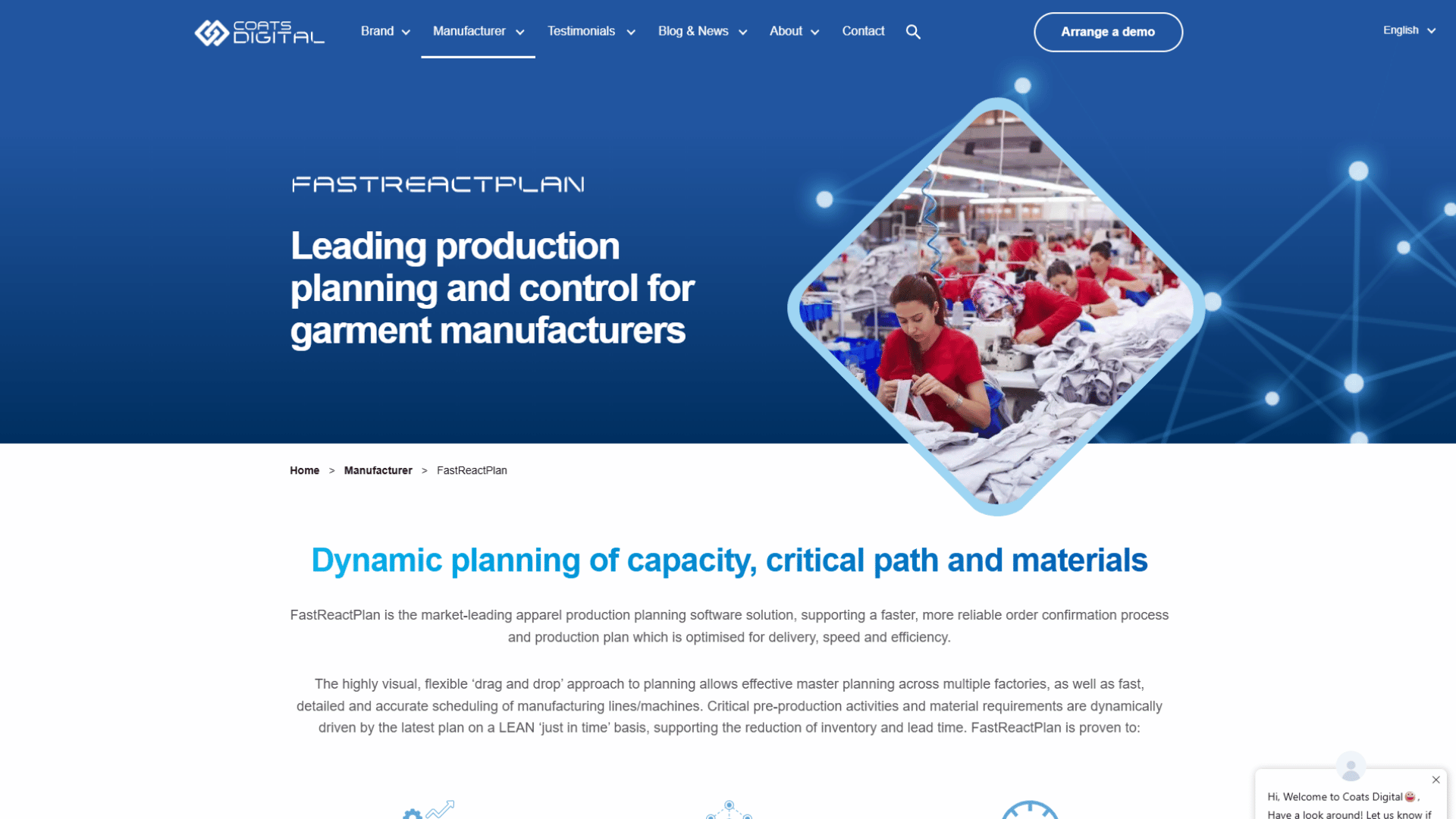
1. Coats Digital FastReactPlan
Production planning and control
FastReactPlan is a dynamic, visual production planning and control tool built specifically for apparel, textile and footwear manufacturers, and it sets the benchmark for planning discipline.
Key capabilities
- Drag-and-drop visual planning board across multiple lines and factories.
- Dynamic capacity planning that recalculates as the plan changes.
- Critical-path management with colour-coded alerts on late events.
- Lean, just-in-time material triggering driven by the latest plan.
- A single source of truth for planning, proven across more than 2,000 factories in 40-plus countries.
Denim relevance. FastReactPlan manages the wash-programme sequencing, line changeovers and overlapping multi-buyer delivery windows that spreadsheets cannot hold. At Tunicotex, the rollout spanned knitting, sewing, washing, printing, embroidery, ironing and packing on a single board, which is exactly the multi-process picture a denim laundry operation faces.
Verified, attributable proof points. These are published customer results, not guaranteed outcomes.
- Tunicotex: on-time delivery rose from 75% to 85%, planning time fell by around 25%, and roughly 40% additional capacity was unlocked.
- South Asia Textiles: a Hayleys Fabric subsidiary that supplies brands including Levi’s. On-time delivery improved by 15%, and capacity-planning time fell from eight hours to two.
- ApparelTech: around 9% annual productivity gains and a 7% lift in on-time delivery.
- Madura Garments: part of the Aditya Birla Group and one of India’s largest shirt manufacturers. Operational efficiency improved by more than 7% over two years.
Best for. Mid-size and large Indian denim exporters where planning discipline is the primary pain point.
Consideration. It is a planning and scheduling specialist. Pair it with an ERP for full order-to-shipment financial visibility.
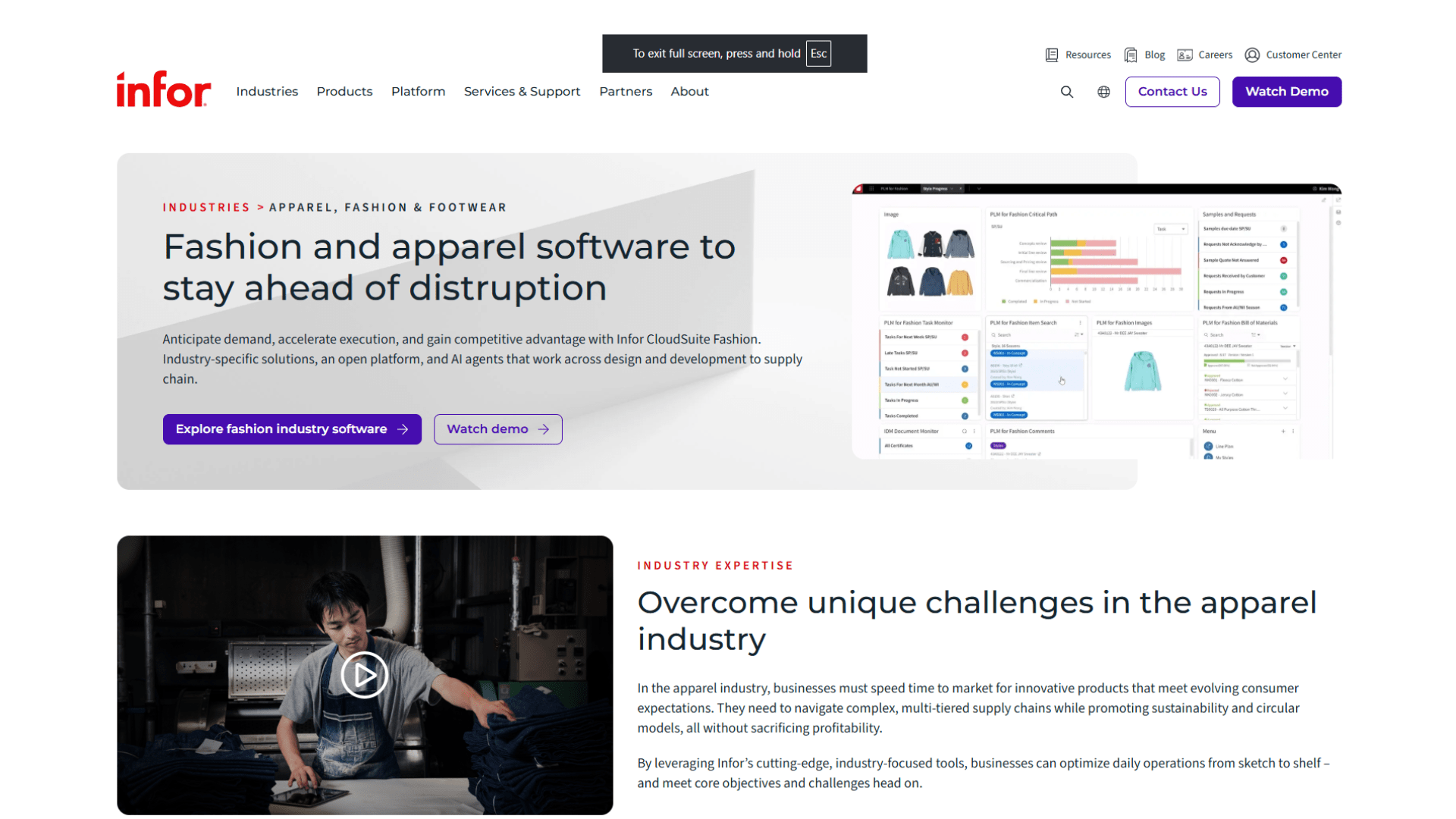
2. Coats Digital GSDCost (with GSDQuest)
Garment costing and SMV
GSDCost is the international standard for SMV and method-cost benchmarking, grounded in time-motion science. It turns subjective, negotiated costing into a repeatable standard.
Key capabilities
- A predetermined time-motion database of Motion-code library, each with an associated Standard Minute Value.
- The ability to build thousands of operations across unlimited styles.
- Fact-based brand and vendor negotiation through a common costing language.
- Fair-wage and CSR documentation built on transparent standards.
- GSDQuest, an AI module that generates an image-based Bill of Labour and reduces costing time by more than 90%.
Denim relevance. Generic costing tools miss the operations that define denim, namely riveting, bartacking and multi-stage wash and finishing. GSDCost prices them, which is what makes a cost-to-make defensible in front of a buyer.
Best for. Export factories that need transparent, audit-ready costing and SMV-driven capacity inputs.
Consideration. It delivers most value with trained industrial engineering staff, and it is strongest when paired with FastReactPlan, because accurate SMVs feed accurate capacity planning. GSDCost was recognised at the 2025 UK Digital Excellence Awards, which speaks to its current standing.
3. BlueKaktus
India-origin apparel ERP and iPPC
BlueKaktus is an India-developed, cloud platform that combines intelligent production planning and control with full apparel ERP, built by the apparel industry for the apparel industry.
Key capabilities
- Planning and ERP in one stack, with PLM and PMP modules alongside.
- An iPPC module that auto-plans by batch, shift, material and deadline.
- MES integration and real-time production monitoring.
- Local Indian support and mobile access for line workers.
Denim relevance. BlueKaktus handles style changeover and wash-stage scheduling natively within an integrated platform, which suits denim units that want planning and execution under one roof.
Best for. Mid-to-large Indian denim manufacturers wanting one integrated platform with local support. The company reports 50,000-plus users across 10-plus countries and more than 350 factories.
Consideration. BlueKaktus states that its iPPC module has increased factory efficiency by up to 10% and reduced costs by up to 5%, with a 300-operator factory expected to save around ₹30 lakhs. Treat these as the vendor’s published figures. International brand recognition is lower than the global ERPs, which can matter for factories with global audit expectations.
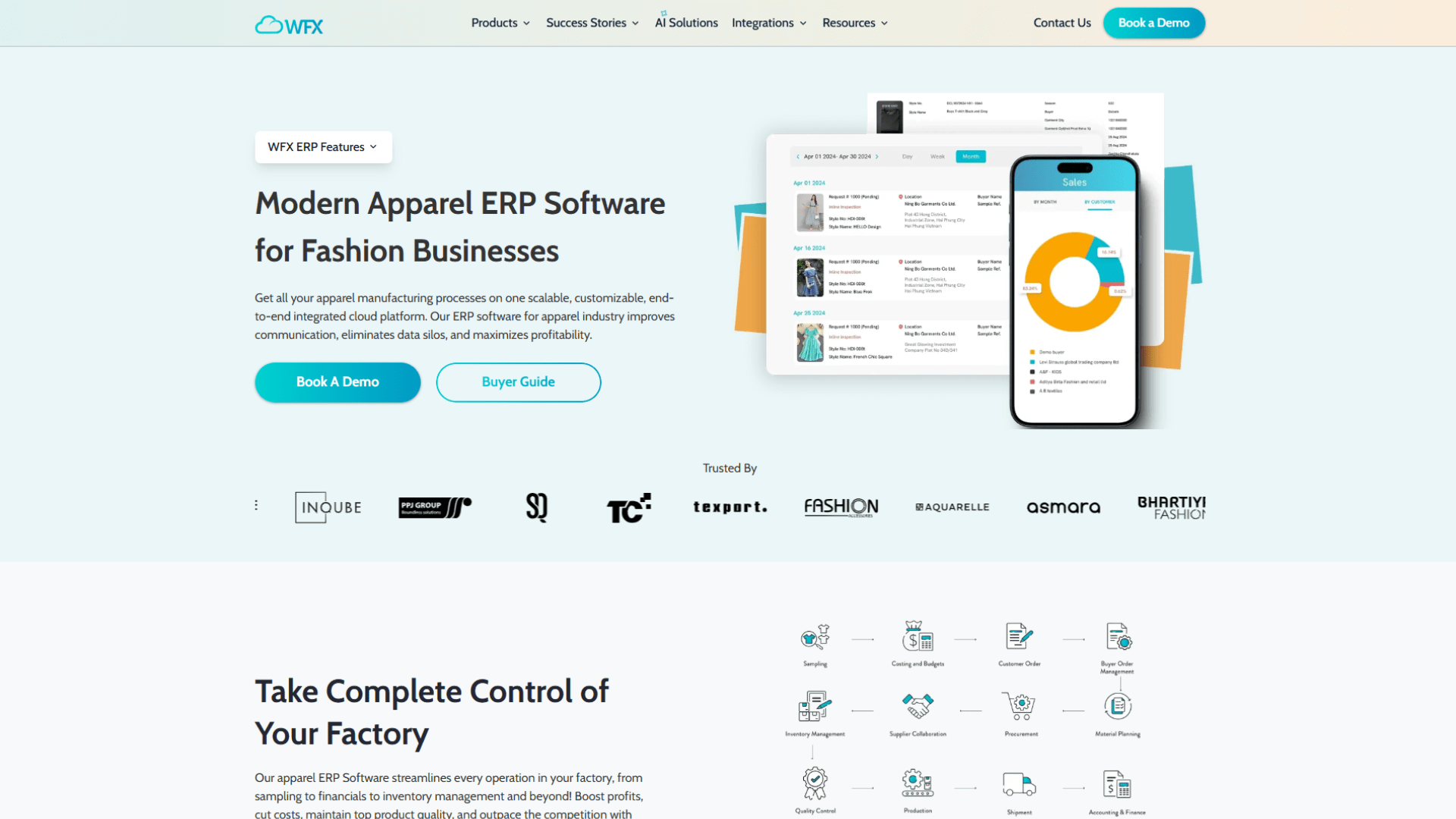
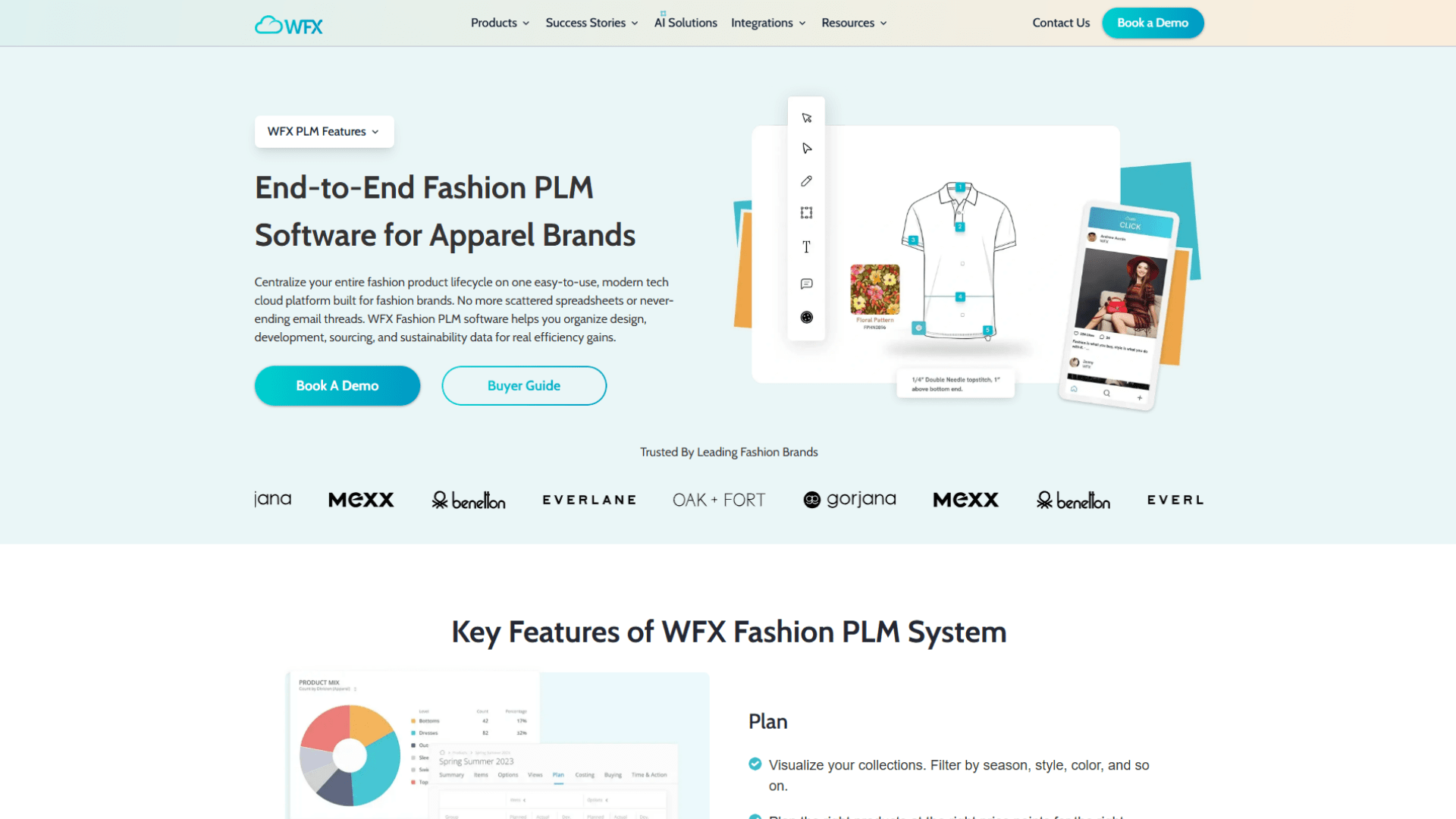
4. WFX (World Fashion Exchange)
Cloud apparel ERP and PLM
WFX is an end-to-end cloud platform for fashion manufacturers and exporters, combining ERP and PLM, with a technology centre in Gurgaon and customers across 50-plus countries.
Key capabilities
- A time-and-action calendar with alerts on delayed tasks.
- Order processing, quality control and dispatch management.
- Combined PLM and ERP coverage from design to delivery.
- A Cut Plan fabric-optimisation tool, useful where denim fabric is the largest cost line.
- A common migration path from legacy on-premise systems.
Denim relevance. The time-and-action calendar supports denim’s longer lead times across fabric sourcing, lab dips and wash development, where a single late lab dip can push an entire delivery.
Best for. Indian denim exporters running multi-buyer, multi-style programmes.
Consideration. Implementation cost can exceed India-origin alternatives, and the breadth of the suite means scoping the right modules matters.
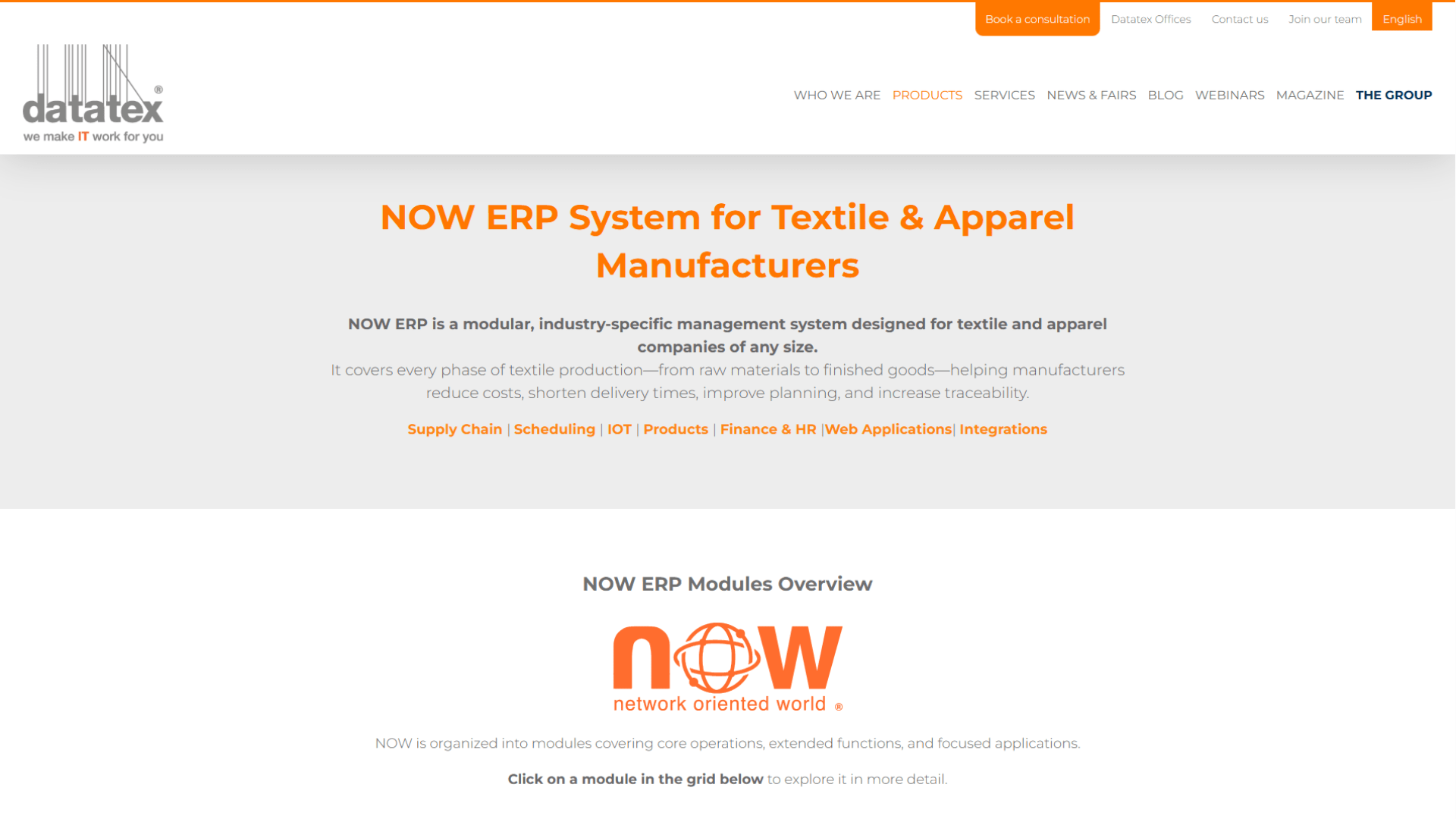
5. Datatex NOW ERP
Textile-vertical ERP
Datatex NOW is a modular ERP built exclusively for the textile and apparel industry, with one of the largest installed bases of textile software worldwide and a presence in 45-plus countries.
Key capabilities
- Coverage from fibre to finished product across spinning, weaving, dyeing, processing, garmenting and printing.
- Advanced production planning and scheduling (APS) plus shop-floor execution (MES).
- Dynamic BOM and routing, including per-customer and alternative components.
- Dye-lot, shade and roll-level inventory management.
- Built on modern web standards, browser-accessible and modular.
Denim relevance. Datatex’s strength sits in dyeing and finishing, which maps directly onto denim’s wash and laundry stages. It also handles dye-lot and shade management, and it can plan on partial demand rather than finished SKUs alone. That suits vertically integrated denim mills that run fabric and garment under one roof.
Best for. Vertically integrated textile-to-garment denim operations and larger groups that want textile-specific logic rather than a generic ERP with apparel add-ons.
Consideration. GST handling and local rollout typically run through an implementation partner in India, and the depth of the platform rewards factories with genuine process complexity rather than simple cut-make-trim units.
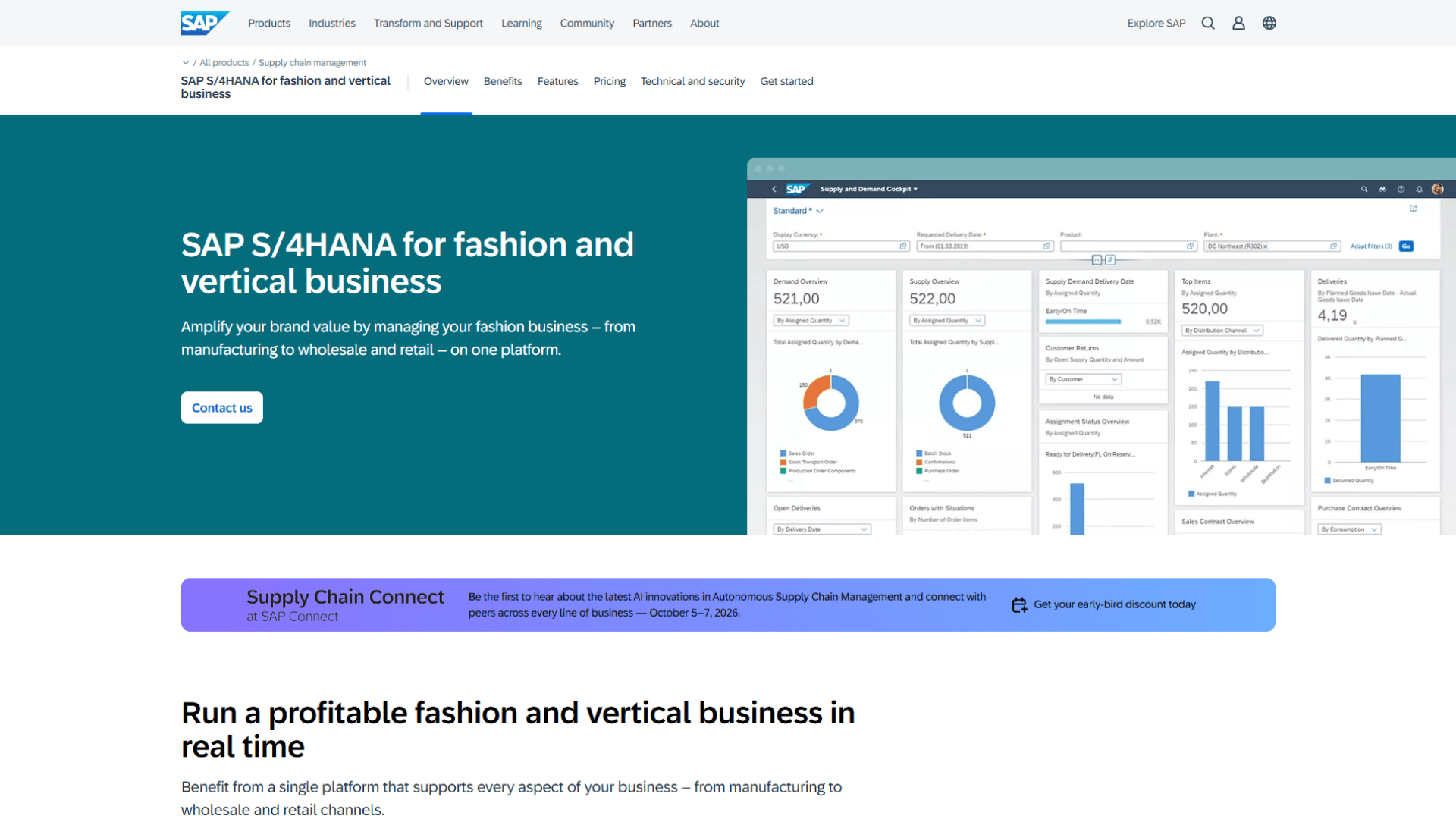
6. SAP S/4HANA (Fashion and Vertical Business)
Enterprise ERP
SAP S/4HANA for Fashion and Vertical Business is an enterprise ERP for large, vertically integrated apparel groups, run in real time on an in-memory core.
Key capabilities
- Built-in style, colour and size logic across the whole platform.
- One system for manufacturing, wholesale and retail.
- The ability to handle subcontracting and integrate garment manufacturing with textile manufacturing processes.
- Advanced available-to-promise, MRP and embedded analytics.
- Multi-currency, multi-plant financial consolidation.
Denim relevance. SAP supports the full vertical from greige fabric through to finished garment under one group, which is the picture for a denim conglomerate running weaving, manufacturing and export together.
Best for. Large Indian denim conglomerates with weaving plus manufacturing plus export.
Consideration. High cost and implementation complexity, and an interface that can feel dated next to newer SaaS. This is a multi-year commitment, not a quick deployment.
7. Oracle NetSuite (Apparel)
Cloud ERP
Oracle NetSuite is a cloud ERP with native matrix inventory and strong financial visibility, widely deployed across mid-market apparel.
Key capabilities
- Matrix items that manage a single style across all its size and colour variants.
- Landed-cost tracking that captures freight, duties and agent fees at item level.
- Omni-channel order management and multi-entity financial consolidation.
- Real-time visibility by season, style, size and location.
Denim relevance. The style, size and colour matrix, combined with raw-material-to-shipment traceability, supports the sustainability and compliance documentation that EU and US buyers increasingly require. For denim exporters, that is now a live commercial issue, not a future one.
Best for. Mid-to-large Indian denim brands with export-compliance needs.
Consideration. Apparel-specific manufacturing functionality is configurable and often needs a third-party SuiteApp or a local implementation partner in India to handle cut-make-trim and shop-floor realities.
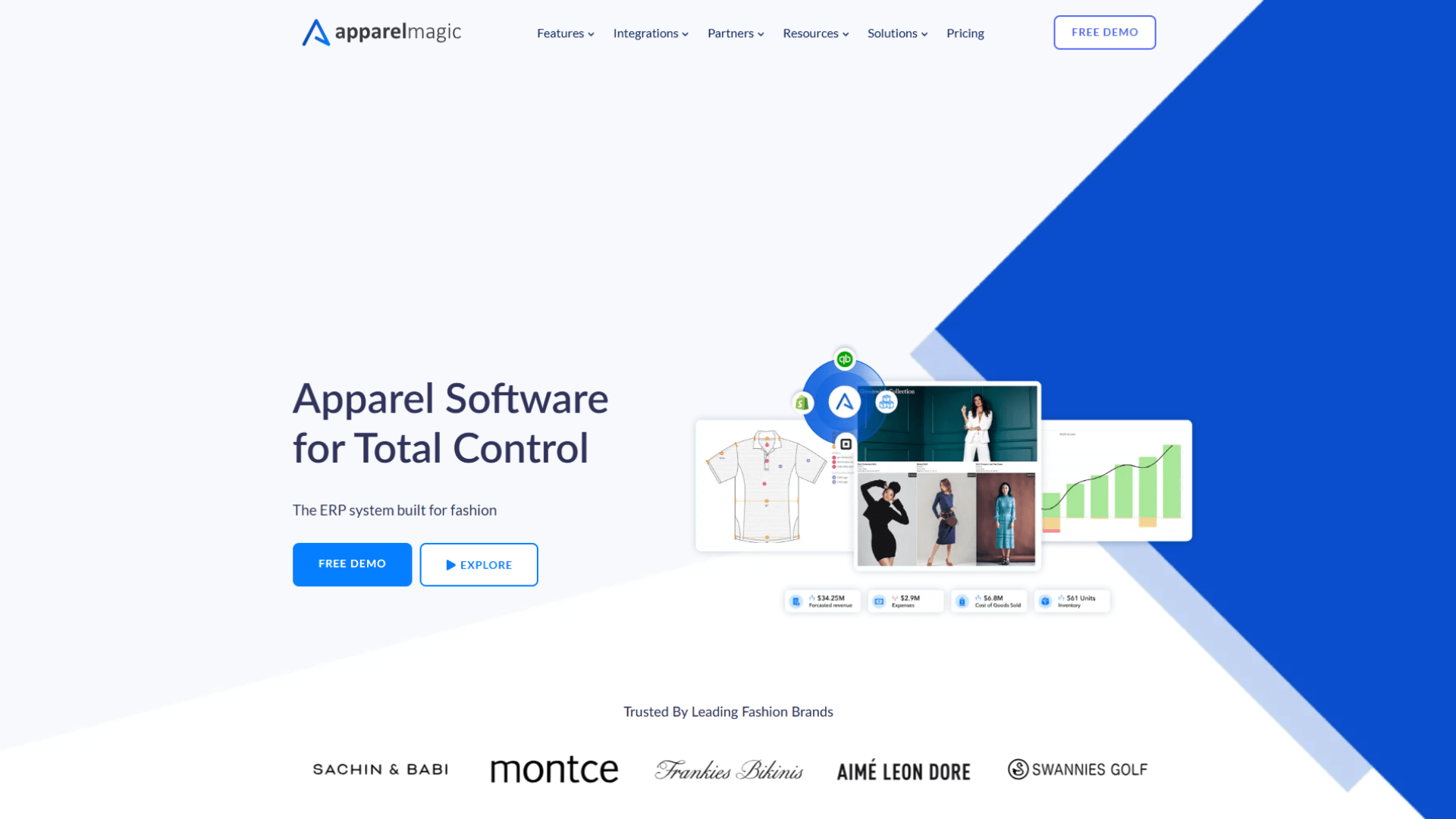
8. Centric PLM
Product lifecycle management
Centric PLM, from Dassault Systèmes subsidiary Centric Software, is one of the most mature apparel PLM platforms, and it markets a dedicated solution for denim and jean companies.
Key capabilities
- A seasonal calendar linking design, sourcing and production.
- Bill-of-materials management across full ranges, with reduced sample rounds.
- Costing approvals and supplier-performance visibility.
- Integrated 2D and 3D creation tools and Visual Boards.
Denim relevance. Centric manages the full denim development pipeline, from fabric development and fit approval to wash development and bulk sign-off, to compress time-to-market. Denim brands including Mustang Jeans and A.P.C., the latter known for raw denim, have adopted it.
Best for. Design-led Indian denim brands with complex development cycles.
Consideration. It is a PLM, not an execution system. It needs ERP and planning integration to reach the floor.
9. LOGIC ERP (Apparel)
India-origin apparel ERP
LOGIC ERP is a widely used India-origin ERP covering planning, inventory, warehousing, GST and the size and colour matrix on one platform, with strong local support.
Key capabilities
- Production planning, MRP and multi-level BOM.
- A style, size and colour matrix with bin-wise and barcode or RFID inventory tracking.
- GST-ready billing, e-invoicing and job-work tracking.
- Production costing with variance analysis across labour, process, overhead and rework.
- SMB-to-enterprise scalability, cloud or on-premise.
Denim relevance. LOGIC ERP offers a GST-compliant single system for mid-size denim mills, with job-work tracking that covers outsourced stages including washing. The denim brand Killer Jeans has run LOGIC ERP across four manufacturing units for around two decades.
Best for. Indian SMB and emerging mid-size denim manufacturers.
Consideration. It is retail and distribution strong, and less suited to complex multi-factory export operations that need deep industrial-engineering integration. Smaller units sometimes find it feature-heavy for their needs.
10. Microsoft Excel
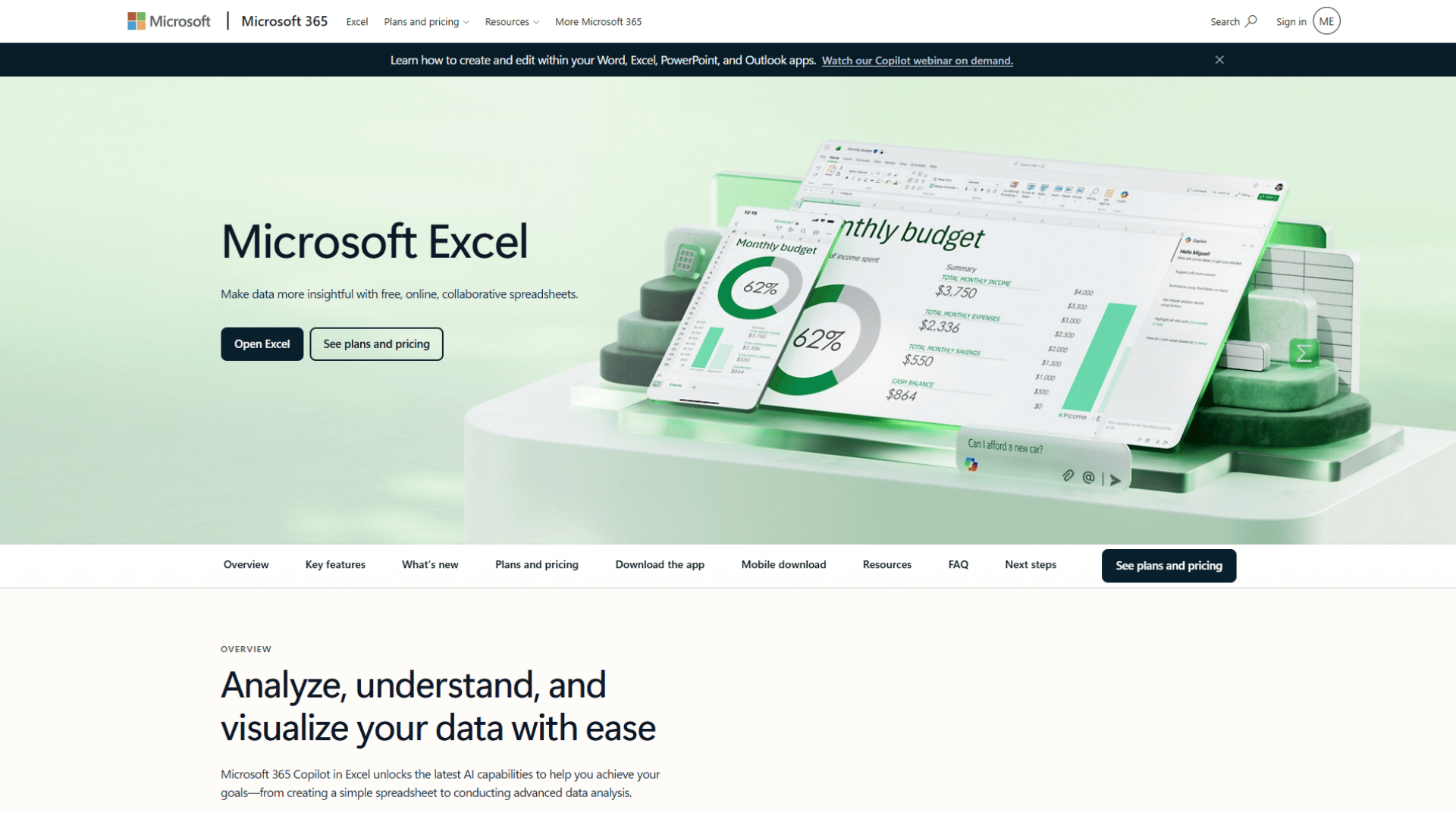
Spreadsheet (the baseline)
Microsoft Excel is where almost every denim factory starts, and there is no shame in that. It is flexible, universally understood, and carries no per-seat planning licence.
Key capabilities
- Free-form modelling of orders, capacity and material requirements.
- Familiar to every planner, with no training overhead.
- Easy to share, and effective for a single line or a handful of styles.
Denim relevance. Excel has no native concept of a wash programme, a critical path or dynamic capacity. Every dependency between sewing, washing and finishing has to be maintained by hand, which is where it breaks.
Best for. Micro units and early-stage startups running one or two lines.
Consideration. The hidden cost is error. Roughly 88% of spreadsheets contain formula errors, and the manufacturers in the case studies above each named scattered spreadsheets as the reason capacity got over-promised and ship dates slipped. As a denim operation adds wash variants and buyers, the spreadsheet stops being a tool and becomes a risk.
How to Choose the Right Tool for Your Denim Factory

Four selection lenses
Before comparing features, decide what problem you are actually buying for.
- Functional fit. Be clear about whether you need planning, ERP, PLM, costing or MES. These are different jobs, and most “we need an ERP” conversations are really “we need planning discipline”.
- India deployment readiness. GST compliance, local support and a realistic cloud or on-premise choice matter as much as the feature list, especially outside the metros.
- IE capability on the floor. Tools like GSDCost and FastReactPlan repay industrial-engineering maturity. If you have IE staff, lean into standards. If you do not, start simpler.
- Buyer audit and traceability requirements. If EU and US buyers are asking for documentation, traceability and costing transparency should sit near the top of your criteria.
Factory-tier recommendations
| Factory size | Recommended combination |
| Small (under 500 operators) | LOGIC ERP for structured GST-ready operations, with manual SMV to start. Excel is the realistic starting point, but treat moving off it as the first milestone. |
| Mid (500 to 2,000 operators) | FastReactPlan plus GSDCost as the planning-and-costing core, with BlueKaktus or WFX providing the ERP layer. |
| Large or multi-factory (2,000-plus operators) | FastReactPlan plus GSDCost, layered onto SAP S/4HANA, Datatex or Oracle NetSuite, with Centric PLM driving development. |
The thread running through every tier is the same. High-performing factories pair a dedicated planning tool with a costing standard, rather than leaning on an ERP planning module alone. That is why FastReactPlan and GSDCost keep appearing together as the benchmark pairing: the costing standard sets accurate SMVs, and those SMVs make the capacity plan trustworthy.
Conclusion: The Right Planning Stack Wins the Order
In 2026, planning software is an operational foundation, not overhead. It decides whether a denim factory wins on delivery, cost and buyer trust, or quietly loses orders to a competitor whose ship dates hold. The wash programme is what makes denim hard to plan, and it is also where the right tools earn their keep.
The honest answer to “which is best” is that it depends on your scale, your export orientation and your industrial-engineering maturity. A small unit leaving spreadsheets behind has different needs from a vertically integrated group running weaving through export. What does not change is the underlying logic: standards over estimates, a single source of truth, and on-time, in-full, on-cost as the metrics that matter.
Where to go next
- Explore the GSDCost and GSDQuest product page.
- See how FastReactPlan handles line-level scheduling.
Frequently Asked Questions
-
What is the difference between ERP and production planning software for a garment factory?
An ERP runs the whole business: finance, inventory, procurement, orders and reporting. Production planning software does one job extremely well, scheduling the factory floor. ERP plans at the order and material level, while a tool like FastReactPlan adds visual line-level scheduling, dynamic capacity and critical-path control. In practice the two work together rather than one replacing the other.
-
Do Indian denim factories need both PLM and ERP?
Often, yes, but not always at once. PLM manages product development, from fabric and fit to wash sign-off and tech packs. ERP runs operations and finance. A design-led denim brand with complex development benefits from PLM early, while a contract manufacturer may prioritise ERP and planning first and add PLM as ranges grow.
-
How is FastReactPlan different from an ERP’s planning module?
ERP planning modules schedule at the order and material level and assume capacity. FastReactPlan adds visual, line-level scheduling, dynamically recalculated capacity, and critical-path control with alerts on late events. It is designed to be used alongside an ERP, not instead of it, and it is the layer that makes a denim wash-and-sewing schedule executable.
-
What is the best production planning software for a small Indian garment factory?
For a small factory, start with a GST-ready India-origin ERP such as LOGIC ERP, paired with manual SMV, and treat leaving Excel behind as the first goal. As order complexity and wash variants grow, a dedicated planning tool becomes the next logical step. The right answer scales with operator count and buyer count, not with brand prestige.
-
How does SMV connect to production capacity planning?
SMV, the Standard Minute Value, is the time a defined operation should take. Accurate SMVs let you calculate true line capacity rather than guessing it. GSDCost builds SMVs from a database of the Motion-code library, and those values feed directly into capacity planning. Without reliable SMVs, a capacity plan is only as good as the assumptions behind it.
-
Is open-source ERP viable for an Indian denim exporter?
Open-source ERP can work for cost-conscious units with in-house or partner technical resources, and it offers a low entry cost. The trade-off is that textile-specific functionality, GST configuration and ongoing maintenance usually require real technical capability. For an export operation facing buyer audits, the support model and denim-specific functionality often matter more than the licence saving.
-
How long does ERP implementation take for a mid-size Indian factory?
It varies with scope and the number of modules. India-origin apparel ERPs such as LOGIC ERP can go live in roughly 4 to 12 weeks for a focused deployment, while enterprise platforms like SAP S/4HANA are multi-month or multi-year programmes. Clean master data, a firm cut-over date and role-specific training are the biggest levers on timeline.
-
Which production planning features matter most for denim specifically?
Five capabilities carry the most weight in a denim context: wash-programme scheduling, a multi-wash SKU and size matrix, fabric and trim MRP, line-changeover management, and SMV-based capacity. The wash programme is the differentiator. A tool that cannot sequence and cost the wash stages will struggle on a denim floor, however strong it is elsewhere.

Brand-to-Vendor Cost Collaboration: Which Layer of the Cost Stack Are You Missing?
Why Does Capacity Planning Software Fail in Bangladesh’s Garment Manufacturing Sector?
The Best Tools for US Fashion Brands to Track and Report Supplier Labour Costs for ESG Compliance
All Blog Categories
- Production Planning
- Supply Chain Solutions
- Corporate
- Method Time Cost Optimisation
- Sustainability
- Videos