Top AI Tools US Fashion Brands Are Using for Smarter Sourcing Decisions in 2026
by Kunal Kapur
 9
Mins Read
9
Mins Read
Key Takeaways
- US tariffs on apparel and footwear jumped from roughly 13% to as high as 54% in spring 2025 before settling near 36%, close to triple historical norms, making fast, accurate sourcing decisions a margin-protection necessity.
- AI’s highest value in sourcing falls into four jobs: costing intelligence, supplier discovery and diversification, traceability and compliance, and demand-aligned buying.
- AI costing tools such as GSDQuest turn a garment image, PDF, or tech pack into a standardised Bill of Labour in seconds, giving brands fact-based leverage in negotiation.
- Standardised, AI-generated costing lets brands compare vendors on the same objective basis and re-cost quickly when sourcing shifts to a new country.
- The best AI sourcing tools integrate with existing product lifecycle management (PLM) and enterprise resource planning (ERP) systems rather than creating new data silos; McKinsey links this unification to double-digit product cost savings.
- Traceability tools such as TrusTrace, Sourcemap, and Inspectorio help brands prepare for Uyghur Forced Labour Prevention Act (UFLPA), EU Deforestation Regulation (EUDR), and Digital Product Passport (DPP) requirements with audit-ready evidence.
- AI works best as decision support, not a replacement: sourcing and costing teams still own the final judgment calls.
Sourcing used to be the quiet part of running a fashion brand. In 2026, it is where the margin is won or lost. A wave of United States (US) tariffs has redrawn the trade map, costs have climbed across the value chain, and the old advantages of scale and cheap labour no longer guarantee a healthy profit and loss (P&L) statement. At the same time, a genuinely useful crop of artificial intelligence (AI) tools has matured, moving sourcing decisions away from gut feel and spreadsheets toward fast, standardised, defensible data.
This guide maps the AI tools US fashion brands are actually using to make sourcing decisions in 2026. Rather than lump every “fashion AI” product together, we have organised the landscape around the decisions a sourcing leader has to make: what a garment should cost, who should make it, how exposed the supply chain is to risk, and how much to produce. For each category, we name verified tools, explain the sourcing job they solve, and point to one concrete capability, so you can build a shortlist that fits your real problem rather than the loudest marketing.
Why AI Sourcing Tools Matter More in 2026 Than Ever
The urgency is not abstract. According to the McKinsey and Business of Fashion State of Fashion 2026 report, the weighted average US tariff on apparel and footwear rose from about 13% on 1 January 2025 to 54% by early April, before settling at roughly 36% later in the year, close to triple historical levels. On 2024 import volumes, that adds an estimated $27 billion in extra duties on apparel and footwear entering the US if volumes hold.
Brands feel it directly in their economics. Forty-five per cent of fashion executives told McKinsey that sourcing costs pressure their model more than any other factor, ahead of pricing and inventory. Seventy-six per cent said responses to trade disruptions and tariffs would be the single most important factor shaping the industry in 2026, and the share of leaders naming trade disputes among their top-three risks climbed to 40%, up from 25% the year before.
The sourcing map itself is moving. US apparel imports from China are down around 30% since 2019, while imports from Cambodia have risen roughly 42% over the same period, as brands rebalance away from tariff-exposed origins. Every one of those shifts means evaluating new suppliers, re-costing garments in a new cost base, and proving origin to customs, all at speed.
Set against that pressure, executives named artificial intelligence the biggest opportunity for the industry in 2026, ahead of product differentiation and sustainability, and around 35% already use generative AI in at least one business function. McKinsey is specific about where the operational payoff sits: digitising sourcing and collaborating better across the value chain can unlock double-digit product cost savings, something the firm says leading players are already piloting.
What are AI sourcing tools? AI sourcing tools are software that uses artificial intelligence to help fashion brands cost products, evaluate and diversify suppliers, model tariffs and landed cost, and trace supply chains, turning slow, manual sourcing into faster, data-backed decisions.
How AI Is Changing Fashion Sourcing Decisions
Before naming tools, it helps to have a clean mental model. AI’s impact on sourcing decisions groups into four jobs. Most brands need more than one, and the strongest tools increasingly overlap two of them.
Costing Intelligence (Should-Cost and Negotiation)
AI generates fast, standardised cost estimates, typically a Bill of Labour and a Standard Minute Value (SMV), so a brand walks into a negotiation with a fact-based figure rather than a supplier’s opening quote. This is where should-costing lives: knowing what a garment ought to cost before anyone starts haggling.
Supplier Discovery and Diversification
AI maps supplier networks, screens new vendors against risk and compliance signals, and supports multi-country and nearshoring strategies. When a tariff shift forces you to move production, these tools compress a supplier search that once took months into days.
Traceability, Risk, and Compliance
AI consolidates multi-tier supplier data into chain-of-custody records, screens for forced-labour and regulatory risk, and prepares the evidence regulators now demand under UFLPA, EUDR, and the coming Digital Product Passport.
Demand-aligned Sourcing
AI forecasting and trend signals feed the decision of what, where, and how much to source, reducing the overproduction that turns into markdowns and dead stock.
Top AI Tools US Fashion Brands Are Using for Sourcing in 2026
Rather than one flat ranked list, the tools below are grouped by the job they do. That is more useful for building a shortlist, and it is a fairer way to compare products that were never designed to do the same thing. Capabilities are drawn from each vendor’s own material and verified reporting; figures are attributed, and nothing here is invented.
| Category | Tools featured | What it does for sourcing |
| AI costing intelligence | GSDQuest, GSDCost, MannyAI (Seamstream) | Turns a garment image, PDF, or tech pack into a standardised Bill of Labour and SMV in seconds, enabling fact-based negotiation and early should-costing. |
| AI supplier discovery and diversification | Sourcemap, Sayari, PLM vendor modules | Multi-tier supplier mapping, automated screening against watchlists, and audit-ready documentation for origin and customs questions. |
| AI traceability, risk, and compliance | TrusTrace, Inspectorio | Unifies supplier and brand data into a chain-of-custody record, supporting UFLPA, EUDR, and DPP compliance and flagging supply-chain risk. |
| AI demand and trend intelligence | EDITED, Heuritech, o9 | Forecasts demand and spots trends early so brands source the right quantities in the right places, reducing overproduction. |
| AI-enabled PLM and ERP (connective layer) | VisionPLM, Centric, Bamboo Rose | Centralises product, cost, and vendor data so insights from the categories above turn into real sourcing decisions. |
AI Costing Intelligence
GSDQuest: GSDQuest is an AI-powered tool from Coats Digital, launched in August 2025 as an enhancement to its established GSDCost solution. It supports the earliest and hardest sourcing decision, what a garment should cost, by analysing product images to identify visible and hidden construction elements and generating a standardised Bill of Labour in seconds. Best for brands and manufacturers that want should-costing and consistent cross-vendor comparison without a certified engineer for every style. One concrete capability: it works across images, PDFs, and tech packs and can analyse multiple garments at once, mapping features to construction methods from Coats Digital’s proprietary QED Library and cutting costing time by more than 90%.
GSDCost: GSDCost is the underlying method-time-cost engine, positioned as the international standard for accurate SMV benchmarks and built on 39 predetermined motion codes. It supports negotiation and fair costing by giving brands and suppliers a shared, scientifically grounded time-and-cost benchmark. Best for organisations that want costing embedded in a longer-term manufacturing-excellence programme. One concrete capability: it establishes International Standard Time Benchmarks that both sides can negotiate against, so pricing reflects method and time rather than opinion.
MannyAI (Seamstream): Seamstream is a first-pass cost estimator from London-based startup MannyAI, launched in beta in July 2025. It supports rapid price alignment between factories and brands by generating a bottom-up Bill of Materials and an operation breakdown with an estimated SMV per construction step. Best for microfactories and lean sourcing teams wanting an AI-native alternative to heavier legacy systems. One concrete capability: its proprietary engine draws on a database of more than 11,000 items to read photos and tech packs, and early testers pushed it to auto-generate clarifying questions to buyers when details are missing.
AI Supplier Discovery and Diversification
Sourcemap: Sourcemap, spun out of MIT research in 2011, supports supplier diversification and origin proof by mapping supply chains from Tier 1 to Tier N and cascading traceability requests down each tier. Best for brands that need customs-grade evidence when re-mapping suppliers under tariff and forced-labour pressure. One concrete capability: its mock customs detention tool lets a brand simulate a shipment seizure to check that its data is robust enough to release goods within the legal window.
Sayari: Sayari is a supply-chain risk-intelligence platform built on commercial registries, customs records, and corporate-ownership data. It supports supplier screening and diversification by mapping ownership and trade relationships from actual records rather than self-reported questionnaires, surfacing risk that hides below Tier 1. Best for teams that need to vet new or prospective suppliers, not just current ones. One concrete capability: it resolves entities across billions of primary-source records and can trace supplier networks tier by tier to flag forced-labour, sanctions, or concentration exposure. The customs practice at Kelley Drye & Warren has used Sayari to gain insight into over 200 upstream suppliers in minutes rather than through manual research.
PLM vendor modules: Increasingly, PLM platforms embed supplier-management and vendor-scoring capabilities so that discovery, evaluation, and onboarding sit alongside the product record. These are covered under the connective-layer category below, but for brands already running a modern PLM, the vendor module is often the fastest place to start structuring supplier data.
AI Traceability, Risk, and Compliance
TrusTrace: TrusTrace, founded in Stockholm in 2016, is a leading textile and apparel traceability platform, trusted by more than 60 global fashion brands and 18,000 suppliers. It supports compliance-driven sourcing by tracking the fibre-to-product chain of custody and using AI to link supplier declarations and evidence to shipments. Best for brands preparing for EUDR, the Corporate Sustainability Due Diligence Directive (CSDDD), and the textile Digital Product Passport. One concrete capability: as reported by Supply Chain Dive, ASOS adopted the platform to gain real-time visibility down to Tier 5, the farm level, to support compliance and due diligence. Named users include H&M, Decathlon, and Adidas.
Inspectorio: Inspectorio is an AI-powered platform for quality, compliance, sustainability, and traceability, anchored by its Paramo AI layer. It supports sourcing decisions by unifying quality checks, compliance records, and product data into a single validated source and automating follow-up workflows. Best for brands where audit, factory quality control (QC), and traceability run through the same team. One concrete capability: in April 2026, Gap Inc. and its brands, including Old Navy, Banana Republic, and Athleta, adopted Inspectorio’s platform to realise product traceability through data collection and automated task execution, with Paramo using agents and copilots to flag supplier-performance trends against compliance requirements. Mango has separately used Inspectorio for six years across hundreds of suppliers, most recently adding its Lab Test Management tool to optimise sourcing decisions.
AI Demand and Trend Intelligence
Heuritech: Heuritech, founded in Paris in 2013, supports demand-aligned sourcing by analysing more than 3 million social-media images daily to detect over 2,000 fashion attributes and forecast trend trajectories up to two years ahead. Best for brands that want to plan quantities during design and merchandising rather than react to sales data. One concrete capability: it quantifies the forecasted market share of specific styles by region so a brand can plan the right volumes and flag declining styles for markdown early.
EDITED: EDITED is a real-time market-intelligence platform that combines external market data with internal metrics, tracking millions of products across global e-commerce for pricing, discounts, sell-through, and assortment changes. It supports demand-aligned sourcing by grounding buying and pricing decisions in live competitive data. Best for brands that need to react quickly to what is selling in-market.
o9 and other planning engines. Alongside trend-signal tools sit established supply-planning platforms such as o9 and Blue Yonder, which translate forecasts into allocation and replenishment. o9’s platform, for instance, was selected by Mango to modernise its end-to-end planning. Brands running large, complex assortments often pair a trend-signal tool with a planning engine, so forecasts flow through to buying decisions.
AI-enabled PLM and ERP (The Connective Layer)
Costing, supplier, compliance, and demand insights only change sourcing outcomes if they land in the systems where decisions get made. Modern PLM and ERP platforms, including Coats Digital’s VisionPLM alongside Centric and Bamboo Rose, act as the connective layer, centralising product, cost, and vendor data so that AI insight becomes a purchase order rather than a slide. This is the practical form of McKinsey’s point about digitised, connected sourcing driving double-digit product cost savings: without a connected backbone, even excellent AI outputs stay stuck in silos.
How AI Costing Tools Give Brands Leverage in the Tariff Era
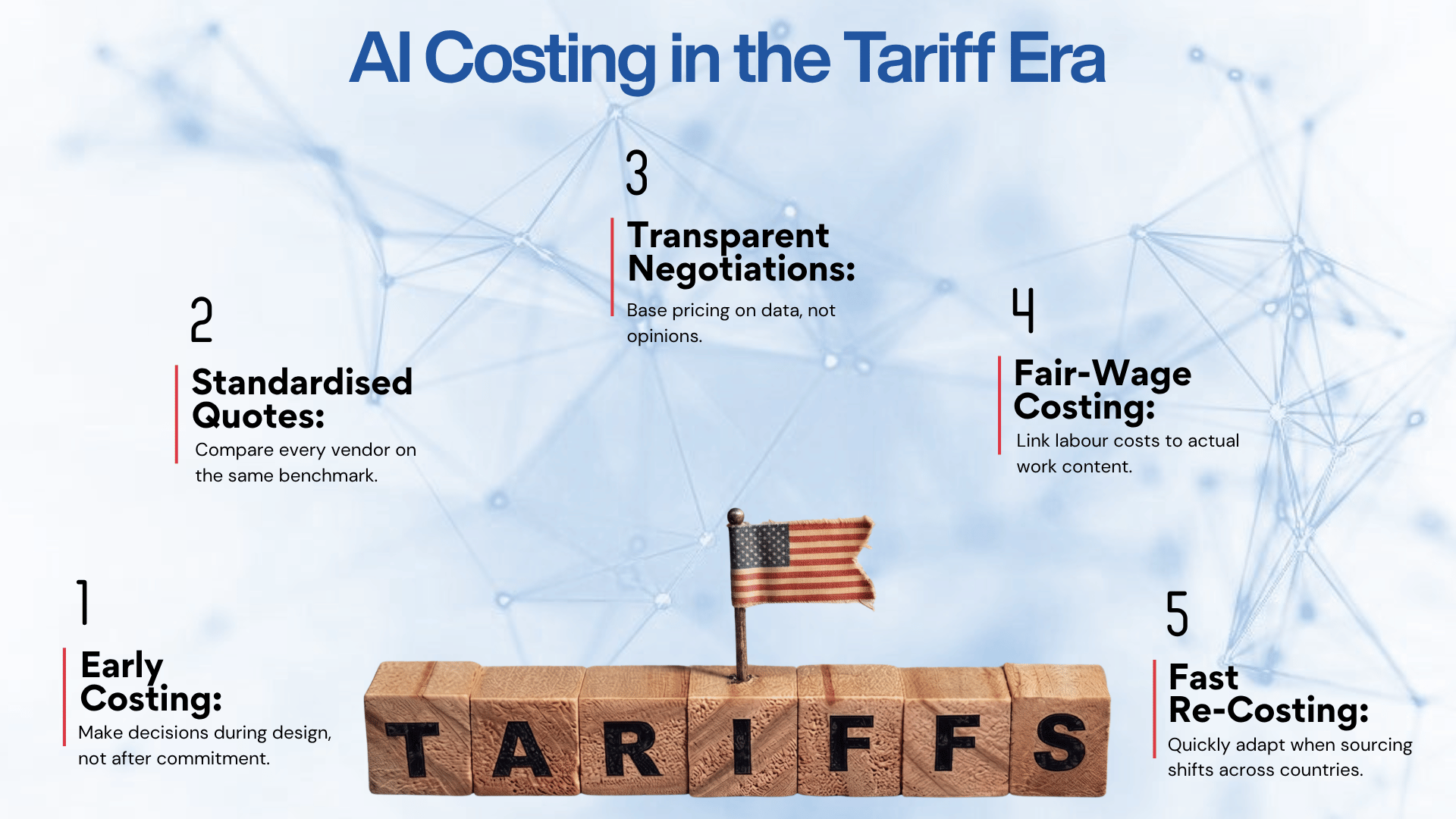
Costing deserves a closer look, because it is where the tariff squeeze bites first and where AI changes the balance of a negotiation.
Start with two definitions in plain terms. A Bill of Labour itemises the sewing and assembly operations needed to make a garment and the time each one takes. A Standard Minute Value is the standard time to complete a garment operation, based on internationally recognised motion codes. Together they answer the question every sourcing negotiation turns on: how much work, and therefore how much labour cost, does this garment actually contain?
Historically, building that answer took a skilled engineer hours per style, and the result varied from person to person. The consequence is visible in the numbers. Before adopting GSDCost, the Chinese sportswear manufacturer Suzhou Tianyuan Garments, a supplier to Adidas, FILA, ANTA, and The North Face, saw SMV calculations vary by up to 30% across production lines, with new-product analysis taking three to four days and producing inconsistent results. After digitising the process, Tianyuan improved SMV calculation accuracy to 98%, lifted cost estimation accuracy to 95%, cut new-product analysis time from four days to one, raised process-analysis efficiency by 60%, and reduced sample-development cycles by 25%.
AI costing tools generalise that gain and push it earlier in the cycle. By converting a garment image or tech pack into a standardised Bill of Labour and SMV, they give a brand an objective, method-based cost figure before the first quote arrives. The practical benefits compound:
- Faster early costing, so decisions happen at design and sampling rather than after commitments are made.
- Consistent comparisons across vendors, because every quote is measured against the same standardised benchmark.
- Fairer, more transparent negotiations, since both sides are working from method and time rather than opinion.
- Support for fair-wage practices, because SMV-based costing ties labour cost to real work content rather than a race to the lowest number.
- Rapid re-costing when sourcing shifts country, which is exactly the manoeuvre tariffs are now forcing on US brands.
That last point is the tariff-era advantage in a sentence. When a duty change makes Cambodia or India the better bet than China, a brand with standardised AI costing can re-cost its range in the new cost base in hours and negotiate from a defensible figure, instead of starting the whole manual exercise again.
If you want to see how AI-driven costing works in practice, Coats Digital’s GSDQuest generates a standardised Bill of Labour from a single garment image; you can arrange a demo to see it applied to your own styles.
How to Choose the Right AI Sourcing Tool for Your Brand
A tool that solves someone else’s problem will not solve yours. Work through this checklist before you shortlist.
- Start from the specific sourcing problem you need to solve: Cost, suppliers, compliance, or demand. The four categories above map to four different tool sets; naming your problem narrows the field immediately.
- Prioritise tools built for fashion over generic AI or machine-learning platforms: Apparel construction, SMV, and multi-tier textile supply chains carry nuance that horizontal tools miss.
- Require integration with your existing PLM and ERP: Integration is what turns insight into a decision; it is also the most common source of project delays, so check it early.
- Check where the AI’s data comes from and whether its output is explainable and auditable: Black-box recommendations that a buyer cannot interrogate will not be trusted or used, and regulators increasingly demand verified evidence, not inference.
- Weigh usability for lean teams: Image-based costing and no-code interfaces lower the barrier for brands without dedicated data specialists.
- Confirm security and compliance posture, such as Service Organisation Control 2 (SOC 2), before any supplier or product data leaves your systems.
For manufacturers, it is worth noting that costing rarely sits in isolation. Tools such as FastReactPlan extend accurate SMVs into production planning and capacity, which is where costing decisions ultimately play out on the factory floor.
The Future of AI in Fashion Sourcing
Three shifts are worth watching. First, sourcing is moving toward connected, agentic workflows that link PLM, ERP, and supplier data into a single view, with AI agents executing steps across systems rather than answering one-off questions. McKinsey frames the payoff conservatively but clearly: digitised, connected sourcing can unlock double-digit product cost savings.
Second, traceability keeps rising up the agenda. With UFLPA enforcement moving to deeper tiers, EUDR obligations phasing in, and textile Digital Product Passports expected under the Ecodesign for Sustainable Products Regulation (ESPR) delegated acts around 2027, the ability to prove where a product came from is becoming a condition of market access rather than a sustainability nicety.
Third, and most important for how you staff and govern all this: AI in sourcing is decision support, not a decision-maker. It removes the manual work of costing, mapping, and screening so that experienced sourcing and costing professionals can focus on strategy, negotiation, and judgment. The accountability for a sourcing call still sits with a person, and the brands that treat AI as a faster analyst rather than an autonomous buyer are the ones getting durable value from it.
Frequently Asked Questions
-
What are AI sourcing tools for fashion brands?
AI sourcing tools are software that uses artificial intelligence to cost products, find and evaluate suppliers, model tariffs and landed cost, and trace supply chains. They replace manual, spreadsheet-based sourcing with faster, data-backed decisions, and increasingly integrate with PLM and ERP so insights turn into purchase decisions.
-
How are US fashion brands using AI for sourcing in 2026?
They use it for four jobs: AI costing and should-costing, supplier discovery and diversification, traceability and compliance, and demand-aligned buying. McKinsey found executives rank AI as the industry’s biggest 2026 opportunity, and brands such as Mango and ASOS already use AI platforms to evaluate suppliers and trace their supply chains.
-
What is the best AI tool for garment costing?
The strongest AI costing tools generate a standardised Bill of Labour and SMV, such as GSDQuest, built on Coats Digital’s GSDCost methodology, and MannyAI’s Seamstream. There is no single “best”; fit depends on standardisation, speed, and the negotiation leverage a brand needs from consistent, method-based costing.
-
Can AI actually reduce sourcing costs?
Yes. McKinsey notes that digitising sourcing and collaborating better across the value chain can unlock double-digit product cost savings, and AI costing speeds and standardises negotiation. The gains are real but bounded; treat vendor figures as directional and validate against your own data before committing.
-
How does AI help with tariffs and landed-cost decisions?
AI re-costs garments quickly when sourcing shifts country, models duty and landed-cost scenarios, and, through mapping tools, produces audit-ready origin documentation for customs. That matters given US apparel and footwear tariffs settled around 36% in 2025, well above historical norms.
-
What is a Bill of Labour and how does AI generate one?
A Bill of Labour itemises the operations and time needed to make a garment. AI tools such as GSDQuest analyse a product image or tech pack to identify visible and hidden construction elements, then map them to a motion-code and SMV library to generate a standardised Bill of Labour in seconds.
-
What is a Standard Minute Value (SMV)?
SMV is the standard time required to complete a garment operation, based on internationally recognised motion codes. It underpins objective costing and fair-wage benchmarking by tying labour cost to the real work content of a garment rather than to negotiation or estimate.
-
Which AI tools help with supplier discovery and diversification?
Multi-tier mapping and risk-intelligence tools such as Sourcemap and Sayari, alongside PLM vendor modules. They perform n-tier supplier mapping and screening against watchlists using real trade and ownership data, which matters as brands rebalance sourcing away from China toward countries such as Cambodia and India.
-
How does AI support traceability and compliance (UFLPA, EUDR, DPP)?
AI consolidates supplier, brand, and third-party data into chain-of-custody records, flags forced-labour and regulatory risk, and prepares Digital Product Passport data. TrusTrace and Inspectorio’s Paramo AI are leading examples; Gap Inc. adopted Inspectorio’s platform for traceability across its brands in 2026.
-
Do AI sourcing tools integrate with PLM and ERP?
The best ones do, and integration is what turns insight into decisions. PLM often acts as the connective layer, and McKinsey specifically links digitised, connected sourcing to double-digit cost savings. Confirm integration with your stack early, as it is a common source of project delay.
-
Are AI sourcing tools only for big brands?
No. Many are increasingly accessible to mid-market and smaller labels through software-as-a-service subscriptions and modular deployments, and image-based costing tools lower the expertise barrier for lean teams that lack dedicated data specialists.
-
What is GSDQuest?
GSDQuest is an AI-powered module of Coats Digital’s GSDCost that turns a garment image, PDF, or tech pack into a standardised Bill of Labour in seconds, cutting costing time by more than 90%. It supports early costing, sample evaluation, and approvals, and is designed for use by non-specialists across design, sourcing, and technical teams.
-
Is AI replacing sourcing and costing teams?
No. AI is decision support that automates manual work so experts can focus on strategy and negotiation. Humans retain judgment and accountability for sourcing decisions; the tools make analysts faster rather than making the call for them.
-
How do I choose an AI sourcing tool?
Start from your biggest sourcing pain, then prioritise fashion-specific models, PLM and ERP integration, data trust and auditability, usability for lean teams, and security such as SOC 2. Matching the tool to a named problem beats buying the broadest platform.
-
What is the difference between AI design tools and AI sourcing tools?
Design AI helps create and visualise products; sourcing AI helps decide what they cost, who makes them, and how to manage risk. This guide focuses on the latter: the decisions that protect margin in a high-tariff environment.
How Bangladesh Knitwear Factories Improve Operator Efficiency Across Sewing, Linking and Finishing

Best Lean Manufacturing Software for the Indian Garment Industry

Brand-to-Vendor Cost Collaboration: Which Layer of the Cost Stack Are You Missing?
All Blog Categories
- Production Planning
- Corporate
- Method Time Cost Optimisation
- Supply Chain Solutions
- Sustainability
- Videos