Top Production Costing Tools Used by US Fashion Brands in 2026
by Kunal Kapur
 9
Mins Read
9
Mins Read
Key Takeaways
- “Production costing software” is really three categories: PTS/SMV (labour-time), PLM costing (BOM and vendor quotes), and ERP/landed cost (freight, duty, and overhead that turn cost-to-make into a true unit cost).
- The categories are complementary, not competing. Most US brands now run more than one across their stack, because each answers a different question.
- The defining 2026 shift is AI-assisted, image-based costing. Tools that read a product image and generate a standardised Bill of Labour cut costing from hours to seconds.
- The second 2026 shift is tariff-aware costing. US import duties moved sharply and repeatedly through the first half of 2026, so scenario and landed-cost tooling now protects margin directly.
- Tool choice follows the operating model. Manufacturer-owned brands need PTS/SMV; product-development-heavy brands need PLM costing; import-driven brands need ERP landed cost.
- Spreadsheets are the “before” state. They break once style complexity, multi-vendor quoting, and duty scenarios stack up on top of one another.
- There is no single winner. The right answer is a category fit for where a brand sits between design, manufacturing, and import.
Why Costing Software Matters More Than Ever for US Brands in 2026
For US fashion brands, production costing software has quietly moved from a back-office convenience to a margin-defence system. The reason is structural. The United States is the world’s largest single-country importer of apparel. U.S. apparel imports were valued at roughly $92 billion in 2024, ahead of every other individual nation, which means the cost of a garment landing on U.S. soil is exposed to every shift in duty, freight and sourcing terms. And 2025-2026 delivered the sharpest, most volatile move in U.S. import duties in decades.
Three pressures are compressing cost-to-make at the same time. First, volatile duty and sourcing costs: as the tariff section below shows, the duty picture changed more than once inside a single quarter, and it is set to change again this month. Second, shorter development calendars and smaller production runs, which leave less time to cost each style and less volume to absorb an error. Third, thinning margins that no longer forgive the over- and under-costing that spreadsheets quietly produce. When a costing sheet is wrong by a few cents per unit across a large order, the error stays invisible until it reaches the bottom line.
This guide takes a deliberately different route from the usual vendor listicle. It is category-first and vendor-by-vendor, and every capability described is drawn from what each provider states on its own site or in its own announcements. Where a figure is a vendor’s own claim, it is labelled as such. The aim is a resource a costing or sourcing lead can actually use ahead of a budget cycle, not a sales page.
What “Production Costing Software” Actually Means
Definition. Production costing software is any system that calculates the cost-to-make (CM) or cost-to-manufacture of a garment by combining labour time, materials and overhead, replacing manual spreadsheets with a repeatable, auditable calculation.
The confusion and the reason so many brands buy the wrong tool is that three very different systems all get called “costing software.” They sit at different points in the process and produce different outputs.
PTS/SMV Costing Engines
Time-and-motion based, built on predetermined-motion-time methodology. They calculate the labour minutes that drive cost-to-make. The reference standard here is Coats Digital’s GSDCost, widely acknowledged as the de facto international standard across the sewn-products industry.
PLM Costing Modules
Bill-of-Materials and vendor-quote based, embedded inside a product-development platform. They cost the materials and components and run “what-if” scenarios early in development. Examples include Centric PLM and Lectra’s Kubix Link.
ERP / Landed-Cost Systems
They layer freight, duty/tariff, insurance and overhead on top of CM to produce a true landed unit cost, and tie it to purchase orders, work-in-process and the books. Examples include AIMS360 and WFX (World Fashion Exchange).
How the three chain together. Think of it as a pipeline, not a contest. PTS/SMV feeds the labour input → PLM feeds the materials/BOM input → ERP wraps freight, duty, and overhead to output the landed cost. The outputs feed forward; they do not replace one another. A brand often owns one tool from more than one stage.
The Building Blocks of Accurate Production Costing

The Cost Components Every Tool Must Account For
Whatever the category, an accurate garment cost is assembled from four inputs: labour minutes (the SMV/CM), materials (the Bill of Materials: fabric, trims, components), overhead, and margin.
Formula: Standard Minute Value SMV = Base Time (predetermined motion data) + Allowances (expressed in minutes)
The distinction that matters is the source of the base time. A predetermined-time system such as the GSD methodology produces a repeatable base time from standard motion codes; a stopwatch estimate does not, and cannot be defended to a vendor the same way.
The Landed-Cost Layer Specific to US Importers
For a brand importing into the US, cost-to-make is only half the number. The landed-cost layer adds everything required to get a garment to the US and through customs.
Formula: Landed Cost = Product Cost + Freight + Insurance + Duties + Handling Fees
The two formulas connect directly: CM (labour + materials + overhead) is the product cost input, and the landed-cost layer turns it into the number a US importer actually pays per unit. In a low-duty year, the gap is modest. In 2026, as the next section shows, the duty line alone can swing the landed cost materially.
The Top Production Costing Tools US Fashion Brands Use in 2026
The table below maps the leading tools by category.
How to read it: the first two rows generate a labour number, the middle two cost the BOM and run scenarios inside product development, and the last two turn cost-to-make into a landed unit cost tied to the books. A brand often uses one tool from more than one row.
| Tool (vendor) | Category | Costing model | Deployment | Best-fit brand profile | Standout / 2026 capability |
| GSDCost (Coats Digital) | PTS/SMV | Labour-time (method-time-cost) | Cloud SaaS | Manufacturer-owned / vertically integrated brands controlling factory-floor cost | 39 predetermined motion codes → a repeatable Method Standard; the de facto SMV standard; feeds the Res. Q shop-floor suite |
| GSDQuest (Coats Digital) | AI-powered SMV | Labour-time, from an image | Cloud SaaS | Any brand doing product development, including lean teams without a full IE function | AI reads a product image / PDF/tech pack → a standardised Bill of Labour in seconds |
| Centric PLM + Planning & Pricing | PLM costing | BOM / vendor-quote / scenario + margin planning | Cloud native | Product-development-heavy brands managing many styles, suppliers and quotes | Costing “what-if” scenarios early in development; Centric Tariff Tracker for tariff-aware pricing |
| Kubix Link (Lectra) | PLM costing | BOM / cost-sheet in a fashion data hub | Cloud native | Enterprise and vertically integrated brands with complex, CAD-linked product data | Centralises styles, materials, BOMs, costs and tech specs; real-time collection and cost monitoring |
| AIMS360 | ERP / landed cost | CM + landed cost tied to POs, WIP and accounting | Cloud | US import- and wholesale-driven brands; CMT to full-package | Landed cost + three-way matching; native QuickBooks / NetSuite / Sage / EDI |
| WFX (World Fashion Exchange) | Cloud ERP + PLM | Style cost sheets (fabric, trim, labour, freight, duty, FX, MOQ) | Cloud native | Brands and manufacturers wanting design→costing→production in one system | End-to-end costing across a modular suite; sustainability/traceability built in |
Best Production Costing Tools US Fashion Brands Use in 2026
Each profile follows the same skeleton: category, one-line positioning, verified capabilities, US-brand relevance, best-fit, and one honest consideration. Performance figures carry a named source.
GSDCost (Coats Digital)
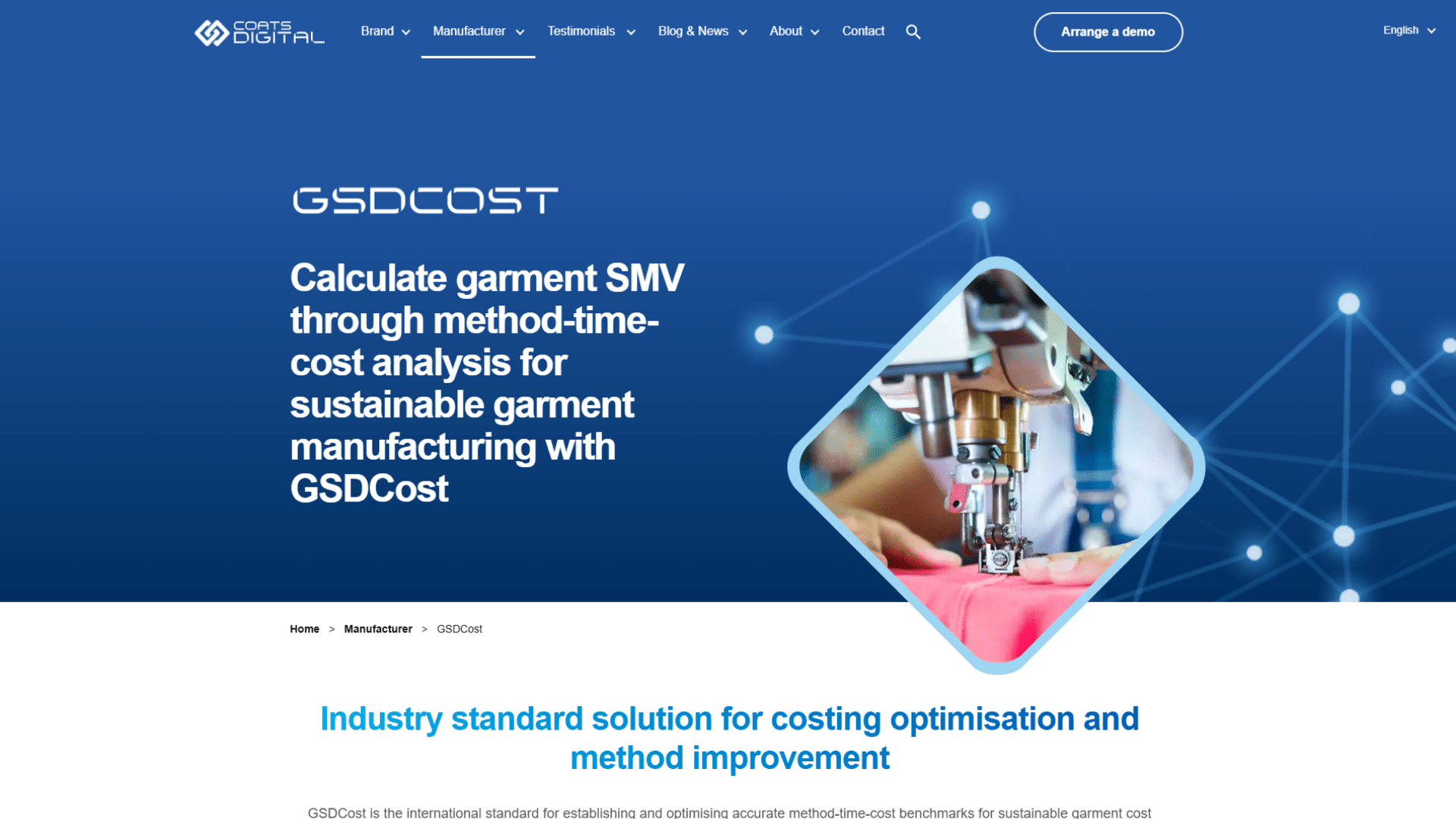
PTS/SMV · method-time-cost
Positioning:
The de facto international standard for method-time-cost benchmarking in the sewn-products industry, the tool that governs the labour half of cost-to-make.
Verified capabilities:
GSDCost is built on a predetermined time-and-motion database of 39 motion codes, each carrying an international standard time, used as building blocks across thousands of operations and unlimited styles. It produces a consistent Method Standard through scientific method analysis, establishes International Standard Time Benchmarks, and enables fact-based CM prediction and win-win negotiation. It supports accurate SMVs for capacity planning and line balancing, ships with pre-built global data libraries, and integrates natively with the Res. Q shop-floor suite for a digital feedback loop of actual-versus-standard SMV. It is delivered as an award-winning SaaS solution used via trained, licensed Practitioners.
US-brand relevance:
For brands that own or tightly control manufacturing, this replaces stopwatch guesswork with a defensible standard, the credible basis for negotiating CM with vendors rather than arguing over unaudited numbers.
Best suited for:
Manufacturer-owned or vertically integrated brands (and their vendor partners) where factory-floor labour cost and negotiation credibility are the primary pain.
Consideration:
It delivers most value with trained/licensed Practitioners in place. Brands with a thin industrial-engineering function should pair it with GSDQuest to generate SMVs quickly at the quoting stage while building capability in parallel.
GSDQuest (Coats Digital)

AI-powered SMV generation
Positioning:
An AI-powered tool within the GSDCost ecosystem that reads a garment image, PDF or tech pack and instantly generates a standardised Bill of Labour.
Verified capabilities:
GSDQuest uses multi-modal AI to detect garment design and construction elements, then maps them to standard operations via Coats Digital’s proprietary QED Library, generating a Bill of Labour grounded in the same GSDCost motion codes and SMVs. It applies consistently across teams and suppliers and is usable at any stage from initial design to production approval. As Coats Digital states, it puts costing “in the hands of any user, regardless of technical background”.
US-brand relevance:
It directly addresses the IE-headcount constraint. A lean US brand or DTC team can produce internationally standardised SMVs at the sampling and quotation stage without a full industrial-engineering function.
Best suited for:
Any brand doing product development that wants fast, standardised costing early, especially teams without deep IE resources.
Consideration:
It runs on the GSDCost methodology and QED Library; a Practitioner review remains best practice for final standards, even though non-certified users can operate it.
Centric PLM + Centric Planning & Pricing (Centric Software)
PLM costing · margin-first planning
Positioning:
A market-leading fashion PLM used to move costing off spreadsheets into a single source of truth, paired with planning and pricing modules for margin control.
Verified capabilities:
Centric provides visibility into supplier costing and raw-material cost data, supports costing “what-if” scenarios to identify cost-saving potential and get accurate costing earlier in development, and manages complex BOMs across full ranges on an open platform that integrates with CAD, 3D, ERP and PIM. Centric Planning handles merchandise financial planning and assortment, while Centric Pricing & Inventory applies AI to price and inventory optimisation and, in 2026, added an AI-powered demand-forecasting engine and intelligent AI functionality for pricing precision.
US-brand relevance:
It fits brands whose cost pain lives in product development and assortment: many styles, many suppliers, many quotes rather than on a factory floor. The scenario tooling lets a costing lead protect margin before commitments are made.
Best suited for:
Product-development-heavy brands (DTC, wholesale and private label at scale) needing BOM/vendor-quote costing and margin planning in one platform.
Consideration:
This is BOM/quote/scenario and margin costing, not factory-floor SMV. Reviews commonly note enterprise-grade cost and a learning curve; scope configuration accordingly.
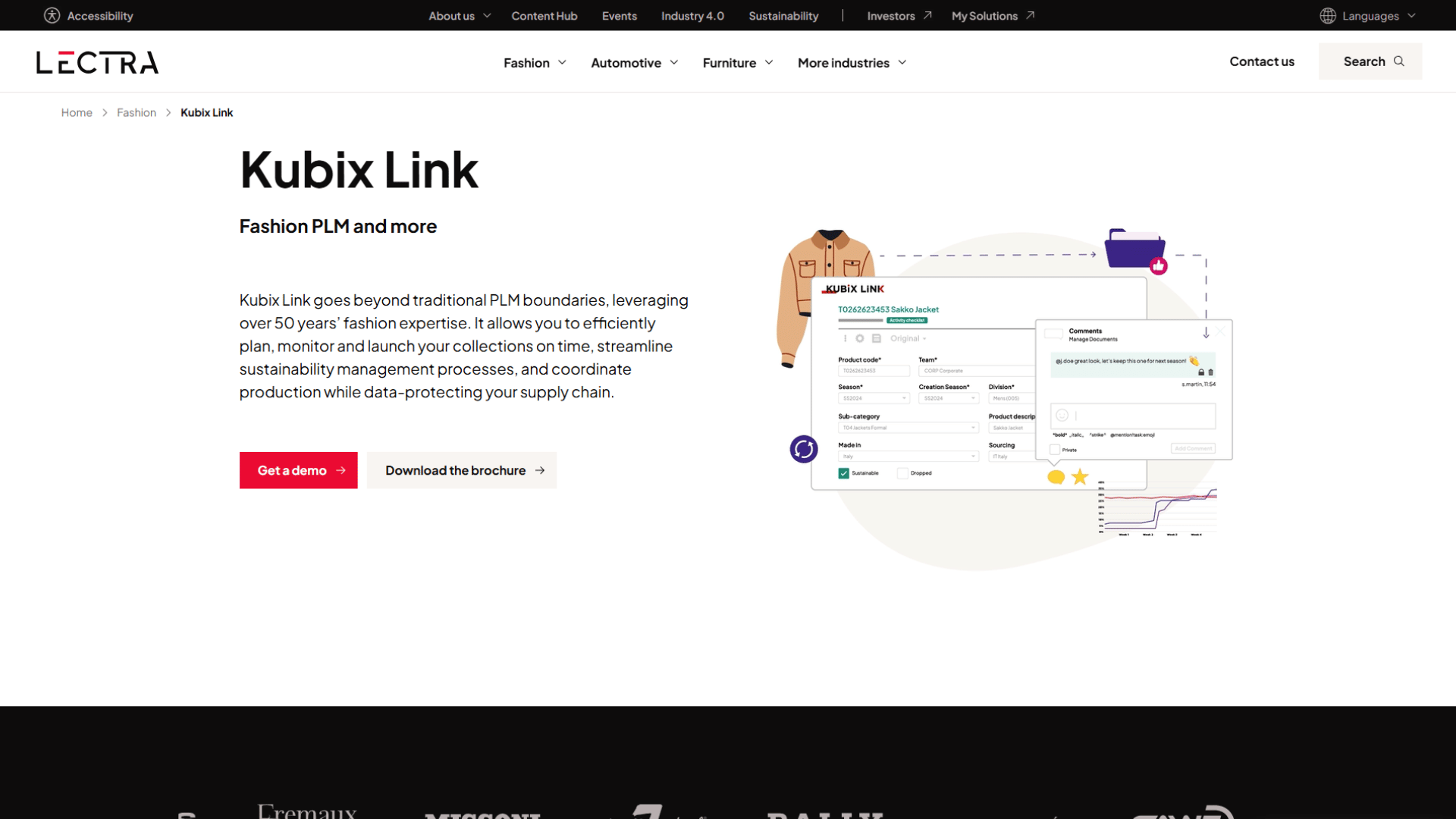
Lectra Kubix Link (and legacy Yunique PLM)
PLM costing · fashion data hub
Positioning:
A cloud-native fashion PLM that functions as a complete “Fashion Data Hub”, centralising styles, materials, BOMs, costs and technical specifications to reduce sampling and production errors.
Verified capabilities:
Kubix Link standardises BOMs by linking materials, colours, sizes and components to each style, with version tracking and supplier BOM sharing for tighter cost control. It adds optional PIM, Board and Forms modules, integrates with ERP and CAD, embeds sustainability, traceability and DPP-ready data, and is SOC 2 Type II–certified by the AICPA. The platform draws on Lectra’s 50-plus years of fashion expertise; the legacy Yunique PLM (from Gerber, now Lectra) offers integrated PLM+ERP modules covering style data, costing and orders relevant to brands already on Gerber CAD.
US-brand relevance:
It suits larger and vertically integrated US brands with complex, CAD-linked product data who want costing to live inside a full fashion data hub rather than a standalone module.
Best suited for:
Enterprise and manufacturer-adjacent brands prioritising centralised product data, technical specs and cost control across many styles.
Consideration:
It carries an enterprise footprint; onboarding and configuration are a larger undertaking than lightweight, DTC-first PLMs. Confirm which capabilities sit in Kubix Link versus legacy Yunique PLM for a given brand.
AIMS360
ERP / landed cost · tied to the books
Positioning:
A US-based apparel ERP built for manufacturers from CMT to full-package production, managing raw materials, costing and compliance.
Verified capabilities:
AIMS360 covers production management across POs, work-in-process and landed costs, with real-time analytics for landed cost, COGS and margin. It performs accounts-payable three-way matching of purchase order, receiving report and supplier invoice for accurate cost allocation, tracks inventory by style/colour/size, and runs on Microsoft Azure with PCI-compliant security. It ships native, in-house integrations to QuickBooks, NetSuite, Sage and EDI retailers, automating EDI 850 purchase orders, 855 acknowledgements, 856 ASNs and 810 invoices plus Shopify, JOOR and fashion PLM tools.
US-brand relevance:
It is purpose-built for the US market, and the import/wholesale model where landed cost (freight + duty + handling on top of CM) becomes a real unit cost that flows straight to accounting and EDI compliance, reducing retailer chargebacks.
Best suited for:
US import- and wholesale-driven brands and domestic manufacturers needing landed cost, retailer EDI and financials in one apparel-native ERP.
Consideration:
An ERP is the system of record for cost, not a generator of SMV; it consumes a labour number rather than producing one via time-and-motion.
WFX (World Fashion Exchange)
Cloud ERP + PLM combined
Positioning:
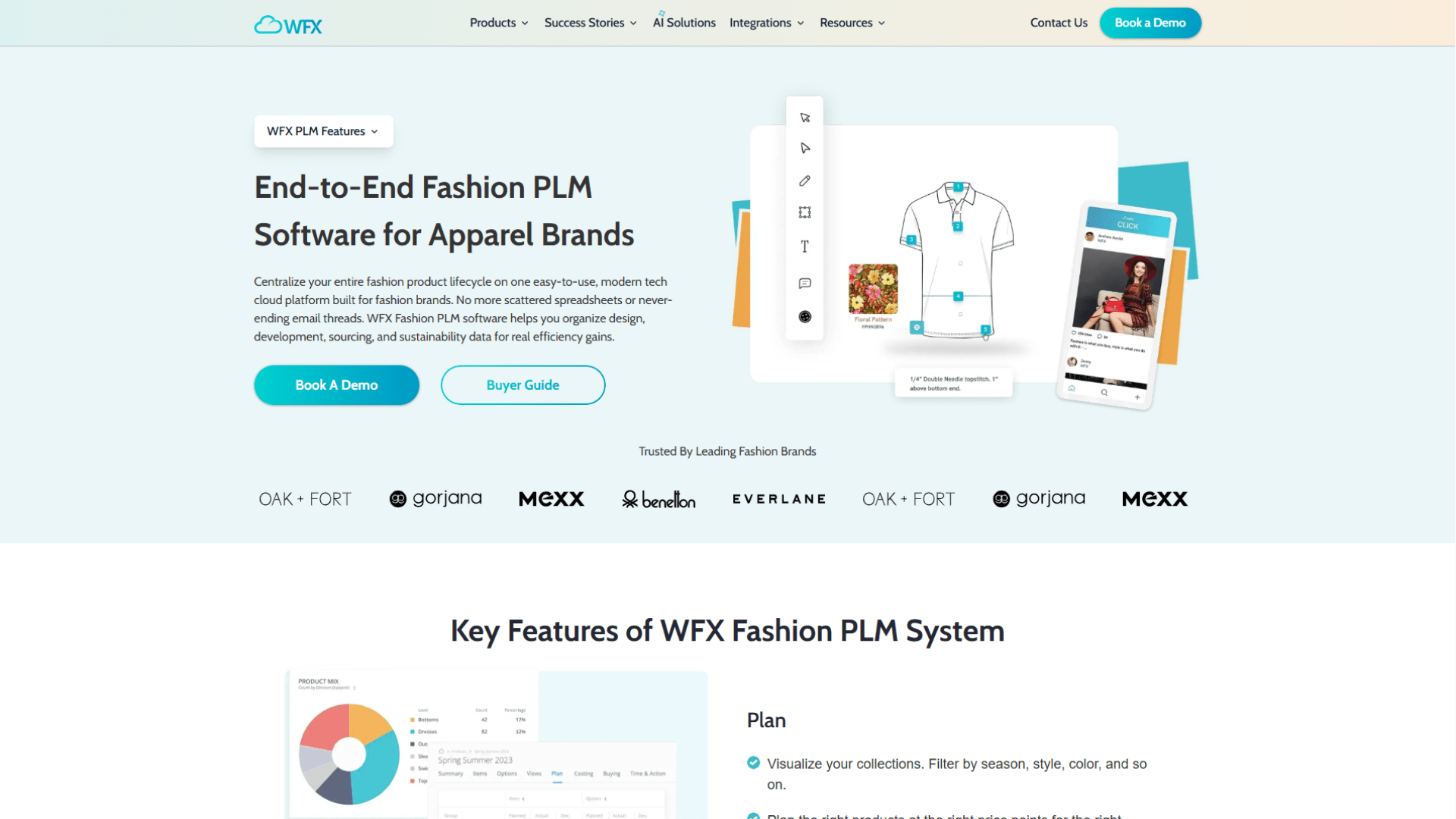
A fashion-native cloud platform that consolidates design, sourcing, costing and production, offered as standalone apps or an integrated ERP+PLM system.
Verified capabilities:
WFX style cost sheets capture the true drivers of garment cost: fabric and trim prices, labour, freight, duties, currency swings and minimum order quantities, with intelligent cost sheets, budgeting and a costing module that models multiple cost scenarios across suppliers and shipping routes. It adds a supplier portal with real-time milestone alerts and vendor scorecards, a module suite spanning Fashion PLM, Apparel and Textile ERP, Manufacturing Execution System (MES), digital showroom and sustainability tooling, and a NetSuite × WFX PLM connector. WFX reports its platform is used by 600-plus apparel businesses worldwide.
US-brand relevance:
It is for US brands and sourcing companies that want one fashion-native system from sampling through costing to production and accounting, rather than stitching a PLM to a separate ERP.
Best suited for:
Brands and manufacturers seeking end-to-end design-to-production coverage with costing and sustainability in a single cloud suite.
Consideration:
Breadth means implementation is scoped and modular; confirm which modules a given brand actually needs before committing.
PTS/SMV vs PLM Costing vs ERP Landed Cost: Which Do US Brands Actually Need?
The category that fits follows the operating model, not the brand’s size or ambition. The framework below maps the sharpest cost pain of each model to the primary category and a named shortlist.
| Brand operating model | Sharpest cost pain | Primary category | Named tools to shortlist |
| DTC-only, product-development-led | Costing styles/BOMs early; protecting margin before commitments | PLM costing (+ AI SMV for the labour input) | Centric PLM; Lectra Kubix Link; GSDQuest for fast SMV |
| Wholesale/private label | Multi-vendor quoting at scale + retailer EDI + landed cost | PLM costing and ERP landed cost | Centric PLM or Kubix Link; AIMS360 or WFX |
| Manufacturer-owned / vertically integrated | Factory-floor labour cost and defensible CM negotiation | PTS/SMV | GSDCost (+ Res.Q for actual-vs-standard); GSDQuest |
| Multi-category enterprise | All three, integrated, at scale | Two or three, in one stack | GSDCost + a PLM (Centric/Lectra) + an ERP (AIMS360/WFX) |
In practice, manufacturer-owned brands lead with PTS/SMV to control the labour half of CM; product-development-heavy brands lead with PLM costing to manage BOMs and quotes; import-driven brands need ERP landed cost to capture freight and duty; and mid-size to enterprise brands typically run two of the three in an integrated stack, with the categories feeding one another rather than duplicating work.
The 2026 Shift: AI-Powered and Tariff-Aware Costing
AI-Assisted Costing
The clearest expression of the shift is the image-to-Bill-of-Labour workflow. Where traditional costing required technical and costing teams to spend hours analysing design features and building operation-level estimates, tools such as GSDQuest read a product image, PDF or tech pack, detect construction features, map them to standard operations, and generate a standardised Bill of Labour in seconds. Two things make that matter. It collapses the industrial-engineering-headcount barrier that used to gate accurate costing, and it standardises the labour input at the earliest, most decision-critical stage: sampling and quotation. On the PLM and planning side, the same trend shows up in Centric’s AI-enhanced modules: demand forecasting, AI functionality for pricing precision, and scenario simulation.
Tariff-Aware Costing
This is the development that makes 2026 unlike any recent costing year, and it is worth stating factually. US import duties moved sharply and repeatedly through the first half of 2026. On 20 February 2026, the U.S. Supreme Court invalidated the administration’s earlier emergency-authority (IEEPA) tariffs. The same day, the administration invoked Section 122 of the Trade Act of 1974 to impose a temporary import surcharge on virtually all imports, effective 24 February 2026 for a maximum of 150 days.
Two things a costing lead needs to know about where that stands now. First, the surcharge is scheduled to expire on 24 July 2026, a hard statutory sunset that the President cannot extend unilaterally, with no extension legislation pending. Second, the surcharge has been through the courts: the U.S. Court of International Trade ruled it unlawful on 7 May 2026, but relief was limited to the named plaintiffs, and the Federal Circuit stayed that ruling pending the government’s appeal, so U.S. Customs has kept collecting the duty in the meantime.
What replaces it is already taking shape. On 2 June 2026, USTR announced proposed Section 301 duties of 10% or 12.5% across 60 economies following forced-labour investigations, with the higher 12.5% rate proposed for most goods of roughly 45 countries, including China, Vietnam and India, the three largest apparel-sourcing origins for US brands. USTR is running an accelerated timeline pointed squarely at the Section 122 sunset. The practical takeaway is unambiguous: duty rates are now a moving variable, not a fixed input, which is exactly why scenario and landed-cost tooling has become a margin-protection tool rather than an accounting convenience.
The clearest example of tariff-responsive tooling is Centric’s Tariffs Resource Hub and Centric Tariff Tracker, an AI interactive dashboard giving real-time duty visibility by key category, country and year for agile pricing decisions. That sits upstream of the point where duty actually lands on unit cost: the ERP landed-cost layer in tools such as AIMS360 and WFX, where the surcharge (or its replacement) becomes a real number on a real purchase order.
Common Costing-Software Mistakes US Brands Make: A Self-Diagnostic
Read these as a checklist. Each is a pattern we see repeatedly, and each maps back to a category above.
- Buying a PLM costing module and expecting factory-floor SMV accuracy. PLM costs the BOM; it does not produce a time-and-motion labour standard. If defensible labour cost is the goal, that is a PTS/SMV job.
- Running landed cost in spreadsheets alongside an ERP that already does it. This duplicates work, invites error, and keeps the real unit cost invisible to the books.
- Failing to integrate PLM costing data into the ERP. When cost data does not flow downstream, teams re-key it between systems and every re-key is a chance to introduce a discrepancy.
- Treating tariff rates as a fixed input. In a year when duties changed more than once inside a single quarter and are set to change again, no scenario capability means no margin protection.
- Relying on stopwatch or historical estimates for CM negotiation. An estimate cannot be defended to a vendor the way a predetermined-time standard can; the negotiation starts from a weaker position.
- Treating costing software as a one-time setup. Methods drift, material and freight prices move, and duties change. Costing accuracy is an ongoing discipline, not an install.
Choosing by Brand Size and Model
The recommendation still follows the operating model, but brand tier is a useful proxy for where most teams should start.
| Brand tier | Typical profile | Recommended starting point |
| Emerging DTC brand | First styles, lean team, moving off Excel/QuickBooks | AI SMV (GSDQuest) for a fast labour number + a lightweight PLM; add an ERP when wholesale/landed cost begins |
| Mid-size wholesale/private label | Multi-line, growing wholesale, retailer EDI | PLM costing (Centric or Kubix Link) + an apparel ERP for landed cost and EDI (AIMS360 or WFX) |
| Manufacturer-owned / vertically integrated | Owns or controls factories; multi-buyer | GSDCost with a Practitioner programme + Res. Q for actual-vs-standard; GSDQuest to accelerate quoting |
| Multi-category enterprise | Scale, compliance-driven, many categories | An integrated stack: GSDCost + PLM (Centric/Lectra) + ERP (AIMS360/WFX) |
The through-line is that the tool follows the model. Vendors’ own scale claims support this tiering: apparel ERPs positioning themselves to grow with a brand, and PLM vendors serving both small and enterprise accounts, but every such claim should be read as vendor-stated and checked against a brand’s real requirements before a budget commitment.
Conclusion: Costing Software as a Margin Strategy, Not a Line Item
In 2026, costing accuracy is a continuous, tool-supported discipline rather than a single spreadsheet exercise. The right stack depends on where a brand sits between design, manufacturing and import and, for the first time in years, on how well it can model a duty line that refuses to sit still.
The three-category model is the map. PTS/SMV governs labour, PLM costing governs materials and scenarios, and ERP landed cost turns cost-to-make into the number a US importer actually pays. Most brands need more than one, and the ones that hold margin are those that treat costing as a system, not a step.
Where to go next:
- A deeper look at PTS/SMV and GSDCost costing methodology, and how method-time-cost benchmarking actually works.
- How GSDQuest turns a product image into a standardised Bill of Labour: the AI costing workflow in detail.
Frequently Asked Questions
-
What’s the difference between PLM costing and SMV costing?
PLM costing works from the Bill of Materials and vendor quotes, costing the materials and components of a style and running “what-if” scenarios inside product development. SMV costing works from time-and-motion data, for example the GSD methodology, to calculate the labour minutes that drive cost-to-make. They answer different questions, materials versus labour, and many brands use both.
-
Do small or DTC brands need dedicated costing software?
Often yes, at least for one piece of it. Even a lean brand benefits from an accurate labour number early, and AI SMV tools such as GSDQuest generate a standardised Bill of Labour from a product image without a full IE team. Full PLM or ERP typically follows once style counts, multi-vendor quoting, wholesale EDI or landed-cost complexity outgrows spreadsheets.
-
How does landed cost differ from cost-to-make?
Cost-to-make (CM) is labour plus materials plus overhead: the cost to produce the garment. Landed cost adds everything required to get it to the US and through customs: freight, insurance, duties/tariffs and handling. In formula terms, Landed Cost = Product Cost + Freight + Insurance + Duties + Handling Fees. For US importers, landed cost, not CM, is the true unit cost.
-
How is AI changing garment costing in 2026?
The clearest shift is image-based costing. AI tools such as GSDQuest read a product image, PDF or tech pack, detect construction features, map them to standard operations, and generate a standardised Bill of Labour in seconds, collapsing a process that traditionally took hours. That puts standardised costing in the hands of non-specialists at the earliest stage of development.
-
Do US brands need tariff-specific costing tools?
In 2026, tariff awareness has become part of costing rather than a separate task. US import duties shifted repeatedly through the first half of 2026, the Section 122 surcharge is set to expire on 24 July 2026, and proposed Section 301 duties may replace it, so scenario-capable tools matter. Purpose-built features such as Centric’s Tariff Tracker give real-time duty visibility by category and country, while ERP landed-cost systems are where duty actually lands on unit cost.
-
What cost categories does a costing tool track?
Typically: labour minutes (SMV/CM), materials via the BOM (fabric, trims, components), overhead and margin and, for importers, the landed-cost layer of freight, insurance, duty and handling. PTS/SMV tools focus on labour; PLM tools focus on materials and scenarios; ERP tools consolidate everything into a landed unit cost tied to accounting.
-
How does costing software integrate with PLM and ERP?
The categories are designed to chain. A PTS/SMV tool produces the labour standard; a PLM costs the BOM and passes cost data downstream; an ERP consumes both and adds freight, duty and overhead for landed cost and financials. Most vendors here integrate with the others; apparel ERPs, for example, commonly connect to QuickBooks, NetSuite and PLM/PDM tools.
-
How often should costing data be refreshed?
Continuously, not annually. Methods drift, material and freight prices move, and as 2026 has shown, tariff rates can change within weeks. Treating costing as an ongoing discipline updated method standards, current material costs, and live duty scenarios is what separates brands that hold margin from those that discover cost erosion after the fact.

How Bangladesh Knitwear Factories Improve Operator Efficiency Across Sewing, Linking and Finishing

Best Lean Manufacturing Software for the Indian Garment Industry

Brand-to-Vendor Cost Collaboration: Which Layer of the Cost Stack Are You Missing?
All Blog Categories
- Production Planning
- Corporate
- Method Time Cost Optimisation
- Supply Chain Solutions
- Sustainability
- Videos