Top Production Planning Tools Used by Denim Manufacturers in Bangladesh for Managing Multi-Process and Multi-Buyer Orders
by Coats Digital
 9
Mins Read
Key Takeaways
- The main production planning tools for denim manufacturers in Bangladesh are dedicated planners like FastReactPlan, apparel ERPs with planning modules, enterprise ERPs, and Excel.
- Denim is harder to plan than knit or basic woven because washing runs in batches, needs steady gas, and varies by wash programme.
- Plan an outside wash house as a resource with its own capacity, queue, and status, not as a fixed number of days after sewing.
- An ERP records orders, costs and stock; planning software turns them into a line-by-line, wash-by-wash schedule that recalculates when anything changes.
- Bangladesh led US and EU denim imports in 2025; its EU shipments fell 5.85% in January to August 2026 while Egypt and China grew.
- Bangladesh denim makers Tusuka and Paddock’s Jeans report on-time delivery gains of 9% and 10% with FastReactPlan; figures are company-reported.
- Software surfaces conflicts early, but results depend on accurate standard minute values, a clean wash routing library and a named plan owner.
Which Production Planning Tools Do Bangladesh Denim Manufacturers Use?
Most denim planners in Gazipur, Narayanganj and the export zones know this week. Three buyers have ex-factory dates in the same fortnight, all loaded on the same sewing lines, and one order is sitting at an outside wash house that has quietly slipped two days. The planning desk finds out when finishing asks where the goods are.
Production planning tools for denim manufacturers in Bangladesh fall into four groups:
- Dedicated production planning and control (PPC) software, led by Coats Digital’s FastReactPlan, which schedules lines and supporting processes, laundry included, on one board.
- Apparel ERPs with planning modules, such as WFX, Skylark Soft’s goRMG and BlueKaktus, which combine planning with orders, costing and accounts.
- Enterprise ERPs, such as SAP S/4HANA, which large vertically integrated groups run with a planning layer on top.
- Excel, where most plans start and where most of them break.
One question matters more than any feature list: can the tool treat washing as a live dependency with its own capacity, or does it reduce the wash to a fixed number of days after sewing?
The stakes are high because Bangladesh is the largest denim supplier to both of its main markets. In 2025, it shipped US$ 955.70 million of denim to the United States, a 25.97% share, and US$ 1,643.50 million to the European Union, a 29.88% share, according to OTEXA and Eurostat data compiled by The Daily Star.
That lead is being tested. Between January and August 2026, Bangladesh’s denim exports to the EU fell 5.85% to €869.13 million, and its share slipped from 29.85% to 29.40%. Turkey lost the most ground, but the orders it gave up went mainly to Egypt, China and Vietnam rather than to Bangladesh. A 12.71% rebound in August narrowed the gap but did not close it (Eurostat data compiled by Bangladesh Apparel Voice). Mohiuddin Rubel, founder and CEO of Bangladesh Apparel Voice, concludes that holding share now depends on matching nearer suppliers on speed and flexibility. In denim, both are decided in the plan.
This guide explains why denim is harder to plan than other garments, separates the tool categories, reviews a denim-specific shortlist with honest limits, and sets out how to choose, implement, and justify a tool. For the wider picture, see our guide to production planning software used by Bangladesh garment factories.
Why Is Denim Harder To Plan Than Knit Or Basic Woven?
Denim is harder to plan because every order passes through washing. That stage is slow, sequence-bound, batch-based, and dependent on utilities, and in many units it is run by someone else. Sewing capacity tells you very little until you know whether the wash can take the work.
Washing is a batch process inside a flow factory
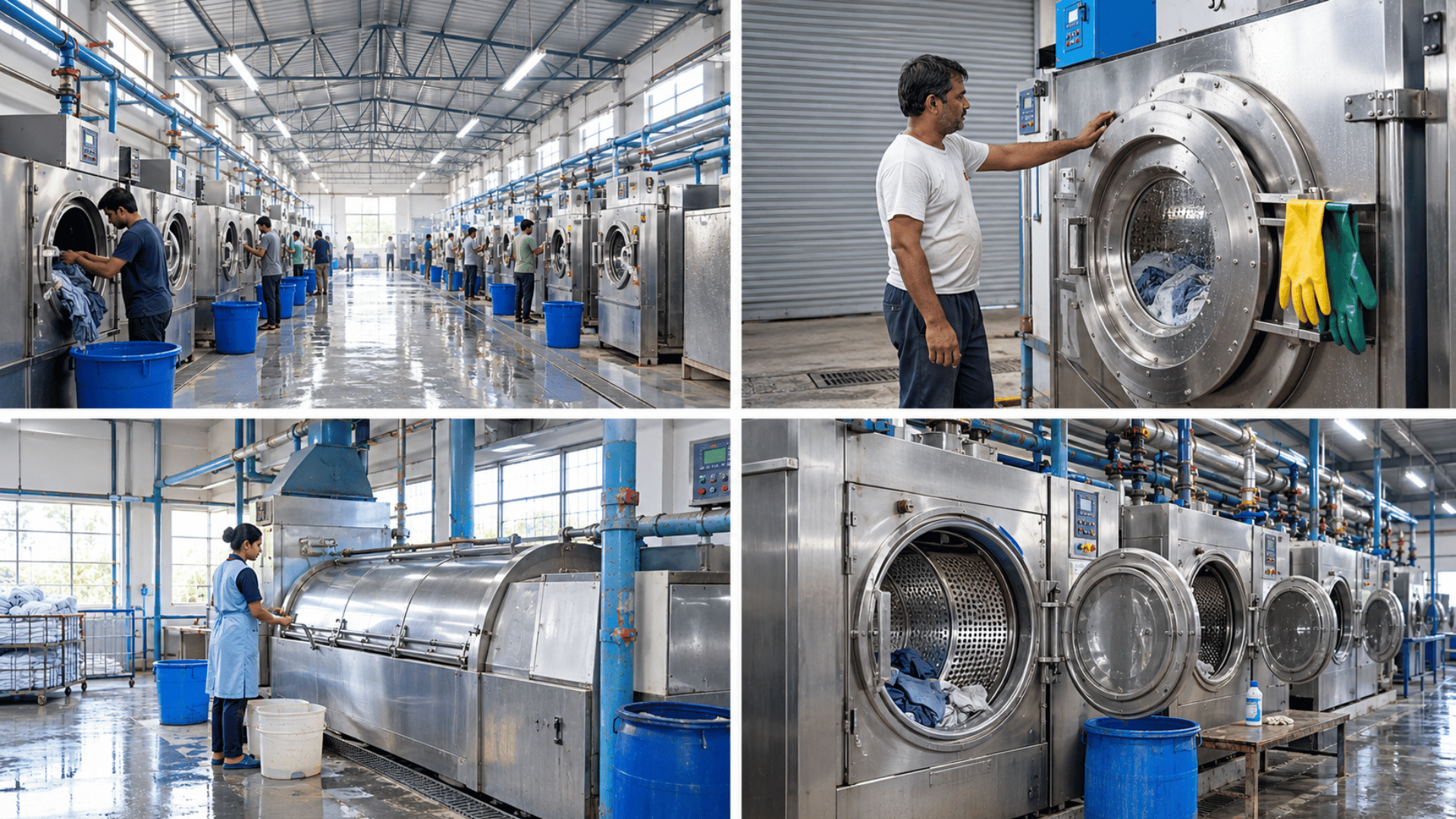
Sewing is a flow process. Its capacity is counted in standard minutes per piece, and lines can be loaded style by style. Washing works in machine loads. Garments go into a washer by weight, run a cycle set by the wash programme, then queue for hydro-extraction and drying. Pieces have to be converted into loads, and a small colourway can still tie up a whole machine.
The programme also fixes the route. A typical mid-stone look might be hand-scraped or whiskered before the wet wash, desized and stone- or enzyme-washed, given a potassium permanganate (PP) spray to brighten the high points, then neutralised, tinted and softened. Laser and ozone shorten some of those steps; they do not remove the sequence. If the shade misses the approved standard, the batch is re-washed, and every style queued behind it moves.
Our work with Vietnamese denim maker Phong Phu International shows how quickly this multiplies. Its laundries offer up to 100 possible processes, and a typical style uses 10 to 22 of them. The bottleneck also moves with the order mix: one week it is the lasers, the next it is PP spray. Some steps handle garments one at a time, while washing handles them in batches.
Bangladesh adds a utility constraint. Washing and drying depend on steady gas pressure, and in March 2026 the president of the Bangladesh Garment Manufacturers and Exporters Association (BGMEA) warned that denim washing needs high gas pressure that many factories were not getting (The Daily Star). By August, AR Wet Processing, a Fashion Globe Group washing unit in Ashulia, said it was losing up to 75% of its washing output, with pressure swinging between zero and 2.5 PSI against the 10 PSI it needs (The Business Standard). In the same period, BGMEA member factories were running 30 to 35% below full capacity.
Buyers compete for lines at cutting and sewing. The wash is where slippage hides, because nothing about it shows up in a plan built on sewing minutes.
Two multipliers: more processes, more buyers
Multi-process means one delay travels. A wash that runs two days late compresses finishing and packing and moves the ex-factory date. Capacity in sewing means little without sight of the stages after it.
Multi-buyer means overlapping Time and Action (T&A) calendars share the same lines and the same wash slots. Pull one buyer’s order forward, and another buyer’s order quietly loses its place. A typical Bangladesh denim book looks like this: Paddock’s Jeans, in the Dhaka Export Processing Zone (EPZ), makes jeans, woven jackets and blazers for Brax, Bugatti, C&A, John Lewis, Adler, Lee and Marc O’Polo, each with its own calendar.
Two habits make both problems worse:
- Tracking capacity by delivery month. At Paddock’s, orders due in a month were not always produced in that month, because of line performance, material availability, or pull-forwards. On Coats Digital’s recommendation, the factory moved to monitoring capacity against the actual line plan.
- Setting targets from average efficiency. Azim Group, whose units include a denim subsidiary, found that average-efficiency targets produced inaccurate capacity forecasts and unrealistic delivery dates. Accuracy improved once it planned by product type, learning curve, and line performance.
The outsourced-laundry dependency
When a denim factory sends garments to an outside wash house, its plan has to model a stage it does not control. That stage has a separate queue, separate capacity, two transport legs, and slippage of its own.
Spreadsheets usually handle this by adding a fixed number of days after sewing. That buffer fails in both directions. Allow too few days and the delivery is missed. Allow too many, and the factory quotes lead times buyers will not accept. And no cell recalculates when the wash house runs late.
The outside leg costs enough that some exporters bring washing in-house. In 2023, PDS Limited’s Bangladesh subsidiary Progress Apparels, in the Adamjee EPZ, installed a wash plant that lets it handle about 90% of its current washing requirement internally, citing savings on transport costs and production turnaround.
Most factories cannot do that for every programme, so the wash house has to go into the plan as a resource. In practice, that means holding four things for each outside laundry:
- Its daily capacity by wash programme, in loads or pieces
- A quoted lead time per programme, plus the transport days each way
- A dated status update from the wash house, ideally daily
- An explicit buffer the planner can see and shrink, rather than one buried inside a total
Where the plan breaks down
| Stage | Why the plan breaks here | Common planning gap |
| Cutting and sewing | Several buyers compete for the same lines; style changeovers lose time | Managed to a line average that hides buyer-level contention |
| Washing (in-house or outside) | Batch-based, programme-dependent and gas-dependent; an outside wash house runs its own queue | Treated as a fixed number of days, not a resource with capacity |
| Finishing and packing | Work content swings with the wash and any embellishment; shade grouping after washing adds sorting | Balanced once, then breaks on a heavily processed style |
| Across all buyers | Overlapping T&A windows share the same lines and wash slots | No single critical-path view, so slippage surfaces late |
What Types Of Production Planning Software Do Denim Factories Use?
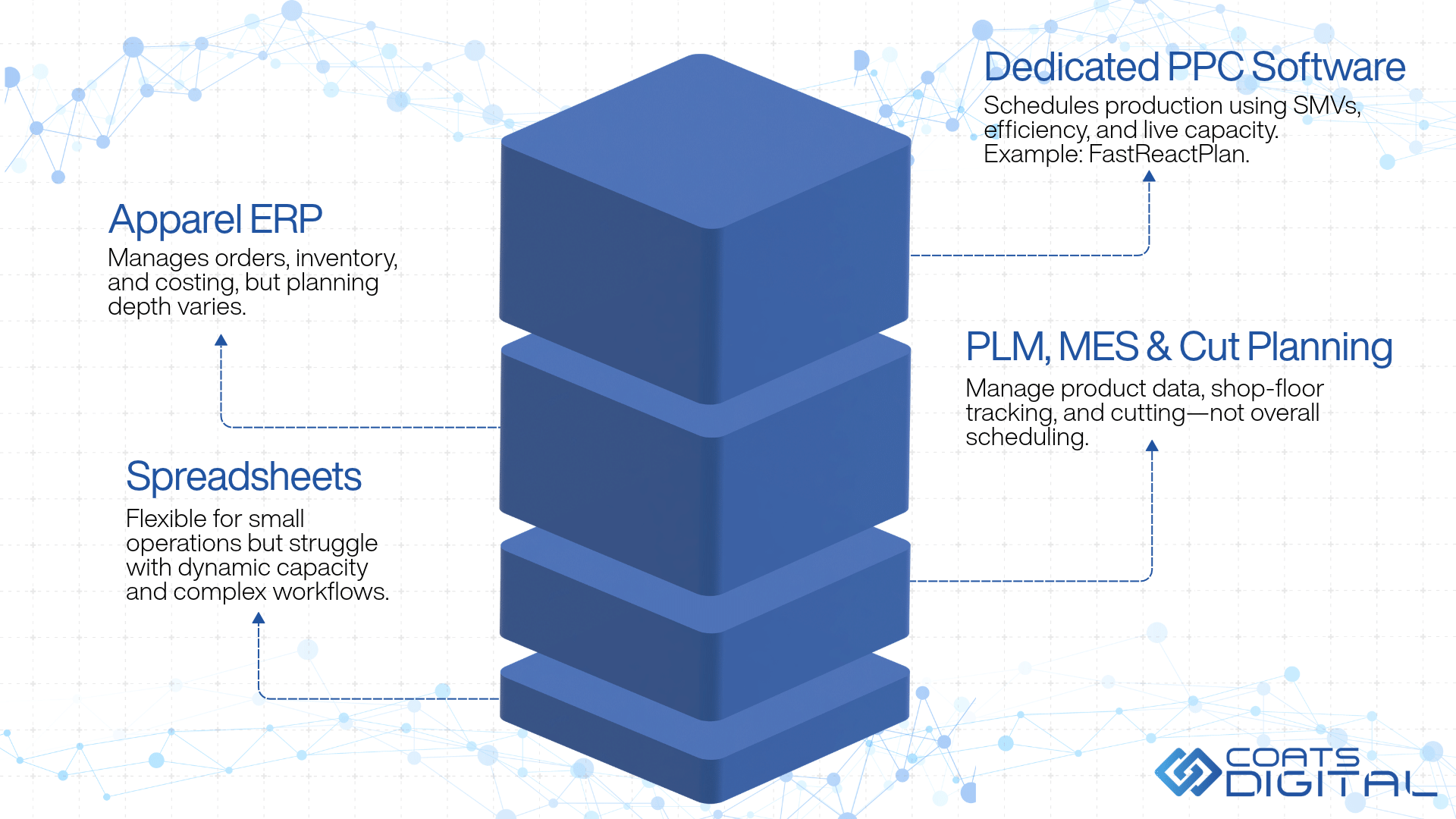
Planning software falls into four practical categories. The most common buying mistake is comparing an ERP with a dedicated planning tool as if they did the same job. The ERP answers what was ordered, what it costs, and what is in stock. The planning tool answers which line, which wash slot, and which day.
Dedicated production planning and control (PPC)
A PPC tool schedules the factory floor. It loads lines using standard minute values (SMVs), efficiency profiles and learning curves. It recalculates capacity when orders or actual output change, ties the plan to the pre-production critical path with alerts for late events, and drives material requirements from the live plan. It takes orders and costs from the ERP rather than replacing it. Example: FastReactPlan.
Apparel ERP with a planning module
An apparel ERP is the system of record for orders, purchasing, inventory, costing, and accounts, and most include some planning. Depth varies widely. Some modules schedule lines visually; others allocate orders to monthly capacity buckets and leave the floor to cope. For denim, the test is blunt: is washing scheduled with its own capacity, or only recorded after the event?
PLM, MES and cut planning
Product lifecycle management (PLM) holds styles, tech packs and approvals. A manufacturing execution system (MES) records what actually happened on the floor. Cut-planning tools optimise markers and lays. None of them builds the forward plan, so judge them on how cleanly they feed it.
Spreadsheets
Excel is where nearly every factory starts, and its flexibility is real. It has no native idea of a wash programme, a critical path or dynamic capacity, though, so every link between sewing, washing and finishing is held together by hand. It works until the order book outgrows the planner’s memory.
| Category | What it does best | Where it falls short for denim | Typical fit |
| Dedicated PPC | Line-level scheduling, dynamic capacity, critical-path alerts, supporting processes scheduled from the sewing plan | Not a finance or purchasing system; needs an ERP for orders and costs | Multi-buyer exporters and multi-unit groups |
| Apparel ERP with planning | One database for orders, materials, costing, T&A and accounts | Planning depth varies; washing may be tracked rather than scheduled | Factories that want one vendor for most functions |
| Enterprise ERP suite | Group-wide finance, procurement and inventory at scale | Detailed line and wash scheduling usually sits in a connected tool; heavy to configure | Large vertically integrated groups |
| PLM, MES and cut planning | Product data, shop-floor actuals, fabric use | Do not build the forward plan | Alongside any of the above |
| Spreadsheets | Low cost and total flexibility | Nothing recalculates; no wash dependency; no alerts | Single-buyer units with simple routings |
The Production Planning Tools For Bangladesh Denim Factories at a glance
| Tool (vendor) | Category | Wash stage, as published | Bangladesh footprint | Best fit |
| FastReactPlan (Coats Digital) | Dedicated PPC | Laundry scheduled as a bottleneck process from the sewing plan; optional module reschedules connected laundry and embellishment processes | Dhaka-based Coats Digital team; denim users include Tusuka, Azim Group and Paddock’s Jeans | Multi-buyer denim exporters, from a single site to multi-factory groups |
| WFX Cloud ERP (World Fashion Exchange) | Cloud ERP and PLM with planning | Planning and T&A inside the suite; lists a FastReactPlan integration | SQ Group (knitwear and shirts) selected it in 2015 | Groups wanting sampling to shipment in one cloud suite |
| goRMG ERP (Skylark Soft) | Bangladesh-built apparel ERP | Woven/denim module with sewing plan board, T&A and production tracking | Dhaka-based vendor; 90+ factories (vendor-reported) | Units wanting a local, all-in-one ERP |
| BlueKaktus | Apparel ERP and MES with line planning | Drag-and-drop line planning by style and shift; wash stages not covered in published material | India-developed; ask for Bangladesh references | Factories wanting planning and execution under one roof |
| SAP S/4HANA, Oracle and similar | Enterprise ERP | System of record; detailed wash scheduling usually in a connected planner | Large groups | Vertically integrated groups |
| Microsoft Excel | Spreadsheet | Fixed buffers maintained by hand | Universal | Single-buyer units with simple routings |
Top Production Planning Tools For Bangladesh Denim Factories In 2026
FastReactPlan (Coats Digital)

Category: dedicated production planning and control.
Deployment: cloud SaaS, with hosted and on-premise options.
Why it fits denim: Sewing is planned on a drag-and-drop board using standard minutes, efficiency profiles, and start-up curves. Supporting bottleneck processes, laundry included, are scheduled from the sewing plan, so moving a sewing order moves the wash schedule with it. An optional embellishment and laundry planning module reschedules several connected processes together, respecting each one’s minimum production run and lead time (Coats Digital). That minimum-run logic matters in washing, where a small colourway still fills a machine.
At Phong Phu, the module creates a planning order for each critical laundry and finishing process and plans it from the sewing feed. Planners see which processes are overloaded and can move work to another factory or adjust the timeline.
For multi-buyer books, the master planning board shows demand against capacity across factories. Planners can test “what if” moves, including shifting work to subcontractors, before anything is released. The pre-production critical path recalculates target dates from the live plan and flags late events in colour. Material requirements are pulled from the latest sewing plan on a LEAN, just-in-time basis.
Bangladesh proof. Tusuka, a Dhaka manufacturer with 10,000 staff and 67 lines dedicated to denim, replaced a tangle of spreadsheets, emails and phone calls with FastReactPlan. It reported a 5% increase in overall efficiency, a 9% improvement in on-time delivery performance (OTDP) and a 7% fall in absenteeism, which the case study links to fewer repetitive manual tasks. Azim Group completed its FastReactPlan project within six months, and Coats Digital states that the project scope covers scheduling of cutting, laundry, and finishing at Global Outerwear Ltd, the group’s denim subsidiary. Coats Digital supports Bangladesh customers through a Dhaka-based implementation and customer success team.
Scale. More than 500 clients in over 40 countries, and 2,000+ factories planned on the system. Coats Digital cites a typical return on investment within 12 months.
Honest limitations.
- It is a planning layer, not a finance or procurement system, so most factories run it alongside an ERP. Tusuka later integrated it with its ERP and Power BI.
- It plans against the SMVs and efficiencies it is given. That is why engineered method-time data, for example from GSDCost, matters.
- An outside wash house can only be planned as well as its capacity and status are known. Confirm with Coats Digital how your outsourced-wash set-up would be configured and what the wash house needs to share.
WFX Cloud ERP (World Fashion Exchange)
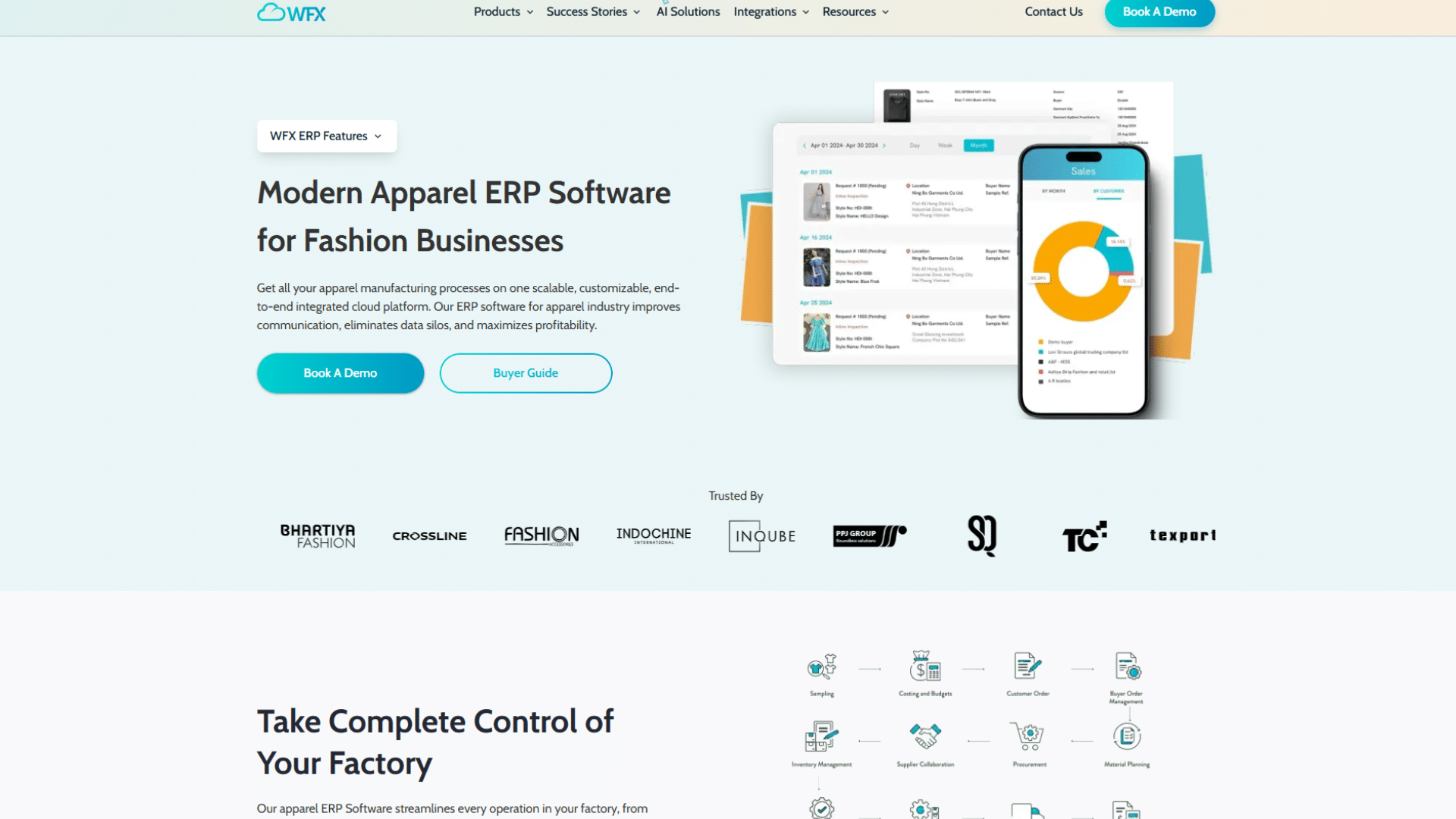
Category: cloud ERP and PLM with production planning and T&A.
Deployment: cloud.
WFX is a fashion-specific platform covering product development, merchandising, materials, production planning, and accounts as integrated modules. In Bangladesh, SQ Group, a maker of sweaters, knitwear, lingerie and shirts, selected WFX Cloud ERP in 2015 and said its existing FastReact planning would integrate with it. WFX’s integrations page also lists FastReactPlan, describing a link that syncs production planning data and connects orders, materials, and the production floor. The two can run as a stack rather than an either-or choice.
Limitation. Breadth means implementations are scoped module by module. Ask how the planning module stores wash routings by style, and whether an outside wash house can be scheduled as a resource with its own capacity.
goRMG ERP (Skylark Soft)
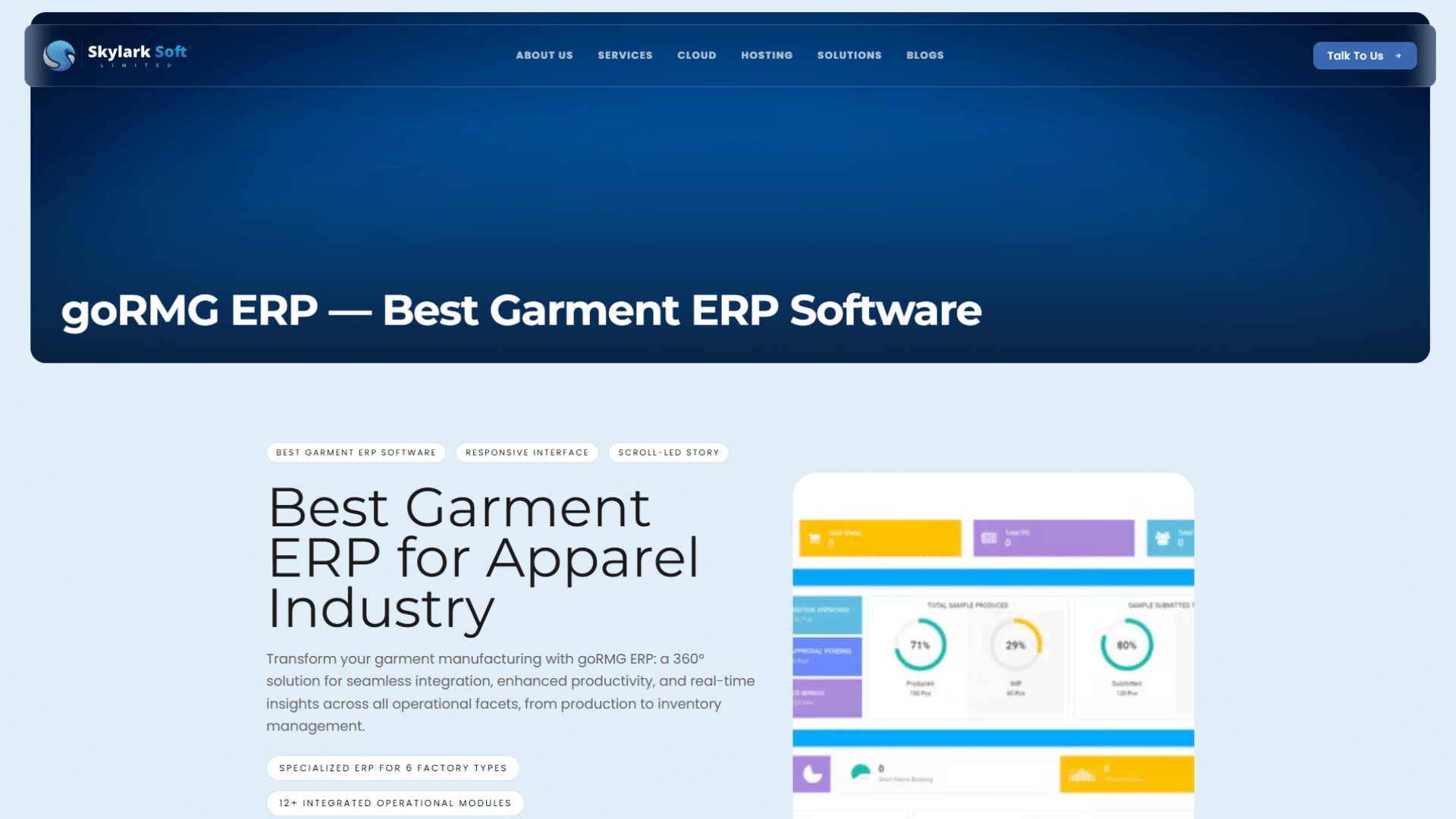
Category: Bangladesh-built apparel ERP.
Deployment: confirm options with the vendor.
Skylark Soft is a Dhaka developer whose goRMG ERP offers tailored modules for six factory types, including woven/denim. The suite covers merchandising and T&A, work study, a sewing plan board, real-time production tracking (PROTRACKER), inventory, and accounts. The vendor reports the system is running in more than 90 factories. Its appeal is a local vendor and one database built around Bangladesh ready-made garment (RMG) workflows.
Limitation. Planning is one module in a broad ERP, and the published material centres on the sewing plan board and tracking. Test whether wash programmes and outside laundries are scheduled with their own capacity or only tracked after the fact.
BlueKaktus
Category: apparel ERP and MES with a line planning module.
Deployment: confirm options with the vendor.
BlueKaktus is an India-developed platform. Its line planning module offers drag-and-drop planning by style, line availability, and shift capacity, line-wise and plant-wise capacity views, planned-versus-actual tracking, and a calendar view aligned with each style’s T&A. The vendor claims a 30% reduction in line idle time and a 25% boost in manpower efficiency.
Limitation. The published material focuses on sewing-line and manpower planning and does not describe wash-stage scheduling. Bangladesh references are also less visible than for vendors with long local histories. Ask for Bangladesh denim customers and a live demonstration of an outside wash house on the plan.
Enterprise ERP suites (SAP S/4HANA for Fashion and Vertical Business, Oracle and similar)
Category: enterprise ERP.
Deployment: cloud or on-premises.
For groups running spinning, fabric and garmenting under one roof, an enterprise ERP holds finance, procurement and style-colour-size inventory across every unit. These systems are the backbone, not the scheduler: detailed line, wash and finishing scheduling usually sits in a connected planning tool. Our Bangladesh cloud planning guide profiles them in more depth.
Limitation. Heavy to configure, and justified mainly at group scale.
Microsoft Excel: the entry point that breaks
Excel earns its place because it is still where most planning starts. It is cheap, flexible, and understood by every planner. It breaks in a predictable way on denim. Once buyers share lines and the wash house slips, nothing recalculates unless someone remembers to change it, and that someone is usually also the person firefighting.
How Do You Choose The Right Production Planning Tool For A Denim Factory?
Choose by the shape of your problem, not the length of a feature list. Four lenses do most of the work.
- Where is the pain sharpest? Missed ex-factory dates, wash-house surprises, planner hours lost to rework, or no group-level view of capacity. Start with the category that fixes that pain first.
- Denim process fit. Can the tool schedule washing as a dependency with its own capacity, routing by style and lead time, including at an outside wash house? Make the vendor show it with one of your own styles, not a demo dataset.
- Bangladesh readiness. Look for local implementation and support, references from Bangladesh denim units, and a straight answer on how the system behaves when power or connectivity drops at a site.
- Industrial engineering (IE) maturity. Dynamic scheduling is only as good as the standard minutes and efficiency data behind it. A unit without reliable SMVs should fix that alongside the planning tool, not after it.
Decision matrix
| Factory profile | Sharpest pain | Recommended starting point |
| Single unit, one or two buyers, in-house wash | Basic visibility of capacity and dates | Disciplined spreadsheet or a lightweight RMG ERP; revisit when buyers multiply |
| Mid-size exporter, several buyers, outside wash house | Buyer contention, wash slippage, falling OTDP | Dedicated PPC such as FastReactPlan, fed by your ERP |
| Multi-unit group with in-house laundries | Allocating orders and laundry capacity across units | Dedicated PPC with master planning, connected to the group ERP |
| Large vertically integrated group | Finance and procurement at scale, plus floor scheduling | Enterprise ERP backbone with a dedicated planning layer |
Larger groups can compare options in our guide to apparel production planning software for large Bangladesh manufacturers.
Six questions to put to every vendor
- Show me a style with a three-step wash programme. Where is the routing held, and what happens to finishing when the wash moves by two days?
- Show me an outside wash house on the plan. How is its capacity entered, and who updates its status?
- Pull one buyer’s order forward by a week. Which other buyers’ orders move, and how am I told?
- How do Eid closures and gas-related capacity cuts go into the plan?
- What does the system need from our ERP, and how often does it sync?
- Who supports us locally, and can we speak to a Bangladesh denim reference?
When you do not need this yet
A single-buyer unit with an in-house wash and a handful of styles can run disciplined spreadsheets for longer than most vendors will admit. The trigger is not headcount. It is several buyers sharing lines plus a wash stage, especially an outside one. When a planner starts keeping a second spreadsheet just to chase the wash house, the trigger has arrived.
What Does Implementation Involve, And What Will Software Not Fix?
A planning tool changes what the team can see. It does not change what the team decides. Published Bangladesh timelines are shorter than many owners expect. FCI (BD) implemented FastReactPlan in 3.5 months and was using it effectively within five, and Azim Group finished its project within six months. What separates the fast rollouts from the stalled ones is preparation.
What has to be in place
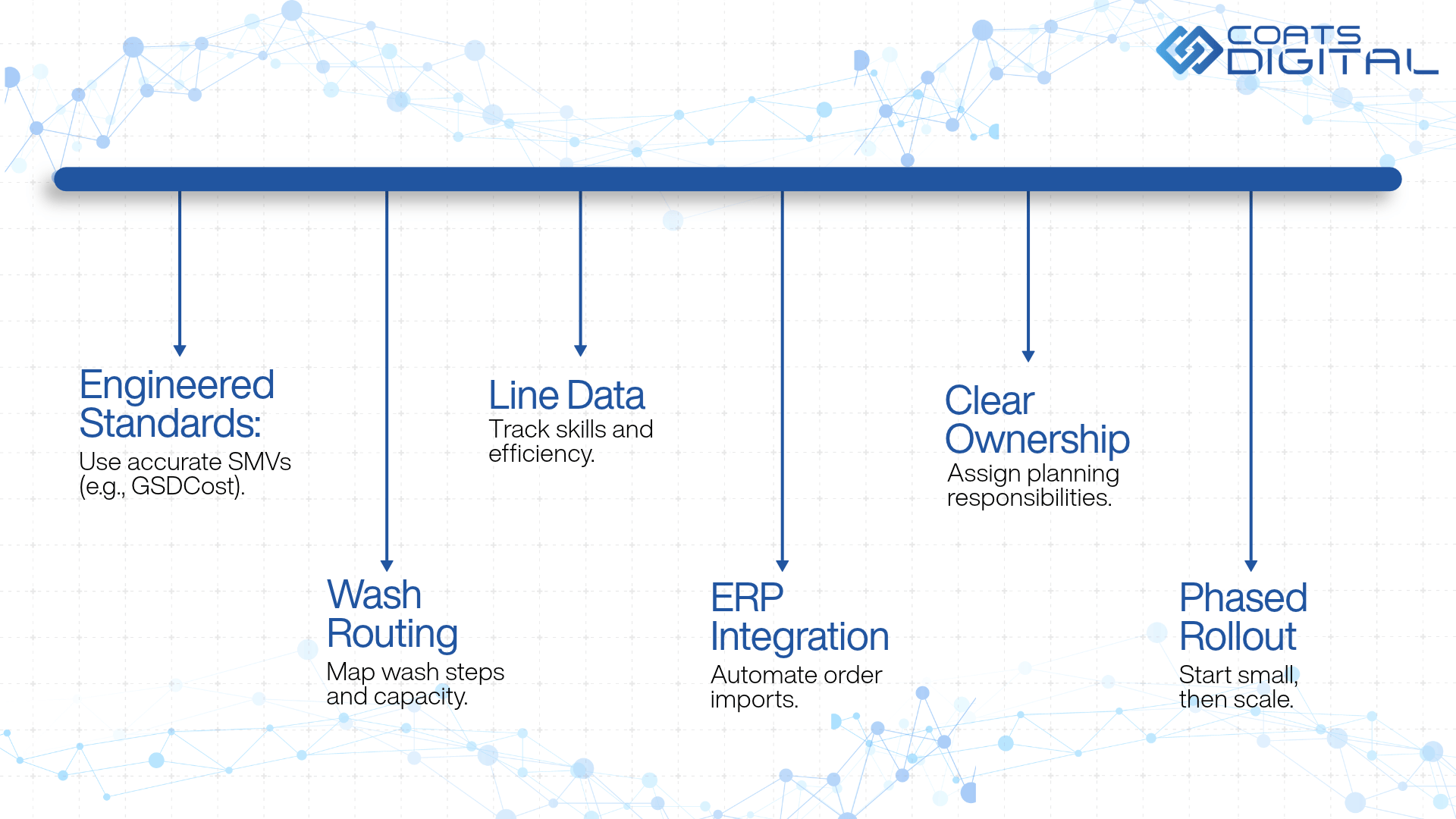
- Engineered standards. SMVs built from a predetermined motion time system rather than supervisors’ estimates. GSDCost is Coats Digital’s tool for this.
- A wash routing library. Every wash programme with its steps, cycle times, and the machines, or outside laundries, that can run it.
- Line data that matches the floor. Skills by product type, learning curves and real efficiency profiles, not a single factory average.
- An ERP feed. Orders and styles flow in automatically, so nobody re-keys them.
- Named owners. The planning head owns the plan, IE owns the standards, IT owns the integration, and merchandising does not promise a date the plan has not checked.
- A phased start. One unit or product family first, then extend once the plan holds.
What the software will not do
It will not decide which buyer gets the last wash slot in a tight week, negotiate with a wash house, or make an outside laundry share its status. It will show a conflict days earlier than a spreadsheet would; resolving it is still a management call. For a fuller account of where rollouts go wrong, see our analysis of why capacity planning software fails in Bangladesh garment factories.
Does Production Planning Software Improve On-Time Delivery?
Yes, when it is used with discipline. The clearest published evidence is on on-time delivery, plan accuracy, and the time planners spend rebuilding the plan. Measure six numbers before you start and again after a full season:
- OTDP: the share of orders shipped on or before the agreed date.
- Performance to plan: actual output against planned output, by line and by day.
- Capacity forecasting accuracy: how closely booked capacity matched what the floor delivered.
- Critical-path (T&A) adherence: the share of pre-production events closed on time.
- Planning time: planner hours per week spent building and revising the plan.
- Avoidable cost: overtime, airfreight, buyer discounts and claims.
What manufacturers have reported
| Customer | Segment and location | Reported result | Source |
| Tusuka | Denim, 67 dedicated lines; Dhaka, Bangladesh | +5% overall efficiency, +9% OTDP, 7% lower absenteeism, reduced overtime | Coats Digital case study |
| Azim Group | Multi-unit group: 13 garment units and four backwards-linkage factories in Bangladesh; project scope covers laundry scheduling at denim subsidiary Global Outerwear | +15% plan-versus-actual efficiency, +7% factory efficiency, order confirmation cut from two days to about 30 minutes, 68% less report-generation time (group-level) | Coats Digital case study |
| Paddock’s Jeans | Jeans, woven jackets and blazers; Dhaka EPZ; in-house washing | +8% performance to plan, +10% OTDP, +13% critical-path (T&A) monitoring, +15% capacity forecasting accuracy | Coats Digital case study |
| Phong Phu International | Denim specialist with 15 sewing units and 9 laundries; Vietnam; laundry planned with the embellishment module | OTDP up from 90% to 96%, around 100 staff hours a week saved | Coats Digital case study |
| FCI (BD) Ltd | Ladies’ garments for M&S, H&M and C&A; Dhaka EPZ; not denim | +15% performance to plan, about 5% higher capacity utilisation and factory efficiency, US$6,000 less airfreight | Coats Digital case study |
| FastReactPlan customer base | Apparel, global | Typical 3 to 10% productivity gain, 10 to 30% OTDP improvement, 10 to 30% lead-time reduction; ROI typically under 12 months | Coats Digital product page |
Read the table with care. Every figure is customer- or vendor-reported; none has been independently audited, and no single factory’s result is an industry average.
- Tusuka and Azim are the closest Bangladesh denim comparisons. Azim’s figures cover the whole group rather than its denim unit alone.
- Paddock’s Jeans washes in-house, so its numbers say nothing specific about outsourced washing.
- Phong Phu is the clearest published example of laundry scheduled on the plan, but it is in Vietnam and runs its own laundries.
- FCI is not a denim maker. It earns its place as a Bangladesh implementation timeline.
- Several case studies are a few years old; Azim Group’s, for example, was published in January 2022.
How to build the case for ownership
Start with what late or unstable delivery already costs, and where to find each number:
| Cost line | Where the number lives |
| Airfreight on rescued shipments | Freight invoices, matched to orders |
| Buyer discounts, claims and chargebacks | Debit notes and commercial correspondence |
| Overtime to recover the plan | Payroll, by line and month |
| Planner and merchandiser hours spent re-planning | A two-week time log |
| Idle lines or wash capacity from poor loading | Line and laundry output records |
Apply a conservative improvement from the bottom of the published ranges and set it against licence, implementation and training costs over three years. If the case only works at the top of the range, it is not a case.
The cost of lateness is not small. During August 2026’s gas shortage, The Business Standard reported exporters spending around US$50,000 extra on airfreight and offering buyers discounts of up to 20 to 25% on late deliveries (The Business Standard). A September survey of 134 member factories by the Bangladesh Knitwear Manufacturers and Exporters Association (BKMEA) found that 87% had missed shipment dates since the gas crisis began on 20 July, and nearly 60% had offered buyers discounts (The Business Standard).
Trade policy adds pressure from another side. Bangladesh is scheduled to graduate from Least Developed Country (LDC) status on 24 November 2026. The government has asked the UN for a three-year extension to 2029, and in July the UN Economic and Social Council referred the request to the General Assembly (BSS). On 19 October, Commerce Minister Khandakar Abdul Muktadir said he expected a decision within the month (BSS). At the time of publication, that decision was still pending. Either way, productivity will have to carry more of the margin over time, and planning is one of the few levers that raises output without adding lines or people.
Six Production Planning Mistakes Denim Factories Make
Use these as a self-check. If three or more sound familiar, the plan is already costing more than a tool would.
- One blended spreadsheet for every buyer: The totals look balanced while one buyer’s order is quietly starved of lines and wash slots. Buyer-level contention only becomes visible when that order is late.
- The outside wash house as a fixed number of days: A buffer in a cell cannot tell you the wash house is two days behind. Plan it as a resource with capacity, a queue, and a status someone updates.
- Running the floor from an ERP’s order-level plan: ERP planning modules are built to allocate orders and materials. Asked to schedule lines, they tend to assume capacity rather than test it, and the gap shows up as overtime.
- Loading without the wash programme: A multi-step wash puts far more work on finishing and packing than a simple rinse. Ignore the programme and finishing collapses on exactly the styles that carry the most work after sewing.
- Managing to one capacity or efficiency average: An average hides the constraint. In denim, the constraint is usually washing, and a healthy line-efficiency figure says nothing about whether the wash slots exist.
- Treating Eid, gas cuts and pull-ins as surprises: The 2025 and 2026 amendments to the Bangladesh Labour Act raised the festival holiday entitlement from 11 to 13 days a year, although EPZ units fall under a separate labour act that was not amended in parallel (Legal 500). Factories concentrate much of that leave around the two Eids. In March 2026, many RMG units announced up to 10 days off for Eid-ul-Fitr by adjusting general holidays and duty schedules (The Financial Express). Shipments bunch up beforehand too: ahead of Eid-ul-Azha in May 2026, the daily flow of export containers through Chattogram’s 21 private off-docks rose from about 7,500 to 11,000, which the off-dock association put down to the pre-Eid rush (BSS). Hold both Eids as calendar exceptions and keep a reduced-capacity scenario for gas-dependent stages such as washing.
Conclusion: Plan The Process, Not The Order
Denim planning in Bangladesh is a multi-process, multi-buyer discipline. It depends on three things:
- Modelling cutting, sewing, the wash (wherever it happens), and finishing as connected dependencies
- Seeing every buyer’s critical path in one place
- Recalculating the moment something moves
No single tool suits every factory. A single-buyer unit can stay with disciplined spreadsheets for a while, and a large group needs an ERP backbone with a planning layer on top. What every multi-buyer denim exporter needs is a plan that treats washing as a live dependency with its own capacity. Get that right, and OTDP, capacity use, and penalty costs tend to improve together, because they were never separate problems.
Where to go next
- See how dedicated production planning and control links capacity, materials and the pre-production critical path.
- Read how Tusuka improved OTDP across 67 denim lines.
- Compare the wider Bangladesh tool landscape before you shortlist.
To see one plan hold cutting, sewing, washing and finishing across every buyer, arrange a FastReactPlan demo using your own styles.
Frequently Asked Questions
-
What is the best production planning software for a denim factory in Bangladesh?
It depends on scale, the number of buyers, and whether washing is in-house or outsourced. For multi-buyer exporters, a dedicated production planning and control tool such as FastReactPlan is the strongest fit, because it schedules laundry and other supporting processes from the sewing plan. Bangladesh-built ERPs such as goRMG suit units that want one local system, and large groups usually pair an enterprise ERP with a dedicated planner.
-
What is the difference between an ERP and production planning software?
An ERP is the system of record for orders, purchasing, inventory, costing, and accounts. Production planning software turns those orders into a schedule, line by line and process by process, and recalculates when anything changes. The ERP knows what was ordered and what it costs; the planning tool decides which line, which wash slot, and which day. Most multi-buyer factories need both, connected.
-
How do you schedule an outsourced wash stage in a production plan?
Treat the outside wash house as a resource, not a buffer. Record its daily capacity by wash programme, its quoted lead time plus transport days each way, and a dated status update. Load it from the sewing plan so the wash schedule moves when sewing does, and keep any buffer visible. FastReactPlan schedules laundry as a bottleneck process from the sewing plan; confirm the outsourced configuration with Coats Digital.
-
Why is washing capacity so hard to plan?
Because washing runs in batches while sewing runs as a flow. Sewing capacity is counted in standard minutes per piece; washing capacity is counted in machine loads and cycle time, which change with garment weight and wash programme. The bottleneck also moves with the order mix, from lasers one week to PP spray the next. Shade re-washes, drying queues and unstable gas pressure add further variability.
-
What is a critical path or T&A calendar in garment production?
A Time and Action (T&A) calendar, or critical path, lists every pre-production event an order needs before production can start on time, such as fabric booking, lab dips, fit and wash approvals, and trims, each with a target date. In a dynamic planning tool, those dates recalculate from the live production plan, and late events are flagged early instead of being discovered on the planned start date.
-
Does FastReactPlan handle denim wash programmes?
Yes. FastReactPlan schedules laundry as a supporting bottleneck process driven by the sewing plan, so the wash schedule moves when sewing moves. An optional embellishment and laundry planning module reschedules connected processes automatically, respecting minimum production runs and lead times. In Bangladesh, the scope of Azim Group’s project covers laundry scheduling at its denim subsidiary. Confirm with Coats Digital how an outsourced wash house would be configured for your set-up.
-
How long does it take to implement production planning software?
Published Bangladesh examples point to months, not years. FCI (BD) implemented FastReactPlan in 3.5 months and was using it effectively within five, and Azim Group completed its project within six months. The real driver is data readiness: engineered SMVs, a wash routing library, accurate line data, and an ERP feed. Starting with one unit shortens the time to a plan people trust.
-
How much OTDP or lead-time improvement is realistic?
Coats Digital reports typical FastReactPlan results of a 10 to 30% OTDP improvement, a 10 to 30% lead-time reduction and a 3 to 10% productivity gain. Bangladesh denim examples sit at or just below the bottom of the OTDP range: Tusuka reported 9% and Paddock’s Jeans 10%. Treat published figures as company-reported and build your business case from the bottom of the range.
-
How should denim factories plan around Eid closures and gas shortages?
Hold both as capacity exceptions, not surprises. Outside the EPZs, workers are now entitled to 13 festival holidays a year, and in March 2026 many factories closed for up to 10 days for Eid-ul-Fitr, so load orders around both Eids months ahead. For gas, keep a reduced-capacity scenario for gas-dependent stages such as washing, so the effect on every buyer’s dates shows up before the shortfall does.
-
Is cloud or on-premise planning software better for a Gazipur or Narayanganj site?
Cloud lowers upfront cost, removes server maintenance, and gives head office and every site the same live plan. On-premise keeps data and access local, which some groups prefer where connectivity is unreliable. The deciding questions are practical: how the software behaves during a power or internet outage, how quickly it resynchronises, and who supports it locally. FastReactPlan is offered as cloud SaaS, with hosted and on-premises options.


Garment Cost Collaboration Software in India: 10 Features to Look For and How to Choose (2026)

Garment Labour Cost, Explained: What a Bill of Labour Is and How It Differs From a Bill of Materials
All Blog Categories
- Production Planning
- Corporate
- Method Time Cost Optimisation
- Supply Chain Solutions
- Sustainability
- Videos
