Garment Cost Collaboration Software in India: 10 Features to Look For and How to Choose (2026)
by Coats Digital
 9
Mins Read
Key Takeaways
- Garment cost collaboration software gives exporters, buying houses and brands one shared, version-controlled cost sheet to build, question and agree, instead of emailing spreadsheets.
- Judge tools on features, not category labels. Version control, a method-based labour line, controlled disclosure and job-work process costing matter most.
- The labour line is often the hardest to defend. Building it from Standard Minute Values lets both sides check cut-make cost operation by operation.
- In Tiruppur, most of roughly 20,000 units handle one production stage, so one knitwear cost sheet can carry rates from several separate businesses.
- Keep exchange rate, commission and export incentives on separate lines. RoSCTL currently runs only to 31 December 2026, so 2027 shipments carry incentive risk.
- No single tool type covers all ten features. Pairing a PLM, ERP or spreadsheet cost sheet with a method-time-cost tool closes most gaps.
- Pilot with one buyer and one product family. Agree the template, costing basis and disclosure depth in writing before extending to other buyers.
Version seven of the cost sheet lands on a Thursday evening. The buying house has changed the fabric price, the brand wants the cut-make (CM) figure down by three rupees, and the dyeing unit raised its rate last week. Nobody is sure which version the buyer approved, and the labour line has been entered three different ways.
That is the problem garment cost collaboration software is meant to solve. For Indian export houses, the stakes are high. In September 2025, Tiruppur exporters told the Hindustan Times they work on margins of 5 to 8 per cent (Business & Human Rights Resource Centre). On margins that thin, one unnoticed change in a cost sheet can turn a profitable order into a loss.
This guide explains what cost collaboration software does, the ten features that matter most for Indian exporters, buying houses and brand sourcing offices, which types of tools deliver them, and how to choose for your role.
Quick answer: Garment cost collaboration software gives a buyer and a supplier one shared, version-controlled cost sheet that both can see, question and agree. For Indian garment exports, prioritise version control, a labour line built from Standard Minute Values, like-for-like vendor requests, job-work process costing, and dated fields for currency, commission and export incentives.
What Is Garment Cost Collaboration Software?
Garment cost collaboration software is a shared workspace where the parties to an order build, submit, review and agree on a garment’s cost. It replaces the usual mix of spreadsheets, email attachments and messaging-app photos of cost sheets with one structured record that keeps its history.
In Indian sourcing, four groups typically use it:
- Export houses, which build the cost and defend it to buyers.
- Buying houses and sourcing agents, which compare vendors and pass costs between factory and brand.
- Brands’ India sourcing offices, which need to check whether a quote is fair.
- Sub-contractors and job workers, indirectly, because their rates feed the exporter’s sheet.
How is cost collaboration software different from costing software and PLM?
The three overlap, but they solve different problems:
- Costing software calculates what a garment should cost. Method-time-cost tools, for example, build the labour cost from Standard Minute Values (SMVs).
- Product Lifecycle Management (PLM) software manages product data: specifications, Bills of Materials (BOMs), samples and approvals. Most PLMs include a cost sheet.
- Cost collaboration governs how a cost is shared, questioned, revised and agreed between companies.
The strongest set-ups combine the first and third: a calculated cost that both sides can see and challenge. If you want a ranked list of costing tools for factories, see our guide to the best garment costing software for factories in India. For how brands decide which layer of the cost stack they are missing, see Brand-to-Vendor Cost Collaboration. This guide focuses on the collaboration features themselves, from the Indian supply side.
Why Does Cost Collaboration Break Down In Indian Garment Exports?
Indian export costing has four features that make spreadsheets fail faster than they do elsewhere.
Cost sheets are multi-tier: Tiruppur has around 20,000 units, and most specialise in a single production stage, according to Tiruppur Exporters’ Association figures (Upstox, September 2026). The cluster has about 2,500 knitting units, 360 dyeing units, 400 printing units, and 790 compacting and calendering units hired by the piece. An exporter can take a large order by outsourcing these stages locally, so one knitwear cost sheet may carry rates from five or six separate businesses, each of which can change independently.
Intermediaries re-key the numbers: Many orders pass through buying houses or agents, which add a commission and often rebuild the cost sheet in their own format. Every re-keying step is a chance for a figure to drift.
Currency and incentive assumptions hide inside the price: Costs are incurred in rupees while quotes go out in US dollars or euros, so every quote rests on an exchange-rate assumption. Exporters also factor in export benefits such as the Rebate of State and Central Taxes and Levies (RoSCTL). At the end of September 2026, the Ministry of Textiles extended RoSCTL for apparel, garments and made-ups by only three months, to 31 December 2026, at existing rates (KNN India, October 2026). A quote for a 2027 shipment therefore assumes the scheme will be renewed. If that assumption or the exchange rate changes, the margin disappears without any line on the sheet showing why.
Revisions are constant, and so is price pressure: A cost sheet changes at proto, fit, pre-production and bulk. Buyers also push duty costs upstream: in 2025, some US buyers asked Tiruppur exporters to absorb part of a tariff increase or face cancelled orders, according to the same Hindustan Times report. Since late July 2026, Indian goods, including textiles and apparel, have carried a 10 per cent US tariff imposed after Section 301 investigations into forced-labour enforcement. The Confederation of Indian Textile Industry (CITI) warned that competitors such as Bangladesh and Cambodia may be allowed to ship some apparel free of that tariff under tariff-rate quotas, which could divert orders from India (Knitting Views, July 2026). Every pressure point produces another version of the sheet.
10 Features To Look For In Garment Cost Collaboration Software
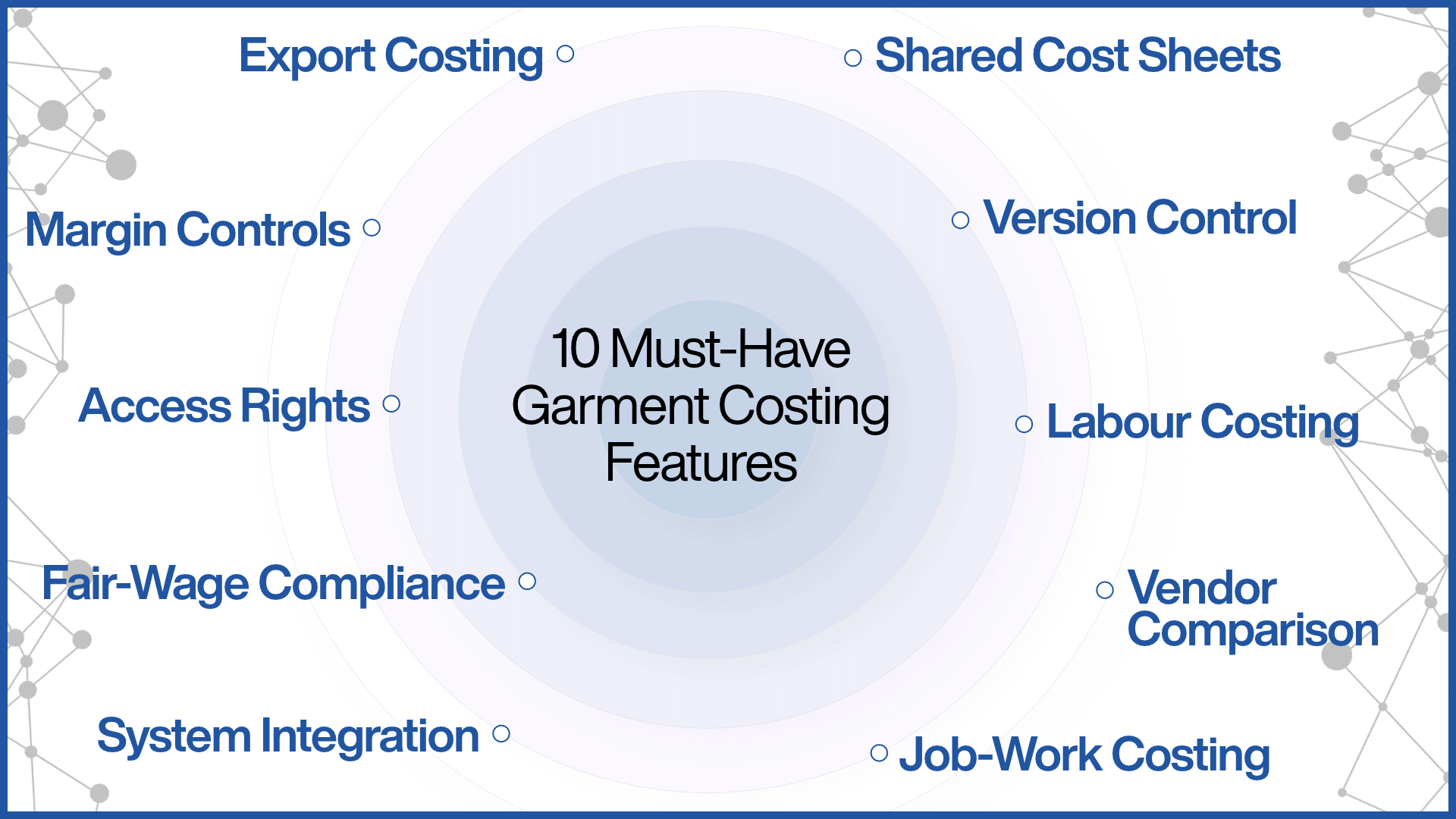
Use these ten features as a demo checklist. For each one, ask the vendor to show it working on one of your own styles, not on a sample dataset.
1. A structured, shared cost sheet
Every party should work from the same structure: fabric (with consumption and wastage), trims, outsourced processes, CM, overheads, commercial costs and margin. Templates by product category and by buyer save time, but the underlying structure must stay comparable.
The sheet should also label its basis clearly. CM, cut-make-trim (CMT), fully factored (FF) and Free On Board (FOB) figures cover different scopes of cost. FOB, for example, is the full ex-factory price, including fabric, trims, overheads and margin. Comparing a figure on one basis against a figure on another is a common and expensive mistake.
Ask in the demo: “Can we set a template for each buyer without losing comparability across buyers?”
2. Version control and an audit trail
The tool should record every change by line, user, date and reason, from proto through fit, pre-production and bulk. The version a buyer approved should be locked, so later edits create a new version rather than overwriting the agreed one.
This matters most when an order is disputed months later. A clean history shows exactly when fabric moved, when the efficiency assumption changed, and who agreed to it.
Ask in the demo: “Show me what changed between version 3 and version 7, line by line.”
3. A method-based labour line
This feature does more than any other to make a cost defensible. In most cost sheets, the labour figure is typed in: a rate, last season’s number or the vendor’s quote. A method-based labour line is built from the work itself, using a predetermined motion time system to produce a Standard Minute Value. Coats Digital’s GSDCost, for example, uses 39 predetermined motion codes, each with an international standard time (Coats Digital).
Good tools keep the three drivers of labour cost as separate, visible fields:
CM labour cost per piece = (SMV ÷ line efficiency) × cost per minute
When SMV, efficiency and cost per minute are blended into one number, nobody can see which one moved. For the SMV calculation itself, see our guide to calculating accurate SMV in Indian garment factories.
Ask in the demo: “Where does the SMV on this sheet come from, and can the buyer see the operation breakdown?”
4. Like-for-like multi-vendor requests
Buying houses and brand sourcing teams often ask several factories to quote the same style. That comparison only works if every factory quotes against the same specification and the same labour basis.
Look for the ability to issue one request, with one construction method or Bill of Labour, to several vendors at once and compare the responses side by side. A Bill of Labour is the list of operations needed to make a style, each with its standard minutes. GSDCost, for instance, added functionality in 2024 that lets brands send a standardised Bill of Labour request to multiple vendors and compare the CM responses on one platform (Coats Digital via Just Style).
Ask in the demo: “Can every vendor quote against the same Bill of Labour and allowance basis?”
5. Multi-tier process and job-work costing
For cluster-based production, each outsourced process should be its own line, with the job worker’s name, the rate basis (per kilogram, per piece or per metre) and a validity date. When a dyeing or printing rate changes, the tool should show every open style that uses it.
Spreadsheets struggle here because the same rate is copied into dozens of files. A shared rate library, linked to every cost sheet that uses it, removes that risk.
Ask in the demo: “If one dyeing rate changes, can we see every affected style and quote?”
6. Separate fields for currency, export incentives and commission
A cost sheet for an Indian exporter needs explicit fields for:
- The exchange rate assumed, with the date it was set.
- Export benefits, such as RoSCTL, RoDTEP or duty drawback, shown as separate lines with their validity dates rather than netted silently into the price.
- Buying-house or agent commission, as its own line.
- Payment terms and delivery basis, because they change the real value of the same price.
When these are separate, a change in any one of them can be traced to the quotes it affects. Validity dates matter more than usual right now, because the current RoSCTL extension runs only to 31 December 2026.
Illustrative example: An exporter quotes a knit polo at USD 4.00 FOB with a 6 per cent margin, about 24 cents a piece. If the price quietly assumes an export rebate worth 1.5 per cent of FOB, or 6 cents, and that rebate is not available when the order ships, a quarter of the margin disappears. A separate, dated incentive line shows that exposure before the order is confirmed.
Ask in the demo: “If the exchange rate or an incentive rate changes, which open quotes are affected?”
7. Margin guardrails and what-if scenarios
The tool should flag any style that falls below an agreed minimum margin. It should also let you model scenarios before you commit: a smaller order quantity, a fabric price rise, or a drop in line efficiency.
For a factory on single-digit margins, the efficiency scenario is the one to test. A few points of efficiency often matter more than a small change in the fabric price.
Ask in the demo: “Show me the margin on this style if line efficiency falls by five points.”
8. Controlled disclosure and access rights
Open costing, where the CM price is broken into minutes, efficiency, cost per minute and allowances, builds trust between buyer and supplier. But disclosure has to be controlled. A buyer may see the CM structure without seeing internal overhead rates, and a job worker should see only its own lines.
Good tools let each party set what others can see. This is what makes factories willing to open their costs at all. GSDCost, for example, supports CMT, fully factored and open-costing structures within its Bill of Labour process (Coats Digital).
Ask in the demo: “Can we choose which lines each party sees, style by style?”
9. Compliance and fair-wage evidence
Buyer audits increasingly ask how a CM price relates to what operators are paid. A tool that links standard minutes, factory efficiency, contracted hours and the agreed wage rate can show the wage allowance for each order. Coats Digital’s Fair Wage Tool within GSDCost works this way and benchmarks the result against international fair-wage standards.
This turns a compliance question into a costing question with one set of numbers. Our guide to tracking supplier labour costs for ESG compliance covers the brand-side view.
Ask in the demo: “Can you show a buyer how this CM covers the agreed wage?”
10. Integration and spreadsheet-friendly import and export
Most Indian MSMEs run costing in Excel, and many buyers still ask for their own spreadsheet format. A useful tool imports existing cost sheets, exports in each buyer’s format, and passes agreed figures to other systems.
The most valuable connection is often to production planning. The SMVs agreed in costing should be the ones used for capacity and line balancing, for example in a planning tool such as FastReactPlan. Integration options vary by product and change over time, so confirm them in a demo.
Ask in the demo: “How do the SMVs we agree with the buyer reach our capacity plan?”
Why The Labour Line Deserves The Most Scrutiny: A Worked Example
Every figure in this example is illustrative, chosen to show the mechanics. None of it is market data.
A buying house asks three Tiruppur units to quote CM for a piqué knit polo. Each unit builds its CM from its own SMV, cost per minute and line efficiency. The buying house then re-costs all three against one agreed Bill of Labour, which sets the SMV at 14.0 minutes.
| Unit | Quoted SMV (min) | Cost per minute (INR) | Line efficiency | Quoted CM (INR) | CM at agreed 14.0 SMV (INR) |
| A | 11.5 | 4.60 | 55% | ~96 | ~117 |
| B | 14.0 | 5.20 | 72% | ~101 | ~101 |
| C | 15.5 | 5.00 | 68% | ~114 | ~103 |
On a spreadsheet that holds only the final CM, Unit A wins by about INR 5 a piece. Against the agreed standard, it becomes the most expensive quote. Its low price came from an understated SMV, which hid the least efficient line of the three. Unit C made the opposite error: it padded its minutes, so a fair standard brings it close to Unit B.
Once the minutes are agreed, the conversation moves from price to efficiency. Unit A’s 55 per cent line is also a delivery risk, which a lump-sum quote would never reveal. A tool with a method-based labour line (feature 3) and like-for-like requests (feature 4) shows all of this before the order is placed, not after the first production week.
Which Types Of Tool Deliver These Features?
No single category of software covers all ten features well. The table below shows typical coverage by tool type. It reflects our assessment of each category; individual products vary, so test the features that matter most to you.
| Feature | Structured spreadsheets | PLM or ERP costing module | Sourcing or RFQ portal | Method-time-cost tool |
| 1. Structured, shared cost sheet | Partial | Strong | Partial | Labour-focused |
| 2. Version control and audit trail | Limited | Strong | Partial | Strong for labour analyses |
| 3. Method-based labour line | Limited | Limited (typed input) | Limited | Strong |
| 4. Like-for-like multi-vendor requests | Limited | Partial | Strong | Strong |
| 5. Multi-tier process costing | Partial | Partial to strong | Limited | Limited |
| 6. Currency, incentive and commercial terms | Partial | Strong | Partial | Limited |
| 7. Margin guardrails and scenarios | Limited | Strong | Limited | Partial (design what-ifs) |
| 8. Controlled disclosure | Limited | Partial | Partial | Partial |
| 9. Fair-wage evidence | Limited | Limited | Limited | Strong |
| 10. Integration and spreadsheet export | Strong | Strong | Partial | Partial |
The pattern is clear. PLM and ERP costing modules handle structure, versions, commercial terms and margins well. Method-time-cost tools handle the labour line, like-for-like vendor requests and wage evidence. That is why pairing the two usually gives the widest coverage.
Where specific tools fit
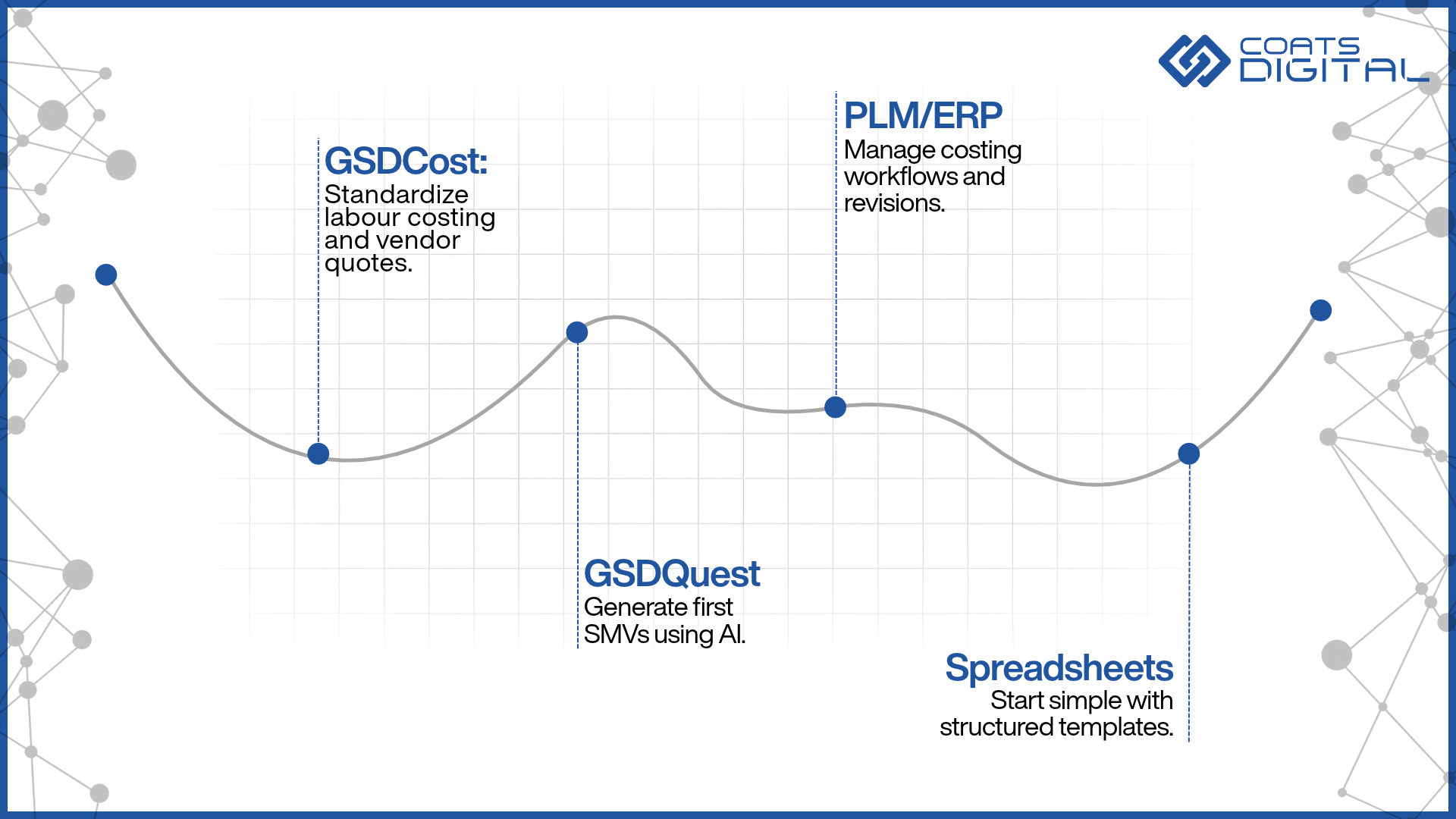
- For a defensible labour line and like-for-like vendor requests: GSDCost. A method-time-cost standard built on General Sewing Data (GSD), used by brands and manufacturers to pre-agree target minutes, factory efficiency and cost per minute before negotiating price. It also includes the Fair Wage Tool.
- For a fast first SMV without a full industrial engineering team: GSDQuest. An AI enhancement to GSDCost, launched in August 2025, that generates a standardised Bill of Labour from garment images, PDFs or tech packs (Just Style, August 2025). Coats Digital designed it to be usable by people who are not certified GSD practitioners. It works as part of GSDCost rather than as a standalone tool, and a trained reviewer should still check high-minute operations on new constructions.
- For workflow, versions and commercial terms: your PLM or ERP costing module. If you already run one, judge it on features 1, 2, 6 and 7, and on how cleanly it accepts a method-based labour figure from another system.
- For small units starting out: structured spreadsheet templates. They are a reasonable first step if you lock the structure, keep SMV, efficiency and cost per minute in separate columns, and plan to move once version control becomes a problem.
For a wider comparison of SMV tools, see Top SMV (SAM) Management Software for Indian Garment MSMEs.
How To Choose The Right Cost Collaboration Tool For Your Role
The right tool depends on where you sit in the order. Start from your role, then shortlist on the features that solve your main problem.
| Your role | Main collaboration problem | Features to prioritise | Typical set-up |
| Export house (knits or wovens) | Defending CM; job-work rates that keep moving | 3, 5, 2, 9 | Method-time-cost tool alongside an ERP or structured cost sheet |
| Buying house or sourcing agent | Comparing vendors fairly; re-keying sheets | 4, 2, 8, 6 | PLM or sourcing platform, with a method-based labour benchmark |
| Brand sourcing office in India | Checking whether a CM quote is fair; audit evidence | 3, 4, 9, 7 | PLM costing module alongside a method-time-cost tool |
| Small unit or MSME | Spreadsheet chaos; no industrial engineering team | 1, 2, 3, 10 | Structured templates plus AI-generated first SMVs |
Before booking demos, answer three questions:
- Which line causes most of your disputes? If it is labour, prioritise feature 3. If it is commercial terms or fabric, prioritise features 5 and 6.
- Who needs to see what? List every party, from job worker to brand, and the lines each should see. This defines feature 8.
- What must the tool connect to? Name the systems that hold your BOMs, orders and capacity plan, and ask how agreed figures will reach them.
Cluster matters too. Tiruppur knitwear exporters tend to feel features 5 and 3 most, because outsourced processes and labour drive their costs. Woven garments usually carry far more sewing work: as a rough guide, a basic woven shirt needs around 12 to 25 standard minutes, against roughly 4 to 9 for a basic knit T-shirt (Coats Digital SMV guide). For woven exporters in hubs such as Bengaluru and the National Capital Region, that makes the method-based labour line even more important.
How To Roll Out Cost Collaboration Without Disrupting Live Orders
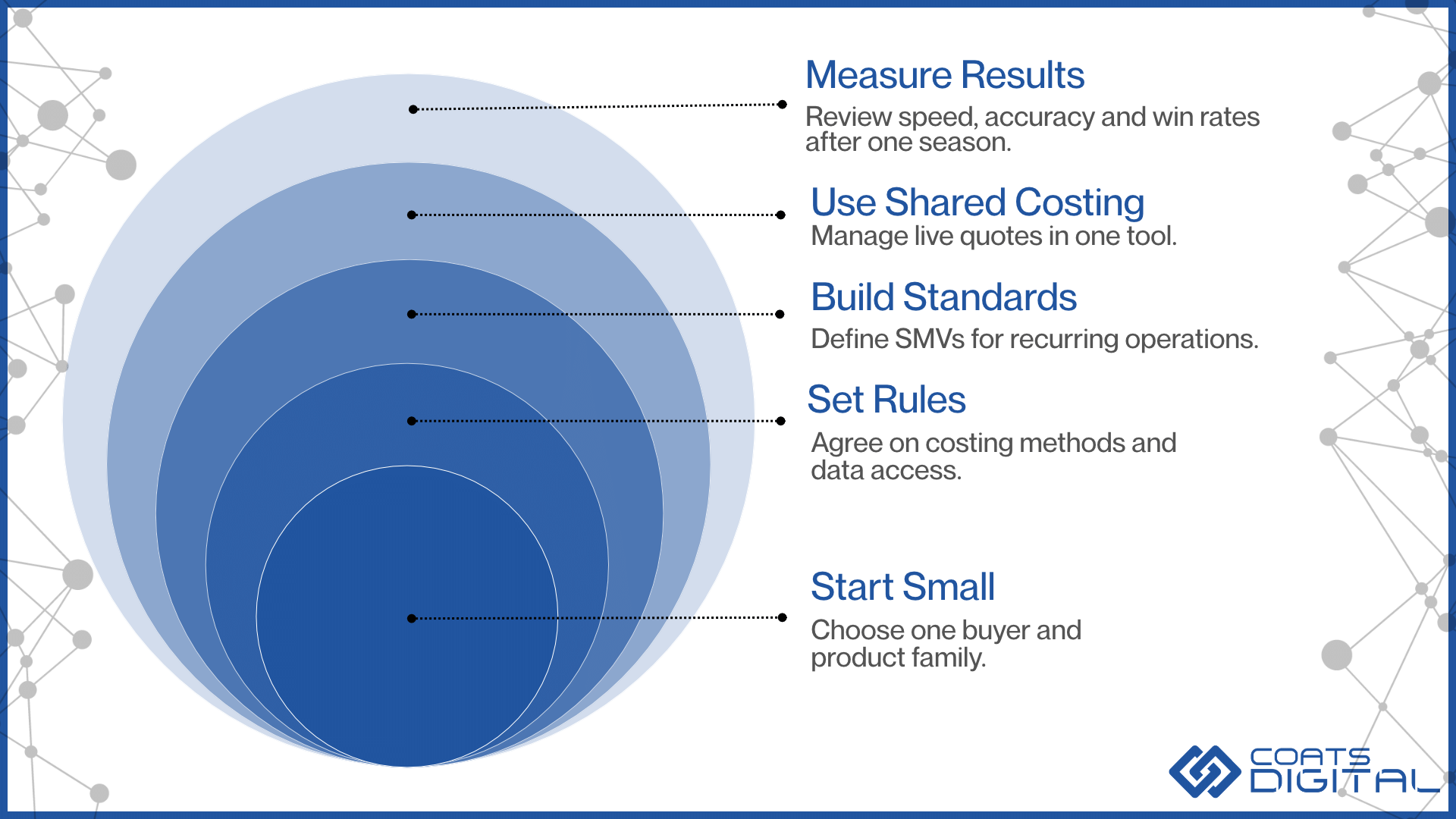
- Start with one buyer and one product family. Choose a buyer willing to cost openly and a high-volume style family, such as knit polos or basic woven shirts.
- Agree the rules in writing. Fix the cost sheet template, the CM, CMT or FOB basis, the allowance basis for SMVs, and how much each party will see.
- Build the labour standard. Create SMVs for the recurring operations in that family, using a method-time-cost tool or AI-generated first drafts reviewed by a trained engineer.
- Move live quotes into the tool. Run new quotes for that family through the shared sheet, and keep spreadsheet export for buyers who still need it.
- Review after one season, then extend. Compare quote turnaround time, revision count, the gap between estimated and actual cost, and CM win rate against your old baseline.
A shared standard also changes how teams inside the factory work. China-based manufacturer Shanghai Jiale reported cutting the SMV of its core styles from 15.9 to 11.28 minutes after implementing GSDCost. It also said its sales, costing and planning teams now work from the same method language (Coats Digital). These are vendor-reported results, and outcomes depend on starting methods and implementation discipline.
Common mistakes to avoid
- Buying for workflow when the dispute is labour. A tidier cost sheet still holds a disputed minute value.
- Opening costs without agreeing disclosure rules. Factories pull back quickly if internal rates reach the wrong party.
- Agreeing minutes but not allowances. Two parties using the same method with different allowances still reach different numbers.
- Netting incentives and commission into the price. When schemes or commission rates change, nobody can see which quotes are exposed.
- Skipping training. Merchandising, costing and industrial engineering teams need the same vocabulary, or the standard erodes within a season.
Where To Start
Garment cost collaboration software is only as useful as the features you choose it for. For most Indian exporters and buying houses, the priority list is short. Start with a version-controlled shared sheet, a labour line built from Standard Minute Values and like-for-like vendor requests. Then add clear, dated fields for job-work rates, currency, commission and incentives.
Use the ten features as your demo checklist, shortlist by your role, and pilot with one buyer before rolling out. If the labour line is where your negotiations stall, GSDCost and GSDQuest are built for that job and work alongside the PLM, ERP or spreadsheets you already use. You can arrange a demo and test them on one of your own styles.
Frequently Asked Questions
-
What is garment cost collaboration software?
Garment cost collaboration software is a shared workspace where exporters, buying houses and brands build, submit, review and agree a garment’s cost. It replaces spreadsheets and email attachments with one structured, version-controlled cost sheet. The better tools also link the labour line to Standard Minute Values, so each party can see how the cut-make figure was built.
-
How is cost collaboration software different from garment costing software?
Garment costing software calculates what a garment should cost, for example by building labour cost from Standard Minute Values. Cost collaboration software governs how that cost is shared, questioned, revised and agreed between companies. Many teams need both: a calculated cost and a controlled way to share it. Some tools, such as GSDCost, cover parts of each.
-
What features should garment cost collaboration software have?
Look for a structured shared cost sheet, line-level version control, a method-based labour line, like-for-like multi-vendor requests, job-work process costing, and separate fields for currency, export incentives and commission. Margin alerts, controlled disclosure, fair-wage evidence and spreadsheet-friendly import and export complete the list for Indian exporters and buying houses.
-
Do buying houses need cost collaboration software?
Usually, yes. Buying houses compare several vendors on the same style and pass costs between factory and brand, often re-keying sheets in the process. Software that issues one specification to every vendor, keeps a version history and controls what each party sees reduces errors. A method-based labour benchmark also helps a buying house judge whether a CM quote is fair.
-
How should export incentives such as RoSCTL appear in a garment cost sheet?
Show them as separate, dated lines rather than netting them into the price. RoSCTL, for example, was extended in late September 2026 for only three months, to 31 December 2026, at existing rates. Because scheme rates and validity can change at short notice, a separate line shows which open quotes depend on a benefit, so you can recalculate them quickly if the scheme lapses or changes.
-
Is open costing safe for Indian exporters?
Open costing can be safe when disclosure is controlled. Exporters can share the CM structure, such as minutes, efficiency and cost per minute, without revealing internal overhead rates or other buyers’ prices. Agree in writing what each party will see before sharing, and use a tool that lets you set visibility line by line.
-
Can a small garment factory start without replacing Excel?
Yes. A small unit can start with a locked spreadsheet template that keeps SMV, efficiency and cost per minute in separate columns. AI-assisted tools such as GSDQuest, an enhancement to GSDCost, can generate first Bills of Labour without a full industrial engineering team. Move to dedicated software once version control, multiple buyers or job-work rates make spreadsheets error-prone.
-
How do Standard Minute Values fit into cost collaboration?
The SMV is the labour minute content of a garment, built from a predetermined motion time system. In cost collaboration, it gives the buyer and supplier a shared, checkable basis for the labour line. Combined with line efficiency and cost per minute, it produces a CM figure both sides can examine operation by operation.
-
Can cost collaboration software work with my PLM or ERP?
Usually, yes, though the route varies. Many teams keep their PLM or ERP as the system of record for BOMs and orders and use a method-time-cost tool for the labour line. The agreed SMV and labour cost then become an input to the main cost sheet. Confirm import, export and API options during vendor demos.
Garment Cost Collaboration Software in India: 10 Features to Look For and How to Choose (2026)
Garment Labour Cost, Explained: What a Bill of Labour Is and How It Differs From a Bill of Materials
All Blog Categories
- Production Planning
- Corporate
- Method Time Cost Optimisation
- Supply Chain Solutions
- Sustainability
- Videos
