Garment Labour Cost, Explained: What a Bill of Labour Is and How It Differs From a Bill of Materials
by Coats Digital
 9
Mins Read
Key Takeaways
- Garment labour cost comes from a Bill of Labour, which prices every operation; a Bill of Materials prices the components.
- Labour cost per garment = Standard Minute Value (SMV) ÷ line efficiency × cost per minute. Agree all three inputs with the factory.
- Many brands cost materials to the cent but accept the factory’s labour line as a single, unexplained number.
- GSDCost builds a Bill of Labour from 39 predetermined motion codes, so the same method gives the same minutes in any factory.
- Direct labour from the Bill of Labour sits inside cost-to-make (CM or CMT), which sits inside FOB, then landed cost.
- Predetermined times, and now GSDQuest’s image analysis, let brands cost labour before cutting a sample, while construction can still change.
- Bill of Labour costing covers footwear and accessories too, and a documented labour number supports US fair-wage and forced-labour due diligence.
You can price every button on a garment to four decimal places and still not know what it costs to make.
It usually goes like this. A product developer builds the Bill of Materials line by line: fabric, rib, tape, thread, labels, packaging. Then the factory quote arrives with one more line, “CMT $4.20”. The garment labour cost inside that figure is accepted as a single number that nobody on the brand side can take apart.
The material half is engineered. The labour half is taken on trust. Coats Digital calls the document that closes this gap a Bill of Labour: an operation-by-operation breakdown of the work, priced from standard times.
The problem is not new. Fair Wear Foundation’s costing guidance notes that until labour is isolated in the product price, suppliers find it hard to argue for changes in labour cost and even harder to quantify them. What has changed is the stakes for US brands. Forced-labour risk rose from tenth to sixth among executives’ top business challenges in the 2026 USFIA Fashion Industry Benchmarking Study. In California, a brand can be held jointly liable for unpaid wages at its contractors. A labour number you cannot explain is now a compliance risk as well as a margin risk.
Bill Of Labour Vs Bill Of Materials: What Is The Difference?
A Bill of Materials (BoM) lists every physical component in a product, with the quantity and cost of each line. A Bill of Labour (BoL) lists every operation needed to make the product, priced from the standard time each operation takes. The BoM gives you material cost. The BoL gives you labour cost. You need both to reach a true cost-to-make.
| Bill of Materials (BoM) | Bill of Labour (BoL) | |
| Question it answers | What is the product made of? | What work does it take to make? |
| Line items | Fabric, lining, trims, thread, labels, packaging | Cutting, sewing, pressing, finishing and packing operations |
| Unit of each line | Consumption × unit price | Standard Minute Value (SMV), in minutes |
| Basis | Supplier prices and consumption | A Method Standard built from standard motion codes and predetermined times |
| Usually prepared by | Designer or product developer, in the tech pack or PLM | Industrial or costing engineer, or generated with costing software |
| Rolls up to | Material cost per unit | Direct labour cost per unit, the core of the cost-to-make charge |
| Moves with | Fibre, fabric and trim prices | Wage rates, line efficiency and construction method |
Is “Bill of Labour” a standard industry term?
Not in the way Bill of Materials is. Every brand already deals with labour cost, usually as a CM or CMT figure in a factory quote. A Bill of Labour is the itemised, method-built version of that figure. In procurement terms, it is a should-cost model for the labour half.
The name comes from Coats Digital’s software, where it is a working document. GSDCost manages a digital Bill of Labour as part of its costing process, linked to operation libraries. VisionPLM holds a style’s bill of materials and bill of labour side by side in its sourcing module.
Independent guidance uses the same building blocks without the name. Fair Wear’s method, for example, multiplies a factory’s cost per minute by a garment’s standard minutes, adjusted for efficiency.
What Is A Bill Of Materials In Fashion?

A Bill of Materials in fashion is a structured list of every physical component needed to make one unit of a product: fabric, lining, interlining, trims, thread, labels, hardware and packaging. Each line carries a description, consumption, supplier and unit cost. The BoM usually lives in the tech pack or PLM system, which is where the material half of the cost is governed.
Here is the material side of the basic crew-neck T-shirt used in the worked example below. Consumption figures are illustrative. Prices are left out because they vary by supplier and season.
| Component | Description | Consumption per unit (illustrative) |
| Body fabric | 100% cotton single jersey, 180 gsm | 0.22 kg |
| Neck rib | 1×1 rib, cotton/elastane | 0.01 kg |
| Shoulder tape | Cotton twill tape | 0.3 m |
| Thread | Spun polyester | 120 m |
| Labels | Woven main label, printed care label | 2 pieces |
| Packaging | Polybag, hangtag, carton share | 1 set |
Multiply each consumption by its unit price, and you have material cost.
When a BoM goes wrong, the cause is usually familiar. The tech pack changed, and the BoM did not, or a price is weeks out of date. These are known problems with known fixes. The labour half has a different blind spot: often nobody checks it at all.
What Is A Bill Of Labour In Garment Costing?
A Bill of Labour is an itemised breakdown of every operation required to make a product. For each operation, it records the standard time, known as the Standard Minute Value (SMV), and the labour cost that time represents. Where a Bill of Materials prices the components, a Bill of Labour prices the work.
A typical line shows the operation, the machine or workstation, and the SMV. The lines add up to the product’s total SMV, which is then converted into cost.
Where do the minutes come from?
The minutes come from the product’s Method Standard: a step-by-step description of how each operation is performed. In GSDCost, every step is coded with one of 39 predetermined motion codes, such as reaching, grasping or positioning. Each code carries an internationally established time value. Motion times add up to an SMV for each operation, and operations add up to the product’s SMV.
The benefit is consistency. A stopwatch study depends on who holds the watch and how they rate the operator’s pace. Predetermined times do not, so the same method should return the same minutes in any factory.
The difference shows up in practice. Suzhou Tianyuan Garments, which makes sportswear for brands including Adidas, reports that its SMVs varied by up to 30% between its own lines when they were based on engineers’ experience. After standardising on GSDCost, the company reports 98% SMV calculation accuracy.
SMV vs SAM: what is the difference?
In many factories, there is none. Standard Minute Value (SMV) and Standard Allowed Minutes (SAM) are often used interchangeably. Prabir Jana, writing in Apparel Resources, notes that American texts tend to say SAM while European ones say SMV, which is why US brands often hear both.
Where a distinction is drawn, SAM is SMV plus allowances. Fair Wear’s guidance, for example, defines SAM as SMV with bundle, machine and personal allowances added.
The practical rule: when a factory quotes minutes, ask which allowances are already inside the number. Comparing one vendor’s SMV with another vendor’s SAM can hide a real gap or invent one.
Can a Bill of Labour be built before a sample is made?
Yes. Predetermined times describe a method, not a measured operator, so the minutes can be calculated from a sketch or tech pack. GSDCost’s Create for Value functionality is built for this. Design and development teams can cost construction variations and compare seam types, trims or features before a sample is cut, while the design can still change.
How To Calculate Garment Labour Cost
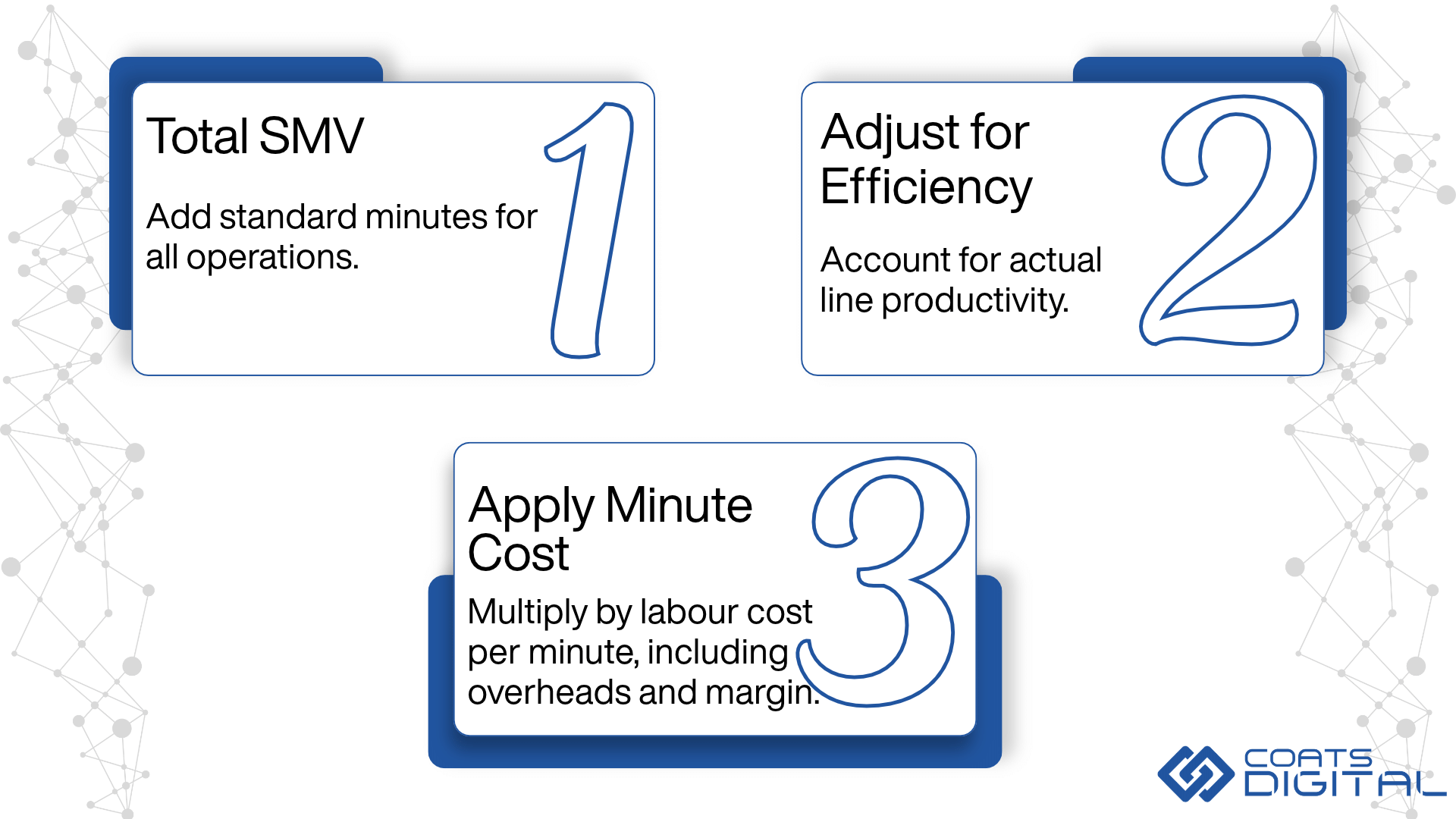
Garment labour cost is calculated in three steps: total the SMVs of every operation, divide by line efficiency to get paid minutes, then multiply by the factory’s cost per minute.
Labour cost per garment = (SMV ÷ line efficiency) × cost per minute
- Total the SMVs Add the standard minutes for every operation in the Bill of Labour. Check whether cutting and packing are included, because many factories count only sewing minutes as direct labour.
- Divide by line efficiency. Efficiency converts standard minutes into the minutes a real line pays for. A line running at 60% efficiency needs 10 paid minutes to produce 6 standard minutes of work.
- Multiply by cost per minute. This is the factory’s cost of one working minute: wages and on-costs, usually with overhead added. Some quotes also include margin, so confirm what the rate covers.
Worked example: a basic crew-neck T-shirt
The operation times below are illustrative teaching figures, not GSDCost outputs or market benchmarks. Real values come from a Method Standard for your exact construction.
| Operation | Typical machine | SMV (minutes, illustrative) |
| Cut and bundle (share per garment) | Cutting room | 0.50 |
| Join shoulders with tape | 4-thread overlock | 0.40 |
| Attach neck rib | Overlock | 0.50 |
| Top-stitch neck and back-neck tape | Coverstitch | 0.50 |
| Attach main and care labels | Single-needle lockstitch | 0.20 |
| Set sleeves | Overlock | 0.80 |
| Close side seams and underarms | Overlock | 0.90 |
| Hem sleeves | Coverstitch | 0.60 |
| Hem body | Coverstitch | 0.40 |
| Trim threads and inspect | Manual | 0.60 |
| Fold and pack | Manual | 0.60 |
| Total garment SMV | 6.00 |
Now run the same tee through two factories with the same efficiency but different costs per minute (illustrative rates):
| Input | Factory A (lower-cost region) | Factory B (higher-cost region) |
| Garment SMV | 6.0 | 6.0 |
| Line efficiency | 60% | 60% |
| Paid minutes per garment | 10.0 | 10.0 |
| Cost per minute | $0.08 | $0.60 |
| Labour cost per garment | $0.80 | $6.00 |
Two lessons follow.
First, efficiency and rate move the result as well as the minutes. If Factory A assumes 50% efficiency instead of 60%, paid minutes rise to 12.0 and labour cost to $0.96. That is 20% more for the same garment at the same wage.
Second, the formula runs backwards. If Factory A quotes $1.20 for labour at $0.08 a minute, it is pricing 15 paid minutes. Either it expects 40% efficiency on a 6.0-minute garment, or its method takes 9.0 minutes at 60%. Both are questions you can now ask.
How To Check If A Factory Labour Quote Is Fair
A labour quote is credible when its minutes, efficiency and cost per minute are each visible and each reasonable. Use these seven checks:
- Ask for the minutes behind the money: Request the SMV or SAM and the operation breakdown, not just the dollar figure.
- Check how the minutes were set: Fair Wear recommends basing agreed minutes on an engineering standard, such as a predetermined motion time system. A stopwatch study or historical average is harder to verify.
- Ask which allowances are included: An SMV and a SAM for the same garment can legitimately differ.
- Test the efficiency assumption: A line starting a new, complex style will not match the efficiency of a long-running basic. The quote should reflect which one this is.
- Confirm the cost per minute and what it covers: It should support at least a lawful wage, ideally your fair-wage target, plus on-costs and overhead.
- Run the quote backwards: Divide the labour figure by the cost per minute to get paid minutes, then compare with your own Bill of Labour.
- Compare minutes across vendors: For the same method, SMVs should be close even when rates differ. A large gap in minutes is the conversation to have.
How Labour Cost Fits Into CM, FOB, and Landed Cost
Material cost and labour cost meet in the factory price. The full stack nests like this:
- Landed cost = FOB price + freight, insurance, duty and inbound handling
- FOB price = material cost + cost-to-make
- Material cost, from the Bill of Materials
- Cost-to-make (CM or CMT) = direct labour + indirect labour + overhead + margin
- Direct labour, from the Bill of Labour
- FOB price = material cost + cost-to-make
CM (cut and make) is the factory’s manufacturing charge when the brand supplies materials. CMT (cut, make and trim) usually means the factory also sources trims. FOB is the price of the finished product loaded at origin, with the factory buying the materials.
Of all these layers, the Bill of Labour is the one a brand can check operation by operation. Our guide to brand-to-vendor cost collaboration looks at how this method layer sits alongside PLM, ERP and landed-cost data.
Why keep the two halves separate?
Material and labour costs move for different reasons. Fabric follows fibre markets and mill capacity. Labour follows wage floors, line efficiency and the construction method. A brand holding a single “CMT $4.20” figure cannot tell which one moved when the quote changes.
Separate, linked documents turn an argument about a total into a discussion of its inputs. In GSDCost, target garment minutes, factory efficiencies and cost per minute can be agreed in advance. Brand-side functionality added in 2024 lets a brand send one Bill of Labour request to several vendors and compare their cost-to-make responses side by side. Brands can then drill into departmental minutes (cutting, machining, inspection, pressing and packing) to see where vendors differ.
Retailer C&A adopted GSDCost for this reason: to give its vendors a common, standardised basis for cost-to-make quotes.
Why Garment Labour Cost Matters More For Us Brands
For a US brand, the labour line is no longer only a cost. It is evidence of how a price was set, and US rules increasingly hold brands responsible for what happens at their suppliers.
The 2026 USFIA benchmarking study surveyed executives at 30 US fashion companies between April and June 2026. Rising production and sourcing costs moved up to the third-biggest business challenge. Forced-labour risk rose from tenth to sixth. More respondents also plan to invest in supply chain mapping and supplier compliance data.
| Driver | What it asks of a brand | How a Bill of Labour helps |
| Uyghur Forced Labour Prevention Act (presumption in force since 21 June 2022) | Goods made wholly or partly in Xinjiang, or by listed entities, are presumed barred from import unless the importer proves otherwise by clear and convincing evidence | It does not prove origin. It does document the work content and wage assumptions behind a price, which belong in the same due-diligence file |
| California SB 62, the Garment Worker Protection Act (in force since 1 January 2022) | Bans piece-rate pay, makes brand guarantors jointly liable for contractors’ unpaid wages, and requires them to keep contract worksheets showing the agreed price per unit for four years | Lets a brand check, before signing, that the agreed price can cover a lawful wage for the minutes the garment actually takes |
| FTC Made in USA Labelling Rule (finalised 2021) | Unqualified claims require a product to be all or virtually all made in the US. Civil penalties reach $53,088 per violation, a level the FTC is keeping for 2026 | Shows what domestic production really costs at US wage rates before a brand commits to a claim. Only about 10% of USFIA respondents named more Made in USA sourcing as a response to tariffs |
| Nearshoring | 76% of USFIA respondents sourced from CAFTA-DR members in 2026, up from 64% in 2025. T-shirts lead the categories they plan to source from the region | Where cost per minute is higher, every minute in the Bill of Labour weighs more in FOB. Regional manufacturers such as Elcatex in Honduras and Industrias MyR in Mexico have turned to GSDCost for costing |
The fair-wage link is concrete. GSDCost’s Fair Wage Tool combines a style’s SMV with factory efficiency, contracted hours and the agreed wage rate. It calculates the wage allowance for an order in any factory, then benchmarks it against international fair-wage standards using Fair Wage Network data.
It is a benchmarking tool, not a legal guarantee. What it gives a brand is a documented, method-based answer when someone asks how a wage allowance was set. For the wider reporting picture, see our guide to tools for tracking supplier labour costs for ESG compliance.
When is a Bill of Labour worth building?
- Emerging brand: use it to sanity-check quotes and learn which construction choices drive cost before the range is locked.
- Scaling brand: use it to compare vendors on the same style and negotiate on minutes, efficiency and rate rather than totals.
- Nearshoring or domestic brand: build it as standard. Labour is a larger share of FOB, so a wrong minute costs more.
How To Build A Bill Of Labour Without An Industrial Engineering Team
The traditional route is accurate but expert-dependent. A Method Standard in GSDCost is built by industrial or production engineers trained as licensed GSDCost practitioners. Many emerging brands have no such engineer in-house.
The newer route starts from a picture. GSDQuest, launched by Coats Digital in August 2025, is an AI enhancement to GSDCost. It analyses product images, tech packs or PDFs and detects visible and hidden construction features. It then maps those features to validated construction methods in Coats Digital’s QED Library and produces a standardised Bill of Labour and SMV.
Coats Digital reports that this cuts costing time from hours to seconds. The tool is designed for brand, costing and sourcing teams, not only certified GSD practitioners. Direct API integration with other systems has been announced as upcoming.
How it works:
- Upload one or more images of the style, or its tech pack.
- The AI identifies visible construction features (seams, stitch types, closures, pockets, trims) and infers hidden ones typical for the style.
- Each feature is matched to a standard construction method in the QED Library.
- GSDQuest produces a standardised Bill of Labour with an SMV for each operation.
- Apply line efficiency and cost per minute to turn the SMV into labour cost.
Treat an early, image-based Bill of Labour as what it is: a consistent, method-grounded starting point for comparing designs and quotes. The factory’s engineers then confirm it against the final production method.
Five Common Labour-Costing Mistakes
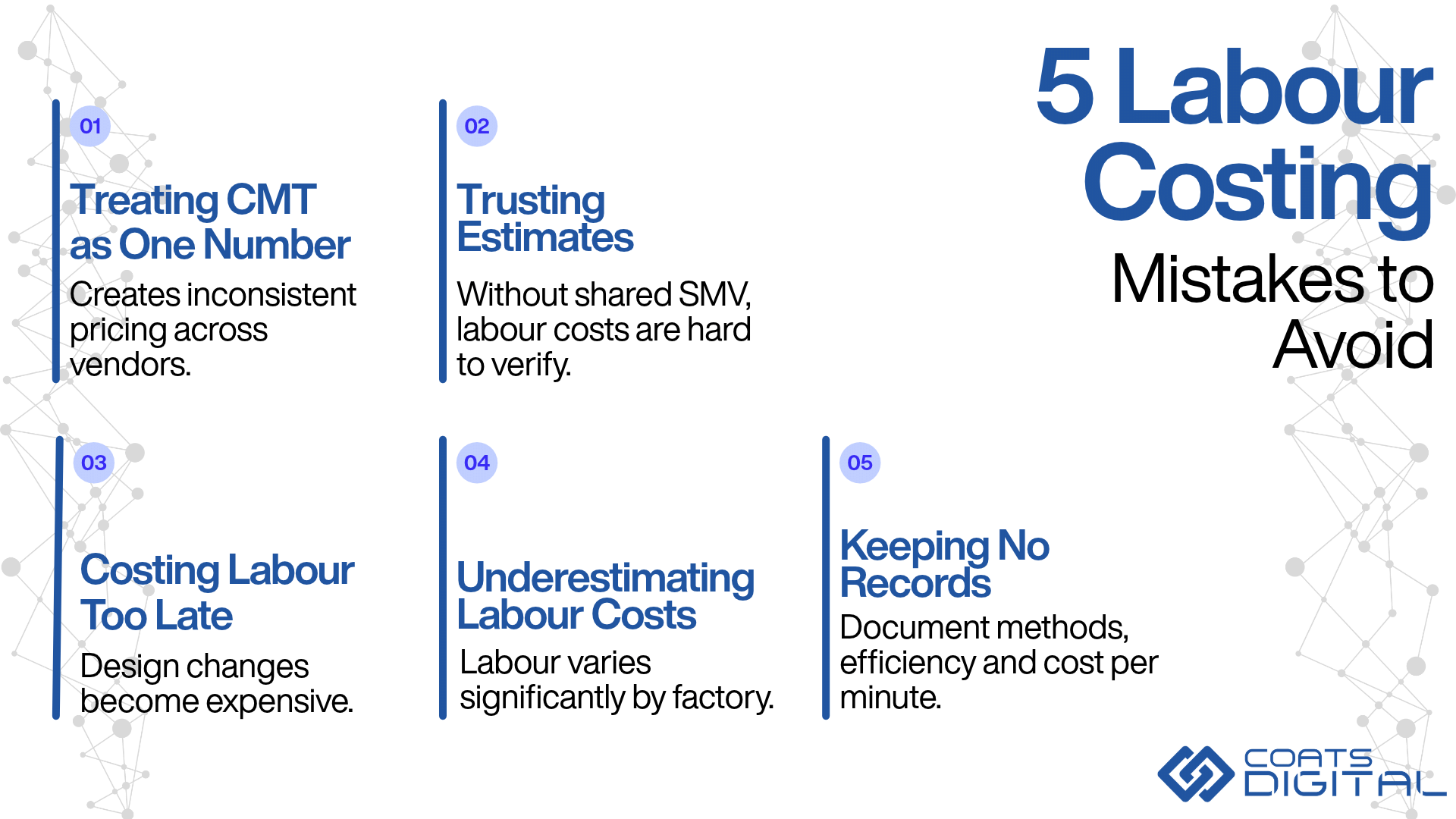
- Treating CMT as one number: The brand accepts “CMT $4.20”, then cannot explain why a near-identical tee costs $3.10 from another vendor.
- Accepting the estimate on trust: Without a shared SMV, the brand cannot challenge the labour line, and the supplier cannot defend it when costs genuinely rise.
- Costing labour after the sample is cut: Swapping a seam type or simplifying a collar is easy to evaluate at the design stage and expensive to change later.
- Assuming labour is too small to matter: In the worked example, labour is $0.80 at one factory and $6.00 at the other. Closer to the US, it stops being a rounding error.
- Keeping no defensible record: When someone asks how a wage allowance was set, “the factory quoted it” is not an answer. A Method Standard, an efficiency assumption and an agreed cost per minute are.
Does A Bill Of Labour Apply To Footwear And Accessories?
Yes. The logic holds for any product assembled through a sequence of operations: give each operation a standard time, add the times, then apply efficiency and cost per minute. What changes is the operation set.
Footwear is built in four broad stages: clicking (cutting the upper components), closing (sewing them into an upper), lasting (shaping the upper over a last) and finishing. Attaching the sole, whether stitched, cemented or moulded, completes the making of the shoe before finishing.
Closing is sewing, so it maps naturally onto motion-code analysis. Lasting and sole attachment involve shaping, cementing and pressing rather than sewing, so check how their standard times are set. A footwear Bill of Labour lists these operations the way a garment one lists cut, sew, press and pack.
Accessories such as bags, caps and belts are mostly cut-and-sew products. They break into measurable operations the same way: panels joined, straps attached, edges bound, hardware set.
One caution on scope. GSDCost’s method is designed for sewn products, so confirm standard-time coverage for non-sewing steps such as lasting or moulding. The principle holds regardless: price the work, not a lump sum.
Cost Both Halves, Not One
Every garment has two costs: the materials that go into it and the work that builds it. Brands have long engineered the first and estimated the second. A Bill of Labour gives the labour half the same discipline, with operations, standard minutes and agreed rates in place of a single line on a quote.
The pay-off is practical. Negotiations move from totals to inputs. Construction choices get costed while they can still change. And when a buyer, auditor or regulator asks how a wage allowance was set, the answer is a method rather than a guess.
Where to go next:
- See how GSDCost sets Standard Minute Values from 39 motion codes, and how brands use them for design for value.
- Explore the digital Bill of Labour and Fair Wage Tool from the manufacturer’s side.
- Find out how GSDQuest can generate a Bill of Labour from a garment image or tech pack.
If you want to see what a method-based Bill of Labour looks like for one of your own styles, the Coats Digital team can walk you through it.
Frequently Asked Questions
-
Is a Bill of Labour the same as CMT or cost-to-make?
No. A Bill of Labour covers direct labour only. The cost-to-make (CM) charge adds indirect labour, overhead and margin, and CMT usually also covers factory-sourced trims. FOB then adds materials. The Bill of Labour is the part of the factory price a brand can check line by line.
-
What is a Standard Minute Value (SMV)?
A Standard Minute Value is the time a trained operator needs to complete an operation using a defined method at standard performance. Predetermined motion time systems such as GSDCost set it from fixed time values for each movement, so the result does not depend on who carries out the study.
-
What is cost per minute in garment costing?
Cost per minute is a factory’s cost of one working minute of production. In Fair Wear’s method, it is built from wages, directly paid benefits and employer on-costs, divided by capacity minutes. It is then uplifted for indirect labour, and overhead per minute is added. Some factories also include margin.
-
What is line efficiency in garment manufacturing?
Line efficiency compares the standard minutes a line produces with the minutes it actually uses. In Fair Wear’s example, trousers with a SAM of 35 minutes that take 56.5 minutes to make are produced at 61.9% efficiency. Efficiency depends on the line, order quantity and style complexity, so agree it per style.
-
Who prepares a Bill of Labour?
Traditionally, industrial or costing engineers at the factory, or a brand’s technical team, use a predetermined motion time system. In GSDCost, trained practitioners build Method Standards from motion codes. AI tools such as GSDQuest now let product developers and sourcing teams generate a standardised first version from images or tech packs.
-
How long does it take to build a Bill of Labour?
It depends on the route. Manual method analysis can take an engineer hours per style. Suzhou Tianyuan reports that new-product process analysis took three to four days before it standardised on GSDCost, and one day after. Coats Digital reports that GSDQuest generates a standardised Bill of Labour from images in seconds.
-
What is a typical SMV for a T-shirt?
There is no single figure. Neck finish, sleeve style, seam types and whether cutting and packing are included all change it. A basic crew-neck tee is among the lowest-minute garments a factory makes. This guide’s illustrative example totals 6.0 minutes, while Fair Wear’s costing example uses 18 minutes for a polo shirt.
Garment Labour Cost, Explained: What a Bill of Labour Is and How It Differs From a Bill of Materials
Garment Capacity Planning Software in India: How to Size, Choose and Implement It (2026)
All Blog Categories
- Production Planning
- Corporate
- Method Time Cost Optimisation
- Supply Chain Solutions
- Sustainability
- Videos
