Best Production Planning Software for Clothing Brands in the USA (2026)
by Kunal Kapur
 9
Mins Read
9
Mins Read
TL;DR: For US clothing brands running multi-factory production in 2026, the strongest production planning software pairs what-if scenario simulation, real-time capacity scheduling and dynamic critical path management in a single platform. FastReactPlan by Coats Digital is the leading specialist solution built for the garment, footwear and accessories industry, used in over 3,000 factories worldwide.
The US apparel supply chain is running under a level of pressure it has not faced in a generation, and the pressure is almost entirely operational. When a duty rate moves, a confirmed order that made commercial sense on Monday can be uneconomic by Friday. The sourcing team has to find another factory, work out whether it can physically take the volume, reposition materials and give the buyer a credible new delivery date, all before the shipping window closes.
That is a planning problem and not a spreadsheet problem. It is also why production planning software has shifted from a “nice to have” to an operational necessity for brands managing external manufacturing.
The scale of the disruption is not in dispute. In the 2025 Fashion Industry Benchmarking Study from the United States Fashion Industry Association (USFIA), every one of the 25 leading US fashion companies surveyed named protectionist trade policy and related uncertainty as a top business challenge, with around 95% ranking it in their top two concerns. Roughly 70% had already delayed or cancelled sourcing orders as a direct result.
When your order book is being reshaped that aggressively, the tool that decides which factory makes what, in what order, with which materials and by when becomes the most important system you own.
This blog evaluates the most capable production planning software available to US clothing, footwear and accessories brands, with a clear focus on the three capabilities that matter most under current conditions: what-if scenario simulation, multi-factory scheduling and real-time visibility. It also draws a line most software round-ups blur, the line between an ERP that records your business and a planning tool that runs your factory floor.
Why US Clothing Brands Need Specialist Production Planning Software in 2026
The tariff disruption problem
Apparel is structurally more exposed to tariff policy than almost any other consumer category, because it barely makes anything at home. Around 98% of clothing sold in the United States is imported, a figure corroborated independently by analysts at Anthesis. There is no domestic inventory to fall back on and no quick way to reshore, so when duties rise, the cost lands somewhere in the value chain almost immediately.
The figures brands have put in front of investors show how material that is. Gap Inc. told the market it faced between $250 million and $300 million in gross incremental tariff cost for fiscal year 2025, with roughly half expected to be offset through mitigation. Adidas flagged around €200 million (about $230 million) in additional product costs for the second half of the year. Crocs put its potential exposure at about $130 million on an annualised basis, and Abercrombie & Fitch guided to roughly a $50 million hit. Nike, at the top end, warned of as much as $1.5 billion in gross incremental costs.
The strategic response across the industry has been diversification. US companies sourced apparel from 46 different countries in 2025, and around 60% intend to add more, precisely so they can move volume away from whichever country the next tariff announcement targets. But diversification only reduces risk if you can actually execute the switch. The moment a brand decides to shift a confirmed order from a high-tariff country to a backup factory network, three operational questions have to be answered fast:
- Can the receiving factory physically absorb this order without breaking its existing commitments?
- What happens to the delivery schedule, and can the buyer live with it?
- Which materials need to be re-sourced or repositioned, and how long will that take?
Spreadsheets and email cannot answer those questions at the speed a tariff cycle now demands. By the time a planner has manually rebuilt three factory schedules to test one scenario, the commercial window has often already closed. This is the specific gap that specialist production planning software exists to fill.
Why generic ERP isn’t enough
This is the distinction most buyers get wrong, and it is worth being precise about.
An ERP system, whether that is Oracle NetSuite, Infor or SAP, is built to run the business. It manages finance, inventory, purchasing, order management and fulfilment. In short, it is an authoritative record of what you have and what you have sold. That is essential, and no serious apparel operation runs without one.
Production planning software manages something different: what happens next on the factory floor. Which manufacturing line, in which factory, in what sequence, using which materials, to hit which delivery date? It is the layer that turns a confirmed order into an executable plan and replans in minutes when circumstances change.
| Why can’t clothing brands use ERP alone for production planning? Because general-purpose ERP manages production at the order and inventory level, not the line-and-machine scheduling level. It can tell you an order exists and what it needs, but it typically cannot simulate reallocating that order across factories, model the capacity impact, or dynamically re-drive the critical path when the plan shifts. Those are specialist functions. |
That is why mature apparel operations almost always run a dedicated planning tool alongside their ERP rather than forcing the ERP to do a job it was never designed for. The manual, disconnected alternatives like spreadsheets, messaging apps, and phone calls stitched across a supplier network are themselves the root cause of late order confirmations, missed deliveries, and permanently reactive planning. The software exists to replace that fragility with a single, dynamic source of truth.
What to Look for in Production Planning Software for Apparel Brands
Before comparing specific products, it helps to fix the evaluation criteria. Five capabilities separate genuine production planning tools from ERP modules wearing a planning label.
What-if scenario planning
This is the single most important capability for any brand operating in a volatile trade environment. What-if scenario planning lets a planner model a proposed change, “what if Factory A can’t take this order?” or “what if we need to lift output 20% next month?”, in a sandbox, without touching the live production plan.
The planner tests the reallocation, sees the downstream impact on capacity, materials and delivery dates, then decides whether to commit.
Multi-factory control tower view
If you source from more than one factory, you need a single consolidated view of demand, capacity, materials and pre-production activity across the entire network, not a separate screen for each site that someone has to reconcile by hand.
Dynamic critical path management
In garment production, the critical path, known in the trade as the Time & Action (T&A) calendar, maps every pre-production milestone that must be completed before manufacturing can start: sampling, fabric approvals, lab dips, trim sign-offs and so on. In a good planning tool, these milestones are driven automatically by the live production plan. When the plan changes, the critical path updates itself rather than waiting for someone to rebuild it.
The strongest systems also run materials on a lean, just-in-time pull basis, calculating requirements from the latest plan rather than pushing stock against a static schedule. That is how planning software reduces inventory and lead time at the same time.
Real-time capacity scheduling
Look for visual, drag-and-drop scheduling of manufacturing lines and machines that reflects confirmed and projected orders together. The practical payoff is faster, more reliable order confirmation, a direct commercial advantage when a buyer wants an answer today, not next week.
System integration and speed to value
A planning tool is one layer in your stack, not a replacement for it. It must integrate cleanly with your existing ERP, PLM and shop-floor systems so data flows without manual re-entry. Implementation speed matters too.
What features should production planning software for clothing brands include? In short: native what-if scenario planning, a multi-factory control tower view, dynamic critical path (T&A) management, real-time line-and-machine capacity scheduling, and clean integration with your existing ERP and PLM.
Top 10 Production Planning Software: Comparison Table
| # | Tool | Company | Category | What-If Planning | Multi-Factory View | GFA-Specific | US Market Fit | Best For |
| 1 | FastReactPlan | Coats Digital | Specialist Planning | ✓ Native sandbox | ✓ Control tower | ✓ Built for GFA | ✓ Tariff reallocation ready | Factory scheduling & capacity |
| 2 | NetSuite + Folio3 | Oracle / Folio3 | Mid-Market ERP | ✗ | Limited | ✓ With config | ✓ Strong US ERP ecosystem | Business operations + finance |
| 3 | BlueCherry | CGS | Enterprise ERP + PLM | ✗ | Limited | ✓ | ✓ EDI + omnichannel | End-to-end brand operations |
| 4 | Infor Fashion | Infor | Enterprise ERP | ✗ | Limited | ✓ | ✓ Large enterprise | Multi-region enterprise ops |
| 5 | WFX Cloud ERP | WFX | Apparel ERP | ✗ | Partial | ✓ | ✓ | Sourcing + compliance |
| 6 | AIMS360 | AIMS360 | Mid-Market ERP | ✗ | ✗ | ✓ | ✓ Strong EDI + DTC | US mid-market brands |
| 7 | Datatex NOW | Datatex | Specialist Textile ERP | Partial (APS) | ✓ Multi-site | ✓ Textile-first | Limited US focus | Vertically integrated mfrs |
| 8 | ApparelMagic | ApparelMagic | Mid-Market ERP | ✗ | ✗ | ✓ | ✓ | Small–mid US brands |
| 9 | Centric PLM | Centric Software | PLM | ✗ | ✗ | ✓ | ✓ Enterprise | Pre-production & design |
| 10 | WFX PLM | WFX | PLM + ERP | ✗ | ✗ | ✓ | ✓ | Pre-production + sourcing |
Table notes: “What-If Planning” refers to factory-level capacity simulation, not financial scenario modelling. “Multi-Factory View” means a unified capacity and scheduling view across supplier factories. “GFA-Specific” means the platform is built for Garment, Footwear and Accessories, not adapted from generic manufacturing or retail software.
The Best Production Planning Software for US Clothing Brands (2026)
Before the individual profiles, one piece of context that reframes the whole comparison. Three distinct types of software serve apparel production in 2026, and they operate at different layers:
- Specialist production planning tools are purpose-built for factory scheduling, capacity management, and the critical path in the GFA industry. Example: FastReactPlan.
- Apparel ERP systems run the full business, finance, inventory, sourcing and fulfilment. Examples: NetSuite with Folio3, Infor Fashion, WFX Cloud ERP.
- PLM platforms manage the product development lifecycle from design to tech pack. Examples: Centric PLM, WFX PLM.
These categories overlap, but they are not substitutes. Most mature apparel operations run tools from more than one of them. This list focuses on the production planning layer, the software that actually runs factory-floor operations once an order is confirmed, and evaluates every product against that yardstick.
1. FastReactPlan by Coats Digital
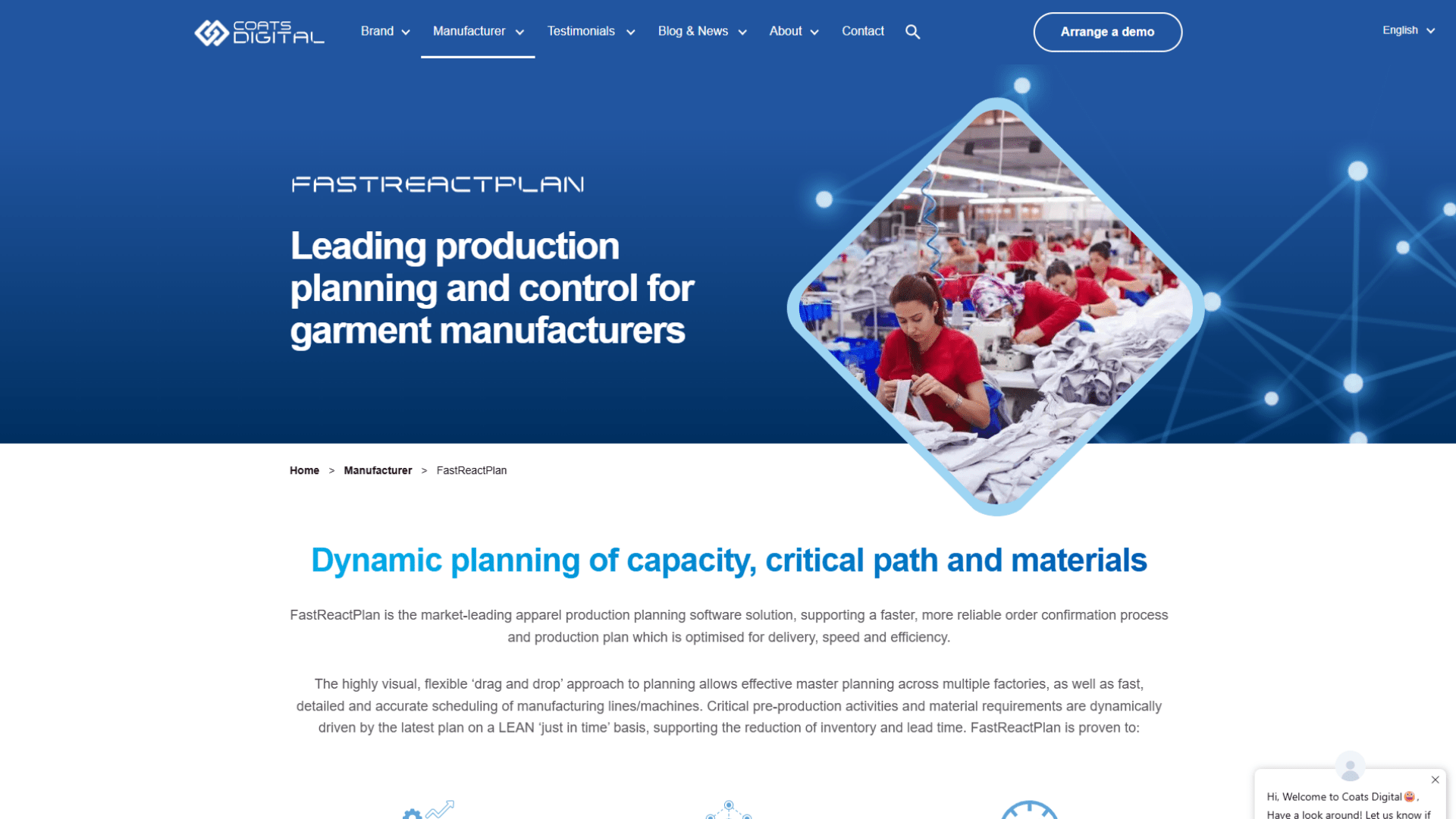
Category: Specialist Production Planning
Best for: Garment, footwear and accessories manufacturers, and brand sourcing teams managing multi-factory production networks
FastReactPlan leads this list because it is the only tool here built exclusively for factory-floor production planning in the GFA industry. Every other entry is either a full ERP or a PLM platform. FastReactPlan concentrates entirely on the operational layer, where plans are made, adjusted and executed.
Its verified capabilities include:
- A visual, drag-and-drop master planning board with a control tower view across multiple factories at once
- A what-if scenario engine to sandbox order changes, factory reallocations and capacity adjustments before committing to the live plan
- Dynamic critical path (T&A) management, with pre-production milestones and material requirements updated automatically from the latest plan on a lean just-in-time basis
- Detailed scheduling at the manufacturing line and machine level within factories
- Management of confirmed and projected orders in a single view
- AI-assisted analytics (“Ask Coats Digital”) that turn planning data into instant insights and charts
- Clean integration with ERP, PLM and other Coats Digital solutions such as GSDCost and FastReactFabric
The platform is used in over 3,000 factories globally and delivers a typical ROI of less than 12 months. It is developed by Coats Digital, the software arm of Coats Group, the FTSE 250-listed and world-leading industrial thread company, which gives it deep, long-standing GFA industry knowledge and the institutional stability that matters when you are choosing a system to build your operations around.
The US market angle: FastReactPlan’s what-if engine is a direct answer to the tariff reallocation problem. A brand can model moving production from a high-tariff country to a backup factory, test the capacity and materials impact, and confirm the order, before committing a single live change.
Website: coatsdigital.com/en/manufacturer/fastreactplan
2. NetSuite with Folio3 Apparel Implementation
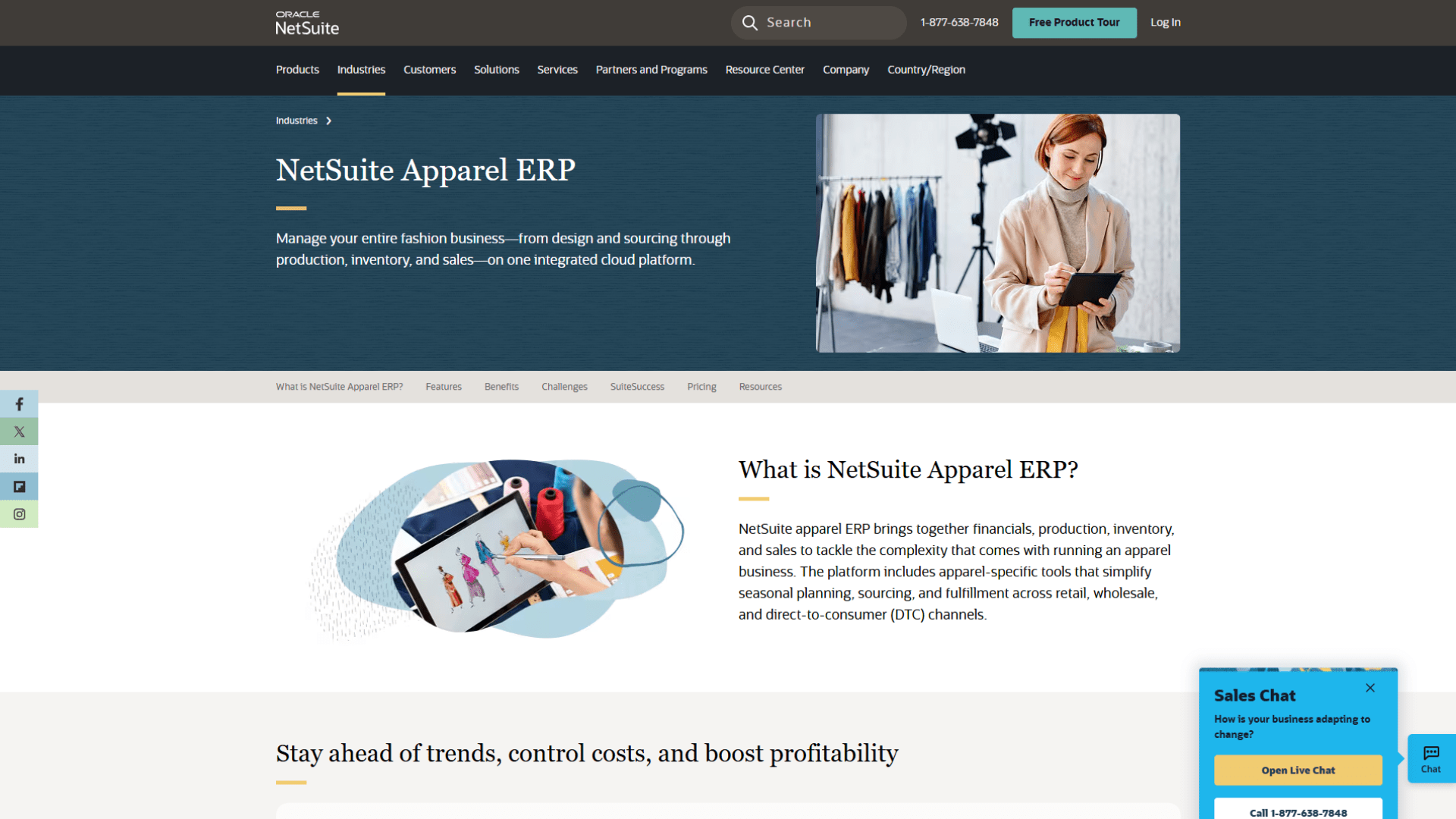
Category: Mid-Market to Enterprise ERP
Best for: Mid-to-large US brands wanting unified ERP for finance, inventory, order management and production workflows
Oracle NetSuite is one of the strongest cloud ERP ecosystems in the US market, and Folio3’s apparel-specific implementation adapts it for fashion. Verified capabilities include native matrix inventory management (style × size × colour) without custom workarounds, seasonal planning aligned to collection launches, a Cut-Make-Trim solution through Folio3, real-time traceability from raw material through finished goods, multi-entity financial management, and an NStitch add-on for enhanced garment production tracking across CMT workflows and outsourced factories.
Limitation for production planning: NetSuite is a comprehensive business ERP; its production modules manage at the order and inventory level, not the factory-floor scheduling level. It does not offer what-if scenario simulation for line-level capacity or dynamic critical path management the way a specialist tool does.
Best for: US brands that need finance, inventory and production data in one business system.
3. CGS BlueCherry Enterprise Suite
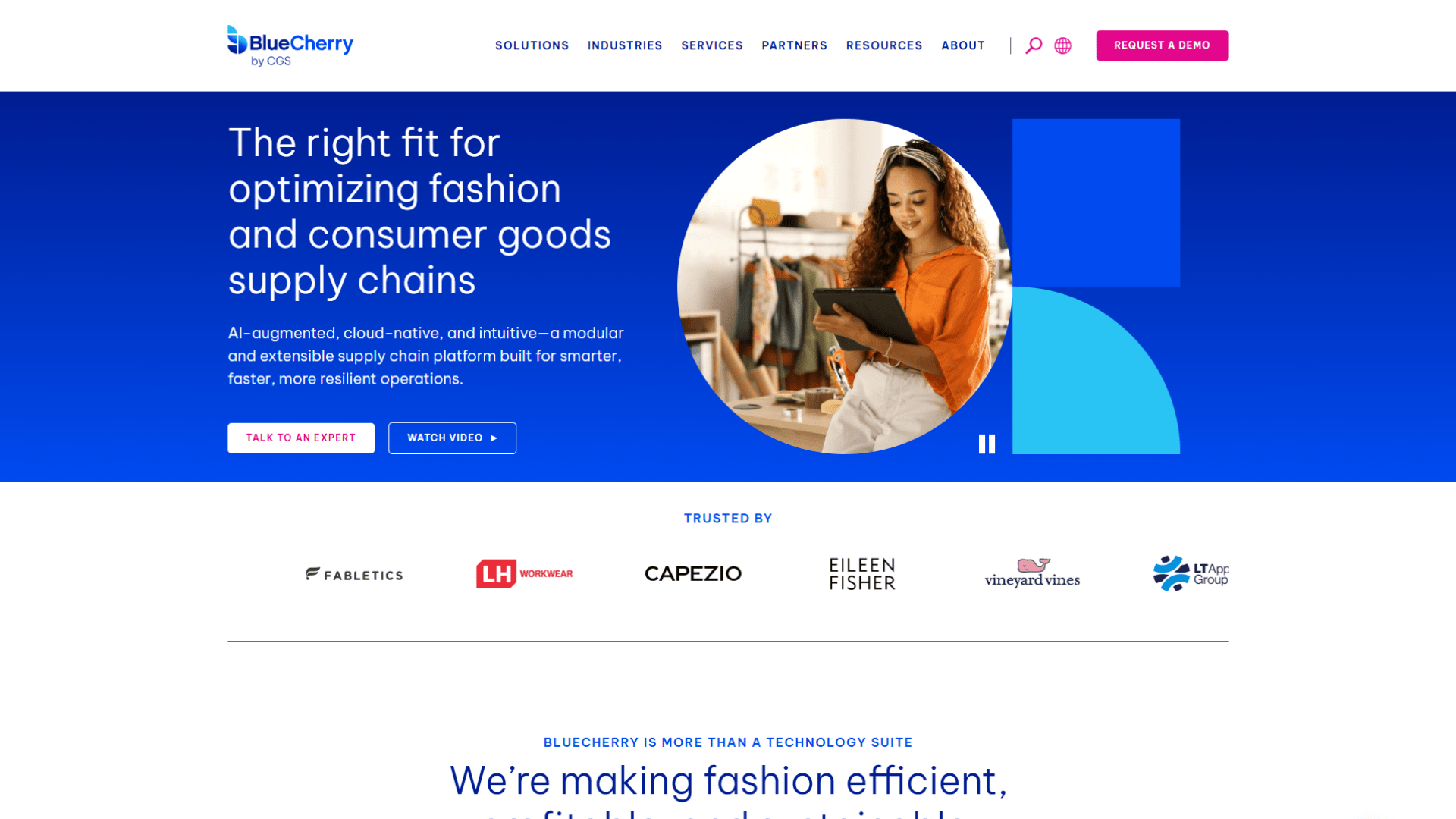
Category: Enterprise Apparel ERP + PLM
Best for: Mid-to-large apparel, footwear and consumer goods brands needing end-to-end ERP and PLM in one platform
Developed by Computer Generated Solutions (CGS), a New York firm with more than 40 years of technology experience, BlueCherry is a unified SaaS platform spanning product development, sourcing, manufacturing, logistics and sales. It includes a Shop Floor Control module for real-time production tracking, EDI compliance and omnichannel order management, business intelligence, and PLM capabilities covering design, costing and supplier collaboration. Recent adoptions include iFabric Corp, which selected BlueCherry ERP in March 2025 to streamline inventory, production planning and order fulfilment.
Limitation for production planning: BlueCherry is a broad enterprise platform. Its shop-floor control provides production tracking, but it does not offer the specialist what-if scenario simulation and visual capacity planning board that dedicated production planning tools provide.
Best for: US brands and manufacturers wanting ERP and PLM in a single apparel-native system, particularly those with complex supply chains and omnichannel fulfilment.
4. Infor Fashion
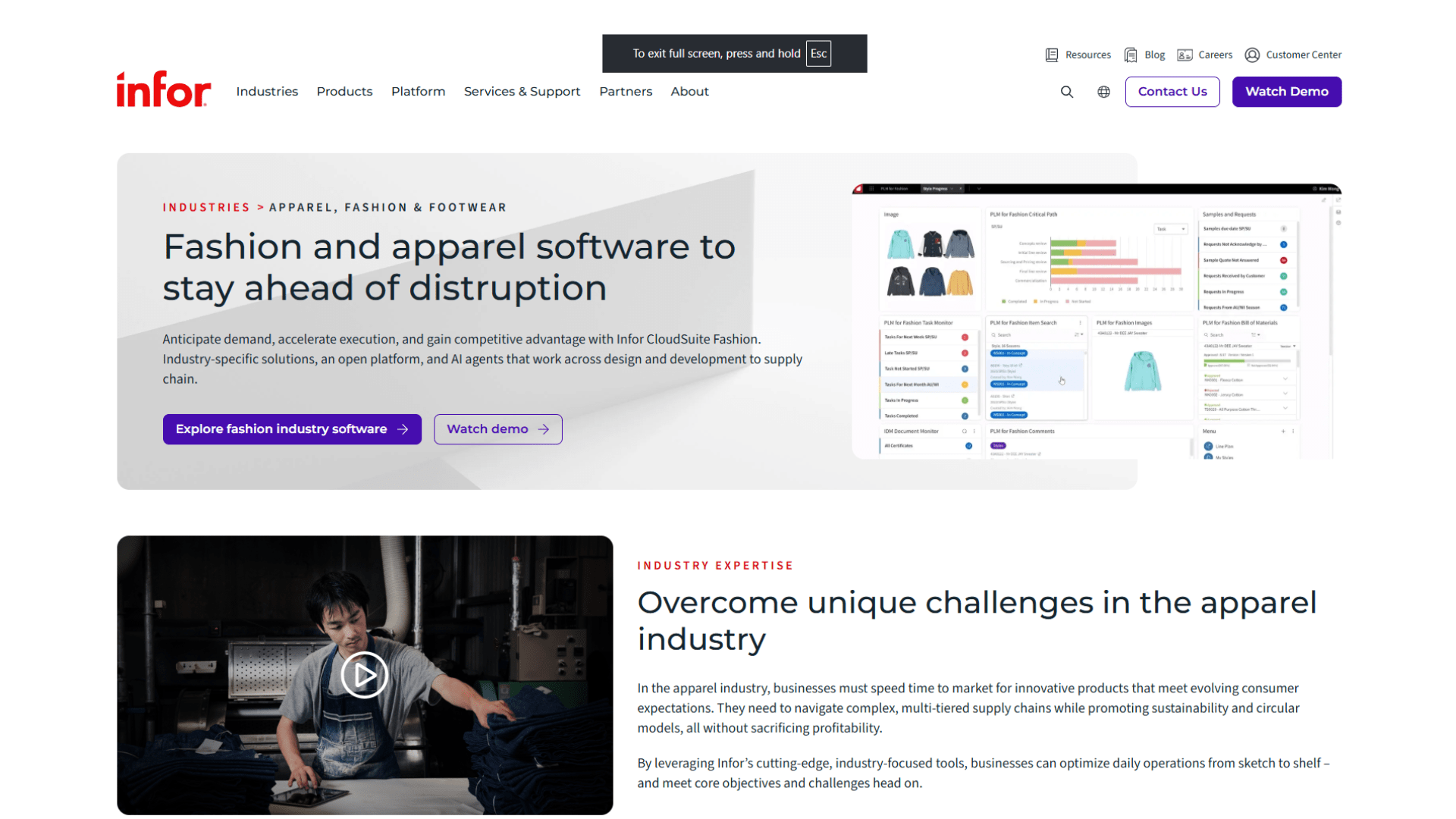
Category: Enterprise ERP
Best for: Large apparel, footwear and accessories manufacturers with multi-region operations and a need for deeply configurable ERP
Infor Fashion is a highly configurable end-to-end ERP for large fashion operations. It covers Material Requirements Planning with seasonal forecasting aligned to collection launches, multi-entity financial management across global subsidiaries, and supply chain visibility from procurement to final delivery. It is engineered for the operational complexity of large enterprises.
Limitation for production planning: Infor Fashion manages production planning at the ERP layer; it is not a specialist factory-floor scheduling tool. Dynamic visual capacity boards and what-if scenario simulation are not its core offering.
Best for: Large US apparel enterprises needing enterprise-grade resource allocation, supply chain management and financial reporting in one configurable system.
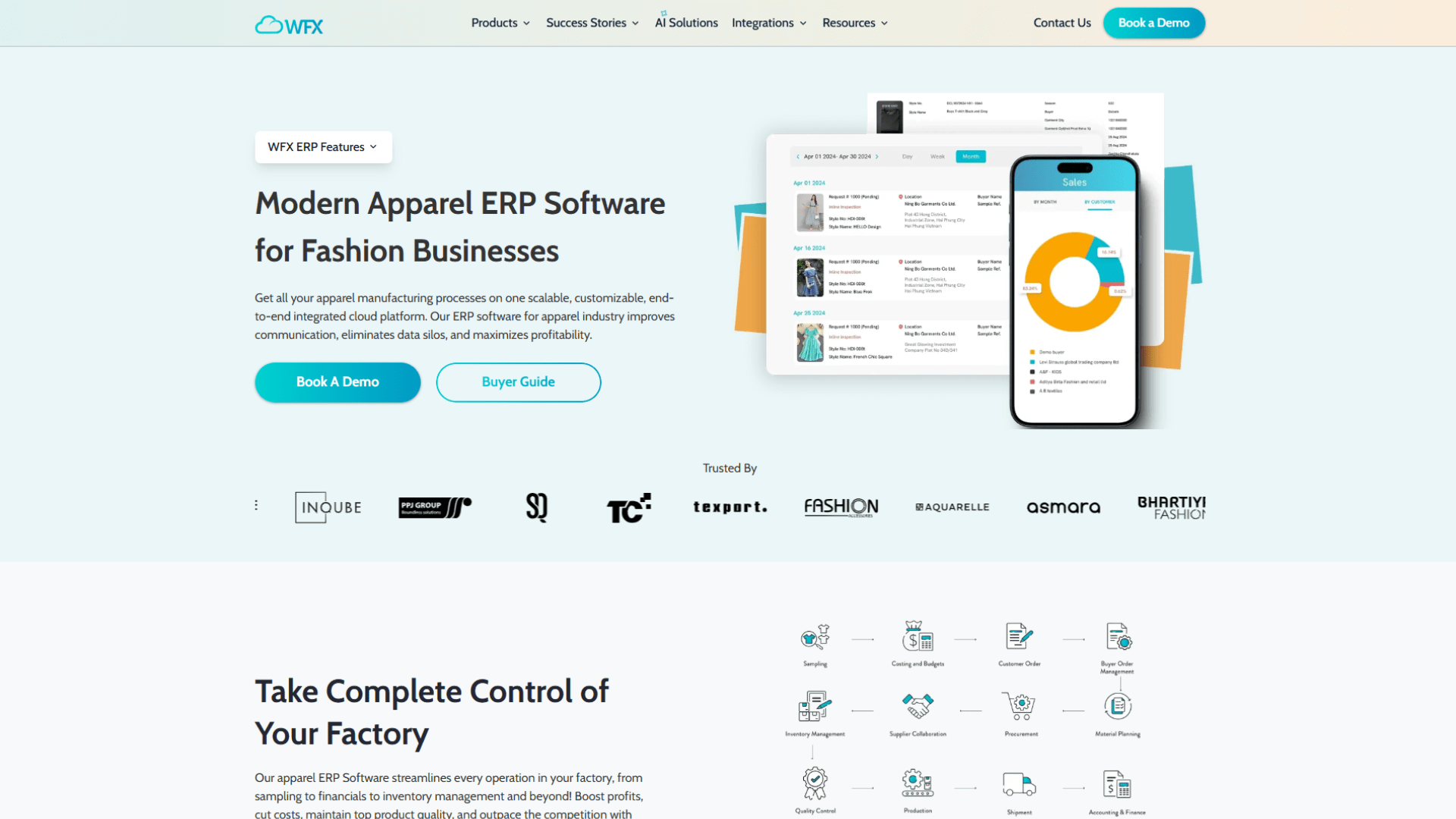
5. WFX Cloud ERP
Category: Apparel ERP with Sourcing and Compliance Emphasis
Best for: Mid-to-large brands managing complex international sourcing networks with strong compliance and sustainability requirements
WFX Cloud ERP covers material planning, quality control and supplier collaboration, with particular strength in visibility across global sourcing teams and supplier networks. It supports seasonal collection planning and tech-pack workflows within the ERP layer, tracks sustainability-led product development, and offers both ERP and PLM modules in one platform.
Limitation for production planning: WFX is oriented primarily toward sourcing, compliance and product development. Factory-floor capacity scheduling and what-if simulation sit outside its core focus.
Best for: US brands with complex supplier networks across multiple countries that prioritise sourcing visibility and compliance tracking.
6. AIMS360 Apparel ERP
Category: Mid-Market Cloud ERP
Best for: US-based mid-market clothing brands and wholesalers managing multi-channel sales, EDI compliance and production tracking
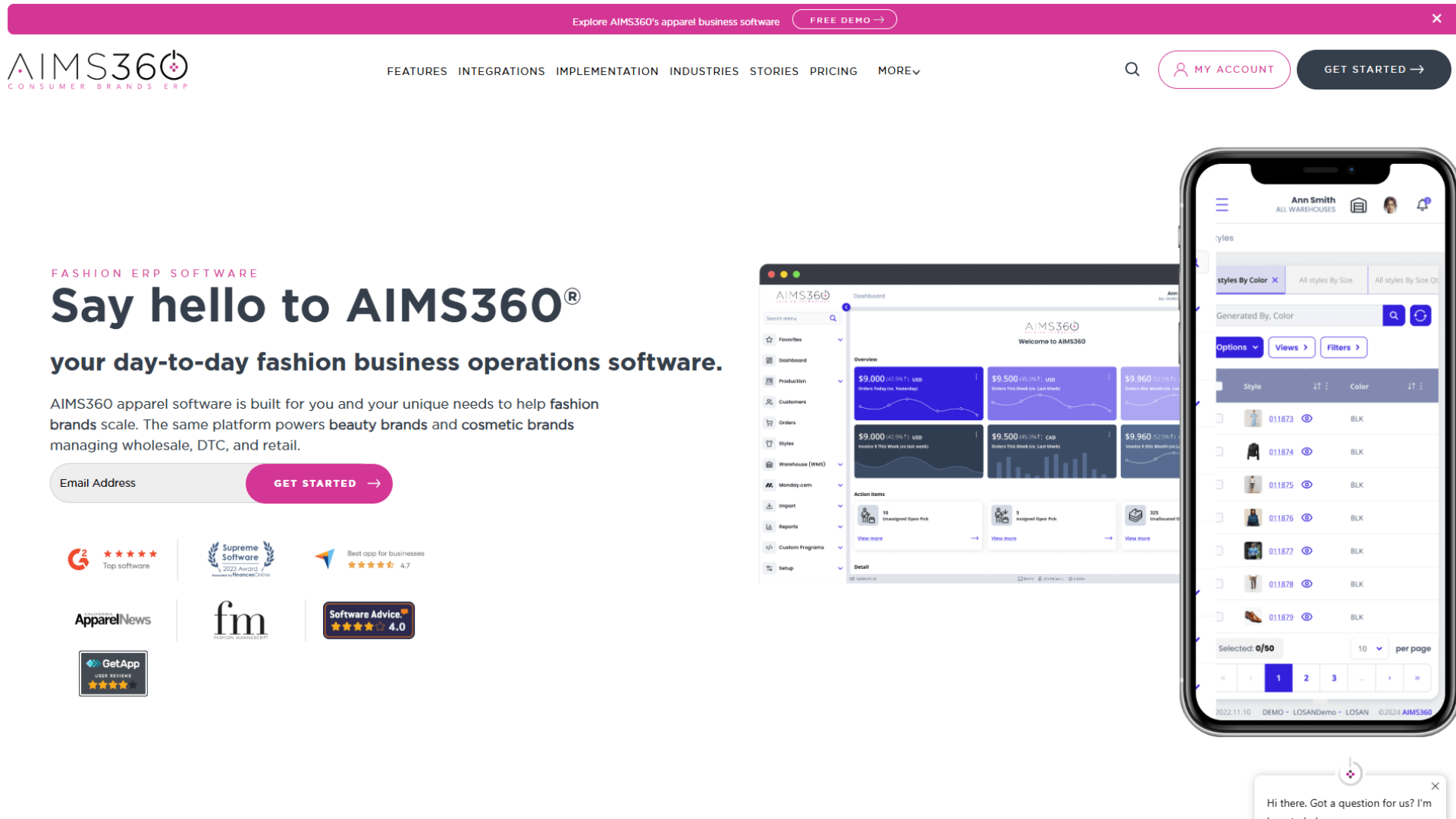
AIMS360 is a cloud ERP built specifically for fashion, covering inventory, production tracking, order management, warehouse management and CRM in one system. It offers native style/colour/size matrix inventory, step-by-step production tracking from cutting through finishing and QC, an extensive library of out-of-the-box integrations including major EDI retailers, and landed-cost calculation that is genuinely useful for tracking imports across tariff-affected sourcing countries. It has a strong, deliberate focus on the US market and is frequently referenced in US-specific apparel guides.
Limitation for production planning: AIMS360 is an ERP platform. Its production tools track production step by step, but do not offer multi-factory visual capacity boards or what-if scenario simulation for factory scheduling.
Best for: US brands selling through wholesale, DTC and EDI channels that need a fashion-native ERP connecting operational data across all channels. A strong fit for mid-market brands moving off manual or spreadsheet processes.
7. Datatex NOW ERP
Category: Specialist Textile and Apparel ERP (Enterprise)
Best for: Vertically integrated textile and apparel manufacturers, particularly those spanning fibre, yarn, fabric and cut-and-sew production
Datatex is an industry-specific ERP built exclusively for textile and apparel manufacturing, with more than 30 years of focus and, by its own account, the largest installed base of textile software worldwide across 45 countries. It covers every production phase from spinning and weaving through dyeing, knitting and garmenting, and includes an Advanced Planning and Scheduling module supporting multiple planning modes (Make to Order, Make to Stock, Engineer to Order and Assemble to Order), multi-level planning, MES integration for shop-floor control, and IoT machine-level data collection.
Limitation for production planning in a brand context: Datatex NOW is built primarily for vertically integrated manufacturers that control fibre-to-finish production. For a clothing brand sourcing finished garments from external factories, its deep textile-process modules can be more than the operation requires, and it does not provide the same brand-level, multi-supplier control tower view that FastReactPlan offers.
Best for: Vertically integrated US manufacturers producing textiles and garments in-house, or enterprises managing complex multi-process production from raw material to finished goods.
8. ApparelMagic
Category: Mid-Market Apparel ERP
Best for: Small to mid-sized US clothing brands managing inventory, production orders, wholesale and DTC sales
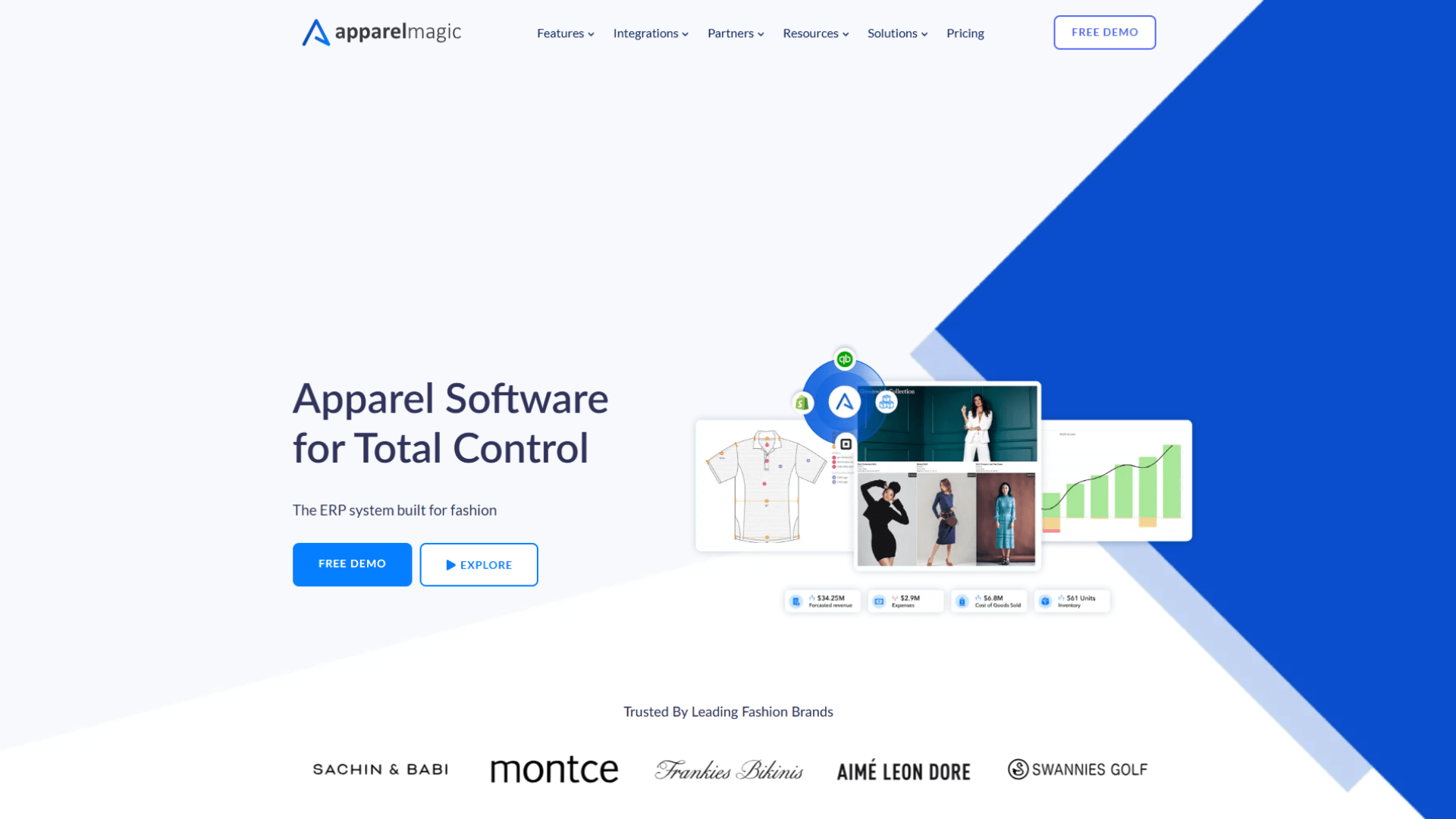
ApparelMagic is a cloud ERP designed specifically for apparel, footwear and sewn goods. It offers style/colour/size inventory with real-time availability, production order management (bills of materials, cut tickets, work orders), multi-channel sales support across wholesale, DTC and B2B ecommerce, and integrated accounting, CRM and reporting, at a price point well below enterprise ERP alternatives. Reviewers on platforms such as G2 and Capterra generally describe it as well suited to fashion’s style/colour/size complexity and relatively straightforward to onboard, while noting that automation and customisation can become limiting as a business scales.
Limitation for production planning: ApparelMagic handles production orders, BOMs and basic production tracking well, but does not offer multi-factory visual capacity scheduling, what-if scenario simulation or dynamic critical path management.
Best for: Small to mid-sized US brands wanting a fashion-native ERP at a mid-market price, especially those running design-to-wholesale workflows without complex multi-factory production.
9. Centric PLM
Category: Product Lifecycle Management (PLM)
Best for: Mid-to-large apparel, footwear and luxury brands managing product development, design, costing, sourcing and pre-production at scale
Centric PLM appears in “production planning software” searches often, because it manages the critical pre-production phase, the work done before factory scheduling begins. Understanding where PLM ends and production planning starts is important for buyers. A subsidiary of Dassault Systèmes, Centric is a market-leading fashion PLM relied on by over 20,000 brands across six verticals. It manages product development from concept to commercialisation, tech packs, materials, costing, sourcing, sample management and approvals, alongside seasonal line planning and AI-enabled workflow automation, on an open platform that integrates with CAD, 3D design tools, ERP and ecommerce. The vendor cites up to 50% productivity improvements and guarantees 100% customer go-live success; these are supplier claims rather than independently verified figures.
Limitation for production planning: Centric manages the pre-production lifecycle, not factory-floor scheduling. It does not provide capacity planning boards, what-if factory simulation or manufacturing line scheduling. It feeds production; it does not execute it.
Best for: Large US brands looking to streamline product development, reduce sampling cycles and manage complex assortments from design to production handoff.
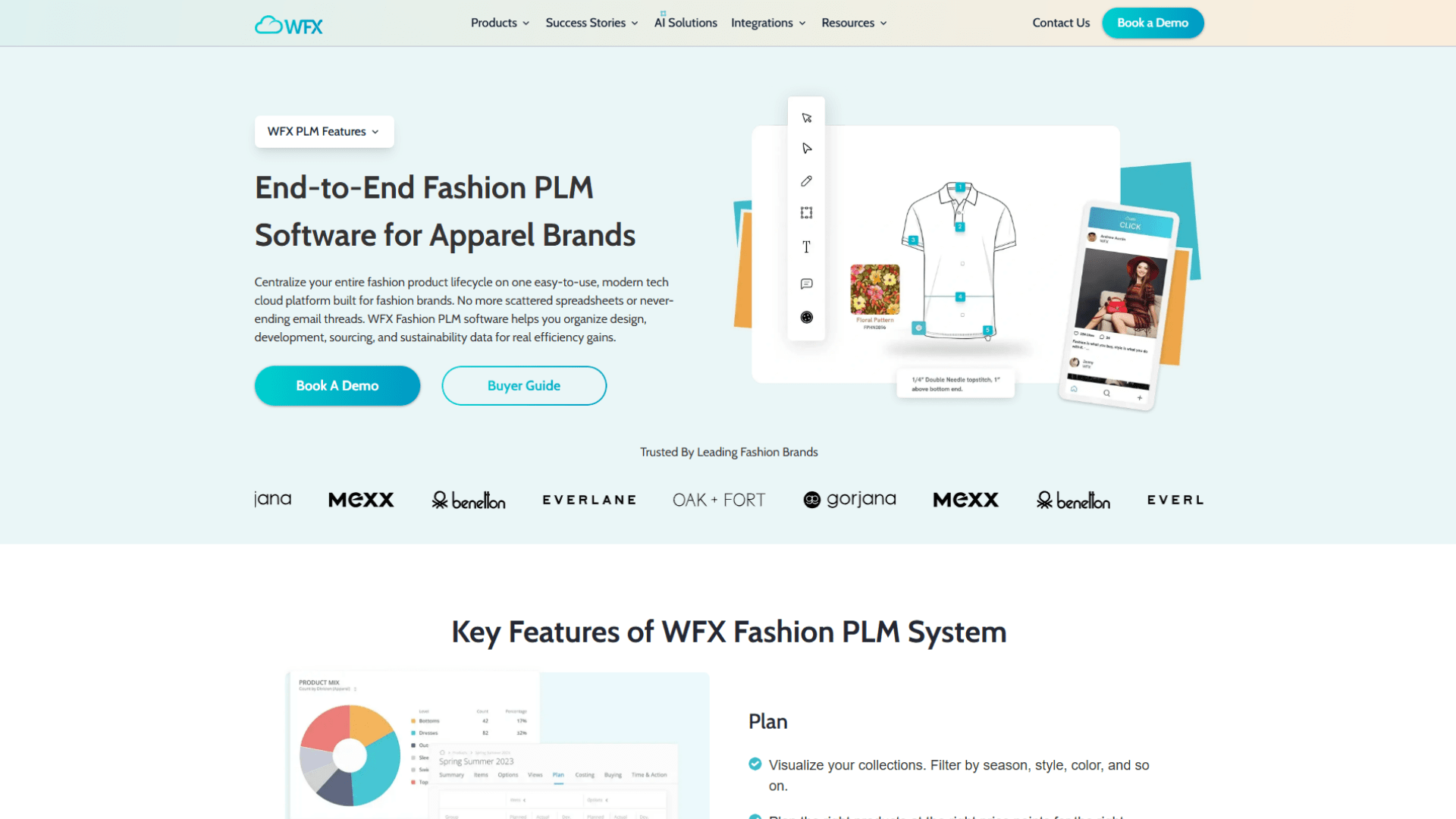
10. WFX PLM
Category: PLM with ERP Integration
Best for: Mid-to-large apparel brands wanting PLM and ERP in a single platform, with strong global sourcing visibility
WFX PLM is a cloud PLM built specifically for fashion rather than a generic tool adapted for apparel. It covers seasonal collection planning, tech-pack management, supplier communication, costing and compliance, and integrates with WFX ERP so product and production data connect in one ecosystem. It is particularly strong for brands managing international sourcing with visibility across global teams and vendors.
Limitation for production planning: As with Centric, WFX PLM manages pre-production design and development, not factory-floor scheduling or capacity simulation.
Best for: US brands wanting PLM and sourcing ERP in a single platform with strong global collaboration features.
Key Questions to Ask Before Choosing Production Planning Software
Use these questions to pressure-test any vendor against your actual operation.
- Is it built specifically for apparel, footwear and accessories, or is it a generic manufacturing module? Generic tools are not configured for matrix SKUs, critical path management, style/colour/size scheduling or material pull logic.
- Does it have native what-if scenario planning? The ability to model order changes and factory reallocation before committing is essential in 2026’s trade environment, and it is not the same as an ERP’s financial “what-if”.
- Can it manage multiple factories in a single view? A consolidated planning board across your whole supplier network is non-negotiable if you source from more than one factory.
- Does it dynamically drive material requirements from the live plan? Materials and pre-production activities should update automatically when the plan changes, not require a manual rebuild.
- How does it handle confirmed and projected orders simultaneously? You need to plan against forecast demand as well as confirmed purchase orders to manage future capacity accurately.
- What integrations does it support? The tool will sit alongside your ERP and PLM; confirm data can flow between them without re-entry.
- What does implementation look like, and what support is provided? Ask for a realistic onboarding timeline and reference customers at a similar scale.
- What outcomes have comparable customers achieved? Ask for case studies from manufacturers of a similar size, category and network complexity to your own.
How FastReactPlan Solves the Core Challenges for US Clothing Brands
Managing sudden order changes
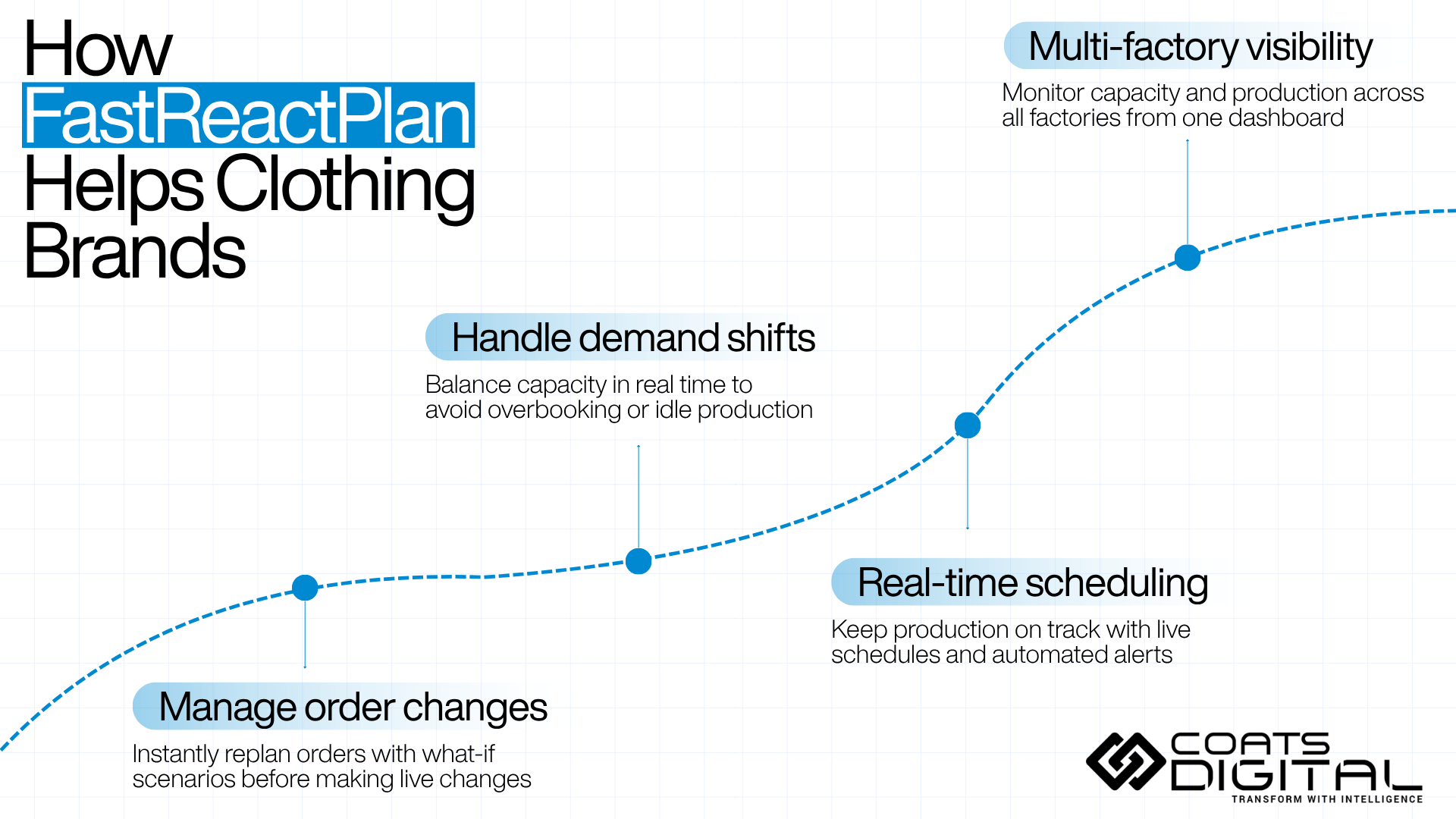
How does production planning software handle sudden order changes? When a tariff announcement forces a brand to move a confirmed order from a high-tariff country to a backup supplier, the production plan has to absorb that change immediately. FastReactPlan’s what-if engine lets the Master Planner model the reallocation first, testing whether the receiving factory has capacity, when materials can be repositioned, and what the realistic delivery impact will be, before making the live change. The result is faster, more reliable order confirmation with full downstream visibility, rather than a decision made on a hunch and corrected later.
Handling demand fluctuations
On-demand production and fragmented order books mean volumes now change far more often than traditional seasonal planning assumed. FastReactPlan manages confirmed orders and forecast demand in a single planning view, adjusting capacity allocation dynamically as order status changes. That prevents the two failure modes that quietly erode margin: over-commitment, accepting orders a factory cannot deliver on time, and under-utilisation, leaving capacity idle because planners could not see it in time to fill it.
Real-time factory scheduling
FastReactPlan enables fast, detailed and accurate scheduling of manufacturing lines and machines, not just factory-level assignments. Critical pre-production activities and material requirements are driven automatically by the latest live plan on a lean pull basis, closing the gap between the plan and what the shop floor is actually doing. Colour-coded alerts flag late materials and capacity conflicts before they turn into delivery failures.
Multi-factory visibility
For brands sourcing across countries, the master planning board gives a single, consolidated view of load versus capacity across the entire network. Hi-Tech Apparel, which runs 10 production locations across Thailand, Cambodia, Vietnam and Laos and supplies brands including Nike, adopted FastReactPlan specifically to solve the problem of monitoring planning across multiple factories at the same time, something its previous, siloed approach made almost impossible.
Proven Outcomes: What Manufacturers Achieve with FastReactPlan
The figures below are drawn from published sources and describe specific manufacturers in specific contexts. They are examples of what is achievable, not guarantees, and results will vary with each operation’s scale and starting point.
| Customer | Outcome | Source |
| Tunicotex Group (Tunisia, Jan 2026) | On-time delivery performance up from 75% to 85%; planning time cut by 25%; production capacity expanded by around 40% | Textile Focus, Fibre2Fashion, Knitting Industry |
| Song Hong (Vietnam) | Planning time reduced by 20%; plan-versus-actual performance improved by 7% | Coats Digital |
| Hi-Tech Apparel (Thailand) | Unified multi-factory visibility across 10 locations in 4 countries | Coats Digital |
| Pilot Knit Garment (Thailand, Oct 2024) | Connected planning and forecasting across departments to improve OTDP and cut lead times | The Interline |
| Platform-wide | Used in over 3,000 factories globally | The Interline |
The Tunicotex case is instructive because the manufacturer, a premium knitwear producer supplying names such as Hugo Boss, Armani and Tommy Hilfiger, achieved that 40% capacity gain not by adding machinery but by planning its existing capacity properly. Better visibility surfaced capacity that had previously been lost to firefighting and idle time.
The Bottom Line
The mistake most brands make is treating “production planning” as one category when it is really three: an ERP records what you own and sell, a PLM moves a product from sketch to tech pack, and neither answers the question that now defines a good week on the sourcing team if this order moves, can the new factory take it, when do the materials land, and what happens to the delivery date? That belongs to the production planning layer, and most brands still run it on spreadsheets.
That improvisation held for years. It does not hold when duty rates shift overnight, and production is spread across dozens of countries, where a slow answer is measured in cancelled orders, air freight and lost margin. The brands coping best can model a reallocation, test its capacity and materials impact, and confirm a revised plan in hours. Diversification buys options; only planning infrastructure lets you use them in time.
That is where FastReactPlan sits apart on this list: the only tool built solely for factory-floor planning in the garment, footwear and accessories industry, not an ERP or PLM dressed up as one, and backed by the industry depth of Coats Group. It is not automatically right for everyone: if your real constraint is finance, an ERP earns the investment; if it is product development, a PLM does. Be clear about which layer is costing you money, judge each tool against that using the eight questions above, and if the pain sits on the factory floor, see FastReactPlan run against your own network in a scoped demonstration with the Coats Digital team.
Frequently Asked Questions
-
What is the best production planning software for clothing brands in the USA?
For brands and manufacturers focused on factory scheduling, capacity management and order-change simulation, FastReactPlan by Coats Digital is the leading specialist solution, used in over 3,000 factories globally. For broader business operations, finance, inventory and order management, apparel ERP platforms such as NetSuite with Folio3 or Infor Fashion are strong options. Most mature operations run both layers.
-
What is the difference between production planning software and ERP for apparel brands?
ERP systems manage business operations: finance, inventory, purchasing and order fulfilment. Production planning software manages what happens on the factory floor: which lines are scheduled, how capacity is allocated, which materials are needed by when, and the impact of any order change. The two are complementary; specialist planning tools work alongside ERP systems, not instead of them.
-
How does what-if scenario planning work in garment manufacturing?
It lets planners model proposed changes, reallocating an order between factories, ramping capacity up or down, or fitting in a rush order, without touching the live plan. The planner reviews the downstream impact on capacity, materials and delivery dates, then decides whether to commit. FastReactPlan’s what-if engine works as a sandbox for exactly this kind of simulation.
-
How does production planning software help US clothing brands manage tariff disruptions?
When tariffs force a brand to move production between countries, the team needs to quickly assess whether a backup factory can absorb the order and what it does to the schedule. A tool with what-if capabilities lets teams model the full capacity, materials and delivery impact before committing, so they solve the tariff problem without creating new delivery failures.
-
What software do clothing brands use to manage multiple factories?
FastReactPlan provides a master planning board that consolidates demand, capacity and materials across multiple factories into a single control tower view, letting a Master Planner adjust plans across an entire network at once. Hi-Tech Apparel, for example, adopted it to gain unified visibility across 10 production locations in Thailand, Cambodia, Vietnam and Laos.
-
What results have companies achieved with FastReactPlan?
Following implementation, Tunicotex Group in Tunisia improved on-time delivery from 75% to 85%, cut planning time by 25% and expanded production capacity by around 40%. Song Hong in Vietnam achieved a 20% reduction in planning time and a 7% improvement in plan-versus-actual performance. Hojeon Improves Capacity Accuracy by 90% with FastReactPlan, increased production line scheduling accuracy by 10%, reduced overtime costs by 5%. Nan Yang Cuts Planning Time By 66% With FastReactPlan, increased production efficiencies by reducing planning time from 3 days to 1 and improved its On-Time Delivery Performance (OTDP) by 10%. VT Garment Improves Productivity by 95% & OTDP by 50% with FastReactPlan, also Plan accuracy got increased by 92%. Coats Digital reports a typical return on investment of less than 12 months.
-
Can production planning software integrate with existing ERP and PLM systems?
Yes. FastReactPlan is designed to integrate with a wide range of ERP and PLM systems, as well as other Coats Digital solutions. It operates as the factory-floor planning layer within a wider technology stack rather than replacing existing systems. Specific integration compatibility should be confirmed with Coats Digital during scoping.
-
How long does it take to implement production planning software for a clothing brand?
FastReactPlan is designed to be fast to implement and intuitive to use, with Coats Digital documenting a typical ROI of less than 12 months. Timelines vary with factory-network size, the number of planning boards required and integration complexity. Contact Coats Digital for a scoping estimate based on your operation.
-
What is critical path management in garment production, and how does software support it?
A critical path, also called Time & Action (T&A), maps the pre-production tasks, sampling, fabric sourcing, trim approvals, lab dips and sign-offs, that must be completed before manufacturing begins. FastReactPlan drives these dynamically from the latest live plan, adjusting due dates automatically and flagging late or at-risk milestones before they cause delivery failures.
-
Is FastReactPlan suitable for footwear and accessories brands, not just garment manufacturers?
Yes. Coats Digital’s solutions are built for the Garment, Footwear and Accessories (GFA) industry, and FastReactPlan’s capacity planning, critical path management and multi-factory scheduling apply across all three. It is used by manufacturers supplying major global sportswear and footwear brands, including Nike suppliers such as Hi-Tech Apparel and Song Hong.
Top Cloud Production Planning Software Bangladesh Garment Factories Use in 2026

How Bangladesh Sweater Factories Manage Production Capacity When Large Seasonal Orders Land at Once
Top AI Tools US Fashion Brands Are Using for Smarter Sourcing Decisions in 2026
All Blog Categories
- Production Planning
- Supply Chain Solutions
- Corporate
- Design and Develop
- Fabric Optimisation
- Method Time Cost Optimisation
- Shop floor execution
- Sustainability
- Videos