How to Calculate Accurate SMV for Indian Garment Factories: A Complete Guide
by Kunal Kapur
 9
Mins Read
9
Mins Read
Key Takeaways
- SMV is the foundation of garment manufacturing economics. Every costing, capacity, and efficiency decision flows from it, so an inaccurate SMV makes every downstream number suspect.
- Most Indian factories run on inherited or supervisor-estimated SMVs that quietly distort margins, capacity plans, and line-balancing targets.
- Three recognised methods exist: stopwatch time study, ILO-validated predetermined motion time systems (PMTS), and General Sewing Data (GSD), each suited to a different stage and context.
- Allowances must be factory-defined. Copying percentages from textbooks or a neighbouring factory is one of the most common and costly errors in industrial engineering practice.
- The core relationship is straightforward: SMV equals Basic Time plus Allowances, where Basic Time equals Observed Time multiplied by (Rating divided by 100).
- Pre-production SMV (via GSD or PMTS) and production-stage SMV (via stopwatch) answer different questions, and a mature IE system uses both.
- IE governance, version control, method standards, and centralised records decide whether accurate SMVs hold or quietly erode within months of being set.
Why Most Indian Garment Factories Are Working With Wrong SMVs
Walk into the IE room of a mid-size garment factory in Tiruppur, Bengaluru, or Ludhiana and ask where the current SMVs came from. The answer is usually some version of “we got these when the style was introduced,” or “the supervisor estimated it.” That candour deserves respect. The consequences do not. Costing drifts off the mark. Lines fall out of balance. Efficiency targets become either unreachable or comfortably soft. And the factory absorbs the gap through squeezed margins, unplanned overtime, or missed shipments.
SMV calculation in the garment industry is not a new problem, but it remains a persistently mismanaged one. The standard methodology stopwatch time study, performance rating, and factory-defined allowances, is well documented by bodies such as the International Labour Organization (ILO) and built into analytical platforms like GSDCost. The gap is rarely in the theory. It sits in the consistency of application: who conducts the study, on which operator, under what conditions, with which allowance table, and how the resulting figure is maintained as methods change.
This guide works through accurate SMV calculation from first principles. It covers the stopwatch method in detail with a fully worked T-shirt example, explains how PMTS and GSD produce an SMV without a stopwatch, consolidates every core formula into one reference block, and closes with a practical diagnostic for the errors that most often undermine SMV accuracy on Indian factory floors.
What Is SMV in Garment Manufacturing?
Standard Minute Value (SMV) is the time, in minutes, that a qualified operator working at standard performance should take to complete a defined sewing or assembly operation, including all applicable allowances. This aligns with the ILO Work Study definition of standard time, the time for a trained, motivated worker at standard pace under defined conditions.
In garment manufacturing, SMV is calculated at the operation level and then summed across the operation bulletin to give the total garment SMV. That total is what feeds CM costing, line targets, and production planning.
Core Formula
SMV = Basic Time + Allowances
where
Basic Time = Observed Time × (Performance Rating ÷ 100)
Allowances = Personal + Fatigue + Machine Delay + Bundle Handling + Special
Operation SMV vs Total Garment SMV
An operation SMV covers a single task, “attach collar” or “close side seam.” The total garment SMV is the sum of every operation SMV in the bulletin. An error at operation level propagates directly into every downstream commercial decision, which is exactly why operation-level accuracy is non-negotiable.
Time Study Fundamentals: Terms, Allowances, and IE Vocabulary
Key Terms Every IE Professional Must Use Consistently
Imprecise vocabulary creates compounding errors. “Cycle time” and “observed time” are used interchangeably on many factory floors, when they are technically distinct.
| Term | Definition | Factory-Floor Context |
| Cycle Time | Elapsed time from the start of one operation cycle to the start of the next. | Measured by stopwatch; includes all task elements. |
| Observed Time (OT) | The average of multiple valid cycle time readings taken during the study. | Typically the mean of 10 to 20 valid cycles. |
| Performance Rating (R) | The analyst’s assessment of operator pace relative to standard, where 100 is standard. | A trained skill; most SMV errors originate here. |
| Basic Time (BT) | The time the operation would take at standard performance. | BT = OT × (R ÷ 100) |
| Allowances | Additional time added to Basic Time for personal needs, fatigue, and unavoidable delays. | Must be factory-defined, not copied. |
| SMV | Basic Time plus all applicable allowances. | The published, audit-grade figure for costing and planning. |
Basic Time Formula
BT = OT × (Rating ÷ 100)
Example: OT = 0.62 min, Rating = 90 BT = 0.62 × (90 ÷ 100) = 0.558 min
Allowances: The Most Factory-Specific Variable in SMV
Allowances are not universal constants. They reflect the physical environment, shift length, labour practices, and operational realities of one specific factory. Applying a generic textbook figure, say 15 per cent across every operation, is a shortcut that reliably produces an inaccurate SMV.
The main allowance categories in garment manufacturing are:
- Personal allowance. Time for physiological needs. Commonly in the region of 4 to 6 per cent, depending on shift length and Indian labour norms.
- Fatigue allowance. Compensation for physical and mental effort, posture, lighting, and temperature. A factory without climate control through an Indian summer carries a materially higher fatigue factor than an air-conditioned facility.
- Machine delay allowance. Time lost to thread breakage, bobbin changes, needle changes, and minor stoppages. This varies significantly by machine type and maintenance quality.
- Bundle handling allowance. Time to pick up, turn, and dispose of garment pieces or bundles, which matters more for heavier fabrics and larger sizes.
- Special allowances. Operation-specific time not covered above, such as chalk marking, trimming, or in-line quality checking.
If your factory’s allowance table was last reviewed more than two years ago, was inherited from a different product category, or was lifted from a training manual, treat it as approximate rather than audit-grade. Factory-defined allowances, reviewed annually and documented, are a non-negotiable element of credible IE governance.
How to Calculate SMV Using Stopwatch Time Study (Step-by-Step)
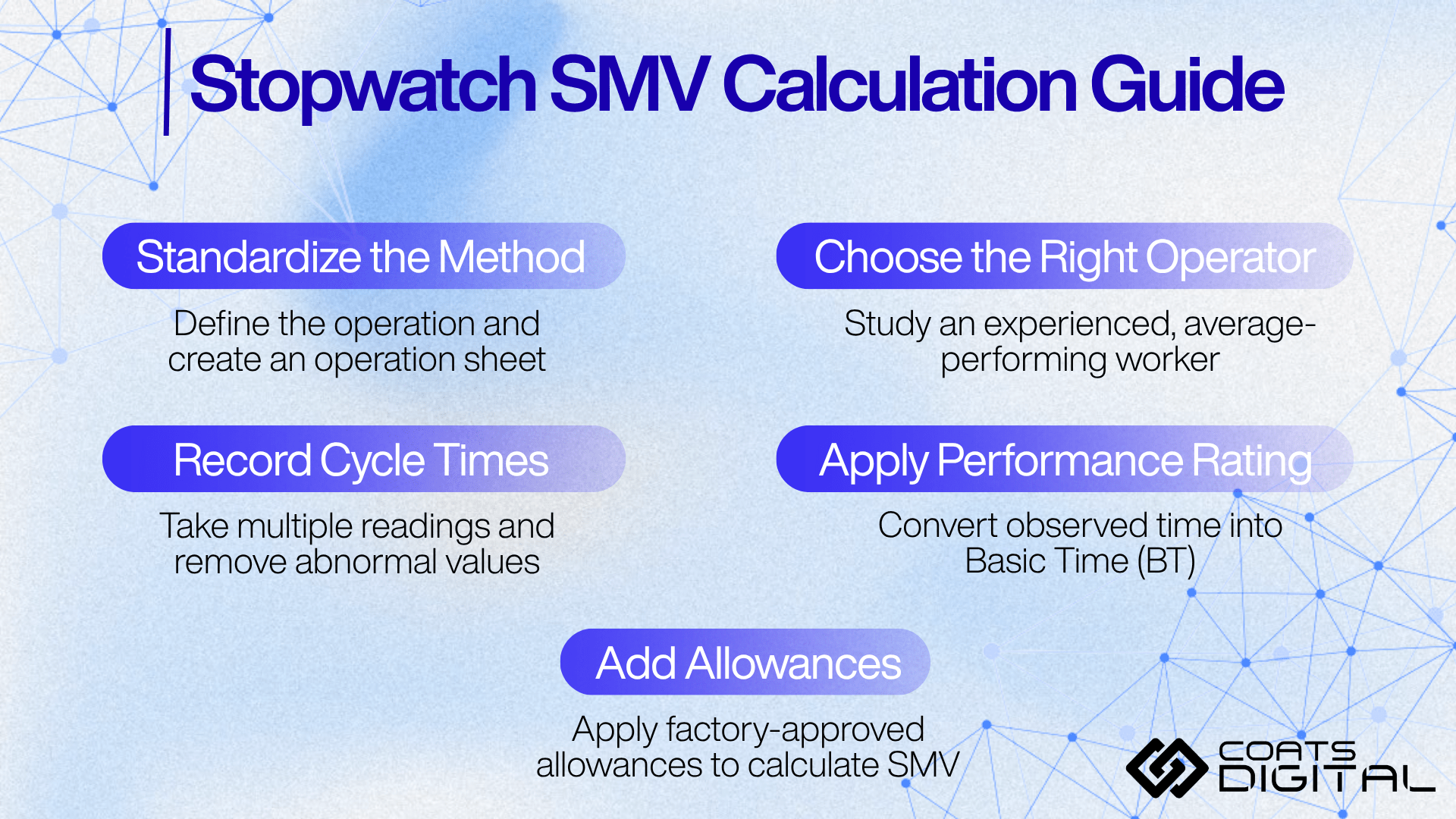
The stopwatch time study remains the primary SMV calculation method on Indian factory floors. Executed correctly, it produces valid, audit-ready data. Here is the five-step process.
1. Standardise the Method and Prepare the Operation Sheet
Before the stopwatch comes out, the operation has to be documented. An operation sheet defines machine type and settings, thread specification, seam allowance, operator posture, workplace layout, and the hand-motion sequence. Studying an unstandardised operation produces a time that reflects one operator’s habit on one day, not a reliable standard. Any study run without a method sheet should be treated as a preliminary observation, never a published SMV. This is the “method-first, then time” principle, and skipping it invalidates everything that follows.
2. Select the Right Operator and Study Conditions
The operator should be trained, experienced on that specific operation, and working at a pace representative of the experienced workforce, not the fastest person on the line. Conduct the study during normal production hours, away from warm-up periods or break recovery. Explain to the operator what is happening. A relaxed, informed operator produces better data than one who is anxious about being watched.
3. Record Cycle Times and Handle Abnormal Readings
Take a minimum of ten complete cycle time readings; twenty is better for variable operations. After recording, review for abnormal values. A cycle more than 20 to 25 per cent outside the mean is typically caused by an external interruption, a dropped piece, a quality issue, a conversation, and should be excluded with a note. Average the remaining valid readings to produce the Observed Time (OT).
4. Apply Performance Rating to Calculate Basic Time
Performance rating is applied simultaneously with observation. A worker moving slower than standard is rated below 100, for example 85; a faster worker rates above 100, for example 110. Basic Time normalises this, so a fast or slow operator yields the same BT for the same work. Rating is a trained skill, and the credibility of the entire study rests on it being calibrated rather than guessed.
5. Apply Factory-Defined Allowances to Arrive at SMV
Apply the allowance percentages from your validated allowance table to the Basic Time. The result is the Standard Minute Value for that operation.
SMV Calculation
SMV = BT × (1 + Total Allowance %)
Example: BT = 0.618 min, Total Allowance = 15% SMV = 0.618 × 1.15 = 0.711 min
Worked Example: Attach Sleeve on a Basic Knit T-Shirt
| Cycle No. | Cycle Time (min) | Excluded? |
| 1 | 0.68 | No |
| 2 | 0.65 | No |
| 3 | 0.67 | No |
| 4 | 0.91 | Yes: thread break |
| 5 | 0.66 | No |
| 6 | 0.64 | No |
| 7 | 0.67 | No |
| 8 | 0.65 | No |
| 9 | 0.68 | No |
| 10 | 0.66 | No |
Full Calculation: Attach Sleeve
Valid readings: 9 cycles (cycle 4 excluded) Sum of valid readings = 5.96 min OT = 5.96 ÷ 9 = 0.662 min
Performance Rating: 95 BT = 0.662 × (95 ÷ 100) = 0.629 min
Factory Allowance: 15% (personal 5% + fatigue 6% + machine delay 4%) SMV = 0.629 × 1.15 = 0.723 min
Hourly Target = 60 ÷ 0.723 ≈ 83 pieces/hour
That single figure, 0.723 minutes, now drives the operator target, the line balance for this operation, and its share of the garment CM. The discipline that produced it is what separates a number you can defend in a buyer audit from one you simply hope is right.
GSD and PMTS: Calculating SMV Without a Stopwatch
What Are Predetermined Motion Time Systems (PMTS)?
Predetermined motion time systems (PMTS) calculate the time an operation requires from a description of the motions involved, without observing anyone perform the work. The principle is that human motions, reach, grasp, position, release, have predictable time values that can be catalogued and summed. MTM (Methods-Time Measurement), first published in 1948 by Maynard, Stegemerten, and Schwab in the United States, is the foundational PMTS used worldwide and remains the most validated system of its kind.
The significant advantage is timing. An SMV can be calculated before the operation is ever performed, in the design office, at quotation stage, before a single garment is cut. That makes PMTS the method of choice for pre-production costing and new-style analysis.
General Sewing Data (GSD): PMTS Built for Apparel
GSD is a PMTS developed specifically for apparel manufacturing. Where general MTM systems require decomposing every motion from first principles, GSD provides an industry-standard motion-code library calibrated for sewing operations, stitching, handling, folding, aligning, and positioning, which enables faster and more consistent analysis.
Coats Digital’s GSDCost is the apparel industry’s leading implementation of GSD and is widely recognised as the de-facto international standard across the sewn products sector. It lets IE teams build pre-production operation bulletins, calculate synthetic SMVs, and produce audit-ready costing documentation before production begins. For Indian factories supplying international retailers that demand costing transparency, that pre-production audit trail is something a stopwatch study alone cannot provide. GSDQuest, Coats Digital’s AI-powered Bill of Labour tool, goes a step further by analysing product images to identify construction elements and generate a standardised operation sequence, reducing the manual effort of building a complete bulletin for a new style.
The Hybrid Approach: How Efficient Indian Factories Use Both Methods
The most mature IE practices in Indian garment manufacturing do not pick a side between PMTS and stopwatch. They use both, at the stage where each adds the most value.
| Stage | Method | Purpose |
| Pre-production / Costing | GSD / GSDCost | Calculate synthetic SMV; produce costing documentation before production begins. |
| Pilot Line / First Run | Stopwatch | Validate synthetic SMV against actual operator performance; calibrate allowances. |
| Ongoing Production | Stopwatch monitoring | Track SMV drift as methods evolve; update when operations change. |
| Annual IE Audit | GSD + Stopwatch | Identify gaps between synthetic and actual; refresh operation bulletins. |
Core SMV Formulas and a Worked T-Shirt Example
Garment IE: Core Formula Reference
- Observed Time (OT) = Sum of valid cycle times ÷ Number of valid cycles
- Basic Time (BT) = OT × (Rating ÷ 100)
- SMV = BT × (1 + Allowance %)
- Earned Minutes = SMV × Units Produced
- Efficiency % = (Earned Minutes ÷ Available Minutes) × 100
- Daily Capacity = (Available Minutes × Target Efficiency %) ÷ SMV
- Hourly Target = 60 ÷ SMV
- CM per Piece = Labour Cost per Minute × SMV
Operation Bulletin: Basic Knit T-Shirt
The table below shows a simplified operation bulletin for a basic single-jersey knit T-shirt. The SMVs are illustrative, and actual values vary with fabric weight, stitch type, seam length, and factory performance level. A complete commercial bulletin would also carry additional operations such as neck tape, size and care label attach, thread trimming, and pressing, which push the realistic total higher than a simplified seven-operation view. Use an analytical tool such as GSDCost to generate derived SMVs for your own styles.
| # | Operation | Machine Type | Sample SMV (min) |
| 1 | Shoulder Join | Overlock 5-thread | 0.38 |
| 2 | Collar Attach | Flat-lock / Overlock | 0.52 |
| 3 | Sleeve Attach | Overlock 5-thread | 0.72 |
| 4 | Side Seam Close | Overlock 5-thread | 0.48 |
| 5 | Hem (Bottom) | Cover-seam | 0.44 |
| 6 | Label Attach | Feed-off-the-arm | 0.31 |
| 7 | Inline Inspection | Manual | 0.71 |
| Total Garment SMV | 3.56 min |
T-Shirt SMV Applications
Total Garment SMV: 3.56 min | Available minutes per 8-hr shift: 480 | Target Efficiency: 75%
Daily Capacity (per operator) = (480 × 0.75) ÷ 3.56 ≈ 101 pieces
Example CM Costing (assume Rs 1.80 per minute, all-in): CM per Piece = (3.56 × Rs 1.80) ÷ 0.75 = Rs 8.54
Always use your factory’s validated cost per minute. Accurate SMVs only translate into commercial advantage once they flow into planning, which is where FastReactPlan converts IE data into optimised capacity and schedules.
Common SMV Calculation Mistakes in Indian Factories: A Self-Diagnostic

A short diagnostic that factory IEs and operations directors can apply to their own practice. The following six errors account for the majority of SMV inaccuracy in Indian garment factories.
Errors in Time Study Execution
- Too few cycle observations. A study built on five or six cycles produces an unreliable observed time. Highly repetitive operations may tolerate ten cycles. Variable or complex operations need twenty or more. More variability demands more cycles, and this is not optional.
- Studying the fastest operator. Selecting the fastest person on the line, deliberately or by default, produces a Basic Time that no typical operator can replicate at scale. The study operator should represent the experienced norm.
- Uncalibrated performance rating. An analyst without formal rating calibration is producing subjective values. A rating error of plus or minus 10 per cent translates directly into an SMV error of the same magnitude, which for a 500-operator factory carries real financial consequences.
Errors in Allowance and Method Policy
- Copied allowances from external sources. Using allowance tables from textbooks, online resources, or a neighbouring factory is a structural error. A factory running nine-hour shifts without climate control through an Indian summer carries a different fatigue burden from an air-conditioned eight-hour operation. Your allowance table must reflect your factory.
- Failure to update SMV after method changes. When a machine is upgraded, a jig introduced, or a sewing sequence modified, the affected operation SMV changes. Without a formal change-management process, published SMVs drift further from reality with every improvement made on the floor.
Errors in Data Governance
- Uncontrolled spreadsheets and multiple versions of truth. When the line supervisor, the costing team, and the production planner each work from a different SMV, efficiency reporting and commercial position become impossible to reconcile. Centralised SMV records, ideally in a dedicated IE system, are a non-negotiable governance requirement, because that is where version control and an audit trail live in a way spreadsheets cannot match.
What Re-Studying Actually Delivers: Documented Coats Digital Results
The payoff from correcting these errors is measurable, and Coats Digital’s published customer outcomes show the scale of it when factories replace inherited or estimated SMVs with disciplined method analysis. Egyptian knitwear manufacturer DICE reduced its core-style SMV by 11 per cent in the initial implementation phase of GSDCost and gained a 16 per cent increase in production line efficiencies during the trial. ODLO established accurate, method-engineered SMVs and reported a 13 per cent reduction on core styles alongside a 10 per cent improvement in overall productivity.
At the upper end, leading apparel manufacturer Shanghai Jiale reduced its SMVs by over 30 per cent after adopting the same analytical approach, a result strong enough that the wider Jiale Group began rolling the solution out across its production base. The common thread across these cases is not a single piece of software. It is the shift from estimated numbers to standardised method, calibrated time, and a single controlled source of record.
Software for SMV Calculation in Apparel: What to Use and When

The Software Landscape
- GSD and PMTS platforms (GSDCost). The international standard for pre-production SMV calculation, analytical costing, and audit-grade operation bulletins.
- AI-assisted costing (GSDQuest). Automates Bill of Labour creation and operation-sequence generation, cutting analysis time for high-volume style programmes.
- Digital time study apps. Mobile and tablet applications that replace paper forms, enabling real-time capture, automatic averaging, and cloud-based storage. Useful across all factory sizes.
- Structured Excel templates. A practical starting point for factories without dedicated IE software, effective only when version-controlled, access-restricted, and reviewed on a defined schedule.
- Production planning integration (FastReactPlan). Accurate SMV has to flow into planning to deliver commercial benefit. FastReactPlan converts IE data into optimised capacity plans and production schedules.
Factory-Tier Recommendation
| Factory Profile | Scale | Recommended Approach |
| Small factory | Under 150 operators, domestic supply | Structured Excel template plus a digital time study app. Prioritise version control and a defined SMV review cycle. The investment is minimal; the accuracy gain is significant. |
| Mid-size exporter | 150 to 500 operators, international buyers | GSDCost for new-style costing, a digital time study app for floor validation, and FastReactPlan integration. Buyer audits typically require analytical costing documentation for key styles. |
| Large multi-factory exporter | 500-plus operators, multiple buyers and sites | GSDCost plus GSDQuest plus FastReactPlan, backed by an integrated IE governance framework. Consistency across sites and a full audit trail are non-negotiable at this scale. |
The India proof point sits in this last tier. Madura Garments Exports, a subsidiary of the Aditya Birla Group and one of India’s largest shirt manufacturers, adopted Coats Digital’s FastReactPlan and, within two years, produced 34.5 per cent more output with only 25.5 per cent more machines and labour, an operational efficiency gain of around 7 per cent. Over the same period, the business cut delivery penalties from nearly 1.3 million US dollars to under 67,000, and lifted its On-Time-In-Full ratio from 35 per cent to roughly 85 per cent. Accurate work content fed into disciplined planning is what made those numbers move.
Conclusion: SMV as Your Factory’s Single Source of Truth
SMV accuracy is not a one-time project. It is a continuous discipline, the combination of rigorous time study, factory-defined allowances, calibrated rating, documented method, and IE governance that decides whether every commercial decision in your factory rests on data or on approximation.
The choice between stopwatch, PMTS, and GSD is not ideological. It is contextual. Large exporters with trained IE teams and international buyer accountability need the audit trail and pre-production capability that GSD and PMTS provide. Smaller factories with limited IE resources can build a credible SMV system with structured stopwatch practice and disciplined data management. The requirement that holds across every scale is identical: factory-defined allowances, version-controlled records, and a commitment to updating SMVs whenever methods change.
Where to go next:
- Review how analytical method-time-cost benchmarking establishes pre-production SMVs with GSDCost.
- See how AI-generated Bills of Labour speed up new-style analysis with GSDQuest.
- Explore how accurate SMVs convert into capacity and on-time delivery gains through production planning with FastReactPlan.
If your published SMVs were last studied before your most recent line upgrade, that is the place to start. Re-study the core operations, document the method, and centralise the records, then decide which tools fit your scale.
Frequently Asked Questions
-
What is the difference between SMV and SAM in the garment industry?
SMV (Standard Minute Value) and SAM (Standard Allowed Minutes) both describe the time in minutes for a qualified operator at standard performance to complete an operation, including allowances. SAM is more common in American and some South Asian usage, while SMV dominates in UK-influenced and international buyer documentation. In day-to-day practice, the formula and methodology are treated as identical, so the difference is largely one of nomenclature rather than substance.
-
How do I calculate SMV step by step?
Standardise the operation and document the method. Select a trained, representative operator. Record at least ten cycle times, excluding abnormal readings. Calculate the observed time as the average of valid cycles. Apply a performance rating to reach basic time (BT = OT × Rating ÷ 100). Apply your factory’s allowance percentage (SMV = BT × (1 + Allowance %)). The result is the published SMV for that operation.
-
How many cycles should I observe in a time study?
A minimum of ten cycles for simple, repetitive operations, and twenty for variable or complex tasks. Where a statistical approach is preferred, calculate the required sample size from the standard deviation of initial readings using 95 per cent confidence and plus or minus 5 per cent accuracy. The ILO Work Study guide sets out the standard formula.
-
How does SMV affect CM and CMT costing?
SMV is a direct input to CM and CMT costing. Your factory cost per minute, all-in labour and overhead divided by productive minutes per operator per day, is multiplied by total garment SMV to give CM per piece. An SMV that is 10 per cent too high inflates the quote and risks losing the order. One that is 10 per cent too low compresses margin on every unit produced. Accurate SMV is a commercial function, not only a technical one.
-
What software is used to calculate SMV in the apparel industry?
The range runs from structured Excel templates to AI-powered platforms. GSDCost is the industry standard for pre-production analytical SMV calculation. GSDQuest adds AI-driven Bill of Labour automation. Digital time study apps handle floor-based stopwatch studies, and FastReactPlan converts SMV data into capacity and scheduling outputs.
-
How often should SMVs be revised?
Whenever a method change, equipment upgrade, or material change affects the operation, and at minimum once a year. Factories that revise SMVs only when they notice an efficiency anomaly are operating reactively. Method-change-triggered review is the correct proactive standard.
-
Can a small Indian factory calculate SMV without expensive software?
Yes. A calibrated stopwatch, a structured observation sheet, a factory-defined allowance table, and a trained IE analyst are the only essentials. Software improves consistency and enables pre-production costing, but it does not replace the foundational discipline of method standardisation, operator selection, and data governance. A structured Excel template paired with a digital time study app is a sound starting point.
-
What are typical SMV ranges for basic T-shirts and woven shirts?
As a general orientation only, a basic single-jersey knit T-shirt, crew neck and short sleeve, commonly falls somewhere in the region of 4 to 9 minutes once the complete operation bulletin, including labels, trimming, and pressing, is counted, with simplified sewing-only breakdowns landing lower. A basic woven cotton shirt with collar, cuffs, and a breast pocket typically ranges from around 12 to 25 minutes. These figures should never be used directly for costing or planning. Accurate SMVs must be derived from studies or analytical calculations specific to your factory’s methods and conditions.



All Blog Categories
- Method Time Cost Optimisation
- Production Planning
- Supply Chain Solutions
- Corporate
- Sustainability
- Videos