How Bangladesh Garment Factories Can Plan for Large Speed Orders from Global Buyers
by Kunal Kapur
 9
Mins Read
9
Mins Read
Key Takeaways
- Speed orders, replenishment runs and small test batches are now a structural share of global apparel sourcing for Bangladesh exporters, not an occasional exception.
- Most failed speed orders trace to one root cause: planning stays reactive, done on spreadsheets after the order lands, rather than predicted in advance.
- SMV-based predictive planning converts a chaotic order intake into a measurable, defensible capacity commitment, often within two to four hours of the buyer’s inquiry.
- Fabric and trim booking must run in parallel with line scheduling, never after it; parallel booking compresses materials lag from five to ten days down to 24–48 hours.
- Real-time WIP tracking prevents the “90% done, nothing shipped” failure that quietly erodes buyer confidence and repeat business.
- Line balancing software lets a factory absorb a sudden high-volume order without breaking the commitments already running on the floor.
- Predictive, digital factory management has become a buyer qualification criterion, particularly for vertically integrated mill-to-garment exporters competing on speed.
The Speed Order Economy and Why Bangladesh Must Be Ready
Global fast fashion and mid-market buyers have redrawn lead-time expectations from the ground up. What was a 60–90-day standard order cycle a decade ago is now regularly compressed to 15–21 days for reorder and replenishment, with “test-and-react” buying models keeping factories on near-permanent standby for sudden volume spikes.
Bangladesh, the world’s second-largest apparel exporter with USD 38.48 billion in shipments in 2024 according to WTO data, sits squarely at the centre of this pressure. The country’s growing base of vertically integrated operations, textile mills paired directly with RMG production under one ownership structure, has emerged as a real structural advantage here. Vertical manufacturing collapses the fabric-sourcing step that most stand-alone garment factories must negotiate externally, and Bangladesh’s knit sector already sources close to 90% of its yarn and fabric locally. Yet most factories, vertically integrated or not, still plan speed orders with the same tools they used for seasonal bulk: Excel, whiteboards and informal floor-level coordination.
The strategic implication is uncomfortable but simple. Global sourcing teams increasingly bypass factories that cannot demonstrate planned, documented capacity for speed orders. Buyers are not only looking for price, but they are also looking for execution confidence, and execution confidence now means predictive planning rather than reactive scrambling. This guide explains how Bangladesh RMG factories, including those running a vertical manufacturing model, can build the planning systems, processes and software infrastructure to take large speed orders reliably and profitably.
On this page:
- What Is Speed Order Planning in Garment Manufacturing?
- Why Standard Lead Times Are No Longer Standard
- The Five Pillars of Speed Order Planning
- Reactive vs. Predictive Planning: Where the Gap Shows Up
- Implementation Roadmap: Rolling Out Planning Software in Five Stages
- The Five Most Costly Mistakes When Accepting Speed Orders
- Technical Backbone and Implementation Realities
- Closing Thought
- Frequently Asked Questions
What Is Speed Order Planning in Garment Manufacturing?
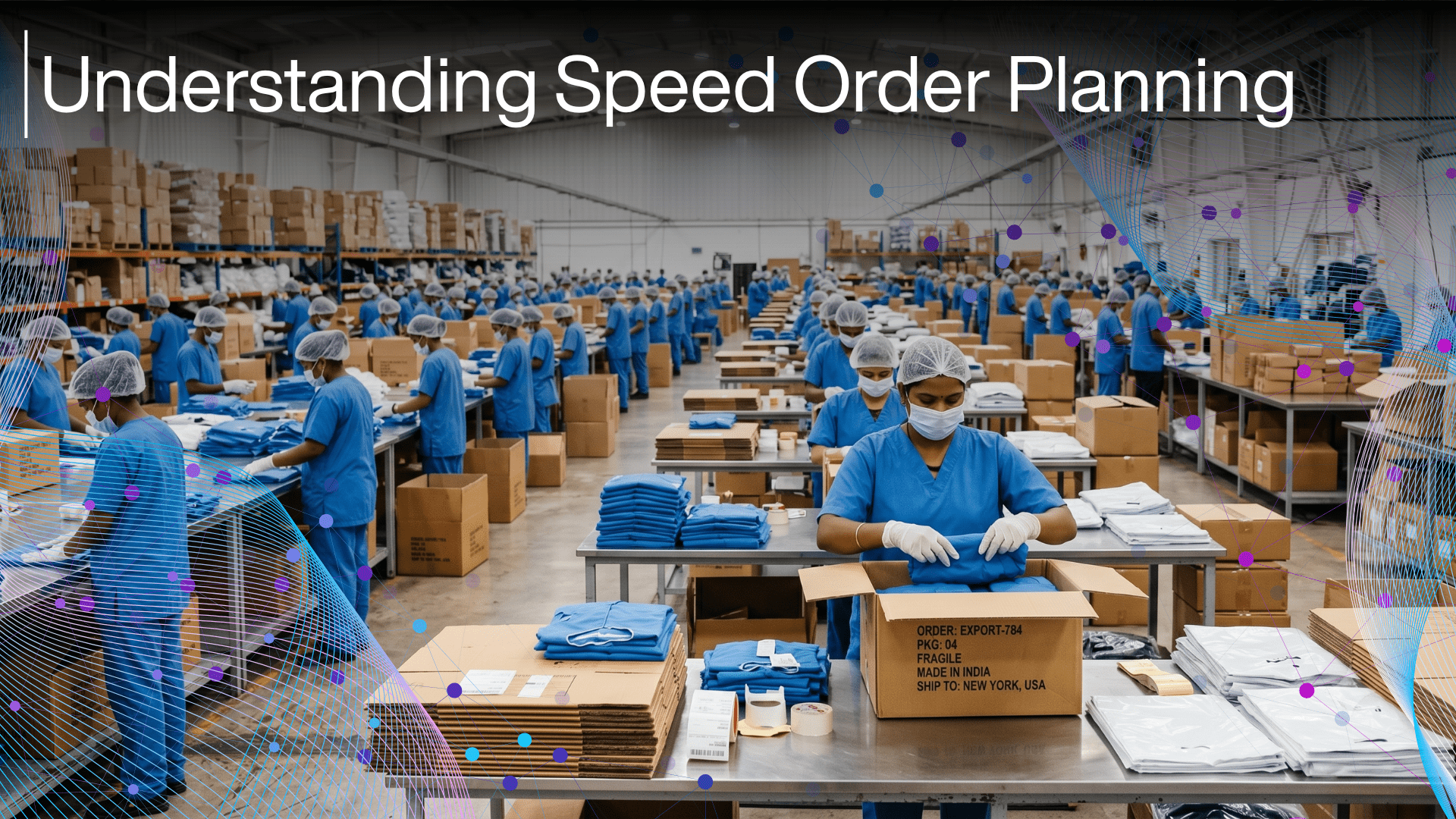
Speed order planning in ready-made garment manufacturing is the structured process of assessing real-time factory capacity, re-sequencing production lines, synchronising material procurement and compressing standard lead times, all while holding output quality steady. It differs from ordinary production planning in one decisive way: runway. In a normal order cycle, planning has days or weeks to settle. In a speed-order scenario, capacity assessment, line allocation, fabric booking and WIP scheduling all have to happen within hours.
In plain terms, speed order planning is the ability to answer a single question, “Can we take this order, start Monday and ship by day 18?”, with a documented, defensible answer rather than a gut call. It replaces optimism with arithmetic. It turns a verbal “yes” into a line plan, a materials calculation and a ship date that a buyer can rely on.
Contrast that with how most Bangladesh factories handle speed orders today. The General Manager says yes on the phone, the floor scrambles to make room, and the delivery risk is absorbed invisibly by the workforce through overtime, displaced orders and last-minute quality compromises. That reactive pattern is precisely what predictive planning is designed to replace.
Why Standard Lead Times Are No Longer Standard: The Buyer Demand Shift
The compression of lead times is not a passing phase; it is a structural change in how the world buys clothes. The rise of near-season and in-season replenishment, enabled by fast fashion’s real-time sell-through analytics, has pushed buyers towards demand-responsive sourcing.
McKinsey’s well-known segmentation of fashion supply chains captures the logic: basics still tolerate long cycles of six months or more, but new in-season product runs on an express cycle of three to six weeks, and untested styles move on a “read-and-react” model that rewards whichever factory can replenish a winner fastest. By many factory estimates, replenishment plus test and small-batch orders now account for roughly a third of total volume for Bangladesh exporters, up from a low single-digit share a decade ago.
| Order Type | Traditional Lead Time | Current Expectation | Factory Risk Level |
| Bulk seasonal order | 75–90 days | 60–75 days | Low |
| Replenishment order | 45–60 days | 21–30 days | Moderate |
| Test / small batch | 30–45 days | 15–21 days | High |
| Emergency reorder | 21–30 days | 10–15 days | Very High |
The reason this compression matters is the gap it exposes between two kinds of factory. A factory relying on reactive, after-the-fact planning cannot meet a 15-day window with anything firmer than a hope, because it has no way to know, at the moment of enquiry, whether the minutes are actually there. A factory running predictive, SMV-based scheduling, with real-time WIP data and connected fabric booking, can give a buyer a confirmed ship date within roughly two hours of that same enquiry. The difference is not just internal efficiency. That response speed is itself a competitive differentiator, because a sourcing manager weighing two suppliers will place the order with the one that answers first and answers with evidence. Lead-time compression has quietly turned the planning function into a sales function.
The Five Pillars of Speed Order Planning
SMV-Based Predictive Capacity Assessment
The Standard Minute Value is the unit of production truth. Before any speed order can responsibly be accepted, the factory must know exactly how many standard minutes of capacity are available, across which lines, at what efficiency rates, and after which existing orders are absorbed.
Predictive planning built on a clean SMV library converts a 50,000-piece speed order into a minutes-required figure, then maps it against available floor minutes in real time, before the order is confirmed. This is the work that costing and method-engineering tools such as Coats Digital’s GSDCost, the recognised industry standard for SMV calculation and method-time benchmarking, are built to do. Without an accurate SMV foundation, “yes, we can do it” is not a plan; it is a promise the factory cannot quantify. This is the core distinction between reactive planning, which discovers capacity problems after committing, and predictive planning, which surfaces them beforehand.
Line Balancing and Re-Sequencing
Taking a speed order rarely means dropping it into an empty factory. It means rebalancing active lines to absorb additional volume. Line balancing software calculates the optimal operator-to-operation distribution for the new style, identifies the bottleneck operations before they form, and models the impact of inserting the speed order into existing line plans. Visual production planning platforms such as FastReactPlan are designed for exactly this, letting planners test a re-sequence on screen before committing a single operator to it.
This is what prevents the most common speed-order failure mode: a factory that accepted the order but never moved any pieces off the original plan to make room, so both the new order and the displaced one slip.
Parallel Fabric and Trim Booking
The single most underestimated cause of speed-order delay is materials. A production plan that is finished before fabric is booked is not a plan at all. Integrated systems connect the production schedule directly to procurement, triggering fabric and trim booking the moment a speed order is confirmed, not after line allocation is complete.
Fabric-planning tools such as FastReactFabric exist to keep buying and cutting on one connected platform so that the materials calculation moves at the same speed as the schedule. For Bangladesh factories sourcing locally from Narayanganj or Gazipur mills, or drawing on their own in-house textile mill under a vertical manufacturing model, this synchronised booking is achievable within 24–48 hours for standard constructions. Vertically integrated operations can often compress it further still, because they remove the external negotiation step entirely. This is where the structural advantage of mill-plus-RMG ownership turns into a measurable lead-time edge.
Real-Time WIP Tracking and Milestone Alerts
A speed order that is 80% complete on day 14 of a 15-day window is not “nearly done”; it is a shipment crisis. Real-time Work-in-Progress tracking gives production managers a live view of where every bundle sits in the assembly sequence, across cutting, sewing, finishing and QC, and raises an alert the moment output falls behind the daily target needed to hit the ship date. The technology ranges from manual scanning at operation checkpoints to full digital floor-management systems. What matters is not the hardware; it is that the data is live rather than collated at day-end, because a delay that surfaces at 6 p.m. has already cost the factory a shift it could have redirected.
Buyer Communication and Compliance Documentation
Speed orders carry elevated documentation risk. When a factory is moving fast, inspection bookings, lab test reports, packing-list accuracy and AQL records tend to lag behind the physical production. Planning software that integrates compliance checklists and generates buyer-required documentation at each production milestone prevents the worst version of this, where a garment is finished and folded but held at the gate by a missing test report.
Coats Digital’s platform sits naturally in this picture as an example of production and documentation management handled in one connected environment rather than as two parallel administrative streams, with VisionPLM extending the same logic back into product development and sourcing.
Taken together, these five pillars SMV-based capacity, line balancing, parallel fabric booking, real-time WIP and integrated documentation, give a factory manager a single framework to carry into an internal planning conversation. Each one closes a specific gap that reactive planning leaves open.
Reactive vs. Predictive Planning: Where the Gap Shows Up
The traditional reactive approach, a GM making a floor judgement, a planning manager working from Excel and a production head coordinating by phone, breaks down systematically once order volume crosses a threshold. The table below shows where.
| Planning Element | Reactive (Manual) Approach | Predictive (Digital) System |
| Capacity assessment | Hours to days; estimate-based | Minutes; SMV-accurate |
| Line re-sequencing | One to two days of floor disruption | Modelled before implementation |
| Fabric booking trigger | After the line plan is fixed | Simultaneous with the line plan |
| WIP visibility | End-of-day report | Real-time, operation-level |
| Delay detection | When it is already a crisis | When it is still correctable |
| Documentation | Assembled manually at shipment | Generated throughout production |
| Order acceptance confidence | Gut-level | Data-backed |
The gap between reactive and predictive planning is not, at root, a speed gap. It is a confidence gap. Predictive planning does not make a sewing operation faster in isolation; it makes the factory’s ability to say “yes” to a speed order defensible, and its ability to deliver on that yes consistent.
Buyers working with predictively planned suppliers report fewer late shipments, fewer QC surprises at final inspection and shorter approval cycles, and the operational outcomes are now visible in published case studies from the field. Texeurop (BD) in Bangladesh, for instance, automates 58% of their fabric cutting processes with Coats Digital’s FastReactFabric. All of that translates directly into repeat order volume and preferred-supplier status, which is the commercial prize the whole exercise is aimed at.
Implementation Roadmap: Rolling Out Production Planning Software in Five Stages
The most useful way to think about planning software is not as a technology purchase but as a factory process redesign that moves the operation from reactive to predictive in deliberate stages.
- Audit your current SMV data. Map where your operation times, standard minutes and line-efficiency records actually live today. Most factories discover their SMV data is a blend of historical estimates, IE assumptions and departmental folklore rather than a clean, current library. No planning software can produce reliable capacity numbers on top of unreliable SMVs, so this is the foundation everything else stands on.
- Standardise your line and operator data structure. Every sewing line, machine configuration and operator skill classification needs to exist in a consistent format before scheduling software can use it. This step typically takes four to six weeks. It is the least glamorous part of the whole project and, for that reason, the part most often rushed; it is also the part that most determines how accurate your outputs will be.
- Connect materials to production milestones. Build the link between your production schedule and your fabric and trim booking, or, for vertically integrated operations, your in-house mill’s output schedule, so that a confirmed order line automatically generates a materials requirement calculation. Even a basic shared-spreadsheet integration to begin with, formalised into an API later, is transformative compared with no link at all.
- Run shadow scheduling for 30 to 60 days. Plan every new order twice, once manually and once through the system, and document the variance between the two. This builds the IE team’s trust in the outputs, surfaces data-quality issues while the stakes are low, and creates the internal evidence base you will need to persuade sceptical owners and buyers that the system can be relied on.
- Activate real-time WIP scanning. Once the planning outputs are trusted, install operation-level WIP checkpoints, whether barcode, RFID or mobile scan, so that daily production data feeds back into the schedule automatically. This closes the loop between planned and actual, and completes the shift from a reactive process to a genuinely predictive one.
The Five Most Costly Mistakes When Accepting Speed Orders
Read this as a self-diagnostic. If two or more of these describe your factory floor, your speed-order risk is sitting in your planning process, not your production capability.
- Saying yes without checking available minutes. The most expensive habit in Bangladesh RMG is accepting a speed order on the basis of factory size rather than actual available capacity. A 1,200-machine factory that already has 94% of its minutes committed cannot take a 50,000-piece order on a 15-day window, but it often does anyway, and pays for it in overtime, quality failures and damaged buyer relationships.
- Treating fabric booking as a post-planning step. Booking fabric after the line plan is set introduces a five to ten day lag that a speed order simply cannot absorb. Factories that book fabric in parallel with their production planning routinely compress their total lead time, because the materials clock and the production clock finally start at the same moment.
- Failing to rebalance existing lines before inserting the speed order. Dropping a speed order onto an already-scheduled floor without modelling the impact creates invisible capacity debt. It surfaces later as delays on both the new order and the existing orders it quietly displaced, usually at the worst possible time.
- Measuring progress by pieces, not by minutes. A line that has completed 60% of its pieces may have only 35–40% of its production minutes remaining, because the harder, more labour-intensive operations are typically still ahead. WIP tracking that counts bundles rather than operation-level minutes gives a systematically optimistic picture, and that single distortion is often the largest contributor to last-minute shipment crises.
- Discovering documentation gaps only at final inspection. When AQL records, lab test reports or packing-list entries are assembled after production rather than checkpointed during it, a factory can be physically ready to ship and still face a hold. Building documentation checkpoints into the production schedule itself, rather than treating paperwork as a separate administrative task, is what separates the factories that ship on day 18 from those still chasing reports on day 19.
Technical Backbone and Implementation Realities
It is worth being candid about something most planning-software vendors underplay: the factories that struggle with adoption usually do not have a technology problem; they have a data-quality problem.
An SMV library built on inconsistent historical records, an operator-skills database that was never formally maintained, or a fabric-inventory system that effectively runs on WhatsApp will not become reliable simply because a software layer has been placed on top of it. The system inherits the quality of the data beneath it, and a tidy interface over messy records produces confident-looking numbers that are quietly wrong.
The organisational reality matters just as much. Production planning software requires a shift in how authority flows on the factory floor. Decisions that were previously made by experienced supervisors on the strength of institutional knowledge have to move towards decisions validated against data outputs, and that cultural change is the real core of the reactive-to-predictive shift. It takes time, it generates resistance, and it needs deliberate change management from senior leadership. None of this is a reason to delay; these are solvable challenges, not roadblocks. It is worth noting that the Bangladesh factories that have implemented planning systems successfully almost always credit one internal champion with the will to hold the line through the difficult transition period. Technology rarely fails on its own merits; it fails when no one owns the change.
Closing Thought
In a sourcing environment where a buyer’s decision to place a speed order with your factory or your competitor’s comes down to confidence, the factories that win are not necessarily the ones with the lowest CM or the newest machines. They are the factories that can answer “yes, we can ship by day 18” with a line plan, a WIP schedule and a fabric booking confirmation attached. That is not a gut call. That is a predictive planning system doing its job. Planned, not promised, is the whole difference, and in the speed order economy it is increasingly the difference between a preferred supplier and a backup option.
Your next step: Audit your current speed order response process. If your factory takes more than 24 hours to confirm capacity, assign lines and book materials for an unplanned large order, then your planning process, not your production capability, is your primary constraint. That is a fixable problem, and fixing it is where execution confidence starts.
Frequently Asked Questions
-
What software helps Bangladesh garment factories plan for large speed orders from global buyers?
Production planning platforms built specifically for RMG, such as Coats Digital’s factory management suite, let factories assess SMV-based capacity in real time, re-sequence lines and synchronise fabric booking with production schedules. General ERP systems are not designed for operation-level garment scheduling. Factories evaluating software should prioritise tools with a built-in SMV library, line-balancing capability and WIP tracking at the operation level rather than at the order level.
-
What is SMV, and why does it matter for speed order planning?
Standard Minute Value is the number of minutes a trained operator working at 100% efficiency needs to complete one unit of a garment operation. In speed order planning, SMV is the unit of capacity truth: it converts an order quantity into a minutes-required figure, which can then be matched against available floor minutes. Without accurate SMVs, any capacity commitment is an estimate dressed up as a plan, and speed orders punish estimates.
-
How much lead time can a predictively planned Bangladesh factory compress compared to a reactively planned one?
The compression varies by factory size and order complexity, but factories using integrated, predictive planning typically report confirming speed-order capacity and generating an initial line plan within two to four hours of an enquiry, against one to two days for reactive, manual processes. Connecting materials booking to the schedule generally saves a further five to ten days across the full lead time by removing the sequential wait for fabric.
-
What is line balancing in garment production, and why does it matter for speed orders?
Line balancing distributes sewing operations across operators and machines so that no single operation becomes a bottleneck that throttles the whole line. In a speed-order scenario, inserting a new high-volume style into an already-scheduled line requires rebalancing, which means recalculating the optimal operation-to-operator assignment for the combined workload. Software that models this before implementation prevents the floor disruption that almost always accompanies a manually managed speed-order insertion.
-
How should a Bangladesh factory handle fabric booking for a speed order?
Fabric booking for a speed order must happen in parallel with production line allocation, not after it. The moment the order is confirmed, the planning system should generate a materials requirement calculation, covering fabric, trims and accessories, and trigger procurement outreach at the same time. For factories sourcing from local mills, or running their own mill under a vertical manufacturing model, this parallel approach can cut the materials lag from five to ten days to 24–48 hours for standard fabric constructions.
-
How long does it take a Bangladesh garment factory to implement production planning software?
A basic implementation, covering SMV data upload, line-structure configuration and manual scheduling, typically takes six to ten weeks. Full integration with fabric booking, WIP scanning and buyer documentation generally needs four to six months. The primary constraint is data readiness rather than software complexity: factories with clean SMV libraries and structured line records implement faster and reach reliable accuracy earlier than those starting from scattered historical estimates.
-
Is production planning software only viable for large Bangladesh factories?
No. Large factories of 5,000 operators and above historically drove adoption, but SaaS-based RMG planning tools have brought the category within reach of mid-size factories of 500 to 2,000 operators. The real constraint is data readiness and internal process discipline, not factory scale. A 600-machine factory with clean SMV records and a structured IE function can implement and benefit from planning software just as effectively as a much larger exporter.
-
How does speed order planning software help with buyer compliance in Bangladesh RMG?
Planning software that builds compliance milestones into the production schedule ensures inspection bookings, lab test submissions, AQL records and packing documentation are generated progressively throughout production rather than assembled in a rush at the end. For buyers with strict compliance requirements, including documentation tied to EU-bound shipments, that integration directly reduces the risk of shipment holds caused by paperwork gaps surfacing only at final inspection.



All Blog Categories
- Production Planning
- Supply Chain Solutions
- Corporate
- Method Time Cost Optimisation
- Sustainability
- Videos