How Bangladesh RMG Factories Can Prove Their Production Costs Are Accurate, Not Inflated
by Kunal Kapur
 9
Mins Read
9
Mins Read
Key Takeaways
- Buyers doubt factory costs because stopwatch and historical costing produce numbers that only the factory can reproduce, so buyers cannot verify them and assume padding.
- A Standard Minute Value (SMV) built from predetermined motion-time data gives the same result regardless of who calculates it, which makes it verifiable.
- SMV and SAM are the same measure: standard minutes to complete a garment operation. SMV is used in Europe, SAM in South Asia.
- GSDCost applies 39 predetermined motion codes to calculate standardised SMVs and produces an operation-level Bill of Labour that buyers can audit.
- GSDQuest generates a standardised Bill of Labour from a product image, tech pack, or PDF in seconds, and reduces costing time by around 90 per cent.
- Separate three levers in negotiation: garment minutes, factory efficiency, and cost per minute. Each can be verified and agreed on its own.
- Bangladesh loses duty-free EU access at LDC graduation, so price competitiveness must come from measured efficiency rather than tariff advantage.
When a buyer pushes back on your cost sheet and calls the number inflated, the problem is rarely the price itself. It is that your price cannot be independently checked. A factory can quote an honest cost of make and still lose the argument, because the method behind the number, usually a stopwatch reading or a historical average, produces a figure only that factory can vouch for. The fix is to replace the unverifiable number with a science-based Standard Minute Value (SMV) built from predetermined motion-time data, backed by a transparent, auditable Bill of Labour. That single shift turns “trust me” into “verify me”, and it is the difference between defending your margin with evidence and defending it with insistence.
This matters more now than it did five years ago. Margins on cost of make have narrowed to low single digits, open costing has spread across the Bangladeshi export base, and the country is preparing for a post-graduation trading environment in which its historical price advantage will erode. In that climate, a costing method a buyer already recognises is not an administrative nicety. It is a commercial defence.
Why Global Buyers Doubt Factory Cost Submissions
Most cost disputes trace back to a single structural fact: the buyer and the factory do not hold the same information, and the buyer knows it. A merchandiser reviewing dozens of quotes for the same style has a rough sense of what the garment should cost, but no way to confirm what any individual factory’s cost actually is. When the number cannot be checked, suspicion becomes the rational default. The buyer assumes some padding is built in, discounts accordingly, and the negotiation opens from a position of distrust.
That dynamic is sharpened by the sheer scale of competition. Ready-made garments account for roughly 81 to 84 per cent of Bangladesh’s total export earnings, with the sector fetching US$39.34 billion in FY25 out of US$48.28 billion in total national exports according to Export Promotion Bureau data. Thousands of factories compete for the same buyers, and that imbalance hands pricing power to the buyer. Manufacturers report being given a profit margin of just 1 to 4 per cent on the cost of making, as reported by The Business Standard, which means every disputed cent is material. There is no comfortable buffer to absorb an aggressive discount.
The result is a market where a factory quoting a completely legitimate cost is treated the same as one quoting an inflated one, because the buyer has no tool to tell them apart. The honest factory ends up subsidising the buyer’s suspicion.
The Information Gap Between Buyer and Factory
The buyer sees an output, a total cost, with no visibility into how it was built. Was the labour content measured or estimated? Does it reflect an efficient method or an inefficient one? Without that breakdown, the buyer cannot separate a fair cost from a padded one, so every submission attracts the same scepticism.
Why Competition Pushes Prices Down
With a large supplier base chasing the same orders, buyers can always find another factory willing to quote lower. Manufacturers describe a long downward spiral in unit prices, in which the pressure to stay operational drags quotes toward, and sometimes below, the true cost of production. Intense competition among factories further weakens their ability to negotiate on price.
The Hidden Cost of an Unverifiable Number
An unverifiable cost carries a price even when it is accurate. It invites a discount the factory then has to absorb; it lengthens the negotiation, and it erodes the trust that underpins repeat orders and preferred-vendor status. The factory pays for the ambiguity, whether or not it ever padded a single line.
Why do buyers think factory costs are inflated? Buyers doubt factory costs because they cannot independently verify them. When a cost is built from a stopwatch reading or a historical average that only the factory can reproduce, the buyer has no way to confirm it is accurate, so they assume some padding and discount accordingly. Intense competition among thousands of suppliers reinforces that default suspicion.
What “Open Costing” Really Means for Bangladeshi Exporters

Open costing is a pricing approach in which the factory shares a detailed, itemised breakdown of a garment’s cost, materials, labour, overhead and profit, rather than quoting a single fixed price. The buyer reviews each line and, in effect, approves the build-up. In principle it is a transparency mechanism. In practice, its effect on the factory depends entirely on whether the shared numbers can be defended.
This is a different model from FOB (freight on board) pricing, where the factory quotes an all-in price that bundles the various cost factors together and retains room to earn margin on materials and accessories. Under open costing, buyers set the price against the transparent cost breakdown, and there is far less room to earn additional profit on inputs. The approach has spread quickly in Bangladesh. The Business Standard reports that open costing has grown from around 10 per cent to roughly 60 per cent of total exports over the past decade, shifting a significant degree of pricing control toward buyers. These figures come from trade-press reporting rather than official statistics, so they are best read as directional.
That shift is why open costing has become a live industry debate. Some manufacturers argue it has turned into a tool for buyers to compress margins, and have called for a BGMEA-administered price floor to stop factories undercutting one another. When one manufacturer proposed publishing standardised costs and a price floor on the BGMEA website, the stated intent was to stop buyers exploiting the fragmented supplier base. Whether a price floor is workable in an industry as diverse as Bangladesh’s is contested, but the underlying grievance is real.
Open Costing vs FOB: What’s the Difference?
Under FOB pricing, the factory quotes a single delivered price and keeps the internal build-up private, which preserves some margin on materials and accessories. Under open costing, the factory exposes every cost line and the buyer prices against that breakdown. FOB protects margin through opacity; open costing exposes it to scrutiny. The decisive variable is whether the factory’s numbers survive that scrutiny.
Why Open Costing is Spreading in Bangladesh
Buyers favour open costing because it gives them visibility and control, and in a buyer’s market they have the leverage to require it. As global brands standardise sourcing practices and press for supply-chain transparency, more of them have made an itemised cost breakdown a condition of doing business, which is why its share of Bangladesh’s export mix has climbed so sharply.
The Leverage Trap: When Transparency Works Against You
Here is the trap. Sharing a cost breakdown only helps the factory if each line can be independently defended. If the labour figure rests on a subjective stopwatch reading, transparency simply gives the buyer more surface area to challenge, and the factory has no external standard to point to. Exposing an unverifiable number does not build trust; it hands the buyer a target. The way out is not to share less, but to make what you share defensible.
The Root Cause: Why Stopwatch and Historical Costing Can’t Be Verified
The reason a cost submission cannot be verified usually sits in how the labour content, the SMV, was measured. The two most common methods, stopwatch time study and historical averaging, both produce numbers that an outside party cannot reproduce, which is precisely the ambiguity buyers distrust.
A stopwatch time study captures one operator, on one day, performing one operation, then multiplies the observed time by a performance rating the analyst assigns by eye. That rating step is the weak point. The standard time-study formula is Observed Time multiplied by (Rating divided by 100), then multiplied by (1 + Allowance percentage), and the rating is a subjective judgement about whether the operator was working faster or slower than normal pace. Two qualified analysts watching the same operator can reasonably assign different ratings, and so arrive at two different “true” times for the same operation. When the factory’s number depends on a judgement call, the buyer has every reason to question it.
Historical-average costing carries a different flaw. It builds the new cost from what past production actually took, which bakes in whatever inefficiency existed in that history: wrong methods, unbalanced lines, avoidable delays. The factory ends up defending a number that reflects how it happened to perform before, not how the garment can efficiently be made, and that is a difficult position to argue from.
One vocabulary point is worth settling here, because it causes needless confusion. SMV (Standard Minute Value) and SAM (Standard Allowed Minutes) are the same measure. The term SMV is more common in the UK and Europe; SAM is more common in South Asia. A buyer talking about SAM and a factory talking about SMV are describing the identical concept: the standard time, in minutes, to complete an operation under defined conditions.
How Stopwatch Costing Works Actually
An industrial engineer observes an operator operating, times it with a stopwatch across several cycles, and records the average. They then apply a performance rating to normalise for the operator’s pace and add allowances for fatigue, personal needs, and unavoidable delays. The output is a standard time, but it is anchored to one observation session and one analyst’s rating.
Where Subjectivity Creeps In
The subjectivity lives in the rating. Deciding that an operator is working at 90 versus 110 per cent of normal pace is a trained judgement, not a measurement, and it scales the final time directly. Research on work measurement notes that stopwatch studies carry human error and subjective assessment that predetermined systems are designed to remove. Change the rating, and you change the cost, which is exactly what a buyer suspects is happening.
SMV vs SAM: Same Measure, Different Name
SMV and SAM describe the same thing: the standard minutes required to complete a garment operation under normal conditions, including allowances. The regional preference differs, but there is no technical distinction. Using both terms interchangeably lets a factory speak the buyer’s language wherever the buyer sits.
Is SMV the same as SAM? Yes. SMV (Standard Minute Value) and SAM (Standard Allowed Minutes) are the same measure: the standard time in minutes to complete a garment operation under defined conditions. SMV is the more common term in the UK and Europe; SAM is more common in South Asia. There is no technical difference between them.
The Solution: A Science-Based, Independently Verifiable Cost Benchmark
If the problem is that a stopwatch reading cannot be reproduced by anyone else, the solution is a method that produces the same answer no matter who runs it. That is what a Predetermined Motion Time System (PMTS) does.
A PMTS breaks every operation down into a set of basic human motions- reach, grasp, move, position and assigns each motion a time value established through decades of controlled study and agreed internationally. Because the times are fixed and the method is defined, two analysts working from the same construction method will build the same SMV. The subjective rating step disappears. The most widely adopted PMTS, Methods-Time Measurement, was developed in 1948 by Maynard, Stegemerten and Schwab, and the approach has been refined and validated across industries ever since.
The evidence that this produces more defensible standards is well established. Industrial-engineering research consistently finds that predetermined systems deliver more reliable, consistent, and accurate standard times than stopwatch studies, precisely because they remove observation error and performance rating from the calculation. A 2026 peer-reviewed study applying PMTS in a Bangladeshi jeans manufacturing unit found that basing time on defined motion elements improves the consistency and accuracy of SAM calculations and supports fairer, more transparent wage-setting. The reproducibility is the whole point: it gives the factory and the buyer a common language for time and cost that either side can audit.
In sewn products, the PMTS that has become the reference standard is GSD (General Sewing Data), widely regarded across the industry as the de facto international benchmark for method-time-cost. Its core database is built on 39 motion codes, each mapped to an international standard time or SMV, and those 39 codes act as building blocks that combine to define thousands of operations across an unlimited range of styles. A cost built on that foundation is not one factory’s opinion. It is a number expressed in a vocabulary the buyer already accepts.
What is a Predetermined Motion Time System (PMTS)?
A PMTS is a work-measurement technique that decomposes a manual task into basic motions and assigns each a predetermined, internationally validated time value. Summing those values, plus allowances, gives the standard time for the operation, with no stopwatch and no performance rating. Because the motion times are fixed, the result is consistent and reproducible regardless of who performs the analysis.
Why Reproducibility is What Buyers Actually Want
Buyers are not really objecting to the size of a number; they are objecting to their inability to check it. A reproducible method solves that. When the same garment and the same construction method always yield the same SMV, the buyer can verify the labour content independently, and the accusation of inflation loses its footing. Reproducibility converts a disputed claim into a shared fact.
GSD: The Industry’s Common Language for Time and Cost
GSD functions as a shared standard the way a recognised unit of measurement does. When a factory in Bangladesh and a buyer in Europe both express labour content in GSD-based SMVs, they work from the same definitions, so a cost sheet built on GSD arrives pre-translated into terms the buyer trusts. That shared language is what makes fact-based negotiation possible.
Here is how the two approaches compare on the criteria a buyer cares about:
| Stopwatch / historical | PMTS / GSD-based SMV | |
| Basis | One operator plus a subjective rating | Predetermined international motion times |
| Reproducible? | No, varies by observer | Yes, method-driven |
| Buyer-auditable? | Difficult to defend | Yes, against a recognised benchmark |
| Common language with buyer? | No | Yes |
How GSDCost Gives Factories a Buyer-Recognised Costing Standard
The method becomes practical through software. GSDCost, the solution built on the GSD methodology by Coats Digital, is a SaaS platform that applies the 39 predetermined motion codes to each step of a garment’s construction to calculate a standardised, accurate SMV. It is used by leading brands and by apparel and footwear manufacturers, and the underlying method is widely acknowledged as the de facto international standard across the sewn products industry. In 2025, the platform’s standing was reinforced by external recognition, including the Software Innovation Award at the Global Digital Excellence Awards and dual honours at the Just Style Excellence Awards.
What makes it useful in a negotiation is what it produces: a transparent, operation-level method-and-cost standard the factory can put directly in front of a buyer. GSDCost is positioned as a common language for time, cost, capacity and compliance, and it lets both sides pre-agree the three variables that actually drive the number. As Coats Digital describes it, used as part of a strategic sourcing initiative, target garment minutes, factory efficiencies and cost per minute can all be pre-agreed, which shortens the costing cycle and settles on a sustainable cost. Instead of arguing over a single opaque total, the factory and buyer discuss three defined, defensible levers.
The commercial effect of that shift shows up in named results. Suzhou Tianyuan Garments, a manufacturer supplying brands including Adidas and The North Face, reported that after adopting GSDCost, the accuracy of its cost estimation improved from 75 per cent to 95 per cent, which it credited with strengthening its negotiation power and helping it secure premium clients. Before implementation, the same manufacturer had SMV variations of up to 30 per cent across production lines because calculations depended on individual engineers’ experience. Removing that variation is exactly what lets a factory sit across from a buyer and defend its number with data rather than assertion. Performance figures here are as reported by Coats Digital and the manufacturer, and results vary by factory, product and season.
A Common Language Buyers Already Trust
Because GSDCost is built on the recognised GSD standard, its output does not ask the buyer to take the factory’s word for anything. The buyer can see the method, the motion-level build-up and the resulting SMV, all expressed in a benchmark their own costing and compliance teams already use. The cost sheet arrives credible rather than needing to be argued into credibility.
From Cost Dispute to Fact-Based Negotiation
Once both sides accept the SMV, the conversation changes character. Rather than a standoff over whether the price is padded, the discussion moves to the three genuine levers: garment minutes, factory efficiency and cost per minute, each of which can be examined on its merits. Coats Digital frames this as the basis for win-win negotiation built on scientific costing methodologies. Disagreement becomes analysis instead of suspicion.
What a GSDCost Cost Breakdown Looks Like to a Buyer
To the buyer, the output is an operation-by-operation Bill of Labour: every step in the garment’s construction, the motion-based method behind it, and the SMV attached to it, all traceable to the recognised standard. It is a document built to be audited, and that auditability is precisely what an unverifiable stopwatch total can never offer.
What is GSDCost? GSDCost is an award-winning SaaS solution from Coats Digital that calculates standardised Standard Minute Values from a predetermined motion-time database of 39 motion codes. Widely regarded as the de facto international standard for method-time-cost in sewn products, it gives factories a transparent, buyer-auditable costing standard and is used by leading global brands and manufacturers.
How GSDQuest Speeds Up and Democratises Verifiable Costing
The historical barrier to benchmark-grade costing was that it took time and expertise. Building an operation-level analysis by hand required a trained, certified practitioner and hours of work per style, which put it out of reach for the early, fast-moving stages where many costing decisions are actually made. GSDQuest, launched by Coats Digital in August 2025, is the AI-powered answer to that barrier.
Built on the same GSDCost methodology and Coats Digital’s proprietary QED Library, GSDQuest analyses product images, PDFs or tech packs, automatically identifies the visible and hidden construction features, and generates a fully detailed, standardised Bill of Labour in seconds. Because the output is grounded in the same standard motion codes and SMVs that underpin GSDCost, the result carries the same benchmark credibility, but arrives far faster. Coats Digital reports the tool delivers a costing-time reduction of around 90 per cent, compressing a task that took hours into one that takes seconds.
The more significant change may be who can use it. GSDQuest is designed to be accessible to all supply-chain professionals, not only certified GSD practitioners. A merchandiser, a sourcing manager or a costing analyst without industrial-engineering training can generate a standardised Bill of Labour, which means benchmark-grade costing can happen at the point where early decisions get made, during design, sampling and final approval, rather than only after a specialist becomes available.
From a Single Image to a Standardised Bill of Labour
The workflow is deliberately simple: upload one or more garment images, a tech pack or a PDF; the AI detects the construction features, including those not immediately visible; and it maps them to construction methods in the QED Library to produce a detailed, standardised Bill of Labour in seconds. The manual analysis step, historically the bottleneck, is removed.
Why Non-Experts Can Now Run Benchmark-Grade Costing
By handling feature recognition and method mapping automatically, GSDQuest removes the need for specialist certification to produce a defensible cost. The output is grounded in the same time-motion science as a practitioner-built analysis, so the numbers hold up, but the person generating them does not need years of training. That widens who in the organisation can produce a cost a buyer will accept.
Where GSDQuest Fits in The Product Lifecycle
GSDQuest is built to be used across the product lifecycle, supporting early costing, sample evaluation and final approvals. Applying benchmark-grade costing at the concept and sampling stages, rather than only at final quotation, means a factory can enter negotiations already holding a defensible number, and can answer a buyer’s “what if” questions in real time instead of going away to rebuild the analysis.
How does GSDQuest work? GSDQuest uses AI to analyse a garment image, tech pack or PDF, automatically identify the construction features, and map them to methods in Coats Digital’s proprietary QED Library, generating a standardised Bill of Labour in seconds. Because it is built on the GSDCost methodology and the same standard motion codes, the output carries benchmark-grade accuracy while remaining usable by non-specialists.
A 6-Step Playbook to Make Your Costing Buyer-Proof
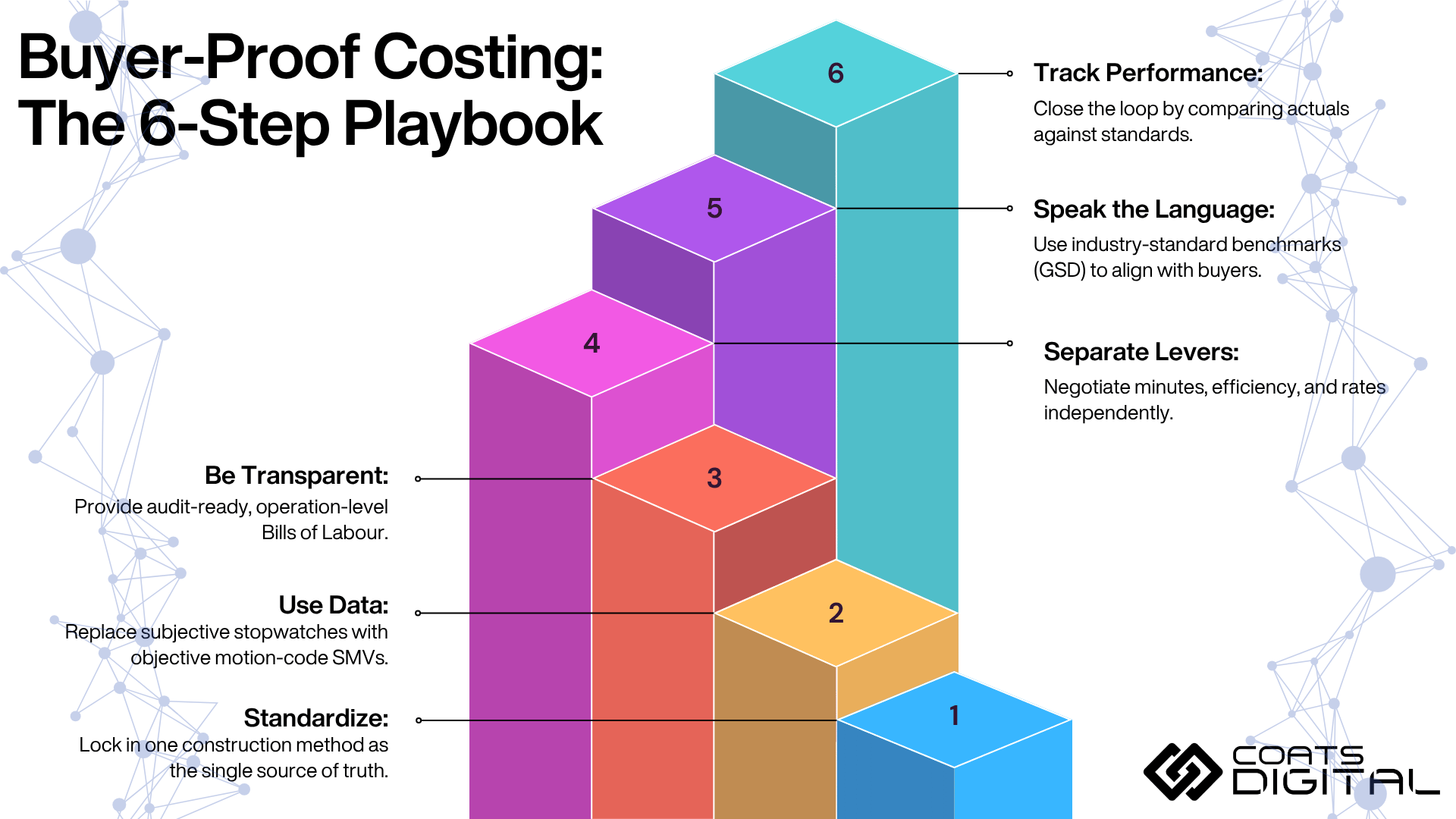
Turning the method into practice comes down to a repeatable sequence. Each step builds the audit trail that lets a factory defend its number when a buyer challenges it.
- Standardise the construction method for each style. Fix one agreed method per style as the single source of truth, so every cost, plan and target references the same construction. Without a locked method, every downstream number is arguable.
- Build the SMV from predetermined motion-time data, not stopwatch averages. Apply the motion-code approach so the SMV is reproducible and does not depend on a subjective rating. This is the step that makes the number defensible in the first place.
- Produce a line-by-line Bill of Labour the buyer can audit. Generate the operation-by-operation breakdown, each step with its method and SMV, as the document you put in front of the buyer. This is the artefact that replaces “trust me” with evidence.
- Separate the three negotiation levers. Break the discussion into garment minutes, factory efficiency and cost per minute, and negotiate each on its merits rather than fighting over one opaque total. Defined levers keep the conversation factual.
- Use the same benchmark the buyer already recognises. Express everything in the recognised GSD-based standard, so your cost sheet lands in a vocabulary the buyer’s own teams use and trust. Shared standards remove the translation gap where disputes start.
- Maintain a digital feedback loop of actual versus standard. Track real production against the standard SMV over time to catch variances and defend, or refine, the number after the order is placed. GSDCost supports this through a digital feedback loop of actual versus standard minute value at the operation level, which highlights variances and opportunities for continuous improvement.
Step by Step: Building a Defensible Cost Submission
Read in sequence, the six steps assemble a complete evidence chain. A fixed method feeds a reproducible SMV; the SMV populates an auditable Bill of Labour; the Bill of Labour is expressed in a recognised benchmark; and the feedback loop keeps it honest over the life of the order. Each artefact, the operation bulletin and the Bill of Labour, exists to be shown to a buyer, not filed away.
The Three Levers to Negotiate Separately
Garment minutes are the standard time to make the garment. Factory efficiency is how close the line runs to that standard. Cost per minute is the factory’s rate. Bundled into one price, the three invite blanket suspicion; separated, each can be examined, agreed and defended independently, which is why pre-agreeing all three shortens the costing cycle.
Defending the Number after the Order is Placed
Winning agreement on the cost is not the end of it. A feedback loop comparing actual production against the standard lets the factory show that its costed efficiency is real, surface where reality diverges, and either defend the original number with performance data or adjust it with evidence. That ongoing proof is what sustains buyer trust across repeat orders.
Why Verifiable Costing Matters More After LDC Graduation
The case for defensible costing gets stronger when set against Bangladesh’s changing trade position. The country was scheduled to graduate from United Nations Least Developed Country status on 24 November 2026. That timeline is now shifting. In February 2026, the government requested an extension of the preparatory period, and the UN Committee for Development Policy has since recommended that the General Assembly grant an extension, while indicating that a shorter extension than the three years Bangladesh requested would be more appropriate. The recommendation passes to ECOSOC in July 2026 and then to the UN General Assembly, with a final decision expected around September. The direction of travel is unchanged; only the timing is in question, and any extension is explicitly conditional on domestic reform.
What graduation changes is market access. On graduation, Bangladesh will phase out several trade preferences, including duty-free, quota-free access to the European Union market under Everything But Arms, along with special and differential treatment under WTO rules. The EU provides a transition period and a subsequent pathway toward its standard GSP arrangements, but the net effect is that the tariff advantage which has underpinned Bangladeshi competitiveness in its largest market will narrow. Given that the EU accounted for just over 50 per cent of Bangladesh’s RMG exports in FY25, that exposure is substantial.
The strategic consequence is an important part. When a price advantage rests on preferential tariffs, it can be legislated away. When it rests on genuine productivity and efficiency, it belongs to the factory. Graduation therefore pushes Bangladesh to shift from a cost-advantage model to a productivity-and-value model, and in that model accurate, defensible, efficiency-based costing stops being optional. A factory that can prove its efficiency, and price against it, protects its margin in a higher-tariff world in a way a factory competing purely on a low headline number cannot.
What Changes at LDC Graduation
Graduation removes LDC-specific support measures: duty-free access to key markets, softer WTO obligations, and priority access to concessional finance and technical assistance. For the garment sector, the loss of duty-free entry to the EU is the most consequential, because it directly raises the landed cost of Bangladeshi apparel relative to competitors that keep preferential access.
From Cheap to Efficient: The New Competitive Basis
With the tariff cushion thinning, price competitiveness has to come from the factory floor rather than from trade policy. That means measured, optimised methods, higher line efficiency and accurate costing, the productivity levers a manufacturer controls directly. Competing on demonstrable efficiency is more durable than competing on a low quote, because efficiency cannot be revoked by a change in trade status.
Why Costing Accuracy Protects Margin in a Higher-Tariff World
When buyers face higher duties on Bangladeshi goods, they will press harder on factory prices to offset the added cost. A factory armed with a verifiable, efficiency-based cost can hold its legitimate margin and reject unrealistic targets with evidence, rather than conceding ground it cannot afford. Accurate costing becomes the mechanism that defends profitability precisely when the pressure on it intensifies.
How will LDC graduation affect Bangladesh’s RMG competitiveness? Graduation will phase out duty-free access to markets such as the EU, narrowing the tariff advantage that has underpinned Bangladeshi apparel pricing. The UN has recommended extending the preparatory period beyond the original November 2026 date, pending final approval, but the shift is coming. It pushes the industry from a cost-advantage model toward a productivity-and-value model, making accurate, efficiency-based costing essential to defending margins.
Will Transparency Erode My Margin? An Honest Answer
The scepticism deserves a straight response, because it rests on something true. Many exporters argue that open costing has shifted leverage to buyers and squeezed margins, and they are not wrong that this has happened. Manufacturers report that under open costing, buyers also factor in the tax and cash-incentive benefits the government provides to exporters, effectively capturing subsidies meant for the factory. The industry leader who called for a price floor was responding to a genuine erosion of pricing power. Any honest treatment of this subject has to concede that transparency, done badly, can cost a factory money.
The resolution lies in the distinction between two kinds of transparency. Unverifiable transparency, exposing a cost breakdown built on numbers the factory cannot defend, does shift leverage to the buyer, because it hands over detail with no external standard to anchor it. Benchmark-grade transparency does the opposite. When each line is backed by a recognised, reproducible SMV, transparency removes the “you’re inflating this” accusation entirely and lets the factory defend its legitimate costs and decline unrealistic targets with data the buyer cannot easily dismiss. The problem was never openness; it was openness without a standard behind it.
There is also a genuine alignment of interests that an adversarial framing tends to hide. Buyers increasingly use SMV benchmarks themselves, for fair-wage compliance, because a credible standard time is what lets them verify that the wage allowance in a cost supports fair pay. The same benchmark that lets a factory defend its margin lets a buyer confirm its compliance obligations. On the question of what the labour content actually is, both sides want the same reliable number, which is why a shared standard serves each of them.
The Case Against Open Costing
The argument against open costing is straightforward and partly valid: it gives buyers visibility they use to drive prices down, it can leave factories with margins as thin as 1 to 4 per cent, and it lets buyers absorb government incentives intended to support exporters. In a fragmented, oversupplied market, exposing costs with no floor or standard can tilt an already unequal negotiation further toward the buyer.
Why Verifiable Transparency Changes the Equation
The counter is that the damage comes from the missing standard, not from the openness. A verifiable SMV converts a cost breakdown from a list of contestable claims into a set of auditable facts. It neutralises the inflation accusation, gives the factory firm ground to reject targets that fall below a sustainable cost, and shifts the balance of a negotiation from who holds more leverage to what the evidence supports.
Where Buyer and Factory Interests Align
Both sides need a reliable figure for labour content: the factory to defend its price, the buyer to verify fair-wage compliance and plan its own costs. A shared, benchmark-grade SMV meets both needs at once. Framed that way, verifiable costing is less a concession to the buyer than a common foundation that serves the factory’s interests just as directly.
Conclusion: Win Cost Trust with Method, Not Assertion
Cost disputes are not, at root, arguments about price. They are arguments about verifiability, and they are won by replacing a number only the factory can vouch for with one anyone can reproduce. A reproducible, buyer-recognised SMV, backed by an auditable Bill of Labour, removes the ambiguity that makes buyers suspicious and gives the factory firm ground to defend its margin.
The playbook is compact: standardise the method, build the SMV from predetermined motion-time data, produce an auditable Bill of Labour, negotiate garment minutes, efficiency and cost per minute as separate levers, express everything in the standard the buyer already recognises, and keep a feedback loop running to defend the number over time. As Bangladesh moves toward a trading environment where efficiency, not tariff advantage, decides competitiveness, that discipline shifts from good practice to competitive necessity.
To see how a buyer-recognised benchmark is established in practice, explore how GSDCost and GSDQuest turn a defensible method into a cost your buyers can audit and accept, or arrange a demo to see it applied to your own styles.
Frequently Asked Questions
-
How can a garment factory prove its production costs are accurate?
Replace subjective stopwatch or historical estimates with an independently recognised, science-based standard: an SMV built from predetermined motion-time data. Then share a transparent, operation-level Bill of Labour the buyer can audit against a common benchmark. Because the method is reproducible, the buyer can verify the labour content independently, which removes the basis for an inflation accusation.
-
What is open costing in the garment industry?
Open costing is a pricing approach where the buyer reviews a transparent breakdown of a garment’s production costs, materials, labour, overhead and profit, rather than a single fixed price. It improves transparency but can shift leverage toward buyers when the factory’s cost data is not independently verifiable. Trade press reports it has grown to roughly 60 per cent of Bangladesh’s exports over the past decade.
-
What is SMV (Standard Minute Value)?
SMV is the standard time, in minutes, required to complete a garment operation under normal conditions, comprising the base time plus allowances for fatigue, personal needs and unavoidable delays. It underpins costing, line balancing, capacity planning and fair piece-rate pay, and is the core unit in which garment labour content is measured.
-
Is SMV the same as SAM?
Yes. SMV (Standard Minute Value) and SAM (Standard Allowed Minutes) are the same measure. SMV is the common term in the UK and Europe, while SAM is more common in South Asia. There is no technical difference between the two.
-
What is the difference between stopwatch and GSD/PMTS costing?
Stopwatch costing observes one operator and relies on a subjective performance rating, so results vary by observer and are hard to defend. PMTS and GSD-based costing assign internationally agreed times to standard motions, producing a reproducible, method-based SMV that yields the same answer regardless of who calculates it, and is therefore far easier to justify to a buyer.
-
What is GSDCost and why do buyers trust it?
GSDCost is an award-winning SaaS solution from Coats Digital that calculates standardised SMVs from a predetermined motion-time database of 39 motion codes. It is widely regarded as the de facto international standard for method-time-cost in sewn products and is used by leading brands and manufacturers, which is why a cost sheet built on it arrives in a vocabulary buyers already recognise and can audit.
-
What is GSDQuest?
GSDQuest is an AI-powered tool from Coats Digital, built on the GSDCost methodology and the proprietary QED Library, that analyses product images, PDFs and tech packs to generate a standardised Bill of Labour in seconds. It makes benchmark-grade costing accessible to non-specialists such as merchandisers and sourcing teams, and Coats Digital reports it reduces costing time by around 90 per cent.
-
Why do global buyers trust SMV-based costing?
Because it is reproducible and method-driven rather than opinion-based. The same garment and construction method yield the same SMV regardless of who calculates it, which gives both sides a common, auditable language for time and cost. That shared standard is what lets a buyer verify a factory’s labour content independently.
-
What is a Bill of Labour?
A Bill of Labour is a structured, operation-by-operation breakdown of the labour and SMV required to make a garment. It is the auditable backbone of a transparent cost submission, showing the buyer each construction step, the method behind it and the standard time attached, all traceable to a recognised benchmark.

How Bangladesh Knitwear Factories Improve Operator Efficiency Across Sewing, Linking and Finishing

Best Lean Manufacturing Software for the Indian Garment Industry

Brand-to-Vendor Cost Collaboration: Which Layer of the Cost Stack Are You Missing?
All Blog Categories
- Production Planning
- Supply Chain Solutions
- Corporate
- Method Time Cost Optimisation
- Sustainability
- Videos