Top SMV (SAM) Management Software for Indian Garment MSMEs (2026 Guide)
by Kunal Kapur
 9
Mins Read
9
Mins Read
Key takeaways
- SMV and SAM are the same metric. South Asia says “SAM” (Standard Allowed Minutes); the UK and Europe say “SMV” (Standard Minute Value). Both terms describe the labour content of a garment.
- The tools split into four categories: dedicated SMV/PMTS software, shop-floor/MES and planning tools, ERP costing modules, and the manual Excel baseline. No single product covers every category.
- Factories running a dedicated, science-based SMV/SAM tool consistently produce more defensible cut-and-make (CM) costings than those relying on stopwatch studies or spreadsheet estimates.
- GSDCost is the de facto international standard for method-time-cost benchmarking in the sewn-products industry, recognised by the International Labour Organisation and used across manufacturers and brands worldwide.
- There is no universal winner. The right tool depends on factory size, export orientation, industrial-engineering (IE) maturity, and whether the priority is costing accuracy or method improvement.
- India-readiness matters as much as features: local implementation support, regional-language usability, GST-compliant costing outputs, and a cloud-versus-on-premise fit for tier-2 clusters.
Why Indian garment MSMEs can’t manage SMV/SAM on stopwatch and spreadsheet anymore
For a small or mid-sized Indian garment factory, an inaccurate SMV (SAM) is no longer a rounding error. It is the difference between quoting a style that makes margin and quoting one that quietly loses money on every piece. Choosing the right SMV (SAM) management software for Indian garment MSMEs has become a costing decision, a compliance decision, and increasingly a survival decision, and that is why so many industrial engineers and owner-operators are re-evaluating how they set standard times in 2026.
The pressure is coming from several directions at once.
| Indian textiles and apparel employ roughly 45 million people directly, making the sector the country’s second-largest employer after agriculture, yet India still commands only about 4% of global textile trade, according to Swarajya. | The Swarajya analysis notes that around 80% of that capacity sits in MSMEs, and in a cluster like Tiruppur that means over 2,500 export-oriented firms, many of them family-run units with fewer than 50 workers. | The minimum garment-sector wage in Maharashtra, India (readymade garments industry) is ₹14,488–₹15,288 per month (~US$170–180) for unskilled workers, effective July 2025, per WageIndicator. |
Trade policy has, for once, moved in India’s favour. The India–UK Comprehensive Economic and Trade Agreement (CETA), signed in July 2025, takes tariffs on Indian textiles and apparel entering the UK from around 12% to zero, and a concluded India–EU trade agreement secures zero duties on textiles in Europe as well. That opens real headroom, but the brands on the other side of those deals expect documented, standardised methods and wage data before they place orders, and buyer-compliance programmes are being tightened accordingly.
The EU’s Corporate Sustainability Due Diligence Directive (CSDDD) reinforces the direction of travel: even after the Omnibus I package narrowed its scope to very large companies and pushed application to 2028–2029, the large buyers who are in scope pass human-rights and wage due-diligence expectations straight down their supply chains to Indian suppliers.
The failure modes are concrete. CM prices get under-quoted from stopwatch-estimated SMVs; i.e., staff cannot defend a costing when a buyer’s sourcing team challenges it line by line. Line-balancing goes wrong because operation times are inaccurate, and factories struggle to scale style complexity across multi-buyer programmes without a proper methods database. This guide is written for that Indian MSME context, not as a global enterprise roundup, and it walks through the tools that actually address those failures.
SMV and SAM: the same metric, two names
SMV (Standard Minute Value) and SAM (Standard Allowed Minutes) measure the same thing: the standard time, in minutes, allowed to complete a garment operation or a whole garment at a defined method and pace. The UK and Europe tend to say SMV; South Asia tends to say SAM. The standard formula is the same either way:
SMV (SAM) = Observed Time × (Rating ÷ 100) × (1 + Allowance %)
Observed time is what you measure, rating adjusts for operator pace against a standard of 100, and the allowance accounts for fatigue, personal needs, and unavoidable delays. The weakness of a stopwatch study is baked into that first term: observed time and rating are both observer-dependent, which is precisely the subjectivity that predetermined-motion systems are built to remove.
In this Article:
- How we chose these tools
- The tools at a glance (comparison table)
- The tools, reviewed
- GSD vs stopwatch time study vs ERP costing module
- How to choose the right SMV/SAM tool for your factory
- Conclusion
- FAQ
How We Chose These Tools
This is a curated set of tools across functional categories, not a single ranked league table, and it is worth stating plainly: We assessed each tool against four criteria:
- Evidence of India or South-Asia garment adoption, through named customer references, verifiable regional deployments, or a documented India partner network.
- India-relevant SMV/SAM functionality, meaning a predetermined time-motion database, method analysis and standardisation, a garment costing module, line-balancing support, and fair-wage or CSR documentation.
- Deployment readiness for MSMEs, covering cloud or an affordable on-premise option, local-language support or partner presence in Tiruppur, Bengaluru, NCR or Ludhiana, GST-compliant costing outputs, and low IT overhead.
- Scale fit, from micro and small (under 100 operators) through small-to-mid (100–500) to mid-to-large (500–2,000+).
Dedicated SMV/SAM tools lead the list because the article’s thesis is that SMV/SAM accuracy is the MSME’s primary costing pain point. GSDCost heads the list as the recognised industry standard; GSDQuest follows as the AI-powered upgrade within the same ecosystem.
The Tools at a Glance
This table is your shortlisting starting point. Each tool maps to its primary category, deployment model, best-fit factory size, India-readiness, and the one capability that matters most in an Indian MSME export context.
| Tool | Category | Deployment | Best factory size | India-ready | SMV/SAM strength |
| GSDCost (Coats Digital) | Dedicated SMV / PMTS | Cloud (SaaS, Azure) | Mid-to-large exporters with an IE team | Yes | International-standard method-time-cost benchmarking via 39 predetermined motion codes; feeds FastReactPlan |
| GSDQuest (Coats Digital) | AI-powered SMV | Cloud (SaaS) | Any size doing product development | Yes | AI reads a product image, PDF or tech pack and auto-generates a standardised Bill of Labour; ~90% costing-time reduction |
| SewEasy | Dedicated SMV / PMTS | Desktop / Cloud | Small-to-mid | Partner | Quick sewing-data system to estimate SMV/SAM for sewn products (Sri Lanka origin) |
| Pro-SMV (Methods Apparel Consultancy India) | Dedicated SMV / PMTS | Desktop / Windows | Any size | Yes | MTM-2-based standard-time and best-method tool built for apparel; India-origin vendor |
| TimeSSD / Vector Times | Dedicated SMV / PMTS | Cloud / Desktop | Any size | Partner | MTM-2-based predetermined-motion systems for benchmark sewing times; Vector Times is India-based |
| Custom Excel / Sheets | Manual baseline | N/A | Micro / very small | Yes | The “before” state; breaks down at style complexity above around 20 operations. No SMV science |
| FastReactPlan (Coats Digital) | IE/capacity planning | Cloud / On-prem | Mid-to-large | Yes | Capacity-planning engine that consumes accurate SMVs from GSDCost; not an SMV generator |
| ApparelMagic | Apparel ERP with costing | Cloud | Small-to-mid exporters | Partner | Style, size and colour costing within an ERP; consumes an SMV, does not generate one |
| ERPNext (Frappe) | Open-source ERP | Cloud / Self-hosted | Small factories & startups | Yes | Open-source BOM and work-order costing; configurable for basic SMV/SAM fields; lowest-cost route off manual |
| STITCH MES | Shop-floor / MES | Cloud | Small-to-large | Yes | Real-time cut-to-pack production tracking that measures actual output against standard; consumes an SMV, does not generate one |
How to read this. “India-ready” separates tools with established India deployment or partner networks (Yes) from those needing third-party configuration (Partner). The “SMV/SAM strength” column names the single most relevant capability in an Indian MSME costing context and flags which tools consume an SMV rather than generate one.
Top SMV (SAM) Management Software for Indian Garment MSMEs Reviewed
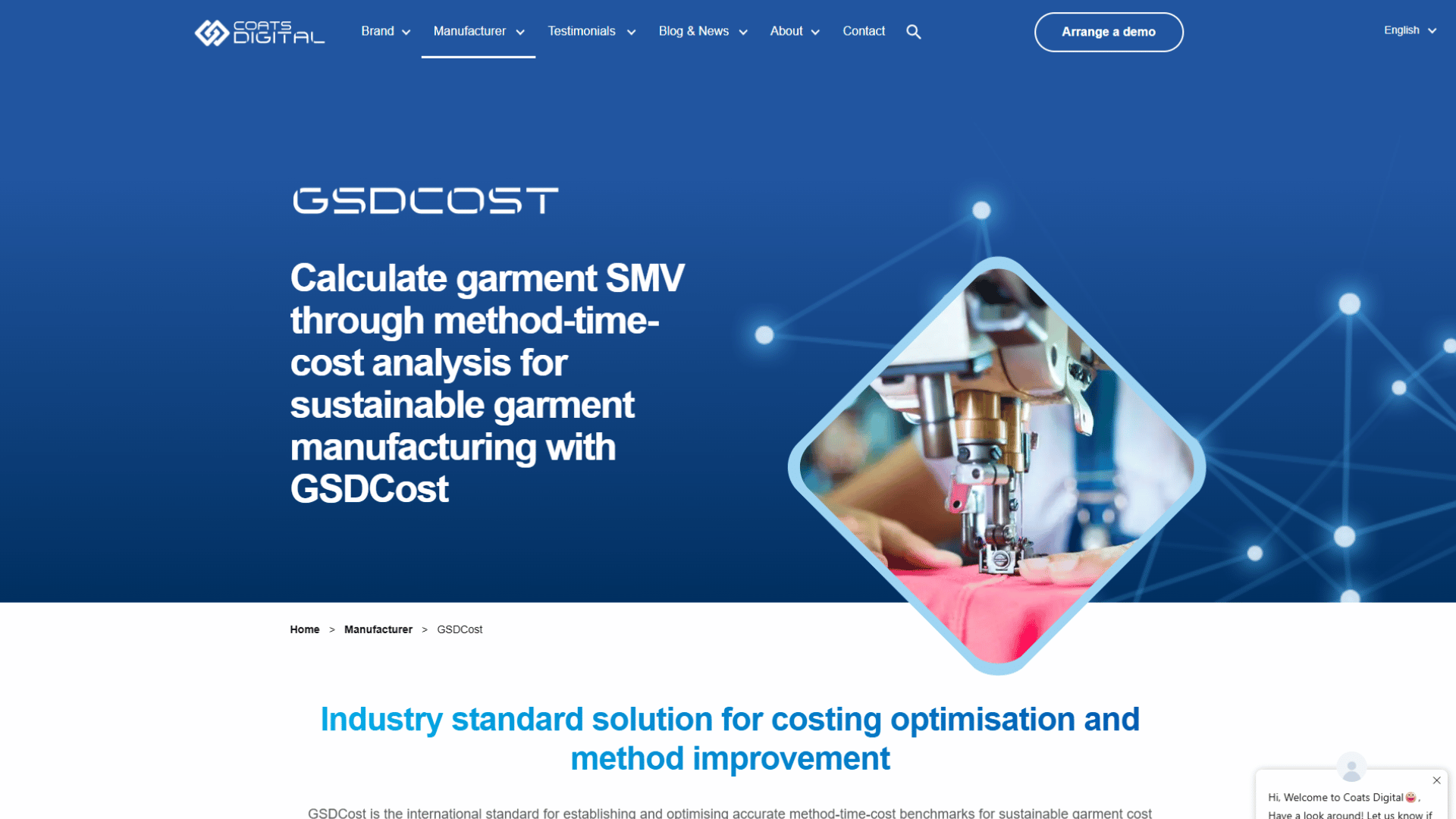
1. GSDCost (Coats Digital): Dedicated SMV / Method-Time-Cost
Category: Dedicated SMV / PMTS.
GSDCost is the de facto international standard for method-time-cost benchmarking in the sewn-products industry, used for more than 40 years (originally as GSD) and recognised by the International Labour Organisation.
Key capabilities:
- 39 predetermined motion codes used as building blocks for thousands of operations and unlimited styles, each with its associated international standard time. (Source)
- Scientific method analysis that produces a repeatable Method Standard, rather than an observer’s stopwatch estimate.
- Fact-based CM negotiation, with target minutes, factory efficiencies and cost-per-minute pre-agreed so costings hold up under buyer scrutiny.
- The Fair Wage Tool, which combines the SMV, factory efficiency, contracted hours and the agreed wage rate to benchmark orders against international fair-wage standards. (Source)
India / MSME relevance. The Fair Wage Tool maps directly to buyer CSR audits; the jersey-knit and intimates libraries fit Tiruppur knitwear; and a defensible Method Standard lets an IE team hold CM pricing under a buyer’s sourcing challenge.
Verified proof points. On its own product page, GSDCost states typical business benefits of a 5% reduction in SMVs, a 5% increase in productivity and a 10% improvement in on-time delivery performance (OTDP). Individual customer results, each that customer’s own outcome rather than a guarantee, include PT. Sumbiri at +13% productivity, Sabrina at +15% productivity efficiencies, ODLO at +10% productivity, Egyptian knitwear firm DICE at −11% core-style SMV and +16% line efficiency in its initial trial, and Gürmen Giyim at +5% productivity. A recent South-Asian example, Ansell Textiles Lanka, reported a 7% productivity gain and up to 7% SMV reduction, moving from tracking 36 styles manually to accurate SMVs across 150 styles.
Best for: mid-to-large Indian exporters with a functioning IE team, where costing accuracy and buyer-negotiation credibility are the primary pain points.
Consideration: GSDCost delivers most value with trained and licensed Practitioners in place. MSMEs with thin IE headcount should pair it with GSDQuest for faster initial SMV generation and build IE capability in parallel.
2. GSDQuest (Coats Digital): AI-Powered SMV Generation

Category: AI-powered SMV.
GSDQuest is an AI-powered tool within the GSDCost ecosystem that reads garment images, PDFs, or tech packs and instantly generates a standardised Bill of Labour.
Key capabilities:
- Multi-modal AI detection of both visible and hidden construction features from an uploaded image.
- Mapping to standard operations via the proprietary QED Library of proven construction methods.
- Instant Bill-of-Labour generation, with costing reduced from hours to seconds.
- Consistent application of GSDCost motion codes across teams and suppliers, improving data quality and reducing human error.
- Faster product-development and approval cycles at the sampling and quotation stage.
India / MSME relevance. This directly addresses the IE-headcount constraint. A small factory without a full IE team can still produce internationally standardised SMVs at the sampling and quotation stage, and the vendor headlines a 90%+ reduction in costing time.
Best for: any Indian factory doing product development that needs standardised SMVs quickly, especially smaller units quoting across many styles per season.
Consideration: GSDQuest requires GSDCost as the underlying platform, but it is designed to be usable by non-certified professionals, not only trained Practitioners. A Practitioner review remains best practice for final standards.
3. Custom Excel / Sheets: The Manual Baseline
Category: Manual baseline.
Custom spreadsheets are the “before” state for the smallest units, and for a handful of simple styles they are workable. The problem is scale: a spreadsheet built on historical or stopwatch-estimated times breaks down once style complexity climbs above roughly 20 operations, and it carries no SMV science, no method standardisation and no way to defend a number to a buyer. It is the cheapest option and the least defensible, which is exactly why it is the starting point most growing MSMEs are trying to leave.
4-7. Dedicated third-party SMV / PMTS tools
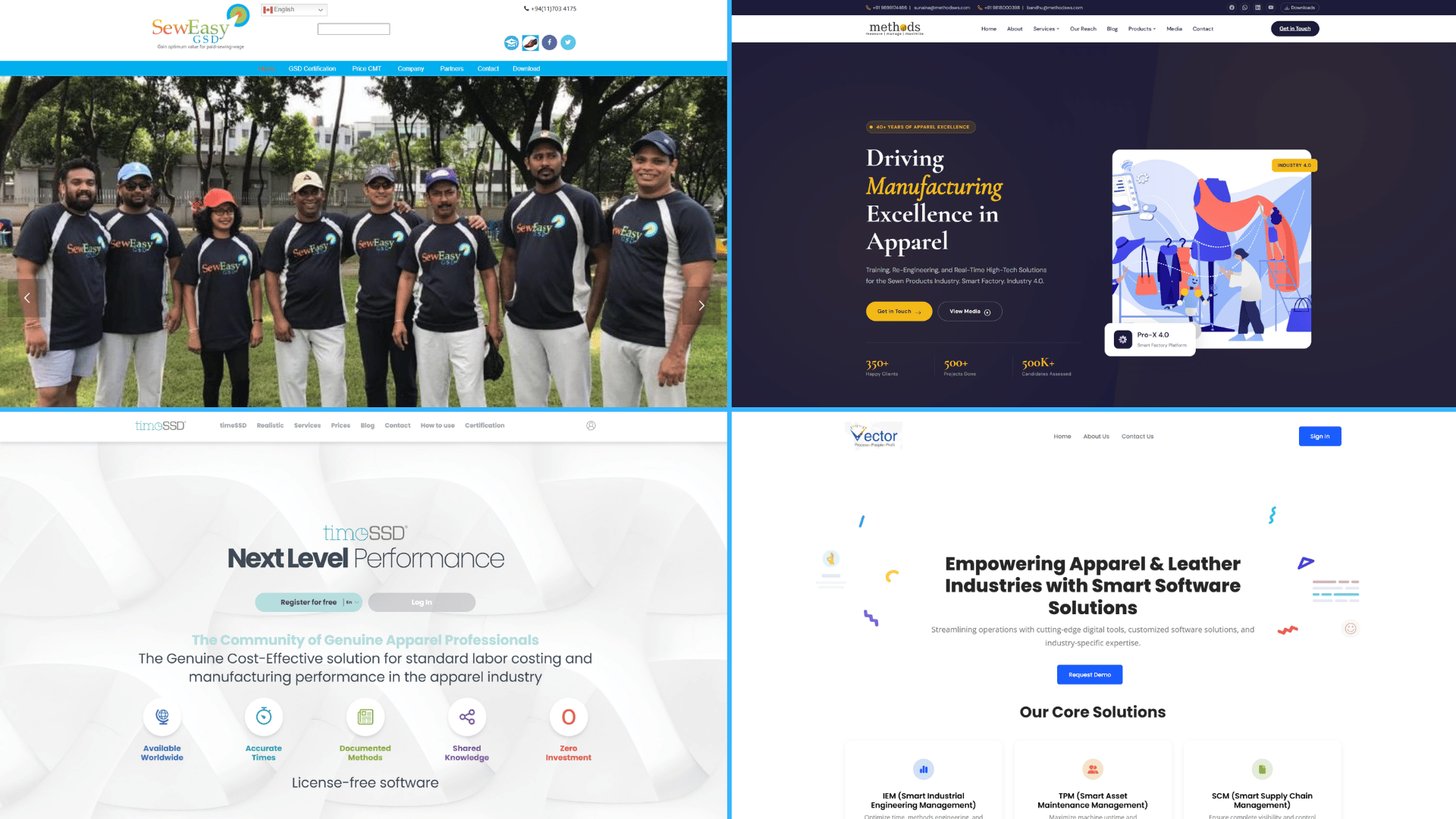
These are the genuine category peers to GSDCost, and taking them seriously is what makes this comparison credible.
- SewEasy is a quick sewing-data system for estimating SMV/SAM across garments, lingerie, home furnishing and leather goods. It is developed by a Sri Lanka-based company, is web-based with video-based analysis, and is recognised, alongside GSD and MODAPTS, by the University of Manchester as an MTM-based apparel labour-costing system. It is positioned as competitively priced for Asian manufacturers and is used across South-Asian factories, which makes it a realistic entry point for a small-to-mid unit.
- Pro-SMV (Methods Apparel Consultancy India) is an MTM-2-based standard-time and best-method tool built specifically for apparel. Its developer, Methods Apparel Consultancy, is a 44-year-old firm with its Indian headquarters in Gurugram, which makes Pro-SMV directly relevant to the target audience. It is a multi-user Windows/.NET application, is positioned as an affordable alternative to GSDCost, and its consultants run a Practitioner-style certification for analysts.
- TimeSSD is a cloud, MTM-2-based predetermined-motion system for benchmark sewing times, dedicated to the ready-made-garment sector with ready-to-use standard motion elements grouped into industry-specific classes.
- Vector Times is an MTM-2-based work-measurement tool from an India-based company, giving a scientific approach to establishing international standard time values.
For each of these, the pattern is similar: a scientific, observer-independent standard time at a lower price and training overhead than GSDCost, with the trade-off being less depth of global buyer standardisation and, for TimeSSD and SewEasy, a partner rather than a full in-country network.
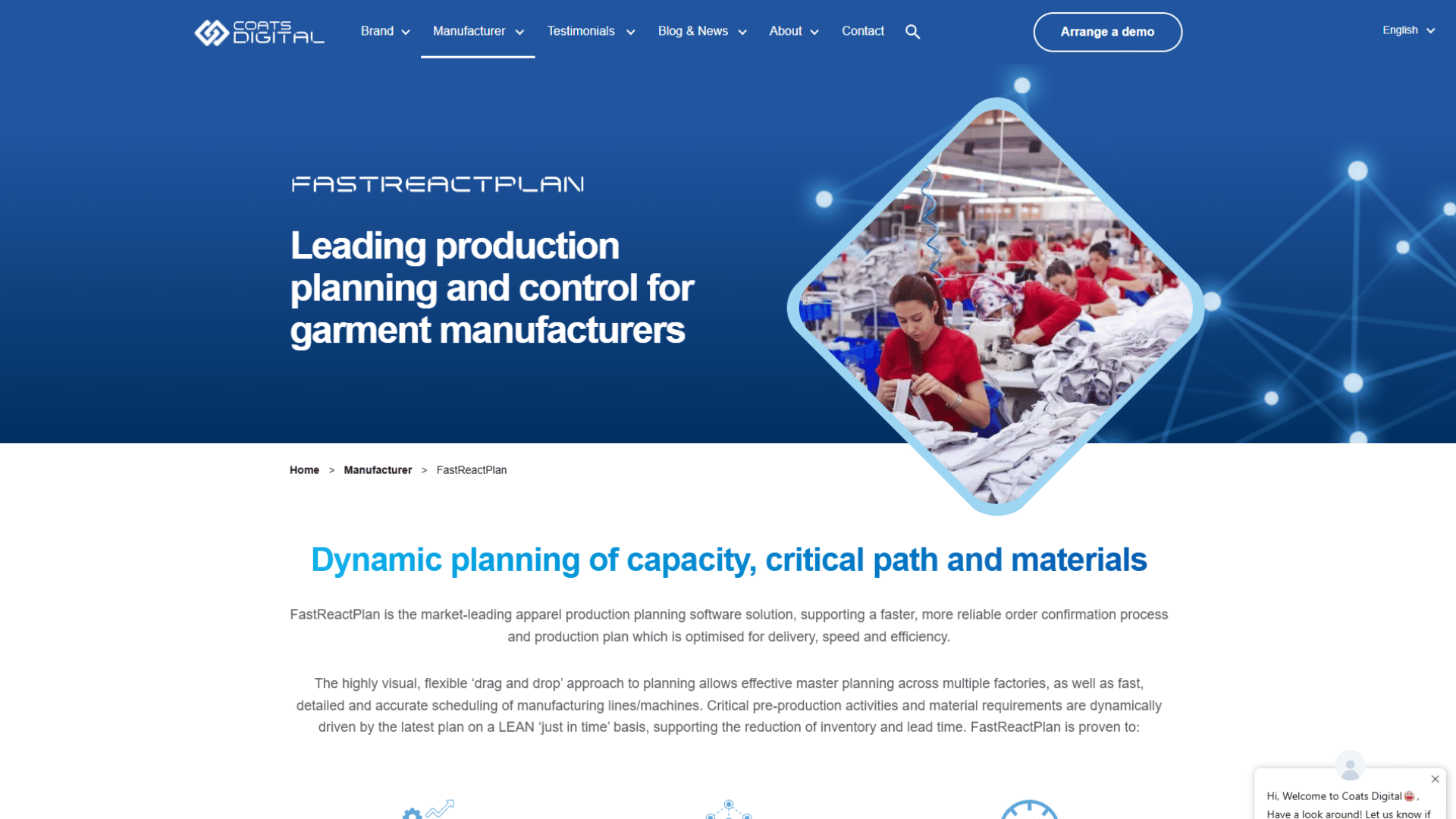
8. FastReactPlan (Coats Digital): IE / Capacity Planning
Category: IE/capacity planning.
FastReactPlan is a capacity-planning engine, not an SMV generator. It consumes accurate SMVs, ideally from GSDCost, to generate line-level schedules, using a highly visual “drag and drop” approach to master planning across multiple factories and detailed scheduling of manufacturing lines. Coats Digital positions it as able to boost production efficiency by 5–10% without adding people or machines, and Tunisian knitwear manufacturer Tunicotex reported on-time delivery rising from 75% to 85%, planning time cut by 25% and 40% additional capacity unlocked after implementation. It belongs on this list because a good SMV is only useful if it drives a realistic plan, but it depends on an accurate SMV coming from somewhere else.
9. ERP Costing Modules: ApparelMagic and ERPNext

Category: Apparel ERP with costing.
ERP costing modules hold CM-costing fields and consume an SMV; they do not generate or validate one. Flagging that category distinction is important because a factory that buys an ERP expecting it to fix its SMV problem will be disappointed.
- ApparelMagic is a cloud-based, fashion-specific ERP and PLM whose costing tools cover material, labour, overhead and margin analysis, with an apparel-savvy Bill of Materials that lets you assign labour processes, fabrics and trims. It suits small-to-mid exporters who want style, size and colour costing inside one system, but the labour figure it costs against is one you supply.
- ERPNext (Frappe) is the world’s leading open-source ERP, created by Frappe Technologies in India and free to self-host. Its manufacturing module supports multi-level BOMs, work orders, routings and job cards, where you can specify the operation cost and operation time of each step and compare actual versus standard production costs. It is the lowest-cost, open-source route off manual Excel and is configurable for basic SMV/SAM fields, but the time standards it holds are the ones you enter, not scientifically derived ones.
10. STITCH MES: Shop-floor / MES

Category: Shop-floor / MES.
STITCH MES rounds out the four-category picture as a real-time shop-floor system. It is an India-based manufacturing-execution suite that provides full, real-time visibility from cut to pack with order-level status across every stage, spanning production planning, time-and-action, fabric and cutting, quality, industrial engineering and machine maintenance, typically implemented in 30–45 days.
India / MSME relevance. For a factory drowning in manual work-in-progress reports, an MES turns bundle-level scanning into a live dashboard, surfacing line imbalances and delays hours earlier than a supervisor’s paper count. That is genuine value on an Indian shop floor.
Consideration. Like an ERP, an MES measures actual output against a standard, but it does not generate the scientific standard itself. It answers whether you are hitting the SMV, not whether the SMV is right, so it complements a dedicated SMV/SAM tool rather than replacing one.
GSD vs Stopwatch Time Study vs ERP Costing Module
These three approaches are constantly confused, so it is worth separating them cleanly.
- Stopwatch time study is observer-dependent and rated. Two analysts timing the same operation can, and do, arrive at different numbers, because both the observed time and the performance rating are judgement calls. It is quick to start and hard to defend.
- An ERP costing module is order-based. It uses an SMV that was estimated or historically entered elsewhere, then applies a cost-per-minute to it. Useful for financial control, but it neither generates nor validates the underlying SMV.
- GSD or PMTS is scientific and observer-independent. It uses 39 standardised motion codes to build a repeatable Method Standard, so the same operation analysed by two trained Practitioners yields the same time.
Where stopwatch and ERP both fall short is defensibility. Neither lets you prove an SMV to a sceptical buyer, neither guarantees consistency between practitioners, neither offers a method-improvement capability, and neither produces fair-wage documentation. The defensible thesis for Indian exporters is straightforward: the factories that win on CM margin do so because their SMVs are accurate, defensible, and improving, which requires a dedicated method-time tool rather than a stopwatch log or an ERP field. The decision matrix below shows how that plays out by factory size.
How to Choose the Right SMV/SAM Tool for Your Factory
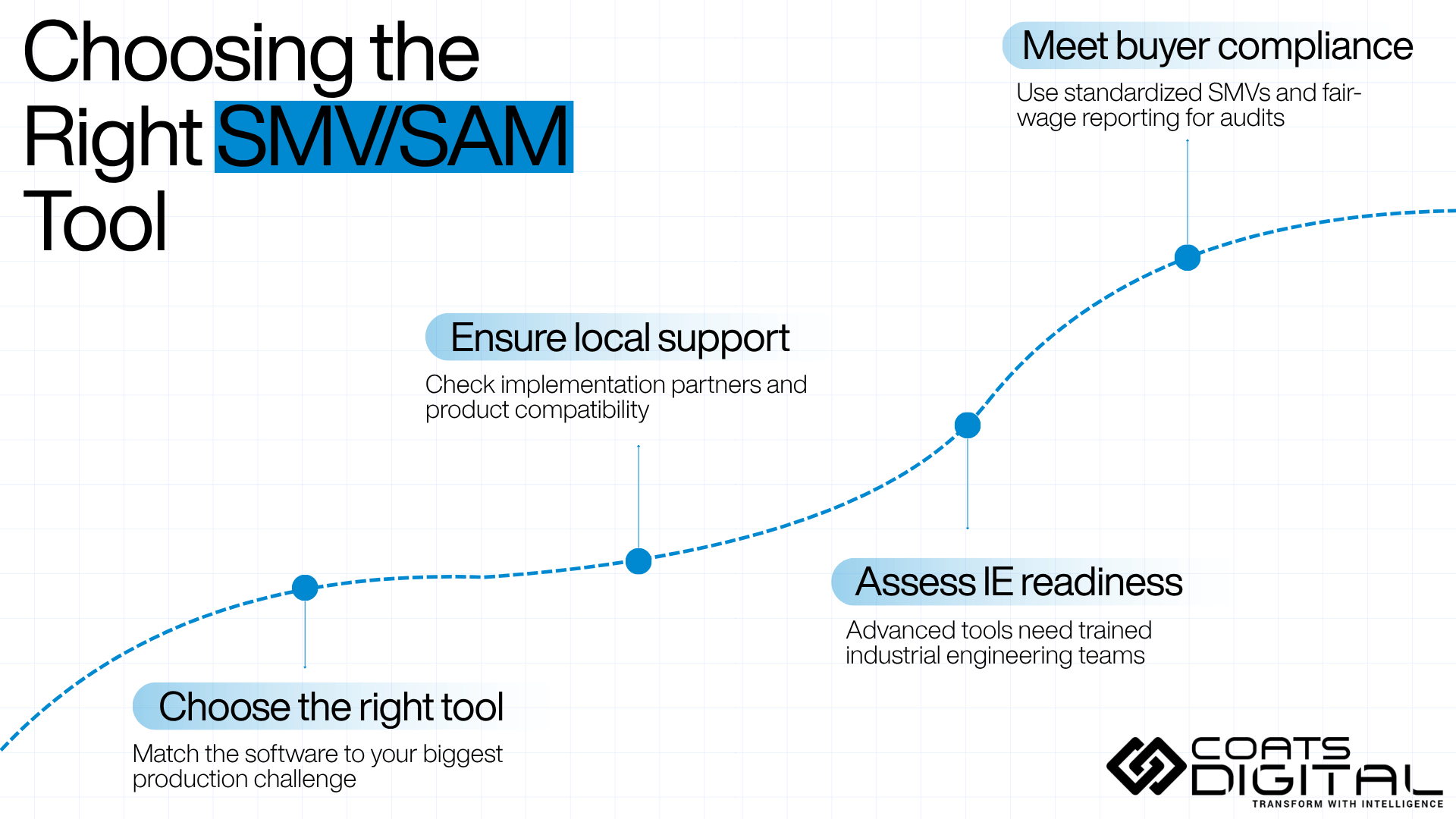
Four Selection Lenses
- Functional fit is the sharpest pain. Is your most costly failure mode CM-costing accuracy (GSDCost), speed of SMV at quoting (GSDQuest), floor-level actual-versus-standard tracking (MES), or basic order costing (an ERP)? Map the tool category to the failure that hurts most, first.
- India deployment readiness. Is a licensed Practitioner or partner available in your cluster (Tiruppur, Bengaluru, NCR, Ludhiana, Ahmedabad)? Confirm connectivity for cloud tools and check product-type support, because knitwear and woven have different method needs.
- IE capability on the floor. GSDCost rewards trained Practitioners maintaining a methods database. Factories without an IE team should start with GSDQuest and build capability in parallel.
- Buyer audit and CSR compliance. Buyers subject to the EU CSDDD increasingly require documented, standardised SMVs and fair-wage evidence; the GSDCost Fair Wage Tool produces exactly that documentation.
Factory-tier Decision Matrix
| Factory tier | Typical scale | Recommended combination |
| Micro / very small | Under 100 operators; single or few lines; domestic or tier-2 export | Start with GSDQuest for fast SMVs at quoting; build toward full GSDCost as IE capability develops. A verified low-cost PMTS tool such as Pro-SMV is an alternative entry point. |
| Small-to-mid MSME | 100–500 operators; multi-line, growing export | GSDCost for method standardisation plus an ERP for order and inventory; add GSDQuest to accelerate SMVs at sampling. |
| Mid-to-large | 500–2,000+ operators; multi-buyer, compliance-driven export | GSDCost with a licensed-Practitioner programme, and FastReactPlan for capacity planning fed by accurate GSDCost SMVs |
The consistent pattern among Indian exporters winning on CM margin is a dedicated, science-based SMV/SAM tool at the core, not a stopwatch log stretched across a spreadsheet. A 120-operator Tiruppur knitwear MSME does not need the same starting point as a 1,500-operator woven exporter in Bengaluru, but both are better served by an accurate, defensible standard than by an estimate.
The Right SMV Foundation Wins the Order
In 2026, SMV/SAM accuracy is the foundation of CM pricing, line-balancing, delivery performance and buyer-compliance documentation. As Indian MSMEs face tighter audits, the ongoing pull of the EU CSDDD through large buyers, wage and input-cost pressure, and price competition from Bangladesh and Vietnam, the factories that quote confidently, start on time and can show fair-wage compliance are the ones that grow into the new UK and EU market access.
The right choice depends on scale, IE maturity, and whether your priority is faster quoting (GSDQuest), deeper method standardisation (GSDCost), or floor-level tracking ( an MES on top of GSDCost). Start where the pain is sharpest, which is usually CM-costing accuracy, and build out from there.
Ready to see it in your own style? Book a GSDCost demo for your Indian factory, or see how GSDQuest generates an SMV from a product image in seconds.
Frequently Asked Questions
-
Is SMV the same as SAM?
Yes. SMV (Standard Minute Value) and SAM (Standard Allowed Minutes) are the same metric: the standard time in minutes allowed to make a garment or complete an operation at a defined method and pace. SAM is the term used across South Asia, while the UK and Europe tend to say SMV. Both are calculated the same way, from observed time adjusted for rating and allowances, so a factory can use the two terms interchangeably.
-
What is the best SMV/SAM software for Indian garment MSMEs?
For most exporters, GSDCost is the benchmark, because it is the recognised international standard for method-time-cost accuracy and produces defensible cut-and-make costings. GSDQuest is the fastest route to a first SMV for factories without a full IE team, and dedicated peers such as SewEasy and Pro-SMV are credible lower-cost options. ERP modules such as ApparelMagic and ERPNext are complementary for costing and orders, not substitutes for an SMV tool.
-
What is GSD, and how does it differ from a stopwatch time study?
GSD (General Sewing Data) is a predetermined-motion-time system that uses a motion-code library to build a repeatable Method Standard. Because the time comes from a scientific database rather than an observer’s stopwatch and rating, it is observer-independent: two trained Practitioners analysing the same operation get the same result. A stopwatch study, by contrast, varies between analysts and is difficult to defend to a buyer.
-
How does GSDQuest reduce garment costing time?
You upload a product image, PDF or tech pack; GSDQuest’s AI detects the visible and hidden construction features; the proprietary QED Library maps them to standard operations; and a standardised Bill of Labour is generated in seconds. Coats Digital reports a 90%+ reduction in costing time, taking costing from hours to seconds while keeping motion codes consistent across teams and suppliers.
-
How does SMV/SAM accuracy affect CM negotiation with buyers?
An inaccurate SMV under-prices complex operations and over-prices simple ones, so a factory quoting from stopwatch estimates loses margin on hard styles and loses orders on easy ones. A GSD-based SMV is built from an auditable method standard, which means it can be defended line by line when a buyer’s sourcing team challenges the costing, where a stopwatch estimate cannot.
-
Which SMV/SAM tool is best for a small knitwear factory in Tiruppur?
GSDQuest is the most practical starting point for immediate SMV generation at quoting, especially for a small unit without a dedicated IE team. As scale justifies a full implementation, GSDCost brings pre-built jersey-knit and intimates data libraries that suit Tiruppur knitwear, along with the Fair Wage Tool for buyer CSR audits.
-
What is the GSDCost Fair Wage Tool and why does it matter for Indian exporters?
The Fair Wage Tool combines the international standard SMV for a style with the factory’s efficiency, contracted hours and agreed wage rate, then benchmarks the result against international fair-wage standards. For Indian exporters, that produces the documented, standardised evidence that large buyers, and the due diligence expectations flowing from the EU CSDDD, increasingly ask for.
-
How long does GSDCost implementation take for an Indian MSME?
It depends on factory size, the number of styles in scope, IE readiness, and whether Practitioners are trained in-house or through a Coats Digital partner. Rather than quote a fixed timeline, the sensible step is a scoped assessment with Coats Digital, which can size the roll-out against your cluster, product type and team.
-
Can an Indian MSME use GSDCost without a dedicated IE team?
Yes. GSDQuest lowers the IE entry barrier by automating initial SMV generation, so a factory can produce internationally standardised SMVs before it has built a full IE function. Practitioners can then be developed over time through Coats Digital’s training programme, with GSDCost as the underlying platform.
How Indian Garment Exporters Manage On-Time Delivery for Multiple Global Buyers at the Same Time

How US Clothing Brands Protect Profit Margins When Supplier Production Costs Go Up

Apparel Production Planning Software For Large Garment Manufacturers In Bangladesh
All Blog Categories
- Production Planning
- Supply Chain Solutions
- Corporate
- Design and Develop
- Fabric Optimisation
- Method Time Cost Optimisation
- Shop floor execution
- Sustainability
- Videos